The Atlantic Puzzler
by Emily Cox and Henry Rathvon
“SHORT AND SWEET”
Words entered in the diagram (called “lights”) begin and end at the heavy bars. The unclued lights are related. Other answers include two proper nouns, a variant spelling at 24D, and a possibly unfamiliar expression at 1 A. Remember that punctuation in the clues may be used deceptively.
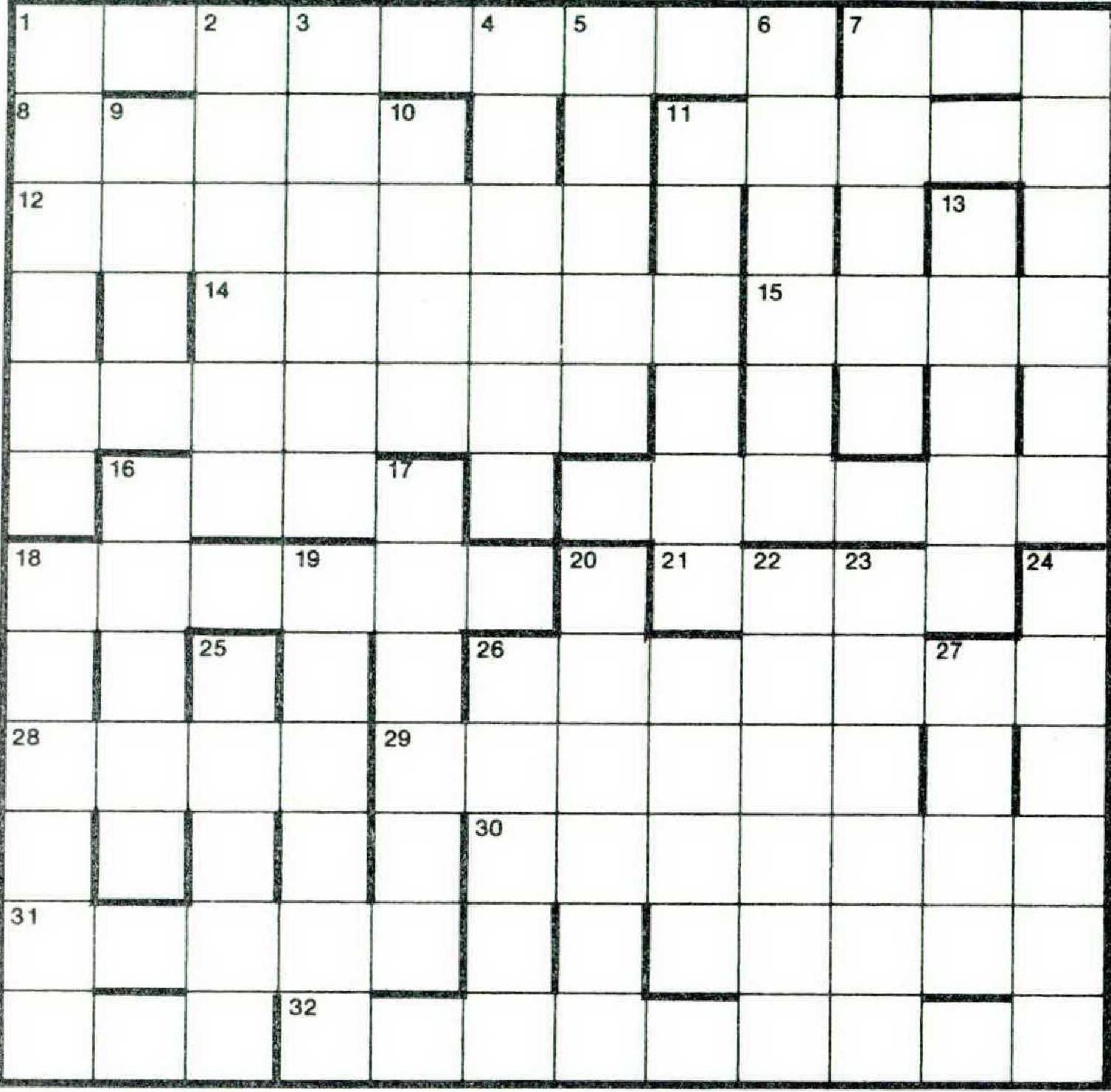
1.Europeans plot practical joke (6,3)
ACROSS
7. Acceptable behavior at parties? (3)
8. Faced with wrinkles (5)
11. Toast and cocoa (5)
12. About . . . about 101 years old (7)
14. Follow ocean about, returning stones (6)
15. Used to be wolf’s mate (4)
16. Tax pool of sorts (4)
21.Cocks fight back (4)
26. A lot of hot pepper will lead to the asylum (7)
28. Propellers in uproar, spinning (4)
29. A French interior, with mirrored South American baths (6)
30. Overseer for regressive military program (7)
31. Nobody’s dates (5)
32. Unproductive charms will make no rain fall (3,6)
DOWN
1. Bit of flouncing gets baby bent out of shape (6)
2. Put in casket, arrange seance (6)
3. Disquieted pig amidst flapping hens making beastly noises (6)
4. Attila gets set back in quest (4,2)
5. Rocking Beatle to Miss—a sort of nut (5)
6. Raise arm to point in sleep (6)
9.Civilization takes little part in reincarnation (4)
10.Parade a fault—obviously senseless (4)
11. Rock-bottom, head to toe (6)
13. Makes snare drums (5)
16. Beat the best (5)
17. Jerks make crude pass at liberated woman (6)
18. Gershwin’s first song subject (6)
19. Maiden of mystery invited in disguise (6)
20. There’s nothing ih false drugs, but people go crazy when out of them (6)
22. Say! A freckly Indian! (6)
23. Burning to drink up what’s in a flower (6)
24. Merest changes in rhythms (6)
25. It pays to sound sincere! (5)
27. Lump in bedclothes (4)
For detailed instructions, see the following pages
CLUE-SOLVING FOR BEGINNERS
Color of a ghost (5 letters)
Here is a crossword puzzle clue which, to the average American solver, should present no challenge. But in the Atlantic Puzzler, making its debut in this issue, the obvious and automatic answer (presumably white comes hurrying to your mind with a flap of linen) is not the correct answer; indeed, it cannot be the correct one, as you will see.
The Atlantic Puzzler is modeled after English crosswords, which differ from American puzzles in one important way: their clues appeal to the solver’s imagination with some form of wordplay. Each clue presents an acceptable definition of the answer, but the definition is accompanied by a set of directions which either redefines that answer or provides some hints as to how it can be constructed. In other words, every clue has two parts: a more or less standard definition, and an auxiliary indication which, while contributing to the solution, puts on a little verbal magic show. That each answer is thus doubly defined may seem an advantage to the solver; but the auxiliary indication, with its twirlof-the-cape, is apt to distract and mislead. The challenge and the fun of the puzzle is to see through the cluemaker’s deceptions, to tease out the definition (which may be hiding anywhere in the clue) by rethinking—and often repunctuating—the clue’s phrases. All appearances in a clue should be regarded as suspect; but remember that every clue has to yield a fair reinterpretation which directs you to the answer.
The following paragraphs will explain every type of device the solver can expect to encounter. Very simple examples will be used throughout, but none of the cluemaker’s secrets will be withheld. The game may be bewildering at first, but the determined solver will quickly learn to recognize in each clue the hints for its solution.
1.DOUBLE DEFINITIONS
The simplest type of auxiliary hint in a clue is a redefinition. “Color of a ghost (5)” is of this type. White, while it may satisfy the phrase as a whole, fails to account for the two separate parts which the clue must offer. Is there then some word which will satisfy both the term color and the term ghost? There is indeed, and the quick-witted reader may have thought of it already: shade.
Here is another example:
Trim a tree (6)
Resisting the assumption that you want some 6letter word meaning “to trim a tree,” you search instead for a word meaning both trim and tree. Practiced punsters don’t have to test their brains very long before spruce comes sprouting up neatly.
Although double definitions are not complex, they can be deceptive if their two indications blend smoothly. At first glance, “Places for tennis games (4)” seems to require a 4-letter word meaning courts. But a good solver will realize that places, masquerading as a noun in the clue, actually wants sets as its synonym.
2.HOMOPHONES
When a word or phrase puns orally (bear and bare), the clue will signal the homophone with some such description as “sounds like,” “in the ear,” or “it is said.” Here’s an example:
Hear story to the end (4)
The clue tells the solver that a word meaning story will have the same sound as the answer, a word meaning end. The solution is tail. Another example:
It’s said flies have blemishes (5)
Again, some deception has been laid on with flies, which parades as a noun in the clue. But flies is also an acceptable synonym for soars, and this word, when pronounced, has the same sound as the clue’s desired answer: sores.
Here’s another:
Choose a bass, you say, for an instrument? (7)
The clue’s message is this: The answer, a 7-letter word meaning instrument, is homophonically related to some word or words meaning “choose a bass.” The solution is piccolo, with its homophone pick a low. (The quirkiness of this association is hinted at by the question mark at the end of the clue; although punctuation in clues is likely to be sly, a question mark or exclamation point is often used in a spirit of fairness to warn the solver of a pun.)
3.CAMOUFLAGED CLUES
Occasionally the cluemaker will leave the desired answer embedded in the clue itself. The word reach, for example, can be fitted into a single longer word (preacher) or can be broken up inside a phrase without disturbing the order of the letters (spare a child). Whenever the answer to a clue is thus visible to the solver but disguised, tucked in a thicket of letters, the cluemaker will give an appropriate signal, commonly, “in.” As,
Employed in house drains (4) with the answer being used. See it?
Here are three more examples, with varying signals:
Peaks are visible to psychologists (4)
Some cats have to cut off whiskers (5)
Clue with interest, partially (4)
Once you have spotted the answers nestled in their hideouts, they seem obvious. But these camouflaged, or “run-along” clues, if not recognized, can be wonderfully misleading. What on earth do psychologists have to do with that first clue? And what is this nonsense about cats’ whiskers? The uninitiated are blinded, but the experienced solver ignores preposterous surface sense and looks for the directions: “visible [in],” “some [of],” “partially.” The answers are tops, shave, and hint.
Once in a while, an answer will be camouflaged in reverse, like this:
Being led back in single file (4)
Can you read the directions? Simply reinterpret the clue: a word for being is “led back” inside “single file.” There it is, plain as life!
Finally, be prepared for “peripheral” clues, like this one:
Jesters clear towns on the outskirts (6)
In other words, the outer edges of the phrase “clear towns” will make a word meaning jesters.
The solution: cl(ear t)owns.
4.REVERSALS
Some words, when spelled backward, produce other words; the solver should watch for clues based on these curiosities. Warning signals for reversals include phrases such as “when returning,” “backing,” “back,” “from the rear,” or, if the clue is vertical, “ascending,” “rising,” or even “upset.” Here’s a sample:
Strike back for friends (4)
The clue is not asking for a word meaning retaliate, of course; it is asking for a word meaning strike, which, when spelled backward, gives the answer—a word meaning friends. The answer is pals.
Here’s one more:
Underwater transport rising to become land vehicle (3) (down clue)
Because the answer is to be entered in the diagram vertically, the solver should suspect the word “rising” of signaling an inversion. The answer is bus (inverted sub).
5.COMPOUND WORDS
When words break into convenient parts, the clue may define each part separately. Since the word mangoes, for example, breaks neatly into man and goes, a fair clue might read
Fellow leaves to get produce (7)
Here’s another example:
A bird has to fight and fight (7)
This is not a comment on our feathered friends’ struggle for survival; the clue is asking for a word meaning bird which has, as its components, two words meaning fight. Is there really such a word? Certainly there is: sparrow.
6.CONTAINERS
When convenient word parts occur not side by side but one within the other, look for such signals as “held in,” “in,” “swallowed by,” “imprisoned in,” or “surrounding,” “around,” and “about.” Consider, for example:
Tuck me in bed with a reindeer (5)
The “tuck in” of the clue seems to suggest a camouflaged answer, but a quick check of the phrase yields nothing sensible. Trying a fresh approach, interpret the directions this way: put me inside a word for bed to get a word meaning reindeer. A moment’s thought, and Comet arrives. Here’s another:
Yellow pig has eaten everything (6) Rethink: for a word meaning yellow, let a word meaning pig “eat” (surround, contain) a word meaning everything. The solution: s(all)ow.
7.ANAGRAMS
Anagrams are words sharing the same letters in different arrangements (comics and cosmic; unites and unties). When the auxiliary indication in a clue involves an anagram, the cluemaker will obligingly signal the scrambling of letters. There is truly no limit to the number of words that may indicate an anagram; common among them are “changing,” “new,” “reforming,” “wild,” “bad,” “confused,” “drunk,” “out” (for “out of order”), and even “possibly,” “could be,” and “perhaps” (indicating the word’s potential for transformation).
Here’s an example:
Noises in restless slumber (7)
The clue says that the letters of the word slumber, when “restless,” will spell out a word for noises. The answer: rumbles. Here’s another:
Wild horses on the beaches (6)
With the answer, shores.
Sometimes the anagram signal can double as the definition, as in
Change later (5)
The word change serves as a direction, telling you to shuffle the letters of the word later. But the answer, alter, is also defined by change. This is an exception to the rule that clues come in two distinct parts, so be wary! (Other kinds of clues may also combine the definition with the instructions.
Making a clue for the word spool, for instance, we might use a reversal, like this: “Loops turn around on one! (5)”)
8. HEADS, TAILS, HEARTS, BITS AND PIECES
There are times when the clue will ask you to derive small clusters of letters—or even a single letter—in the process of constructing the answer. You will learn that “last of alphabet,” for example, might be simply the letter t. Similarly, “the first of January” might indicate a j. “Roy at heart” could be the letter o, since o is at the very center of the word. This is a flexible device, and one which allows the cluemaker a number of elegant strokes: the letters mo, for example, might be signaled by the phrase “half-moon,” and jo can come from “endless joy.”
When one word transforms into another with just a small addition or subtraction (as lake into slake or shear into hear), the clue wi11 dutifully signal the change. Here’s a fair sample:
Headless guard shows the way in (5)
The directions say that a word for guard, minus the initial letter or letters, gives you a word for “the way in.” Decapitate sentry, and there you are!
COMPLEX CLUES
You have now been granted a look at the cluemaker’s bag of tricks, one device at a time.
Your problem will be to decide which of these ruses is being employed in any one clue. Certain signals should already call out to you: if you see “in the ear,” or “on the tongue,” in a clue, you should be ready to pounce on a homophone; the sight of a phrase like “is self-evident in” advertises a camouflage. But a crucial warning: Some clues may involve more than one operation; for example, you may have to anagram one part of the answer while finding a synonym for the other part. Here is a complex clue:
Redhead gets false praise, and revives (7)
By this time you know better than to worry about the surface sense, and you don’t go casting around for a 7-letter word that means, say, “feels better when flattered.” Instead, you try to decide which word is providing the definition and which words are giving the instructions. The word false should alert you to the presence of an anagram, even though praise supplies only six of the seven required letters. The seventh can only come from redhead, a deceptive but fair indication for the letter r. A bit of scrambling, and you have repairs, an acceptable synonym for revives.
ABBREVIATIONS
When an unusual abbreviation is used in a clue, it will be signaled by some such phrase as “in short,” “briefly,” “cut down,” or just “little.” In this way, the letters lo might be supplied in a clue by “little Lois.” On the other hand, standard abbreviations will go unmarked; you can expect “New York” to be ny and “saint” or “street” to be st. In addition, puzzledom has its own conventional shorthand: “left” is often l and “right” is r; “time” can be t; the word “point” in a clue sometimes signals one of the four points of the compass, n, s, e, and w; the word “one” frequently stands for i (the Roman numeral I) , “five” can mean v, “ten” can mean x, and so on; the word “note” may designate any of the letters a through g (the musical scale) or else do, re, mi, etc.; “measure” may refer to printers’ measures (em and en); the letter o in a clue can be signaled not only by the word “nothing” but by the word “love” (as in a tennis score); “school” is often “ (for university); “ship” or “steamship” can be ss; “loud” signals f and “quiet” or “soft” signals p (as in musical notation); and the word “about” can signal re, or else c or ca (as in “circa”).
These and other abbreviations will become part of your working puzzle vocabulary in a surprisingly short time. It may take a few rounds of headscratching and pencil-chewing before the various signals and warnings are clearly arranged in your mind, but if you are a lover of words and wordplay, the learning process will be painless. Soon the world of puzzle clues will cease to be abstruse and hostile, and will begin to yield ticklish surprises.
The punster in you will rise up; the dormant urge to anagram will awaken. Before long you may find yourself scribbling your own clues: Is hashed a “fun house”? Can “hang heads” signal the words string beans?
There may be variations in the shape of the diagram of the puzzle from month to month, but the nature of the clues will not change. Readers are encouraged to keep these instructions for future use. The answer to this month’s puzzle will appear in the October Atlantic.