Culture Watch
Chimp talk
A recent cover story, by Harold T. P. Hayes, in the Sunday magazine section of the New York Times acquainted readers with the present life and plight of a six-year-old female gorilla. (Hayes is the author of The Last Place on Earth and was formerly editor of Esquire.) Born in the San Francisco zoo, the gorilla, called Koko, was borrowed in 1972 by a Stanford graduate student in psychology—“a pale and attractive blonde named Francine ‘Penny’ Patterson”—who had in mind teaching it American Sign Language for the deaf. Five years later, at a conference of the American Association for the Advancement of Science, Ms. Patterson reported on “her methods for establishing the gorilla’s vocabulary at 300 words . . . and for an I.Q. (measured by tests for nonreading children) between 80 and 90, the equivalent of a 5-year-old child, dull but sufficient for the subject to function within human society.” Shortly thereafter the director of the San Francisco zoo let it be known that he wanted Koko back. (Like college tuition, hospital bills, and everything else, gorillas have been going up lately—from $5000 to $20,000 per head in a single decade—and the zoo couldn’t afford to let Koko go.)
The request for the gorilla’s return precipitated protest, and animal rights advocates were swift into the fray. Stephen Burr, a lawyer who has produced a “model statute” on such issues (for the Boston College Law School’s Environmental Affairs), expressed outrage that “we have not granted [animal] lives any real protection in our anthropocentric legal system.” Theodore Sager Meth, a “law professor in animal rights” at Seton Hall University, insisted that Koko had been utterly transformed and was now capable of “meaningful relationships” with human folks:
The gorilla doesn’t, exist anymore. Under normal circumstances, the only thing this animal doesn’t have that we do is language. Now you have changed it. When you give it the conceptual apparatus for conscious reasoning, for mobilizing thought, you have radically altered it. You have given it the pernicious gift of language. If it has never been one before, it is an individual now. It has the apparatus for the beginning of a historical sense, for the contemplation of self. . . . Her right to remain in a meaningful relationship with the people she has known is greater than the zoo’s property rights. This is the whole history of jurisprudence over the past 75 years—that property rights must give way to individual rights. In this case you have an ape that has ascended.
Several primatologists engaged in language studies spoke up about their attachment to the subjects of their research, and their conviction that, man and ape are pretty nearly one. A chimp tutor named Dr. Gill commented that “all the going on in [his ape’s] head is pretty much the same as that going on in mine.” And Ms. Patterson herself, out raising money to purchase her friend (the Parks and Recreational Council had offered her a deal, at $12,500) talked of retreating to an island with Koko, asserting that separation was unthinkable:
To take her away from her family, her environment, to throw her in a zoo cage with a bunch of gorillas (sic) —it could kill her. They don’t believe it but I do. For myself, it would tear me apart. Of course it would. I’d probably be in there in the cage with her.
Moving stuff. The week in which it appeared a second full-length piece on Ms. Patterson and other primate researchers turned up in Rolling Stone, and a new issue of Paris Review carried lead story, by T. Coraghessan Boyle, about a man who is cuckolded by the chimp his female roommate is teaching sign language. (The Stone article, titled “Hand Jive with Talking Chimps,” by Ed Zuckerman, spoke of the coming acceptance of chimpanzees as “people with a different kind of consciousness,” introduced, in good Stone style, a chimp who swears, and included the following colloquy between reporter and primate researcher: “I asked . . . how it felt to be called a shit by a chimpanzee, [and] he replied: ‘I can understand his feelings. I’m sure I’d feel the same way.’”)
But the Times’s piece was deepest into the pathos of the thing. It milked the imminent Patterson-Koko separation with murmurings, in subheads and sidebars, concerning “uncomfortable questions about the difference between man and beast,” and with photos of Ms. Patterson and her gorilla nuzzling each other above such sugary cutlines as:
For Penny and Koko, research means relationship. Above, an intimate moment. . . .
“Who?” asks Penny [holding a mirror up to the gorilla]. “Koko,” replies the ape, clearly aware of herself.
LLL
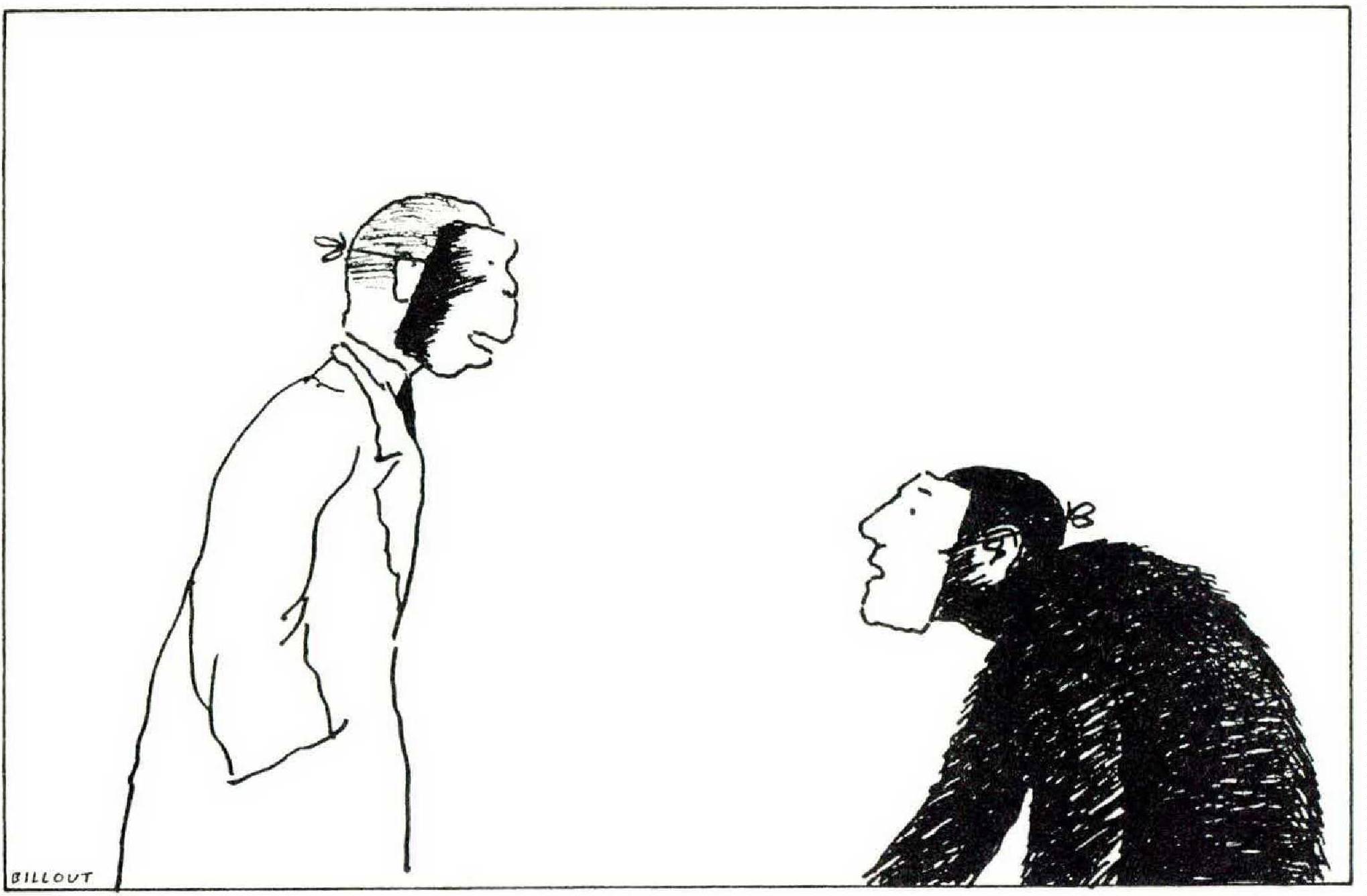
The author, for his part, dealt damnation upon the “sentimentality of anthropomorphism” and “the pragmatic constraints of anthropocentricity,” instancing the failure of standardized intelligence tests to take adequate account of cultural differences (between, that is, apes and men):
One [test] called for the respondent to indicate which of several objects was edible: a rake, a ball, a hat, a tangerine, or a flower. “She [Koko] selected the flower,” Patterson says. “Gorillas eat flowers.”
Warning that “Should the tables be turned . . . apes might judge men for their ability not to fall out of trees,” Mr. Hayes solemnly counseled his readers to bear in mind that “our standards are not necessarily theirs.” He was particularly impressed by Ms. Patterson’s success in eliciting an answer from a gorilla to the question What are you afraid of? (the answer was “Afraid alligator”) because it raised the “possibility of Patterson obtaining intraspecies information available in no other way.” (On this logic we’ll remain in the dark about poultry angst. until somebody teaches chickens to say “fox.”) At intervals Mr. Hayes, whose experience would seem to mark him as a sophisticated man, introduced other prosing beasts, including an ape with a taste for rock (“A ghostly vision indeed is the ape Lana alone in the middle of the night signaling the machine to play her recorded tape of Blood, Sweat and Tears”), and a grief-struck chimp named Washoe:
[Washoe’s] offspring fell from a shelf and died from the fall. It is a subject of considerable interest to the small circle of psychologists working with primates that she signed to the dead infant, “Baby hug.”
His piece ended in a cloud of futurological profundum: “What is to become of these halfway animals? ... If there should come to be a strain of great apes, provided by its own progenitors with this gift [of expression], what cultural estate will it fall heir to?”
Language studies by primatologists (the field is about a decade old) have undeniable value. They’ve corrected mistakes about levels of primate educability and may well contribute to knowledge of language-learning throughout Creation. Nevertheless, the Times’s story is meretricious nonsense, morally vain, dimwitted about the nature of human civilization. “What has become evident,” says the author in a sentence not unartfully confused, “. . . is the absence of significant distinction between the ape’s capacity for language and man’s, a difference in degree, not in kind.” But what is more evident, in both the article and the opinions of the researchers it quotes, is that animal rights advocates are a sly crew, disposed to hide the substance of their case, such as it is, in a throwaway phrase (“a difference in degree, not in kind”), and disingenuously intent upon blurring the difference between hand motions, nonverbal codes, and words.
The pivotal step, obviously, in primatological language studies is that of providing the primate with a symbol system. Some researchers—Ms. Patterson, for example—choose sign language. Others develop graphic codes— arrows, crosses, circles, and the like, which the primate is taught to punch up on a computer console. When speaking about the primates’ learning progress, researchers (and the Times’s Mr. Hayes) tend to under-emphasize the processes of translation. “Koko said,” they say, when what they mean is that the gorilla made a hand motion; “Lana makes a statement,” or “Lana asks,” or “Lana replies,” when what is meant is that a chimp pushed a button on a panel.
The confusion is worsened because the researchers (and, again, Mr. Hayes) translate the graphic symbols that the primates “read” into a lingo that’s a pastiche of Chinese-American and Henry James—rich in prepositions, pronouns, pleases, and thank-yous, hence rich in hints that apes have picked up a variety of graces, not just a line on which track leads to chow. (“Lana: Please machine give piece of cabbage. You [Tim] put chow in machine?”) And the hints are further strengthened by the casual employment of terms assuming the social equality of apes and men:
As Gill was drinking a coke outside Lana’s room, she went to the console and tapped out her desire to share it with him. . . . “This was clearly the most striking event to me, in the history of the project. The fact that it was a conversation is in itself remarkable,” Rumbaugh [another primatologist] says. “But she opened the conversation!”
Why make heavy weather about all this? In theory everybody knows that human language can’t be equated with toneless plastic push-pull. In theory nothing is plainer than that human language is inseparable from human history and from human consciousness of history, from human character, human self-awareness, human feeling. (La Rochefoucauld: Some people would never be amorous had they not learned to talk of love.)
In theory it is inconceivable that any reasonably well-educated person could be ignorant of the truth that human communication through words is an unending interplay of allusion, direct and oblique, explicit and tonal, to the realities of our social being, our complex association with work, class, family, and national past, not to mention our infinitely varied attitudes (along the scale that runs from sincerity to parody) toward the very terms we’re using.
In fact, however, knowledge of this sort seems now to be under siege. Preening themselves for modesty about “our place,” deifying dolphins, ecologists persuade themselves that only by promoting human self-hatred can they solve our crisis. Bemused by their “meaningful relationships,” chimp champions shut down consciousness that differences “only” in degree (“men and gorillas differ only in degree”) are often unreckonably huge differences. A great braying chorus vies for leadership in foisting an idiocy—the idea that all symbol systems are commensurate with each other—on the public. Methinks I see a noble and puissant nation going ape, hallowing the rights of ants, drafting ethics codes for coots. I blush for the editors of the New York Times Magazine.
Unsentimental anthropornorphist
“Man is the highest animal. The fact that he alone is capable of making such judgments is in itself part of the evidence that this decision is correct. And even if he were the lowest animal, the anthropocentric point of view would still be manifestly the only proper one to adopt for consideration of his place in the scheme of things and when seeking a guide on which to base his actions and evaluations of them.”
— The Meaning of Evolution, by George G. Simpson, quoted by Peter Farb in Humankind: What We Know About Ourselves.
Metatalk
A counterpart of the humanized animal is, of course, the computerized human being, or biocomputer, to use the increasingly chic term. In theory (once again), nothing is plainer than that we invented the computer (not vice versa). In theory, everybody understands that the operations the machine performs are abstract, ahistorical, hard-edged, and “nonaffective,” and therefore can’t be “the same” as those occurring within the human beings whom the machine imitates. In theory, it’s common knowledge that computers don’t have inner lives, and that hunting up a machine for guidance on the conduct of one’s life is as silly as falling in love with a tire iron.
In fact, however, this knowledge too seems imperiled lately. The word “program” has already begun to serve, in some quarters, as a synonym for “person.” And a currently flourishing school of psychological analysts takes the computer as the norm and counsels people on how to imitate it. “In a wellorganized biocomputer,” writes John C. Lilly, one such analyst, in Programming and Metaprogramming the Human Biocomputer (1972), “there is at least one . . . critical control metaprogram labelled I for acting on other metaprograms and labelled me when acted upon by other metaprograms.” Lilly acknowledges that, within persons, there’s often more than one “critical control metaprogrammer” and that this makes trouble, but he has remedies to hand:
Most of us have several controllers, selves, self-metaprograms which divide control among them, either in time parallel or in time series in sequences of control . . . One path for self-development is to centralize control of one’s biocomputer in one self-metaprogrammer, make the others into conscious executives subordinate to the single administrator, the single superconscient self-metaprogrammer.
Do unto yourself, in other words, as computers have done unto them.
The minor problem with such counsel is that biocomputers like me could spend years centralizing the administration and never get the staff in line, much less arrive at self-development. The allegedly subordinate executives in my shop are, as it happens, a pack of pranksters, layabouts, workaholics, fantasts, and would-be tyrants forever melting into each other’s way, and altogether disinclined to give any “single superconscient self-metaprogrammer” the time of day. The major problem is that computer-based counselors have too much in common with some primate researchers: they seem not to know what human beings are.
10’s tones
It is writers, of course, who are partly responsible for the clarity of our view of ourselves and for the health of our inner ear for language. They’re meant to keep us in touch with our contradictions while at the same time developing our capacity to delight in the complicated, allusive harmonies of human speech. And while the literary tribe in general seems not to have been functioning well on these fronts lately, there are exceptions. A notable one this season may be Tennessee Williams, whose Letters to Donald Windham 1940-1965 (Holt, Rinehart and Winston, $10.00) will soon be published. This collection amounts, to be sure, to a good deal more than an Image of Average Man or an ear-training device. Among the less evasive works on gay life by a major American writer, the Letters compose a portrait, done from inside, of committed amorality in a person wildly incautious, gifted, appetitive, promiscuous, and unbelieving. They record a progress from penniless obscurity to fame and riches, the growth and death of a close friendship, and numberless saturnalias. And, in addition, they offer much first-rate talk about how to survive in America as an author and many vivid theater vignettes, including a splendid imitation of Julie Haydon and Anthony Ross ad-libbing desperately beside the glass cabinet in The Glass Menagerie while waiting for Laurette Taylor, who had missed her cue.
But it’s the exceptional mobility and inclusiveness of the speaking voice, and the alertness to inner variety and contradiction, that matter most. A typical Williams sentence races between barroom and tearoom: “I always wait to be thrown out of a place, but I find it creates a coolness.” The man’s endless parodies of the sacred idiom of the hard-up American artist are regularly coupled with steely shots at competitors. Go find Saroyan, Williams tells his friend Windham. “—Kid him along about his genius and our sufferings. Both of us starving, selling our souls and trying to sell our asses. And all that. —He may have some good will in him, though there is so much in his plays that I suspect he must have the heart of a crocodile in actuality.” Lovers come in for quick mockerywitness the account of one chap “not quite sixteen, a blond moron who works as a theatre usher, [and] wakes me up every few minutes when I am trying to get my day sleep in to ask me how I like the new wave in his hair. . . .” There are bursts of improvisation in which a half-dozen voices—coarse, elevated, ecstatic, knowing, mean-assed, sentimental—speak nearly at once:
If we make any money on the play, I have a better plan than Texas. Texas would drive us both crazy —I would prefer Mexico City—in a motor-cycle with a sidecar. No, Texas is too heart-breaking. It is the most heart-breaking state in America, or in the whole world I imagine. One is always bumping into it other places without going there and being annihilated by it. . . . See Texas and die of it. It looks to me like they’ve got most of it in the navy now. Which makes it worse. You can’t put Texas in a pair of tight white pants and create anything but disaster. Ocean Street is full of it and sometimes I go home at night with a belly full of burning saw-dust. One needs a peacefully fiery Latin after being consumed in all that blond repose. I am for Mexico!—Love,
And there are moments when the writer, who often signs himself “10,” stands like Don Juan before the statue, at the brink of cataclysm, and roars aloud in fake fear:
The whole fucking wharf is rocking like a boat now, I suspect it has broken loose and gone out to sea ... MY GOD! WATER IS POURING UNDER THE DOOR!
Not since Hunter Thompson’s report on Las Vegas have I read anything funnier than these Letters. Not since Genet has a book appeared that’s less likely to cut into the Anita Bryant vote. But such considerations are, to repeat, incidental. Everywhere in Williams’s pages you feel a human presence, and hear the sound of a human voice, aware of itself, listening to itself, entertaining itself at language games, remembering its past, rejoicing in its own unfathomable, immeasurably perverse complexity. In a generation of ape and computer worshippers, I call this a necessary sound.