Campaigning: Democratic Convention Notes
At Madison Square Garden in July, the sheer symmetry of the Carter nominating festival made people happy for the same reason it bored television audiences: the wounds of the 1968 Democratic convention, which led in turn to the wounds of the 1972 Democratic convention, were finally healing, and there was nothing to fight about this year. And yet, that symmetry made people wonder too. One heard it all week long, undefined expressions of unease, questions that no one but Jimmy Carter could answer, and which he would not. (What, specifically, do you mean by ... ? What, specifically, are you going to do about . . . ?) And there were questions that Carter could not have answered if he had wanted to.
Two southern liberals, a breed probably closer to the beat of the country right now than most folk, wondered about those questions. One was Hodding Carter III, a leader of the fight to bring an integrated Mississippi Democratic party back into the national fold, and editor and publisher of the Greenville, Mississippi, Delta-Democrat Times. “The fight’s over.” he said during convention week; “we’ve won.” He meant that those who have fought to bury the spirit of the Confederacy once and for all are no longer the underdogs in a mean, unending regional struggle. Not only are they on top, they have national work to do.
And yet, something was bothering Hodding Carter. Earlier he had spoken of the strangeness of feeling part of the mainstream after all those years of bruising and losing party fights in Mississippi. In particular, he remarked on a sense that “there’s some force out there in the country that Jimmy Carter’s got hold of—it’s not Wallaceism, but it’s not unconnected to it. The question is whether he can control it, or whether it’s going to ride him. One way or another this is going to be a different country eight years from now, much more different than people think.” (One sign of the times was a brief and friendly exchange between Hodding Carter and a young Mississippi delegate with a familiar name—Ross Barnett. Jr.—on the convention floor. Barnett had just spoken by phone with his father, perhaps Mississippi’s most hardline segregationist governor in recent years. Young Barnett wanted young Carter to know how good and proud his father was feeling. In general. The South was displaying a new kind of solidarity, and it had to do with the burial of the race issue after lifetimes of manipulation of it.)
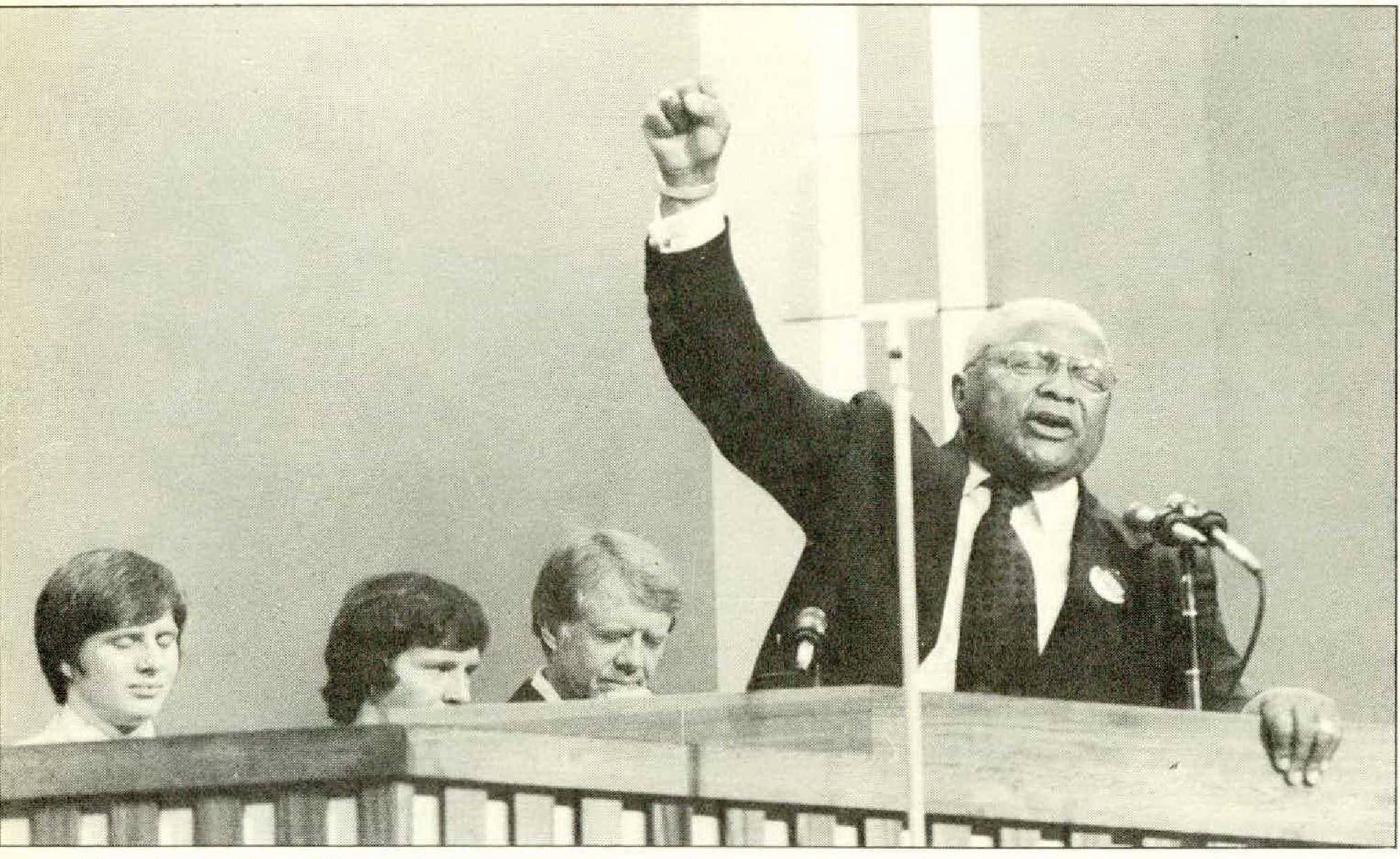
Bill Moyers, once of LBJ’s staff, now of CBS News, put it another way in a conversation right after Carter addressed the convention and party chairman Robert Strauss had summoned Carter’s rivals and assorted Democratic dignitaries to the podium. Among those Strauss called to the podium were the governor of Alabama and Mrs. Martin Luther King, Jr. Moyers said, “As I looked at George Wallace and Coretta King, a cripple and a widow, both victims of the excesses of the sixties and early seventies, I thought that beyond the surface unity of the convention, which is the desire to win in November, you can feel in this hall a shared sense of the cost we’ve paid for those excesses. There’s an Old Testament prayer that says it best—‘My heart is wounded within me’—and there is a healing process at work here. I feel it especially, coming from the same part of the country as Wallace and Coretta King and Jimmy Carter, where those excesses went deepest. Carter is part of the healing process at the same time as he’s exploiting it, as any good politician in his position would. Maybe [Eric] Sevareid said it best when he called him a ‘wheeler-healer.’ ”
Jimmy Carter asked the basic question himself, early on: he asked his party and his country to take him on faith. The answer so far was yes, but it was tentative. Carter’s refusal to give more answers about himself and his positions is of a piece with his acceptance of that tentative yes. It comes down to time. What was at once attractive, and in various ways disconcerting, about the Carter love-in in New York was that we were witnessing, for the first time since 1960, the politics of making a leap from what is past and known toward a future that defies categories and labels. What concerns people, even alarms them, about Jimmy Carter is precisely what he employed to defeat his rivals, and what he has going for him in the election this fall: he blends being elusive with being a man of consensus. Still “Jimmy Who?” in many ways.
That can be frightening. But it’s closer to reality, closer to the truth, than the arguments of those who demand that Carter make himself a known quantity before he takes the power he has earned. His use of that power, not any position paper, promise, or flight of campaign eloquence, is what will make his quality known. If the Democratic party really wanted a known quantity, and no break in the game and roster of players that have been in town since 1960, they could have taken Hubert Humphrey.
“The best man”?
There were two ways to interpret Carter’s method of selecting a running mate. The obvious and popular view was that his methodical, semipublic search was a model for future civics books. And that in any case, it was a welcome and necessary change from the chaos in Miami Beach four years ago that left George McGovern tied up with Thomas Eagleton.
The second, more cynical view was that Carter was teaching an elaborate object lesson. Secure in his lock on the convention, so secure about election in November that he and his staff were already worrying about overconfidence, and having gotten to the nomination with debts to no voters save blacks, he was unusually free to ignore traditional ticket-balancing concerns and take “the best man.”
Or was he? He took a northerner of up-front liberal credentials (ticket-balancing). He and his staff acknowledged concerns about the Catholic vote—whatever that is in 1976—and then he picked a man most unlikely to win the hearts and minds of the angry whites of South Boston (proof of not worrying about tried and true ticket-balancing).
Go back to Carter’s short list of six senators and one congressman (Peter Rodino, who dropped out). Whichever one of them Carter finally chose (and Carter said as much), he would be balancing the ticket with a man of Washington, of the Congress, and in fact of the Washington Establishment against which he had tilted all winter and spring. However, the selectee would be chosen not on Washington’s terms; indeed, the most likely of the finalists reported to Plains. Georgia, for inspection. (It is a subtle point: Would anyone have said the appearance was that of making grandees jump through hoops if the town in question were Hyannisport or Hyde Park?)
The object lesson, according to the cynical view, was that Washington, and in particular Congress, and beyond it the Establishment were being put on notice: of course Carter is coming to Washington. D.C., when he gets elected. Don’t fuss about that primary campaign rhetoric about the bureaucracy, or Washington power-brokers. Why, some of our best new friends live in Washington. Including this fine fellow here who, according to vintage 1974 conventional wisdom, should have been heading for the top of the ticket with little old Jimmy Carter of Georgia, maybe, on the bottom . . .
It was an object lesson, goes the cynical view, in making powerful and respected men hunger for something several of them had not previously wanted, from someone who just months before was a face in a crowd. And in their desire to get it, they were willing to go places and show and be shown in ways that made abundantly clear what deference was now owed Jimmy Carter. In one of the joint press conferences of the vice-presidential semifinals, in New York. Senator Adlai Stevenson of Illinois fielded a question about being a dull campaigner gamely enough—it had been raised in all his campaigns and he’d won them all, he noted—but Carter took it one step further. Smile in place, he remarked that since he too was charged with a dull campaign style, and since “compatibility” was high on his list of requirements for a running mate, he regarded Stevenson’s alleged dullness as an asset rather than a liability. A little light torture, with no telltale marks after the fact.
Then came Walter Mondale, joining Carter at a press conference announcing the final choice, speaking of the wonderfulness of “every word” of Carter’s autobiography, Why Not the Best? Columnist Meg Greenfield calls the syndrome “the grovel factor,” and relates it to previous instances of the seeking, dangling, and awarding of vice-presidential nominations. But there is an argument that Carter was not just engaging in another round of a game presidential nominees play with vicepresidential nominees, but was delivering a message about how he does business, directed to Congress, to Washington, to the Establishment.
A few days after the convention, it was announced that the campaign of Mondale of Minnesota would be run out of Atlanta. Georgia.
MICHAEL JANEWAY