Winter in St. Lucia
When I lived on the island of St. Lucia in the West Indies, my best friend was a young carpenter and spearfisherman named Francis Pomphile. A descendant of African slaves, like most of his 120,000 countrymen, Francis was born on St. Lucia, which is only thirty miles long and lies on the eastern rim of the Caribbean. At the age of twenty-two he’d never been away. Talking about two people who had come from England, Francis once told me, “I believe they come from the same island.”
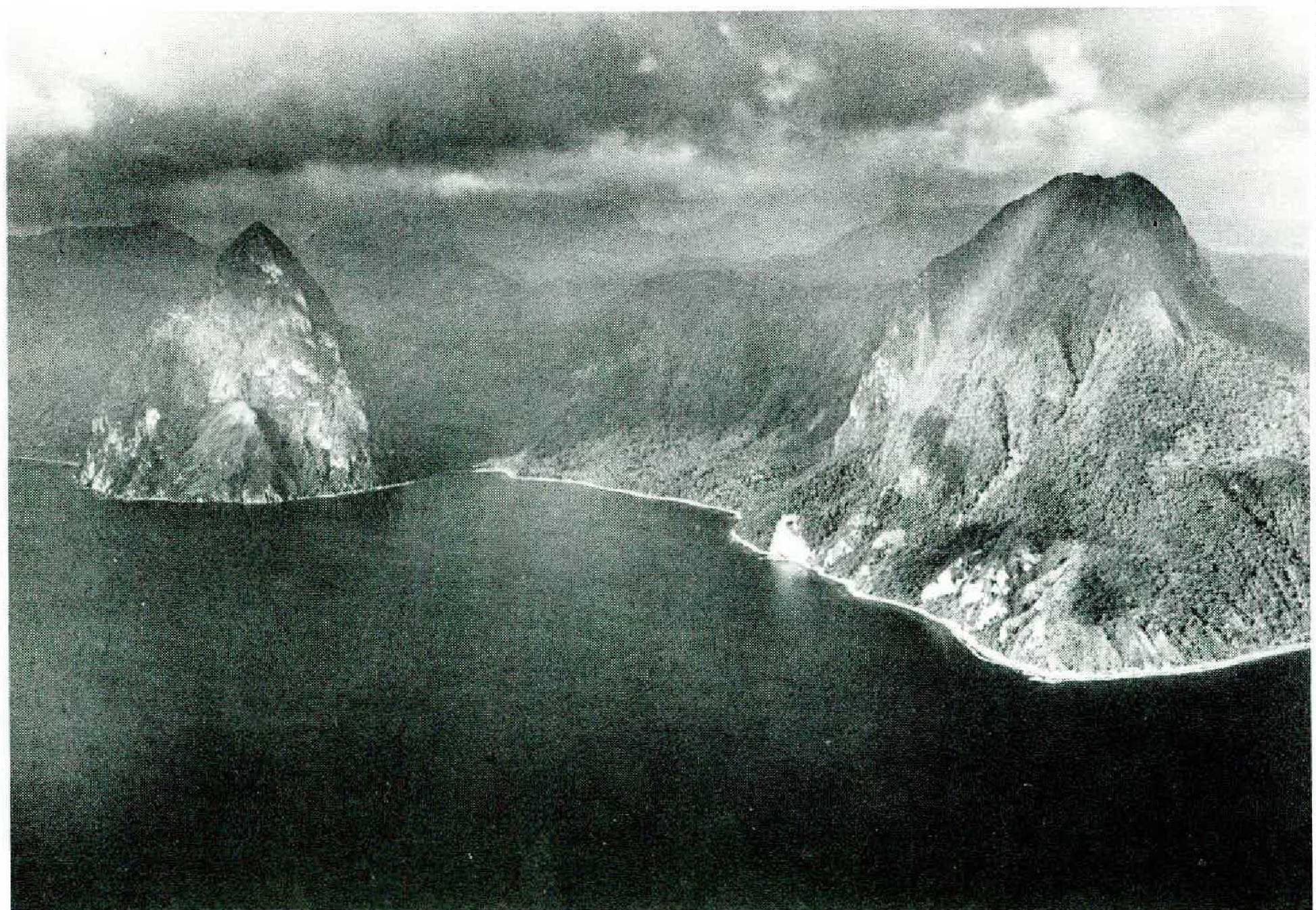
The rest of the world seems remote from St. Lucia. There are airplanes, of course, and a slim assortment of luxury hotels, but when I think of the island I remember cliffs rising out of the sea and a view restricted on clear days to the headlands of Martinique and the gray outlines of volcanic St. Vincent. I remember the banana plantations in steaming valleys, the buses and trucks with messages like CALL ON ME painted on their cabs, the swarming market in the capital city of Castries, where women hawk cinnamon bark, sapodilla, and jars of leeches for purifying the blood.
Last winter my wife and child and I spent seven months on the island in a cottage beside the Caribbean. There was trouble, or the beginnings of it, in St. Lucia then. Every day young St. Lucians in wool caps loitered on hot street corners in Castries, muttering “Honky. Honky” at passing tourists and white expatriates. And there seemed no escaping the Englishwoman at the almost-allwhite Yacht Club and her views on St. Lucians of the servant class. She said, “If you pay them more, they work less.” Then there was the clerk in Castries who’d grown a three-inch pinkie fingernail to prove he didn’t do manual labor: the bartender at the luxurious Holiday Inn who said that the six drinks a friend and I had bought between us cost as much as he made in a week; the song on the radio that went:
Twenty-third of July.
People demonstralin’,
Cost of livin’ is too high.
And there were the fishermen bombing their own waters with dynamite, trying desperately to increase their catches. (“Dynamite killing everything,” Francis Pomphile said. “The Father, Son, and Holy Ghost.” And he was right.) Meanwhile, hoping to create attractive new land for hotels, the government built a causeway to an offshore islet on the Caribbean coast, and because of that causeway acres of coral are dying, turning gray as a woods in winter. I remember several young St. Lucians telling me how badly they wanted to emigrate. But I also remember the breezes, the sudden short bursts of rain and the fragrance that followed. I remember the island in its holiday moods, and while I recall swearing sometimes that I’d leave within the next week, I ended up staying there as long as I could. “St. Lucia, she bit you,” said Francis.
A gardener named Dadnes St. Hill came with our cottage. Dadnes taught me the proper technique ‘ a flick of the machete ‘ for opening the fruit of our almond trees. He was a thin, brown-skinned man in his forties. He’d been a West Indies trader, carrying charcoal on a schooner to Barbados before gas stoves wiped him out. Then he became a shepherd and a fisherman and a gardener for expatriates. He wove an intricate, “malicious” bamboo door for the fish trap I was building. “When you gel in this trap you must be very malicious to get out.” he said. He was always inquiring about the countries beyond the islands, a world he’d never seen, and eventually he asked me to visit his side of St. Lucia.
There are essentially two parts to the island. The largest is rural and undeveloped, and most visitors see this part first. Eastern, Pan Am, and British West Indies Airlines planes, which make the trip from New York in about six hours, have to land on the southern end of the island, at Hewanorra Airport, the only airfield large enough to handle jets. Then, although there are a few hotels on this end of the island, most tourists board taxis and make a two-hour bumpy trip through the countryside, past villages, past little shacks propped up with poles, through a rain forest, to the northern Caribbean coast. Here, along about twelve miles of shoreline, lie the city of Castries and most of the island’s fine hotels: the huge La Toc and the Sleigenberger Cariblue, which looks like a hotel in the Alps: also the Holiday Inn. At these establishments in the wintertime, guests pay an average of $100 a day for a double room and two undistinguished meals that consist, in my experience, of thawed, imported meats and overcooked domestic ingredients. There are several less luxurious inns, such as the East Winds Hotel (about $60 a day for a couple), and there are much better places to eat than at the hotels. Small, unimposing restaurants, such as the Pelican near the hotel district, or Elaine’s Guest House (the island’s best restaurant) down south in the large town of Soufrière. serve wellcooked island delicacies: fried breadfruit balls, banana fritters, boiled topshells, broiled kingfish, conch stew.
I lived on the stretch of Caribbean coast where the hotels are. You see some small wooden dwellings in this area, but modern homes and the hotels dominate the scene. The plain but upto-date ranch-style houses are usually found in clusters and are occupied by moderately wealthy St. Lucians and by English and Canadian technicians, teachers, and advisers. There are also large, elegant homes, owned in the main by the richest St. Lucian entrepreneurs and by English and American retirees. A new two-lane highway serves this section of the island.
Dadnes, the gardener, lived across the island, near the Atlantic coast. He took me there one day. A dirt road, paved in spots, wound east away from the new highway. Not much better than a wagon track, the road crossed small stone bridges and traversed a maze of green hills. About eight miles farther on it entered the village of Monchy. This is a town of about 300 people. A dusty cricket field sat beside a trickling river. Rum shops and tiny wood houses on short stilts spread in several directions from the large stone Catholic church. A man was leading a donkey down the dirt main street.
Modern times are coming only slowly into Monchy, like the power cable that stopped short of Dadnes’ four-room pink house. According to Una, Dadnes’ sprightly forty-five-year-old wife, an obeah man lives in the hills outside the village. Obeah men practice an old African witchcraft that the State has outlawed and the Church has condemned.
“I doesn’t believe in obeah,” said Una, a conscientious Catholic. “But you mustn’t let them have your name.”
“Your fingernails, neither!” said Dadnes.
In Monchy people speak a patois of Creole with a French lexicon and an African syntax. English, the official language for a century and a half, remains a distant second tongue, and people here use it in odd, sometimes felicitous ways: for “skinny,” Dadnes would say “fewer flesh,” and to describe the strength of a sea turtle’s heart, “hard to die.”
The threat of hunger, not starvation, hangs over the town: nevertheless, Monchy celebrates, and I went there for the fêtes. On Christmas, which was a balmy day, the children’s choir sang the old standard: “Long time ago in Bethlehem, so de Bible say . . .” And on New Year’s Eve in the pink house, Una served the traditional Christmas pudding, a sort of sausage made from the blood of pigs and goats and spiced as if it grew on a pepper tree. We washed it down with drinks from a bottle labeled simply and aptly “Strong Rum.” On Easter Saturday, we ate “sea eggs,” and on Whitsunday evening Una and Dadnes led my wife and me into the hills east of town, to a bare wooden house where the people of their generation were dancing the quadrille. It was like a square dance with stately flourishes. The band played on a trumpet, fiddles, and a box full of something that rattled. Dadnes swayed across the floor with mincing steps. Una swung from one dancer to another, embracing men and women and saying, “I so glad!”
After I got to know a few people from around Monchy. I went fishing most of the time.
The island’s spearfishermen went to sea either swimming or in small boats— “Manitoba Hard Wheat” read the home-sewn sails on some of the boats— and they carried homemade wooden guns which had sharpened metal rods for spears and strips of inner tube for power. Wearing only flippers and face masks, the best divers could chase fish eighty to a hundred feet deep, and there were spearfishing heroes like forty-year-old, one-handed Cluster Leo.
“Cluster born to the sea.” the patrons of Jean Baptiste’s rum shop in Monchy said. Cluster might only have one hand, but he was “very, very smart.”
“Wooo!” said Dadnes. remembering a grouper Cluster caught with several spears. “That fish so big three men don’t carry it.”
Cluster speared two one-hundredpound hawksbill turtles the day he let me watch him work.
Most of the time I fished with Francis Pomphile. I have a photograph of him, taken after he’d been at Carnival, a bacchanal which raged in Castries three February days and nights. Francis is a slim, dark, smooth-muscled young man with a small white smile. Tied around his head in the picture is his necktie, the fat end hanging down like a streamer. The photo is incomplete, though; he is serious and hardworking, and when there aren’t any jobs for a carpenter, he goes fishing for food.
Francis lives on his father’s three-acre farm near Monchy, in a small concrete house w’hich he shares with his parents and numerous siblings. When I met him there in the mornings he would be roasting sweet potatoes over a coal pot while a half-dozen little brothers and sisters cavorted around him. The air was misty at that hour. On days when the trees on the peaks above the farm weren’t shaking, a sign that the sea was calm, Francis would call out, “She good.” We’d motor off across back roads, park the car, then walk down footpaths to the empty coves of the island’s northeast coast.
This corner of St. Lucia faces the trade winds and rolling Atlantic. The cacti, the occasional tall palms we walked beneath, the wind-barbered divi-divi trees all lean inland. Francis would stroll along the beaches wearing safety-pinned pants over his bathing suit. The pants are both practical and customary; he subscribes in a half serious way to the St. Lucian theory that fish won’t come the way of a man who looks too rich to need them. We walked along the tops of sheer rock cliffs and around mangrove-fringed bays. Twice we came to places where developers had tried to make a stand. The houses were mostly boarded up. Here and there we saw lone gray shacks on the bluffs, and at La Puente, the ruins of an old British lookout post.
Fishing has declined since Francis was a boy and used to pick up spiny lobsters in waist-deep water off this coast. But I remember some abundant catches. We swam out from empty black and white beaches, Francis carrying his handmade speargun which, out of personal modesty, he named “Doesn’t Miss.” Holding our breath, we dove into patches of coral that looked like forests full of jewels. Under brown limestone branches, in red holes, we found topshells and lobsters, and small, spotted, sharp-toothed moray eels. There were snappers under ledges sometimes, and grunts, and delicious little trunkfish with fins that spun like helicopter blades, and every so often palometa,’ blue runners, and kingfish swimming free.
I remember Francis poking his head out of the water and saying to me. “A whale. A whale.”And I asked “Where?” and followed him down to a piece of pillar coral out of which a fat eel was poking its head. “An eel,” I said, back on the surface. “Yes,” said Francis. “A whale.” I remember him coming up with a ten-pound grouper on his scrap-metal spear, holding the speared fish up and saying. “This is a very, very good shot.”
One day we were sitting on the sand, our bag full of fish we’d caught, and I said to Francis, “St. Lucia’s sweet.” The rum I sipped had given me a glimmering feeling.
“She sweet, yes,” said Francis, who was munching noisily on a sweet potato. “But you must have some breads.” Quite earnestly, he told me he’d rather be in Brooklyn.
“Why?”
“In St. Lucia a man wuk for nothing.”
I had heard pieces of this argument before, while we drove to the coast or sat on the shore tossing pebbles into the water. Francis made only $35 a week as a carpenter, and layoffs and the high price of tools ate up what he tried to save.
He didn’t care about a car. His main ambition was to get “a spot” and build his own house. “I doesn’t build a wall house. I believe a wood house is better.” He said that was because if you had to move, you could always dismantle a wood house and take the pieces with you.
But Francis didn’t see how he could afford the wood house if he stayed on St. Lucia. “If you little they keeping you little,” he said. “If you big you getting bigger every day.” He’d heard that wasn’t true in the United States; he’d heard that a carpenter could make five dollars an hour there. So he hoped his uncle, who had emigrated some time ago and lived in Bedford-Stuyvesant now, would help him get a visa.
Two dark rocky bluffs rose on either side of the beach. The only sign that anyone had been there before us was the ruin of a campfire in the sand. Thinking of Brooklyn in those surroundings, I felt Francis ought to know what he might be getting into. I tried to evoke Brooklyn, the tenements and ruined waterfront.
He said, “I believe there is better.”
As for the problem of finding a job in Bedford-Stuyvesant, Francis said, “I believe I would, you know. I am not a noisy fellow.”
So Francis was determined to leave. Many young islanders are, and for the same reasons. But Francis’ feelings were ambiguous. On another day, at the end of another fishing trip, he told a story which made that seem clear. He had never really left St. Lucia. A couple of years ago, however, he had signed on with a deep-sea fishing boat. The boat went miles out to sea in the morning and came back in the afternoon.
We were sitting in my cottage, and Francis, who really wasn’t a noisy fellow, got loquacious on brown rum. He described how it had felt to return to St. Lucia from far out in the ocean, how he had watched the island rise slowly from the swells. The fishing boat rode in through the St. Lucia Channel, under the huge stone cliffs of Cap Point. Black frigate birds wheeled over the peaks. It was clear from the way he talked that he would always be tied to this island.
Francis never went deep-sea fishing again. The boat went out too far. “So far!” He looked around for words to describe the distances involved and said, “So far you doesn’t see St. Lucia.”