"Are You Too Deeply Occupied to Say if My Verse Is Alive?"
In its April, 1862, issue, this magazine carried an article called “Letter to a Young Contributor,” by Thomas Wentworth Higginson. Poor Higginson. He was a remarkable fellow in his day: a minister and a soldier, abolitionist and defender of women’s rights, essayist, critic, novelist. A man of hard-earned fame. It is impossible to think of a contemporary counterpart for him. but you’d have to start with elements of Norman Mailer and John Kenneth Galbraith. Higginson was surely wise enough to know that history has a treacherous way with fame, but he could never have guessed that he would be remembered best, by those who remember him at all, as the man who failed to understand that his friend Emily Dickinson was a great poet.
Their friendship began by correspondence following the publication of Higginson’s piece of advice to would-be writers, which stressed the importance of form. Emily Dickinson, then thirty-one, wrote to ask, in part: “Are you too deeply occupied to say if my Verse is alive? ... I enclose my name—asking you, if you please—Sir—to tell me what is true?”
Hmmm. It was a letter to give a man pause. If Higginson heard a note of hyperbole in her deference, he didn’t let it bother him. He replied with some editorial suggestions and a request for information. The day after he received her letter with four poems—which, though not her best, deserved at least a second look—he wrote in a clubby way to his friend James T. Fields, editor of The Atlantic, to say: “I foresee that ‘Young Contributors’ will send me worse things than ever now. Two such specimens of verse as came yesterday & day before—fortunately not to be forwarded for publication!” Higginson was later to meet Emily Dickinson, and to continue a correspondence with her, and to assist finally in the posthumous publication of her poems; but he never ceased condescending to them.
In Richard B. Sewall’s new biography, THE LIFE OF EMILY DICKINSON (Farrar, Straus & Giroux, 2 vols. boxed, $30.00), the story of the poet’s long, odd relationship with Colonel Higginson gets told in detail, and with great scrupulousness and sense. The words apply to the whole of this book, which is by far the best and the most complete study of the poet’s life yet to be written, the result of nearly twenty years of work. Its distinction lies not so much in its “discoveries” as in its comprehensive and judicious survey of—I think it is fair to say—literally everything of significance that is known about Emily Dickinson.
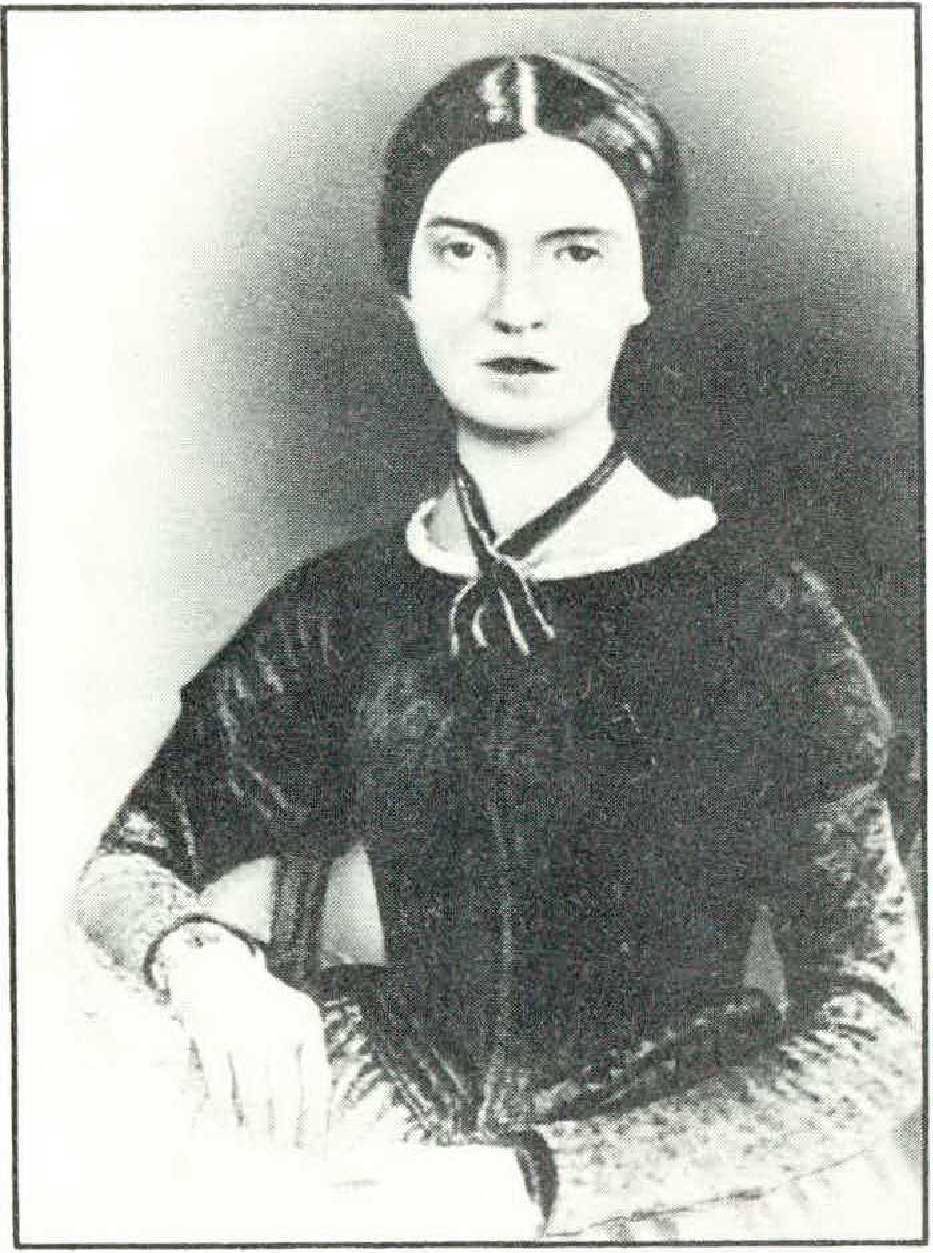
All Emily Dickinson’s biographers have faced a task of demytbiologizing her. In her own lifetime she was already known as “the village mystery,” or the “Myth.” “I must tell you about the character of Amherst,” a new arrival to the town wrote in 1881, in a letter home. “It is a lady whom the people call the ‘Myth.’ . . . She has not been outside of her own house in fifteen years, except once to see a new church, when she crept out at night, & viewed it by moonlight. . . . She dresses wholly in white, & her mind is said to be perfectly wonderful. She writes finely, but no one ever sees her.”
Emily Dickinson has been pursued historically by her reputation as “the white-clad Nun of Amherst,” a soul too sweet and rarefied for the world around her, misunderstood, if not oppressed, by her parents, living unappreciated in a cultural desert, removed from worldly interests—though (in an important variant of the legend) perhaps the victim of an unconsummated love affair that propelled her into reclusion. There is, of course, some foundation for the myth. Except for two terms at Mount Holyoke Female Seminary, a brief visit to Washington and Philadelphia, and seven months in Boston for care of her eyes, Emily Dickinson lived her entire life, from 1830 to 1886, in her father’s house in Amherst, Massachusetts. Beginning in her late twenties, she did remove herself from much daily human contact. But the reasons seemed to have little to do with the frailty of her spirit. She became sardonically hostile, for one thing, to the life of many of her townswomen, whose starched “Dimity Convictions” she mocked. She also could not honor the local forms of religion, though she became, of course, an intensely religious poet. (She once made a succinct statement of her faith: “When Jesus tells us about his Father, we distrust him. When he shows us his Home, we turn away, but when he confides to us that he is ‘acquainted with Grief,’ we listen, for that also is an Acquaintance of our own.”) Moreover, she carried on an active correspondence and maintained friendships—and relationships that were something more than friendly.
She was, during her lifetime, probably less appreciated as a poet than has been the case for any other important poet since the invention of movable type. The current Complete Poems lists nearly 1800 poems; while she was alive, just seven of them were published, all anonymously. Yet even this part of her life is complex. Something of her worth was understood by at least one of her contemporaries, Helen Hunt Jackson, who was a celebrated writer in her time and had considerable influence with publishers. One Boston editor, Thomas Niles, eagerly solicited a booklength manuscript from Emily Dickinson on having seen a handful of her poems. Emily demurred.
The incident leads to a central truth about the “Myth”: much of it was of Emily Dickinson’s own making. She was a willfully private and mysterious person, and could be at moments a highly difficult woman. Consider the bafflement of Col. Higginson on receipt of his second letter from her, which said, in part:
You asked how old I was? I made no verse—but one or two— until this winter—Sir— . . .
You ask of my Companions Hills—Sir—and the Sundown—and a Dog—large as myself, that my Father bought me—They are better than Beings—because they knowbut do not tell—and the noise in the Pool, at Noon—excels my Piano. I have a Brother and Sister— My Mother does not care for thought—and Father, too busy with his briefs—to notice what we do— . . . They are religious—except me—and address an Eclipse, every morning—whom they call their “Father.” But I fear my story fatigues you— . . .
This letter—which was among the first things published after her death—has gone a long way toward hiding its author from her public, as it hid her from Higginson. He later complained of the “fiery mist” with which she surrounded herself. Richard Sewall doesn’t claim to have dispelled the mist, but he has kept a clear eye on Emily Dickinson as her own mythmaker. And he has restored her from isolation to the intricate social and emotional context in which she lived.
She was not the “Backwoodsman” she once found it convenient to call herself, and Amherst was not the backwoods. It was a provincial but intensely self-aware intellectual community, which could be sniffish to the world outside. The town, in this way, had a lot in common with Emily Dickinson. She wrote home from one of her sojourns, her year at Mount Holyoke, that she was surprised to have found so many agreeable companions, though of course “They are not Amherst girls.” Sewall demonstrates that, indeed, quite an intense society of Amherst girls and Amherst boys existed, and that Emily received a stimulating education at Amherst Academy. The Dickinsons occupied the center of the town’s social life. Both her father, Edward, and her brother, Austin, served as treasurer of Amherst College, and their houses were gathering places for faculty, students, and alumni. Emerson, on a lecture tour, was a guest. And life was not so straitlaced as our sense of libertine progress may dictate. Letters from a friend of the Dickinson girls, Joseph Lyman, contain such memorable scenes as the one in which Emily’s sister Lavinia is seated on Lyman’s lap, plaiting her chestnut-colored hair about his neck.
The town absorbed the shock of a long-standing affair between its leading citizen—which, by then, Austin Dickinson was —and a woman twenty-seven years younger than he, Mabel Loomis Todd, wife of the director of the Amherst College Observatory. Although this story has lived in town lore, it has not appeared in print before, and it makes an entrancing tale. (Sewall, literary executor for Mrs. Todd’s daughter, had first access to much material about Austin, his family, and Mrs. Todd. To Sewall’s credit, this part of the story does not become disproportionate.) Adultery was handled coolly in an Amherst kitchen of a morning. Austin reported to Mabel about his confrontation with his wife:
At breakfast . . . the question came square, after leading up properly, “Did you see Mrs. Todd?” I had anticipated it and said at once, “Certainly, that was what I went to Boston for.” This unhesitating frankness was somewhat stunning, and the rally wasn’t prompt. When it came, it was, “She told me she was to spend a few days in Boston before going to Hampton, and I concluded you would see her.” I replied, “Yes, I said I did.” This ended it. There has been no allusion to it or you, since.
What the significance of this affair was for Emily can’t be fully known, but at a minimum, it suggests something of the complexity of the society in which she immediately lived. She cannot be expected to have been displeased by the liaison; though Emily and Austin’s wife, Sue, were girlhood friends, and their early letters have left a legend of idyllic sisterliness, in fact they grew to dislike each other.
Indeed, the affair may have been responsible for little less than the historical survival of Emily Dickinson. It was Mrs. Todd who edited the poems after Emily’s death and persevered in finding them a publisher. Lavinia had despaired of the task, and Sue was indifferent. It seems clear that Mrs. Todd, though a sensitive editor, was acting more out of love for Austin than for the poems. Without her, it is not implausible that they would have been consigned to an attic and thence to the dump.
Emily Dickinson’s own romantic experience has long been a subject that has intrigued her students, beginning with those in her lifetime who attributed her withdrawal from the world to unrequited love. Richard Sewall researches her affections more conclusively than anyone else has done, though the conclusion is still mostly mystery. She was well supplied with beaux, for at least one of whom—Ben Newton, a member of her father’s law practice—her feeling ran deep. He died young, and was the only one of her male friends who is recorded as having apprehended her genius, or the promise of it. She later wrote (to Higginson), “My dying tutor told me that he would like to live till I had been a poet.” She had a sharp, mirthful eye for young men who didn’t measure up. Of John Emerson, another lawyer in her father’s office, she said: “he carries about the sail of a good sized British vessel, when he has oped his mouth I think no dog has barked.”
She had three intense relationships—intense on her side, at least— with three men who were considerably older than she. And Emily left behind three draft letters, addressed only to a nameless “Master,” that record abject agony over disappointment in love. (She strives to make plain that she has been hurt: “Master. If you saw a bullet hit a Bird—and he told you he wasn’t shot—you might weep at his courtesy, but you would certainly doubt his word.”) The recipient of these letters—if in fact versions of them were ever sent—is unknown. Early legend explained the whole of Emily Dickinson’s adult life as a response to rejection by Rev. Charles Wadsworth, a Philadelphia preacher, and the “Master” letters are still felt by some to have been meant for him. It seems far more
likely that they were addressed to Samuel Bowles, a friend of the family, married, publisher of the Springfield Republican, and a man of national prominence. But Sewall is content to review both arguments, and to point out that there may yet be someone else, currently unknown. The record of Emily’s love for Bowles is substantial, though he seems to have regarded her as merely charming. Several letters and poems sent to him survive, some coyly provocative, some nearly wanton. At one moment she plays on the Elizabeth Barrett Browning poem, with a result that is wholly her own:
Because—
The Wind does not require the Grass
To answer—Wherefore when He pass
She cannot Keep Her place. . . .
Wherefore it shut—when He was by
Late in her life, Emily Dickinson apparently came as close as she was to come to a fulfilling love—with Judge Otis Phillips Lord, a member of the Massachusetts State Supreme Court. Like her other “Masters,” he seems an unlikely candidate for her love: twenty years older, worldly, and deeply conservative, and, for most of their relationship, anyway, a married man. Little is known about when and how they met; presumably though, it was through her father, whose friend Lord was. By 1877, after his wife’s death, Emily was writing to him with a frankness that suggested mutual feeling:
My lovely Salem smiles at me. I seek his Face so often—but I have done with guises.
I confess that I love him - I rejoice that I love him . . .
And there are hints elsewhere that Lord may even have proposed marriage.
The truth of any of these relationships can’t be known unless new documents appear, but the truth is less important than the sense imparted by the imperfect record of Emily Dickinson’s adult years, of her continuing, often passionate, involvement with life outside her “Father’s house.”
Many of her poems plainly gain their depth from her anguished relationships with others. Many spring from less turbulent human circumstance. More often than is apparent they were occasional poems, written as an enclosure to a thank-you or condolence note. They could be offhandedly charming and resonant, as in the small poem written to accompany the gift of a cocoon to her nephew:
Drab Habitation of Whom?
Tabernacle or Tomb—
Or Dome of Worm—
Or Porch of Gnome—
Or some Elf’s Catacomb?
Characteristically, her poems, large and small, turn on some interpenetration of the infinite and the finite, and it is a mistake to think that because the infinite appears, the finite is meant to be dismissed. Think of how many of her great poems depend on social imagery:
He kindly stopped for me—
The Carriage held but just Ourselves—
And Immortality.
And I had put away
My labor and my leisure too,
For his Civility—
Children strove
At Recess - in the Ring —
We passed the Fields of Gazing Grain—
We passed the Setting Sun—
The Dews drew quivering and chill —
For only Gossamer, my Gown —
My Tippet—only Tulle—
A Swelling of the Ground—
The Roof was scarcely visible -
The Cornice - in the Ground -
Feels shorter than the Day
I first surmised the Horses’ Heads
Were toward Eternity—
A simplistic way of reading that poem is as a memento mori, a devaluation of ordinary experience, but that is not true to its feeling. It is a poem not just about death, but about the experience of living with the knowledge of death, about the inevitable cohabitation of the temporal and the spiritual. As Richard Sewall remarks of another, lesser poem, and about Emily Dickinson’s poetry in general, “The cosmic jostles the everyday and each is illumined.”
Is it true what they say about TEXAS?
See page 33
Sewall only rarely allows himself a judgmental word on Emily Dickinson’s character. Once he speaks of a visit that Samuel Bowles paid to the house, when Emily refused to come downstairs to greet him. Bowles shouted, “Emily, you damned rascal! No more of this nonsense! I’ve traveled all the way from Springfield to see you. Come down at once.” She came down, and was reportedly “charming and sociable.” “Clearly,” Sewall remarks, “she needed more Bowleses in her life.”
So she did, if only to discover that she didn’t need them. Her habit of apprenticing herself to inferior “Masters” is emblematic of her perpetually confused sense of her relationship with the world. Her life was a whipsaw of reckless vulnerability and excessive self-defense. What to show, what to hide, what to give, what to keep, what to offer, what to expect—the questions seem to have reverberated continually within her consciousness. As Sewall remarks a few pages later, “Her failures, certainly, were with people. Throughout her life, she never achieved a single, wholly satisfying relationship with anybody she had to be near, or with, for any length of time. . . . All her life she demanded too much of people.” And yet this is not the whole of the story; she could be extraordinarily generous. Sewall lets someone else say it, and seems relieved to have it spoken. Judge Lord wrote to Vinnie, concerned about Emily’s health, “knowing how entirely unselfish she is, and how unwilling to disclose any ailment. . . .” Sewall remarks: “Lord’s tribute to her unselfishness is the only one of its kind we have and at last gives a proper title to all those devoted labors for her family and the countless acts of thoughtfulness for her friends that her correspondences, major and minor, indicate. The image of the selfabsorbed recluse has too long dominated the conventional notion of her; Lord’s perception seems truer.”
Among Emily Dickinson’s fears was a fear of excess, and properly so: She was prey to it. She left behind perhaps a greater proportion of bad—or at least precarious poetry than any other major poet. Her poems characteristically go awry in one of the two directions that her life did: toward effusion or evasion. She could be precious and she could be simply inscrutable. The best of her poems are exquisite acts of balance, and how she must have lusted after the poise that is the social counterpart of that achievement.
The hardest part of the “Myth” to dispel is a too easy equation between the suffering of her life and the triumph of her poetry. She can’t be said to have turned to poetry because of her failure at life—though by the end, she knew that poetry was her vocation, and would let nothing interfere with it. She learned a great deal from life, and it is tempting to think that she would have learned still more had her life been less circumscribed; and it is impossible to imagine the experience that could have deterred her from poetry.
Even such slight speculation threatens to trespass the boundaries of Sewall’s biography. For a plainly authoritative work, it is one of the most modest books imaginable. One of the frustrations of reading it is the sense that Sewall has earned the right to say much more than he has said. There are other frustrations. It would be nice to be able to say of The Life of Emily Dickinson what Emily Dickinson said of a life:
Until the House is built
And then the Props withdraw
And adequate, erect,
The House support itself
And cease to recollect
The Auger and the Carpenter—
Just such a retrospect
Hath the perfected Life—
A past of Plank and Nail
And slowness—then the Scaffolds drop
Affirming it a Soul
But the scaffolds are still in place. The book is organized in a way that is more faithful to Sewall’s prodigious research than to the shape of the life he has reconstructed. The first volume ends before the life begins: It consists of Sewall’s careful portraits of family and forebears and of the town. Volume Two describes the life in roughly chronological order, but it is still arranged about Emily Dickinson’s various relationships. As Sewall acknowledges, it is consequently difficult to keep in mind the complex of forces and events that were affecting her at any one moment, and you have to struggle for a sense of the sweep of her life. It is demanding reading, every page carrying a burden of caution and annotation. Yet it is hard to call these qualities flaws, since they are directly a function of Sewall’s knowing so much, and of his refusal to violate the limits of what he knows.