Who’s Running the Country?
As Washington’s power center weakens in a season of distraction, the barons take over. Here is the story of how Kissinger, Schlesinger, Shultz, and Weinberger moved into the void.
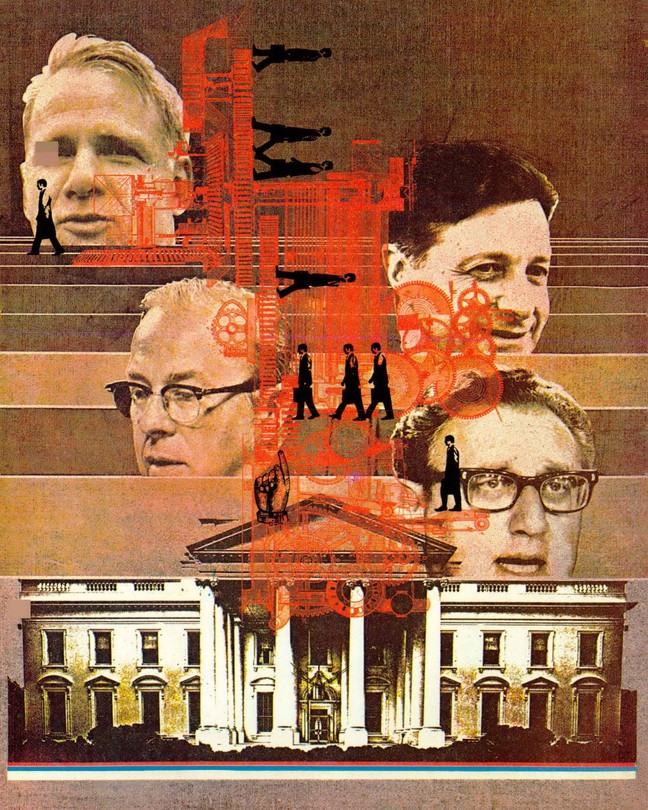
“One year of Watergate,” as Mr. Nixon put it, may not be enough for the President’s critics. But it has been enough to redraw the map of Washington. An enormous change has come over the workings of the federal government. The structure of power here has been altered in ways likely to endure no matter what the denouement of Watergate. The presidency, as well as the President, has been weakened—and the change will affect the man who succeeds Richard Nixon, whoever he is or whenever the succession occurs.
The decline at the center has led to a tremendous growth of power in parts of the bureaucracy. Much presidential authority has been hived off to the State Department, the Treasury, the Department of Defense, and the Department of Health, Education and Welfare. So far this diffusion of responsibility has had no adverse effects. Indeed Henry Kissinger, George Shultz, James Schlesinger, and Caspar Weinberger have done some good things that they might not have been able to accomplish if big brother had been watching closely. But although government continues, the general condition has altered. The king has slipped, and the barons have taken over.
The most striking sign of the weakened presidency is the decline of the small, elite offices set up to manage the rest of the government on behalf of the President. At the top of the list comes the White House staff itself. From Franklin Roosevelt through the first Nixon Administration, central positions on the staff were held by presidential confidants whose chief task was to develop a domestic program in cooperation with the various agencies and the Congress. Hence Samuel Rosenman under Roosevelt; Clark Clifford under Truman; Sherman Adams under Eisenhower; Ted Sorensen under Kennedy; Bill Moyers and Joe Califano under Johnson; and John Ehrlichman in the first Nixon Administration. Under the impress of Watergate, three men with that kind of capacity came to the White House—John Connally, the former governor of Texas; Melvin Laird, the former Secretary of Defense; and Bryce Harlow, who had served as a White House staff man under both Eisenhower and Nixon. All three urged more open government, with a larger role at the White House for the Cabinet and the Congress. All three were turned off.
In the battle for control of the White House staff they were routed by two unlikely victors— Ronald Ziegler, the former press secretary, and Alexander Haig, the former general who succeeded H. R. Haldeman as White House chief of staff. Mr. Ziegler has the President’s confidence, and as a punching bag he’s in the Olympic class. His view that “contrition is bull” seems exactly to express the President’s own attitude toward the Watergate scandals. But he is no heavyweight in any matter of substance. The Watergate hearings showed that even junior members of the staff regularly lied to him. Both Laird and Connally advised Nixon to fire him—and let that fact be known. The best he himself can say of his professional background is, “I was trained thoroughly in political communications.” The one man in the White House who sees Mr. Nixon more than Ziegler is General Haig. Haig is a bureaucratic general. He rose by serving as an expediter for civilians (first in the Johnson Administration, then for Henry Kissinger) who needed to make the military bureaucracy work. His disposition to give orders makes him a fish out of water in dealing with civilians. But, like Ziegler, he is prepared to cover Mr. Nixon. His reaction, on learning from the Chicago Tribune that its reporters had the story of Pentagon “spying” on Henry Kissinger, was: “This story isn’t going to do the country any good . . . but I don’t think it will hurt the President.” Thus for the first time in over two decades, the close-in White House staff has virtually no role in formulating domestic programs.
A special place of distinction in the White House has long been reserved for the staff of the National Security Council. Henry Kissinger, and before him Walt Rostow and McGeorge Bundy, made the staff the vital center for the making of foreign policy. Academics and young officers in the Pentagon and State Department and the intelligence community vied for the few available places. But since Dr. Kissinger became Secretary of State, the NSC staff has fallen into disuse. The full council, which the staff serves, met only twice last year, and not once between September, when Dr. Kissinger moved to the State Department, and the end of the year. Three of the leading staff members, Helmut Sonnenfeldt, Winston Lord, and Lawrence Eagleburger, have gone to State with the boss. While the NSC still functions as a clearinghouse for formal policy papers, the initiative comes from Dr. Kissinger’s office at State, not the other way round. As Lawrence Eagleburger puts it, “When I was at the NSC, people at State always used to call me to find out what was going on. Now that I’m at State, people at the NSC call me to find out what’s going on.”
Next to the NSC, the most prestigious White House group was the Council of Economic Advisers. The membership of the Council is still distinguished. Herbert Stein, the chairman, is a leading light of the Chicago school of economics. William Fellner, another member, is a former chairman of the Yale economics department, with an international reputation as an expert on inflation. But Dr. Stein is stepping down to teach at the University of Virginia. Dr. Fellner, who came to the council at sixty-eight years of age, after a lifetime in the academic world, is said to write memos which never reach the President because they would be better received at some technical journal. The third member, Gary Seevers, is too young (thirty-six) to exert much influence.
In the inner bureaucratic battling of the past few years the council has lost much ground. The fight against inflation is being led by a new organization—the Cost of Living Council. Another new organization—the office of the Federal Energy Administration—has assumed responsibility for programs that hold tremendous consequences for employment, investment, and economic growth. One of the new men in that agency once told me, “Stein doesn’t count for anything in energy. To me, he’s just a guy in the back of a crowded room.”
At the last annual meeting of the American Economic Association in New York, Dr. Stein acknowledged that the United States should perhaps develop a large-scale economic planning ministry of the kind that has grown up in Japan and France. He said it might be “inappropriate” for the council to continue as “a little agency focusing mainly on manipulating fiscal and monetary policy.”
It could be argued, of course, that the plight of the Council of Economic Advisers merely expresses the inveterate Republican dislike of government intervention in the economy. But a similar stagnation has affected the Domestic Council, which was set up by President Nixon himself in 1970. John Ehrlichman, its first head, used the council to undo domestic programs dear to the Democrats and, whatever the complaints, no one could claim that the Council lacked purpose or clout. Now it seems to have lost both. The present director, Kenneth R. Cole, Jr., is an adman with a degree in business administration, who said after his appointment, “I’ve always been interested in this country and the way it’s run, probably more in the foreign affairs area.” The staff has been cut in half. Mr. Cole seems to have little contact with the President, nor has he any drive to achieve particular programs. He is almost unknown to most of the country’s mayors and governors, and one, Jimmy Carter of Georgia, considered it demeaning when he was asked to tell his troubles to Mr. Cole. Cole apparently considers his main goal to be keeping the Domestic Council alive against assault from the other White House agencies. “I see the politics of government being formed by the Cabinet,” he said recently, in what seemed like a bid for allies outside the White House. “His big task now,” one official here claims, “is ushering mayors and governors in to meet Cabinet officials in Washington. Even when he’s doing that, he tiptoes.”
The great threat to the Domestic Council has always been the Office of Management and Budget. OMB was created out of the Bureau of the Budget at the time the Domestic Council was formed in 1970. In theory the policy was to be handled by the Council, while OMB doled out money and audited performance. Rivalry was inevitable given the porous quality of the dividing line, and the character of the Bureau of the Budget. The Bureau had been picking up more and more power since the Roosevelt administrations. Its permanent officials were men of the highest caliber, and they had close ties with the leading departments, the key committees of the Congress, and the White House. In particular, the Bureau had become central to the process of creeping government or incrementalism, which developed steadily from the New Deal through the Great Society. Under the incremental approach, small programs expanded year by year in reach and cost until they became major items. For example, educational grants, funneled through a score of narrow programs, increased sevenfold to $3.5 billion in the years between 1960 and 1970. Budget obligations for a dozen different manpower training programs increased from about $300 million in 1963 to about $4.8 billion in 1971. The Bureau of the Budget—because of its communications with the White House, the departments, and the appropriations committees of the Congress—came to have a unique feel for setting the proper dosages from year to year. As Professor Erwin Hargrove writes in a forthcoming book on the presidency: “The Bureau of the Budget became expert at striking balances and reconciling the President’s directives with the missions of agencies and the perspectives of Congressional appropriations committees. Bureau functionaries were experts in the politics of incremental adjustment. . . .”
But though not many recognized it at the time, the transformation of the Bureau of the Budget into the Office of Management and Budget actually signaled an end to the politics of incremental adjustment. Instead of developing new programs for the White House and feeding them in small doses past the stingy appropriations committees, after the fashion of the old BOB, the new OMB has been dedicated to cutting back old programs and improving performance of extant operations. Not surprisingly, the character of the leadership has changed. The economists who were dominant from 1960 through 1970 have been replaced by the business school managers, headed up by two products of the Harvard Business School: director Roy Ash and his deputy, Frederic Malek. About a hundred business school graduates have been brought into the OMB, nearly a sixth of its total staff. Two new associate directors—Walter Scott and Frank Zarb—have been recruited from the business community. When a very highly trained Harvard economist applied for a post at that level, he was rejected by Mr. Ash with a telling epithet. “He’s a phud,” Ash said, using the term of derision applied by Harvard Business School types for persons with advanced academic degrees.
Just how well OMB does in improving government operations is a matter of dispute. Some claim that truly important progress has been made in developing a capacity to assess government operations. Mr. Malek claims, “The team we’ve put together . . . may be the best in government.” Mr. Scott asserts that the OMB stepped in and helped run the Justice Department during the period after the firing of Elliot Richardson and William Ruckelshaus. Others say that the management boys in OMB waste everybody’s time with complicated studies built around slogans. An OMB attempt to define the “major goals” of the Transportation Department, for example, yielded a directive already issued by the Congress: “Develop a national transportation policy.” In any case, the new managerial function makes OMB far less a power than in the days when it occupied the center of incremental politics. And OMB’s effectiveness has been further limited by the involvement of some of its top officials in personal scrapes that would have been unthinkable in the old Budget Bureau. As a founder and former chief executive of Litton Industries, Mr. Ash is constantly being questioned about the decline of that company. Mr. Malek, as a former high official of the Committee to Re-Elect the President, has Watergate on his hands. So does Lawrence Higby, a former lieutenant to H. R. Haldeman who has been promoted to a top spot as a special assistant in OMB.
As a final index of the plight of OMB, there is clear evidence that the present director does not have what all past directors have always had—good access to the President. Mr. Ash went to San Clemente for a final scouting of the budget on the weekend of January 4. I happened to ride with him to Dulles Airport, and he was quite confident that he would be talking to Mr. Nixon. As it developed, he did not get to see the President. He did all his business with General Haig. When that information came back to Washington, the stock of Mr. Ash and his OMB plummeted. As one former director of the Bureau of the Budget remarked: “That the director didn’t have access to the President when he needed to see him is inconceivable to me. It means OMB has gone to hell.”
Theoretically, the weakening of the central control mechanisms should have been a boon for the rest of the government. The cat was away and the mice could play. Only it turns out that some of the mice can play a little better than other mice. To understand why, it is useful to borrow a distinction made by Professor Thomas Cronin between the “outer Cabinet” and the “inner Cabinet.”
The outer Cabinet comprises those relatively new departments of government which have grown up as a result of constituency pressures, such as Agriculture and Labor. To improve presidential control over such departments, they were brought, in the second Nixon Administration, under the direction of men without any special drive or political independence. As a result, almost all the departments in the outer Cabinet have missed the present opportunity for self-aggrandizement. Interior, despite its historic role in the making of oil, gas, coal, and electric power policies, has not taken hold of the energy problem. Housing and Urban Development, despite the potential stimulus that home building could give a flagging economy, has not been able to put across its plans for a system of housing allowances. Agriculture, despite the strategic importance of American wheat and soybean production, has exerted less and less strength in international matters; indeed, Agriculture has been forced by the State Department to accept American participation in an international food conference, which Secretary Earl Butz was resisting for months. While Transportation has a new program whereby money from the Highway Trust Fund can be used, depending on local options, for mass transit, the idea came not from the department, but from a veteran of the OMB, associate director Paul O’Neill. Commerce seems not even to have a connection with the trade bill now going through Congress. The Labor Department has become a joke. Peter Brennan, the building trade union leader from New York, has not even been given the task of liaison with the AFL-CIO. That has been done by a former Labor Secretary, an old friend of George Meany’s, Secretary of the Treasury George Shultz. Another official on good terms with the unions, W. J. Usery, Jr., has been named a White House assistant for labor relations. Sign-readers interpret this as a hint to Mr. Brennan that he’s dispensable.
The case of the Department of Health, Education and Welfare is different. Under Caspar Weinberger, HEW has emerged as a true powerhouse, able to push through major projects long held in abeyance. A $60-billion health insurance program has been sent up to Congress this year. The Administration wants to transfer the food stamp program from Agriculture to HEW. And, despite long odds, the Administration is again asking for a welfare reform package—another HEW proposition.
The exception in this case does prove the rule. Mr. Weinberger comes out of the inner White House circle; before going to HEW he had served as director of OMB, and won the President’s personal confidence. Moreover, he has been strategically placed to take advantage of important congressional pressure. Some of the most powerful national Democrats—Ted Kennedy and Fritz Mondale in the Senate, and Wilbur Mills and Paul Rogers and John Brademas in the House—have been pushing hard for additional benefits in health, education, and welfare. The best way for the White House to avoid confrontation with the Congress was to give Mr. Weinberger his head.
The inner Cabinet includes those departments which, far from representing a particular constituency interest, are intrinsically presidential in focus. State, Defense, Treasury, and Justice (the original nucleus of the Cabinet) are included in Professor Cronin’s list. All but the Department of Justice are flourishing. Justice has suffered because the Watergate Special Prosecutor has taken over most of the truly important cases. Attorney General William Saxbe, moreover, is not a figure who has worked for long with the President. On the contrary, he is in the job because, as a sitting member of the Senate, he could be confirmed without any embarrassing questions being asked. But the other department heads in the inner Cabinet are names to conjure with in Washington. They are the men whose hands work the lever of power.
Henry Kissinger’s enormous power at the State Department is celebrated daily in headlines. Dr. Kissinger is always at pains to assert publicly that, as he told his January 3 news conference, the “Secretary of State has to be the agent of the President or he represents nothing.” Wherever possible, Dr. Kissinger advertises personal involvement by Mr. Nixon. When the President, in October, 1973, ordered the airlift to Israel, that word was rapidly sent around town. Mr. Nixon himself spoke at great length of his “personal relations” with Leonid Brezhnev after the nuclear alert of October 24-25. The President personally announced the disengagement between Israel and Egypt. He issued invitations to the foreign ministers who attended the international energy meeting in Washington on February 11. But much evidence indicates that— while it is bad form to say so, given the President’s Watergate troubles—Kissinger is operating on his own to a remarkable extent. The nuclear alert, for example, was not preceded by a full-scale National Security Council meeting, contrary to what Kissinger at one point asserted. The Egyptians and Israelis with whom he conducted most of the negotiations for settlement in the Middle East did not have the impression they were dealing with Mr. Nixon. Golda Meir, in announcing the disengagement agreement, said that Kissinger “made history.” One high official in Jerusalem put out a story, later denied, that Kissinger had told him President Nixon would yield office to Vice President Ford in another six months. In Cairo, the independent status of Kissinger was equally a matter of note. Egyptian journalist Mohamed Hasannein Heikal, who had a private interview with Kissinger, reported (in another statement denied in Washington) that the Secretary of State told him: “The President of the United States is incapable of performing any positive role in the Middle East crisis, even if he wanted to, because of domestic pressure on him.”
As for the international energy problem, a critical step was taken on December 12 when Dr. Kissinger, in a speech in London, first proposed setting up an “action group” of the main consuming and producing countries. Until the very last moment the Kissinger text called only for a meeting of the consuming countries. He was persuaded to include the producing countries only when French Foreign Minister Michel Jobert indicated that his country would not participate if the group looked like a gang-up on the Arabs. It is not easy to see how Mr. Nixon could have done much more than accede to sudden shifts like that. One of Dr. Kissinger’s chief assistants in the energy field says: “I don’t think the President has any idea of what Henry is doing in energy.”
George Shultz’s personal impact on economic policy was less visible perhaps, but no less deep, than Kissinger’s on foreign affairs. On succeeding John Connally as Secretary of the Treasury in 1972, Shultz made himself absolute master of the Administration’s economic policy, with a powerful say in social policy. As boss of the Treasury Department, he asserted with a vengeance the Treasury’s constant bias against tax changes. The result last year was a paucity of resources which powerfully inhibited the efforts of other departments to develop new programs. Perhaps the central decision of this year’s budget was not to fight recession with a tax cut—a decision particularly dear to Shultz. Shultz also manipulated the dismantling of price controls, and arranged for a close friend, John Dunlop, to take over the Cost of Living Council. He put his own man, the then Deputy Secretary of the Treasury, William Simon, in charge of the energy program—with a strict injunction to avoid rationing at all costs. As a former Secretary of Labor, he was easily able to keep his touch on the Administration’s relations with George Meany, and as the first director of the OMB, he knew how to influence overall budgetary policy and determine allocations to various departments.
Mr. Shultz has been far too good an operator—and too honorable a man—to allow much daylight to show between him and the President. Certainly Mr. Nixon was not strongly opposed to what Shultz did. Still, the economic policy of the past few years does bear Shultz’s distinct ideological brand, his pronounced belief that the free play of the market is the best of all possible regulators. The abandonment of Phase II economic controls back in January was probably precipitated by the Shultz influence: more important, its significance was advertised to the whole world as a Shultz move, a green light for market forces because the Secretary of the Treasury made it known that he had cleared the action on the golf course with none other than George Meany. Without in any way being disloyal to the President, moreover, Mr. Shultz slapped down hard anyone else who tried to get into the act. Arthur Burns, an old rival who now heads the Federal Reserve Board and entertains skeptical notions about Shultz’s latter-day laissez-faire views, found that the only way he could make his ideas known in the White House was to lobby them through the leading Democrats in the Congress. When Melvin Laird urged the Administration to consider the possibility of tax changes, Shultz told him bluntly to keep his “cotton-picking hands off.”
The influence of James Schlesinger at Defense is less clear. He has been in the office less than a year. He is surrounded by men appointed before his arrival—notably Deputy Secretary William Clements, a hard-bitten Texas oilman with whom the Secretary has little rapport. And the huge independent power of uniformed military always makes it difficult to tell where the real strength lies at the Pentagon.
Certainly the Secretary and the Pentagon are getting their way on some big programs. Defense outlays have risen from about $79.5 billion last year to nearly $85.8 billion for the 1975 fiscal year. Big ticket items, notably the Trident submarine and the B-l bomber, are still going on the go-go board, and talk about cutting troop commitments in Europe is down to a whisper.
Like Kissinger and Shultz, Schlesinger is a Ph.D. who went on to an academic career—another indication that academic politics may be the best training ground for government these days. His specialty at the RAND Corporation was defense planning. He is probably the first Secretary of Defense to come to the job with a sophisticated interest in nuclear strategy. He has pushed into the public arena an abstruse debate about the appropriate design of the nuclear deterrent. This question has been discussed at high levels in the government for several years. Since about the middle of the last decade, the strategic deterrent has been designed according to the concept of Mutual Assured Destruction—MAD for short. The theory has been that if both the United States and the Soviet Union had enough nuclear weaponry to destroy one other power, even after suffering a first strike, neither would hit first. But Schlesinger and others have long pointed out that the MAD theory puts a premium on hitting cities—where the most destruction can be done. In the light of a stepped-up Soviet weapons program featuring highly accurate intercontinental missiles of enormous power, American strategists have come to fear that the Russians might be developing a capacity to knock out major parts of the American deterrent force. Behind this move, the strategists speculate, is a Russian calculation that under such a Soviet threat, the United States, rather than go to total war, would yield on some key political issue. In response to this potential danger, the Pentagon has been moving to develop new intermediate weapons—notably smaller and more accurate nuclear bombs that would take out parts of the Soviet deterrent force. Similarly, the United States is beginning to re-target missiles toward Soviet launching sites as well as cities.
Schlesinger apparently went public in the strategic debate without much consultation inside the National Security Council. State Department negotiators, including Secretary Kissinger, were less than pleased. They felt that Schlesinger’s assertions might complicate the next round of strategic arms control talks by giving Moscow the impression the military lobby had taken over in Washington. As one State Department official complained, “Whether he’s right or wrong, Schlesinger shouldn’t have said that publicly at a time when foreign countries are wondering about the staying power of the President.” But right or wrong, Schlesinger has injected himself into the strategic debate. This time, President Nixon and Kissinger are not going to be able to make an arms limitation agreement without bringing the civilian side of the Pentagon into their discussions. As Kissinger himself once said to me, “Unless Schlesinger and I get together, this town will blow apart.”
So far, they have been getting together. It can even be argued that, given the wounded condition of the President, government by his principal lieutenants works better. A nice example is the nuclear alert called on the evening of October 24-25 in response to intimations of unilateral Soviet entry into the still hot war between Egypt and Israel. The American move—a proclamation of Defense, Readiness, Condition 3, known as Defcon 3—was decided by Secretary Kissinger and Secretary Schlesinger working together in the West Wing basement of the White House. President Nixon in the residential quarters was not present and seems to have been only belatedly informed. Defcon 3 was a rather cool reaction—a similar state of alert was in effect in the Western Pacific all during the last seven years of the Vietnam War. The proclamation of the alert was followed by a rapid standing-down by the Russians. A nascent crisis was thus ended without much fuss. The fuss came two days later when President Nixon at a press conference characterized what had happened as the most serious confrontation we had had since the Cuban missile crisis. In other words, when the President came into the picture, his need for a public triumph tended to make matters a good deal worse. Had he been involved all along, there might well have been genuine confrontation.
Still, cooperation among the barons is hit-or-miss. Moreover, there is something radically wrong when basic decisions of peace and war are made without the active participation of the country’s highest elected official. So even if the barons of government stay strong, a new President will have to re-establish the powers of coordination. He will want to rebuild control mechanisms at the center, to re-implant a brain in the dinosaur.