On Satirizing Presidents
An interview with Philip Roth
ALAN LELCHUK: First, is there a tradition of political satire in America to which Our Gang belongs?
PHILIP ROTH: Yes, I think there is, though it probably isn’t known even to most educated Americans. For one thing, political satire isn’t a kind of writing that lasts. Though satirists by and large deal with enduring social and political problems, their comic appeal lies in the use they make of the situation at that moment. It’s unlikely that reading even the very best satiric works of another era we feel anything like the glee or the outrage experienced by a contemporary audience. Subtleties of wit and malice are wholly lost over the years, and we’re left to enjoy the broadest, least time-bound aspects of the work, and to hunt through footnotes in order to make connections and draw inferences that are the teeth and claws of this sort of writing. Except for a few specialized students of American literature and history, no one today is going to be interested in reading James Russell Lowell’s satires in doggerel verse, The Biglow Papers, which were written in the middle of the nineteenth century from an abolitionist point of view, or the dialect letters of “Petroleum V. Nasby,” written by another antislavery Northerner, David Ross Locke. Yet both are wonderful comic inventions, as virulent and funny as the political satire of Defoe and maybe even some of Swift. Lincoln admired the Nasby letters so much that he is supposed to have said he would have given up the presidency to have been able to write them.
Another reason most Americans might not realize satirical writing once flourished here is that there’s hardly any around today. I think people would be surprised, not only by the imaginative richness but by the ferocity of the political satire that appeared in ordinary daily newspapers throughout the country in the nineteenth century, especially during the decades leading up to and following the Civil War. I don’t believe there’s a daily newspaper in America today that would print the kind of sustained satiric attack that Lowell made upon General Taylor during the campaign of 1847, or Locke made upon the Northern Democrats during Lincoln’s Administration. If you look at the ways in which American Presidents such as Jackson, Polk, Taylor, Lincoln, Andrew Johnson, and McKinley were ridiculed in the daily papers in the nineteenth century, you’d have to conclude that both editors and readers were a heartier bunch a hundred years ago, far less intimidated than they appear to be today by pious Emily Postish notions of “respectability.”
I would think the resident prose satirist of American newspapers today is Art Buchwald. Now, he can be a funny man, but his comedy is generally in what they call Good Taste. The stuff I’m talking about wasn’t in Good Taste.
Q: Are there any other American writers you admire who have worked along these lines?
A: Well, 1 should mention Mencken. I’m thinking specifically of his attack on Harding’s puerile prose style, which he called “Gamalielese.” Mencken said that Harding’s style was so bad that a sort of grandeur crept into it. I also remember a poem by E. E. Cummings that in part goes something like, “Warren Gamaliel Harding/ the only man, woman or child/ who could make seven grammatical errors/ in a simple declarative sentence.”
Q: Are you pointing here to some connection between Mencken’s attack upon Harding . . .
A: And Wilson, and Coolidge, and FDR.
Q: Are you suggesting a connection between Mencken’s attitude toward these Presidents and your own toward President Nixon in Our Gang?
A: Yes and no. I don’t feel much kinship with Mencken’s ideas—social, political, or aesthetic. Particularly his notions as to what constitutes an aristocracy rub me the wrong way. But as a critic of American public rhetoric, he was often brilliant and funny. I think, yes, there is in my book Our Gang a concern similar to his in the essay “Gamalielese.” But obviously we approach the problem of debased political language in different ways. Where he analyzes and evaluates Harding’s prose in a journalistic essay, my book is largely an exaggerated impersonation, a parody, of Nixon’s style of discourse and thought. Each of us ridicules the public utterances of an American President, but I go about it in the ways of a fantasist and farceur, and he with the weapons of a literary critic.
I believe he was also more amused by Mr. Harding than I am by Mr. Nixon. The reason may be that there’s been a lot of terror packed into the short space of time that separates Mencken’s “Gamalielese” from George Orwell’s “Newspeak”—two related linguistic phenomena at which President Nixon is equally adept. Mencken might never have drawn the same conclusions from rotten political prose that Orwell did twenty-eight years later in the novel 1984. Mencken seemed to think it was inevitable that American democracy would produce as leaders clowns and charlatans who, along with their other disabilities, couldn’t speak English. He considered what they said and the way they said it entertainment, rivaled only by Barnum and Bailey. It took an Orwell—and a Second World War, and savage totalitarian dictatorships in Germany and Russia—to make us realize that this comical rhetoric could be turned into an instrument of political tyranny.
Q: You’ve mentioned specifically two nineteenthcentury satirical works, The Biglow Papers and the Nasby letters, both growing out of the Civil War period, and now Mencken’s essays. Are there any other literary works of a satiric nature that seem to you relevant to a discussion of Our Gang?
A: It might be appropriate to mention some satiric works of a nonliterary, or popular, nature. “Satiric” probably isn’t the right word here—I mean broadly comic in the style of Our Gang. I’m thinking of routines by comedians like Olson and Johnson, the Marx Brothers, the Three Stooges, Laurel and Hardy, Abbott and Costello. Recently I saw Abbott and Costello in a segment from an old movie of theirs, doing that famous baseball dialogue “Who’s on First?” It’s a masterpiece of punning and verbal confusion, characterized by the sort of buffoonery that I was trying for in the longest section of Our Gang, “Tricky Has Another Crisis.” Obviously, Tricky—in contrast to either the colorless straight man Abbott or the benign fool Costello—is an oldfashioned villain of the Tartuffian variety. Still, the style of some of Abbott and Costello’s slapstick comedy seems to me suited to the monkey business that Tricky and his friends engage in in that “crisis” section.
Do you remember Charlie Chaplin and Jack Oakie as Hitler and Mussolini in The Great Dictator? Well, in their performances there’s something, too, of the flavor I hoped to get into the more outlandish sections of Our Gang.
All I’m trying to illustrate is that the level of comedy in Our Gang isn’t exactly what it is in Pride and Prejudice—in case anybody should fail to notice. Our Gang is at the other end of the spectrum from that kind of comic irony. It’s written with a deliberate broadness, whose purpose is to deflate the subject of the satire; often it’s coarse, gross—
Q: In other words, in bad taste.
A: Exactly. And that’s the whole point, isn’t it?
Q: How so? Go on.
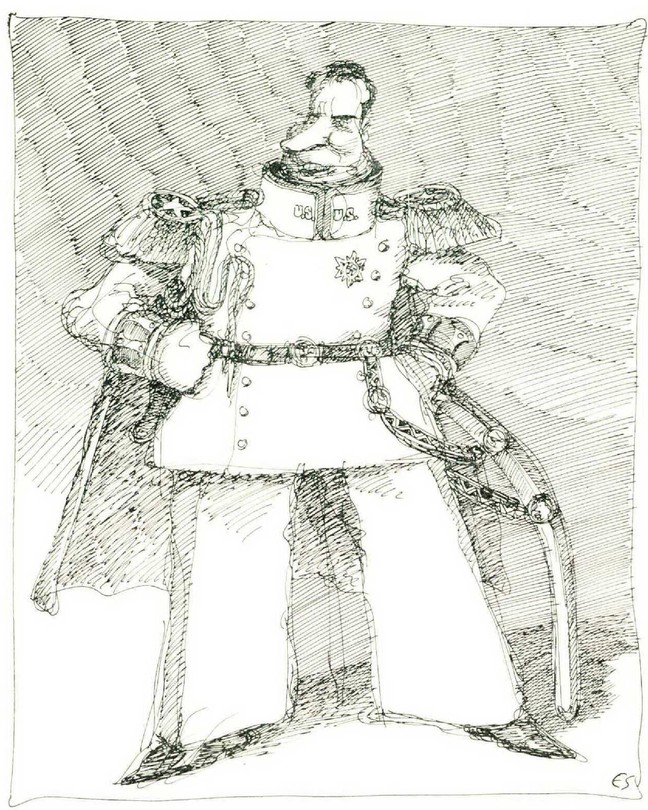
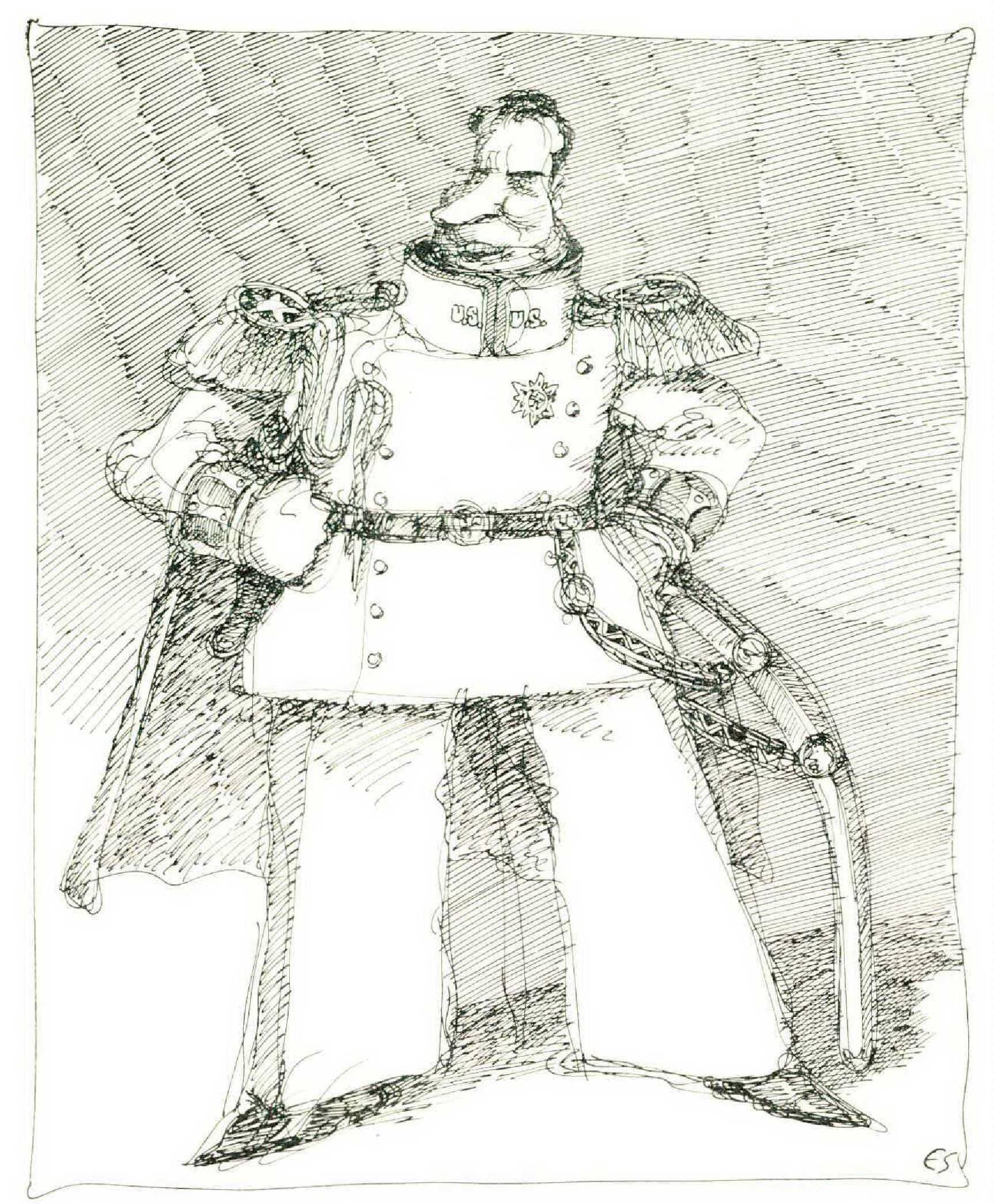
A: Well, a satire like Our Gang is out to destroy the protective armor of “dignity” that shields anyone in as high and powerful an office as the presidency. It was no accident that President Nixon took it into his head a few years ago to tart up the White House police staff in the imperial garb of junkers out of The Student Prince. He knows better than anybody how much he needs to be surrounded by all the trappings of dignified authority—or, as it turned out, authoritarian dignity. A book like Our Gang tries to yank him out from behind all that unearned augustness. Rather than accept his “official” estimate of himself, which we see in the case of Mr. Nixon is very regal indeed, I place him in a low-comedy setting, into a kind of baggy-pants burlesque skit, which strikes me as a more appropriate environment for a man of his character. Of course, it’s a traditional strategy of satire to lilliputianize public figures who on the whole would rather be lionized, but it isn’t only that: it’s a moral judgment.
So you describe the work accurately when you say it’s in Bad Taste. Satire of this kind has no desire to be decorous. Decorum—and what hides behind it—is what it is attacking. To ask a satirist to be in Good Taste is like asking a love poet to be less personal.
Good Taste is inimical to what makes satire satirical. Is The Satyricon in such Good Taste? Is Gargantua, and Pantagruel? Is Aristophanes? Is Swift’s Modest Proposal?
Swift recommends the stewing, roasting, and fricasseeing of one-year-old children so as to unburden their impoverished parents and provide food for the meat-eating classes.
How nasty that must have seemed, how unnecessarily vulgar, even to many who shared his concern for Ireland’s misery. Listen to this, and imagine how it went down in polite society: “A Child will make two Dishes at an Entertainment for Friends; and when the Family dines alone, the fore or hind quarter will make a reasonable Dish; and seasoned with a little Pepper or Salt, will be very good Boiled in the fourth Day, especially in Winter.”
Now that’s considered Literature in the “Swiftian" vein; back in 1729 it probably seemed, to a lot of Swift’s contemporaries,
Bad Taste, and worse. Similarly, Rabelais is no longer an obscene writer who can’t resist a joke about feces or urine or bodily apertures—four hundred years in the grave and he’s “Rabelaisian.” The trick, apparently, is to turn yourself from a proper noun into an adjective, and the best way to accomplish that is to die.
Imagine if today you were to write a satire modeled upon Swift’s Modest Proposal about the situation in Southeast Asia. As it turns out, under orders from Lyndon Johnson and Richard Nixon, our Armed Forces have been following Swift’s advice for some time now, boiling and fricasseeing the children in Vietnam and Laos, and lately roasting succulent Cambodian infants. Suppose a satirist were to propose to President Nixon that instead of killing these Asian children for no good reason, as we do now, we adopt a policy at once more practical and humane; since statistics prove that X number of children are going to die anyway, why not slaughter them for food for the Vietnamese refugees? The proposal might be written in the style of those Pentagon memoranda recently published in the New York Times. This fellow named McNaughton could probably have drafted a damn good “contingency” plan on how to barbecue with napalm, sprinkle with soy sauce, and serve—including a breakdown in percentage points of the various minimal daily vitamin requirements fulfilled by the liver, lungs, and brains of an Asian infant, if eaten with a bowl of rice.
I think we can safely say that few American newspapers would care to publish such a piece. “Swiftian” it is, if it’s about what long-dead Englishmen were doing to long-dead Irishmen in 1729; if, however, you were to employ a similar satiric fantasy to indict our country for what it is doina to the Vietnamese now—which is a thousand times more vicious than anything the British could hope to do in the eighteenth century with their limited arsenal of torture devices—you would find your satire unpublishable in most places because of Bad Taste.
And so it is. All the works I’ve mentioned, by ordinary community standards, or whatever the legal phrase is to describe the lowest common denominator of social conformism, are in execrable taste. By ordinary community standards they are shocking. Which is what they intend to be.
Q: Explain that. Shocking to what end, if any?
A: For the purpose of challenging habitual beliefs and values; for the purpose of dislocating the reader, getting him to view a familiar subject in a way he may be unwilling to, or unaccustomed to. You know how people taking offense will sometimes say, “Now, stop kidding around, this is serious.” But in satire it is by “kidding around" that one hopes to reveal just how serious, how awful, how heartless, how grotesque. I think this is illustrated by the modest proposal to use Asian infants for barbecued spareribs instead of “wasting” them as cannon fodder.
Now, the most distinctive characteristic of the shocking, tasteless satire we’re talking about is its high degree of distortion. On the whole, I think, Americans are more familiar with distortion and exaggeration as artistic methods in the art of caricature than in literary works. Newspaper readers deal with distortion every day in political cartoons, and are not only untroubled by it but grasp with ease the attitudes and the commentary implicit in the technique. Well, the same techniques of distortion apparent in the work of Herblock or Jules Feiffer or David Levine– or, to invoke the names of giants, in the satirical drawings of Hogarth and Daumier—are operating in prose satire. Distortion might be thought of as a dye dropped onto the specimen to make vivid the traits and qualities that otherwise would be blurry or invisible to the naked eye.
Q: You’ve begun to touch here upon the impulses behind the writing of Our Gang. Can you be more specific about your motives? Previous to this, you have written and published four books of fiction. Is it clear to you why you have chosen to write political satire just now in your career?
A: Well, this isn’t the first time I‘ve ever done satire. At Bucknell University, where I went to college and edited a literary magazine in the early fifties, I devoted myself nearly as much to writing satire as I did to waiting fiction. Then when I got out to Chicago in the middle fifties I began to publish pieces in the New Republic, most of them ostensibly “movie reviews,” but with the appeal—in that they had any appeal—of satirical comedy. I once did a parody in the New Republic of President Eisenhower’s religiosity (and prose style) inspired by a Norman Vincent Peale sermon that had revealed to the nation that Ike was on something like a first-name basis with Jehovah. By the way, a man named Jensen—that’s all I know about him—wrote a very funny version back then of “The Gettysburg Address” as Eisenhower might have composed and delivered it. The first sentence went, “I haven’t checked these figures, but eighty-seven years ago, I think it was, a number of individuals organized a governmental set-up here in this country, I believe it covered certain Eastern areas, with this idea they were following up based on a sort of national independence arrangement and the program that every individual is just as good as every other individual.” Not bad, is it? A first-rate writer named Donald Malcolm was also publishing satirical essays and reviews in the fifties, in the New Republic and later in the New Yorker. and I still remember parodies written by John Updike on stylists like Kerouac. And in Chicago, where I was living and teaching, an excellent satiric group was getting under way called The Compass Players, which later developed into The Second City company—satirical improvisations by people like Elaine May, Mike Nichols, Barbara Harris, Shelley Berman, Zohra Lampert, and Anthony Holland. And in England at this time the “Beyond the Fringe” group was already in business. There’s now a crude simplification to the effect that the fifties was a decade of unrelieved tedium and dullness; the fact is that when it came to social satire, what was being done in the late fifties and early sixties has rarely been equaled since for originality and intelligence.
My own first published book of fiction, Goodbye Columbus, was described by Alfred Kazin as “acidulous,” suggesting that it had satiric intentions. To a degree that’s true, but in retrospect, that book seems to me very mild in its comedy, in turn ironical and lyrical in the way of books about sensitive upstarts in summer romances. None of my subsequent books, as you suggest, would seem to qualify as satire, unless you want to call Portnoy’s Complaint a satirical lament. The closest I’ve come to the manner of Our Gang—the distortion, the exaggeration, the Bad Taste—is in a long story that appeared in the New American Review a year ago entitled “On the Air.” It stands in a similar relationship to “real life” as Our Gang, though its comedy is more grotesque. It belongs to the literary family of Paranoid Hallucinations—distant relatives would be Gogol’s Diary of a Madman or The Nose.
Why have I turned to political satire at this point in my career? I can answer that in one word: Nixon.
What triggered—that’s the word for it, too—what triggered me into writing Our Gang was his response to the Calley conviction back in April. Do you remember what the Army lawyer Joseph Welch said to Senator McCarthy at the Senate hearings, after McCarthy had insinuated that a young junior partner in Welch’s Boston law firm had a Communist background? It went something like, “Senator McCarthy, I knew you were an irresponsible man, but I did not think that even you, sir, would sink to this level of recklessness and cruelty.” Well, when Nixon announced that Calley, who had been convicted by a jury of Army officers of murdering four times as many unarmed civilians as Charles Manson, would not have to await his appeal in the post stockade (alongside the monsters who go AWOL and the Benedict Arnolds who get caught snoozing on guard duty) but need only be restricted to quarters until such time as Nixon (with his nose to the wind) reviewed the decision of the appeals court, I thought, “Tricky, I knew you were a moral ignoramus, I knew you were a scheming opportunist, I knew you were fraudulent right down to your shoelaces, but truly, I did not think that even you would sink to something like this.”
Like many a satirist, I am a naïf at heart. Why shouldn’t he sink to that, and worse? But what that statement of his on Calley “made perfectly clear” was that if it seemed to him in the interest of his career, he would sink to anything. If 50.1 percent of the voters wanted to make a hero out of a convicted multiple-murderer, then maybe there was something in it—for him.
Look at him now, positively ga-ga over his trip to Red China, as he used to call it when he was debating Kennedy. Now he says “the People’s Republic of China” as easily as any Weatherman. Really, doesn’t he stand for anything? It turns out he isn’t even antiCommunist! He never even believed in that. I remember joking back in 1968 that if Rockefeller got the Republican nomination, Nixon would divorce Pat, remarry, and try again in '72. But who, even in his most cynical wisecracks about this character, could have imagined that the Nixon who rose to prominence by opposing “godless materialism” with all the passionate idealism of a real estate salesman, the Nixon who gave it to Khrushchev about “freedom” in that kitchen, would one day be delirious with joy about visiting a “tyrant” who had “enslaved” eight hundred million Chinese? Talk about Bad Taste. Doesn’t his heart bleed for “enslaved peoples” anymore? Or did they take everybody’s shackles off over there? If so, he neglected to mention it on his two-minute spot commercial for the People’s Republic of China. No more explanation from Nixon about his ideological turnabout than from the rulers in 1984, when they interrupt news broadcasts every other day to inform the people that their enemies are now their friends and their friends their enemies. You would imagine that the people— here, not in Orwell’s Oceaniamight want their Commie-chasing President to explain to them what it is about godlessness and totalitarianism and slavery that is less repugnant to him today than it was ten years ago, or even ten months ago. If it’s suddenly OK with the United States for eight hundred million people in China not to be able “to determine their own future in free elections.” why isn’t it OK for a mere thirteen million more in Vietnam? By comparison, that’s only a drop in the enslavement bucket. But nobody asks, and he doesn’t tell. The liberal newspapers even praise him for his “flexibility.”
Q: Then you’ve also been inspired to write this book out of frustration with the ways in which popular spokesmen —newspaper columnists, TV commentators, even congressmen and senators—respond to Nixon?
A: Only to a small degree, I think. Nixon is really sufficient unto himself to make the steam rise. Of course, the High Seriousness with which “responsible” critics continue to take this character’s public statements does tend to increase one’s frustration. There is this shibboleth, “respect for the office of the presidency”—as though there were no distinction between the man who holds (and degrades) the office and the office itself. And why all the piety about the office anyway? A President happens to be in our employ.
The best journalists I’ve read on Nixon are Tom Wicker, Nicholas von Hoffman, Murray Kempton, and Garry Wills in Nixon Agonistes. They don’t seem to consider it a setback to Human Destiny to point up how utterly bizarre this guy is. And then in public life, there’s the Arkansas Traveler, Senator William Fulbright. Cross-examining Laird, after that Terry and the Pirates raid on the POW camp in North Vietnam, he was as beautifully droll—his timing as perfect, his assumed innocence as effective—as Mark Twain. When Fulbright retires, he ought to go around the country, the way Twain and “Artemus Ward” and Will Rogers used to, doing comical monologues about his experiences as Chairman of the Foreign Relations Committee. He and Eugene McCarthy could be a very dry comic duo, on the order of “Lum ‘n’ Abner.”
Q: Do you actually think Our Gang will do anything to restrain or alter Nixon’s conduct? Affect his conscience? Shame him? What do you expect to accomplish by publishing a satire like this one?
A: Do I expect the world to be changed by Our Gang? Hardly. True, when we all first learned about satire in school, we were told that it was a humorous attack upon men or institutions for the purpose of instigating change or reform, or words to that effect about its ameliorative function. Now, that’s a very uplifting attitude to take toward malice, but I don’t think it holds water. Brilliant satires have been written in behalf of causes and values that didn’t stand a chance, and the satirists knew as much beforehand. I meant it when I said satirists are naifs at heart; simultaneously, they are probably less afflicted with hopeful illusions than the ordinary citizen.
No, I think writing satire is essentially a literary, not a political, act, however volcanic the reformist or even revolutionary passion in the author. Satire is moral rage transformed into comic art—as an elegy is grief transformed into poetic art. Does an elegy expect to accomplish anything in the world? No, it’s a means of organizing and expressing a harsh, perplexing emotion.
Freud, in discussing the history of aggression, wrote that civilized life began when the first angry man chose invective and verbal abuse over physical violence. Remembering back to my playground days,
I would think that “choice” might also be said to mark the beginnings of cowardice. But why I quote Freud here is to make this point: what begins as the desire to murder your enemy with blows, and is converted (largely out of fear of the consequences) into the attempt to “murder” him with invective and insult, is most thoroughly sublimated, or socialized, in the art of satire. It’s the imaginative flowering of the primitive urge to knock somebody’s block off. It’s a verbal ritualization of frustration and anger, akin maybe to the war dance, or sticking pins in voodoo dolls.
Q: Of course, you have the villainous President in your book murdered, don’t you? The next-to-last chapter of Our Gang begins with the announcement that Trick E. Dixon has been assassinated, and for the next thirty pages or so, you give us everything exuded by the television networks in the wake of that announcement. Do you think there will be readers who will accuse you of advocating or encouraging the murder of President Nixon?
A: If there are, it will be because they have failed to read the chapter—and the book—with even a minimal amount of comprehension. Don’t get me wrong. I’m not saying the chapter is in Good Taste. But I just can’t imagine that the ludicrous manner in which President Trick E. Dixon is disposed of would serve to inflame the imagination or fire the will of a wouldbe presidential assassin. The President in Our Gang is found stuffed in a baggie in the fetal position, so that he resembles—as much as he can—one of those “unborn" for whose rights he speaks so eloquently throughout the book. That he meets his end in a baggie is part of the overall comic scheme. Satiric retribution. Parodic justice.
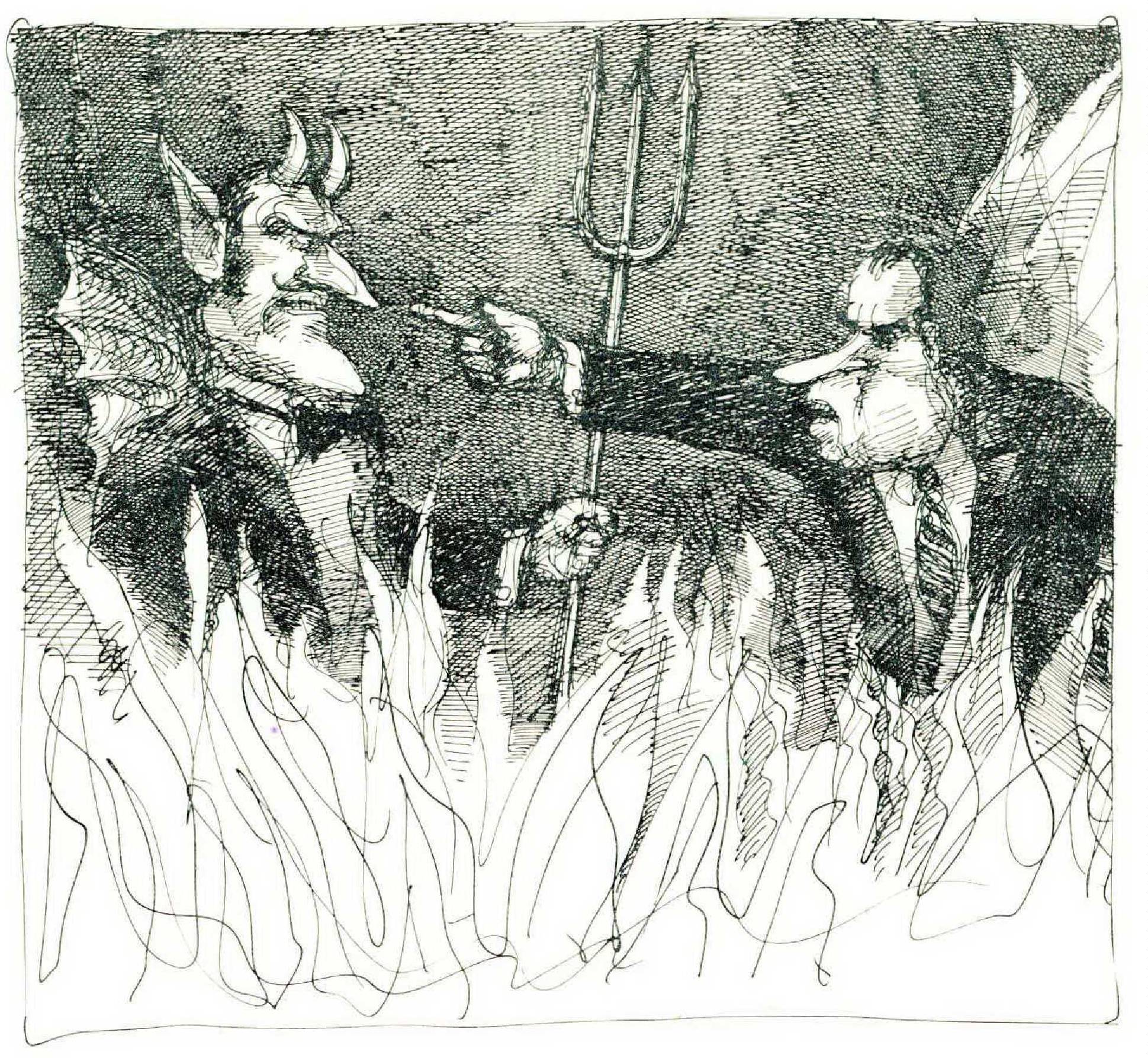
And in the very next chapter he’s alive and well anyway. In Hell, to be sure, but there he is debating the pants off Satan, whom he’s running against for Devil. I subtitle that last chapter “On the Comeback Trail” to suggest that you can’t hold a Trick E. Dixon down, even by stuffing him into a baggie and turning the twister seal.
Finally, to argue against the idea that I advocate political murder, there are the values in behalf of which the book is written.
Back in 1966, Max Hayward edited and translated a chilling and depressing document that he called On Trial. It was the transcript of the trial in Moscow of the Soviet writers Yuli Daniel and Andrei Sinyavsky, who were given fiveand seven-year sentences in a forced-labor camp for “slandering” the state in their literary works. I remember particularly Andrei Sinyavsky’s final plea to the judge, prior to the sentencing. Throughout the trial the judge had brutally chastised Sinyavsky for “lecturing the court on literature”—of all things—whenever the writer tried to explain his intentions in The Makepeace Experiment, a fantastic novel, or fable, in which (among other funny things) the people in a provincial Russian town eat toothpaste and think they’re dining on caviar because their leader tells them so. The judge didn’t want to hear about satire or fantasy or hyperbole or playfulness or humor or the make-believe aspect of literature; he didn’t want to hear any comparisons to Gogol or Pushkin or Mayakovsky—all he wanted to know was: “Why do you slander Lenin?” “Why do you slander the Russian people who suffered so in the war?” “Why do you play into the hands of our enemies in the West?” Yet, when the time came for Sinyavsky to speak his final words to the court—or to anyone in the outside world for a long, long time—he proceeded, with incredible determination, to say: “I want to repeat a few elementary arguments about the nature of literature. The most rudimentary thing about literature—it is here that one’s study of it begins—is that words are not deeds. . . .”
I hardly presume to compare myself with Andrei Sinyavsky, or my situation as a writer with his, or Daniel’s, in Russia. I am wholly in awe of writers like Sinyavsky and Daniel, of both their personal bravery and their uncompromising devotion and dedication to literature. To write in secrecy, to publish pseudonymously, to work in fear of the labor camp, to be despised, ridiculed, and insulted by the mass of writers who obediently turn out what they’re supposed to turn out—it would be presumptuous to imagine one’s art surviving in such a hostile environment, let alone oneself coming through with the dignity and self-possession displayed by Sinyavsky and Daniel at their trial.
I use the case of Sinyavsky because it is an extreme and horrifying example of the kind of “misunderstanding” one’s adversaries might wash to encourage in order to defame a work that makes fun of them. In other words, I am aware of the problem thatyou raise by your questions, and I don’t take it lightly. I expect some readers will miss the point, clear as it seems to me; there may even be public officials calling the work “seditious.” But all I can say to those who will fear for the President’s life is that they would do better to lobby for a strong federal guncontrol bill than to worry about the influence of Our Gang on potential assassins. Admittedly, it might be easier to get the Attorney General to push for a bill outlawing literature than for one making it impossible to buy a rifle through the mail for fifteen bucks, but the fact remains. more people are killed in this country every year by bullets than by satires.
Q: What is your purpose then in writing the chapter entitled “The Assassination of Tricky”?
A: Well, to me it seems so obvious what’s going on in that chapter that I feel uncomfortable having to explain it. . . . What’s revealed here, I hope in all its ridiculousness, is the discrepancy between official pieties and unpleasant truths. On the one hand, I have tens of thousands of people flocking to Washington to confess to assassinating President Trick E. Dixon, and on the other, the television commentators who persist in describing these selfavowed killers as though they were the mourners who crowded into Washington after President Kennedy was killed—or President Charisma, as he is called in the book. It really isn’t Nixon and his friends who are being mocked in this chapter so much as the platitudinous mentality of the media. (Pardon the Agnewesque rhetoric; I assure you there’s no similarity between the Vice President’s attitude toward TV and my own. That he should find this utterly conformist medium, these mammoth corporations like NBC and CBS, to be heretical and treasonous is a perfect measure of his powers of social observation.) Partly the point is that Tricky, living or dead, in the White House or in the grave, is unworthy of such tribute, but the joke in that chapter entitled “The Assassination of Tricky” is largely at the expense of network blindness. The implication is that the mass media are essentially purveyors of the Official Version of Reality, and for all their so-called “criticism” of the government, can be counted on, when the chips are down, to cloud the issue and miss the point.
Lastly, I think that chapter is concerned with the fine art of government lying, but then so is the entire book.
Q: Let me press you further on this chapter, “The Assassination of Tricky,” with a question that some people might want to raise about it. Won’t certain details in that chapter be particularly disturbing, if not repellent, to those who continue to grieve over the death by assassination of the two Kennedy brothers and Martin Luther King?
A:Grief is one thing, and sentimentality is something else. I would hope that even Mrs. Martin Luther King and Senator Edward Kennedy would agree that every time we allude to an act of criminal brutality, such as the murder of a national leader, it is not necessary to draw a long face and make pious testimony to our abhorrence of violence.
I think, really, what is “disturbing” about that chapter hasn’t to do with sorrow over the Kennedy brothers and Dr. King anyway, even if some readers are going to think what’s upsetting them is that I’m riding roughshod over that emotion. What is truly unsettling here, as in all serious literature that deals with murder, is the imaginative exploration of a violent fantasy. To give an extreme example; what could be more unsettling than reading Crime and Punishment? I recently assigned it to a literature class and found those students whose habit it is to read a novel straight through the day and the night before class in a state of anxiety and exhaustion that had to do with something more than just going without their sleep. Reading Crime and Punishment is a disgusting, if not repellent, experience, among other things; so is watching Othello. Even Synge’s Playboy of the Western World, which just toys with the theme of parricide, has been known to cause audiences in Ireland to riot.
In Our Gang, the farcical comedy seems to me to work to becalm such anxiety as is aroused in the reader by a parricidal (or, I suppose, regicidal) fantasy made “real.” It doesn’t dilute it as much as in a Bugs Bunny cartoon—where the violence is morally inconsequential because of the utter silliness of the situation—but there is a similar kind of relief felt, as a result of the comedy. However, simultaneous with the pleasure taken in the harmless, make-believe, sadistic fun, the reader of Our Gang can’t help remembering that Presidents of the United States have been assassinated and that it is within the realm of possibility for President Nixon to be assassinated too. So suddenly it’s not so funny after all-and, frankly, I think what is then most disturbing to the reader is that he has found himself enjoying a fantasy that he has known in reality to be terrible.
Now, if that chapter were to inspire only horror, or only pleasure, I would consider it a failure; its strength as satire seems to me dependent upon maintaining a certain gleeful uneasiness in the reader. After all, isn’t arousing contradictory emotions and challenging moral certainties a good part of what literature aspires to do?
Q: Do you think President Nixon will read Gang? You know, in Aristophanes’ comedy Knights, Cleon, the Athenian ruler at the time, is viciously ridiculed and mocked. He’s accused of war-profiteering, extortion, and political blackmail, and generally portrayed as degenerate and dishonest. He competes in the play against an offalmonger—today’s equivalent might be a garbageman—for the favor of the people of Athens, and when he loses, the offalmonger becomes the ruler and Cleon becomes an offalmonger, drinking water from the baths and brawling with whores. Yet Cleon came to the play himself as a spectator, and the state awarded Knights a first prize in the contest for which it had been written and produced.
A: Well, I don’t imagine Cleon was thrilled by what he saw. . . . FDR used to enjoy the Gridiron Club parodies of himself presented by members of the Washington press corps—or he was clever enough to pretend to enjoy them. But funny as those Gridiron Club parodies can be, they don’t cut deep in the ways that Aristophanes does. Cleon’s presence at the performance of Knights only proves what we already know: there never has been and, from all indications, won’t be again, anything to equal the political sanity and sophistication of Athens in the fifth century B.C.—Aristophanes’ own complaints about the place notwithstanding.
(By the way, I read an editorial in the New York Times recently, deploring the latest prohibitions against freedom of the press invoked by the current Greek government. The editorial noted that among the writers who could not have met these stringent government requirements was Aristophanes. Of course, it was entirely in character for the Times to strike a high cultural note on the editorial page with A Great Name Out of the Remote Past, but somewhat comical if you remembered that only a few years back, they ran another editorial castigating writers like Barbara Garson, whose satire on Lyndon Johnson, Macbird, is the closest thing we’ve had in America—whatever its literary shortcomings—to political satire in the brutal and impious manner of Aristophanes.)
In the best of all possible nations, I imagine the ruler would choose to attend a festival of satiric comedies, commissioned by his own office to be written to ridicule his pretensions and expose his weaknesses; that’s what the leader of the best of all possible nations would do, along with throwing out the first ball at the beginning of each baseball season. I read where Mr. Nixon recently made a trip to Canto,. Ohio, to celebrate the induction of Y. A. Tittle into the football Hall of Fame there. Probably there was an antiwar demonstration going on in Washington at the time, and so he had to hotfoot it out of town, but one would hope that just such religious devotion as our President has to professional sports, the leader of a utopian democracy would have for ruthless satire.
Again, I‘m not arguing that attendance at these satiric performances would necessarily affect the leader’s policies or his character. Watching Aristophanes’ Knights didn’t change Cleon any, and Lysistrata didn’t end the Peloponnesian Wars and save Athens from disaster. Something R. P. Blackmur wrote, in a different context, may help explain what I think might be derived from getting the Cleons go to see themselves mocked. Blackmur said: “The true business of literature, as of all intellect, critical or creative, is to remind the powers that be, simple and corrupt as they are, of the turbulence they have to control.”
From a political point of view, it isn’t what Aristophanes said about Cleon that mattered, but that he demonstrated such things could be said in that circumstance: “right in the Führer’s face,” as they sang in The Great Dictator. Though I’ve described political satire as essentially a literary act, I will say that there is something appealing to me about its defiant side. More so by far than its instructional or didactic function. After all, who doesn’t know that Nixon’s a fraud? So what else is new? But to make indecorous, vituperative comic art that announces that fact with all the gall you can command is to demonstrate that there is a world of feeling and ideas and values that remains unimpressed by the Official Version of Reality. Frustrated as we are in the face of governmental treachery and stupidity and heartlessness, we still have the right to hate our governors for the deeds they perpetrate in our name and at our expense—better, the freedom to hate, the freedom to be contemptuous, disgusted, and outraged. Political satire is to the freedom to hate what churchgoing is to the freedom of religion. Now, making satire may not be what Jefferson or Madison had in mind by “liberty,” but it’s nothing to sneeze at: nobody in 1984 goes around ridiculing Big Brother.^