Notes on Corporate Man
by Richard Todd
Are you “making your age”? If so, you’re paying a price.
1
Some of the men are on the floor on their hands and knees, and others are standing around them. The men on the floor are pushing small toy cars. The cars are yellow. Silence as a car is pushed. The men are mostly in their thirties, dressed in nylon and knitwear, as if for golf; most have incomes of over $25,000 a year. No one is smiling. But when one of the toy cars rolls more than eight feet, there are whoops of pleasure and rich applause. Not at all clear what’s happening, if you are walking in on this scene, but one thing you cannot miss is the intensity of it all; heads and innards, we’re wholly absorbed.
I am in the ring of cheering men, and this is the midpoint of my week at Osage House, a “resort motel” on the shore of the Lake of the Ozarks in Missouri, site of an Executive Development Laboratory. The experience usually goes under the name “sensitivity training”—it’s designed not for random citizens or the avowedly disturbed but for business executives, in this case middle managers, an elusive term itself (“At my place it’s somebody who’s making at least thirty,” one participant says). Not a manager of any kind, I am here as an observer; but under the rules of sensitivity training, observers also participate.
The session, one of several conducted around the country by the National Training Laboratories (NTL), aims to open men to new styles of management, new modes of behavior. “Competition and status is bred into these men,” one of the NTL associates remarks, “and we try to show them there’s a different way.” Another says, “They come here as managers who are also people, and hopefully they leave as managers in search of the people they are.”
As is appropriate to the corporate nature of things, some organizational structure needs to be explained. We are divided into two groups. Phase I (mine) contains about twenty men who have come to sensitivity training for the first time. The Phase II men are veterans of a session held six months earlier. The first night, in the motel dining room, you might be able to tell the difference. Most people are still talking, with the odd courtliness of corporate men, about home. “Do you know Darrell Welles? Don Lazer? . . . I’m in IBM Valley, but not in Armonk. Armonk’s Mecca . . . . I have a cockapoo: it’s a cross between a cocker and a poodle. . . . But Phase II talk occasionally strikes a new note, suggests that something unusual lies ahead: “I used to be perceived as very threatful . . . I thought interpersonal relations were a luxury; now I realize they’re pivotal. . . . This has changed my life. . . .”
The experience turns on two sorts of activities: “Tgroups,” in which the participants simply confront one another and speak of their response to the situation and to each other; and mock business competitions, in which they form model companies and enact the industrial process. Our group is directed by a “trainer,” Herb, a small man with leonine gray hair, a meerschaum pipe, a slow, noncommitted, elegantly deep voice that lends extraverbal weight to his guidance: “This is, uh, just a suggestion, but one thing we’ve found is that it, uh, helps to concentrate on the here and now.” We paw the ground, uncertain what to expect or to do. Mike, a tall, ruddy man with short blond hair, moves his gaze about the room and regards every speaker—a motion that appears to be made of tiny individual movements that are barely invisible—as if he were an artillery piece scanning the sky smoothly but only by dint of the furious efforts of a gun crew spinning wheels beneath him. His voice rises and falls in carefully formed syllables, a remarkable. automated sound.
“Someone has used the word artificial about me. I’m looking for further input. How can you help me here?” (He is told that it’s hard to imagine him losing his temper, but that the temper seems somewhere to exist. Mike says: “I believe that a temper is a luxury a manager can’t afford.”) We gaze out the window to the miniature motor yachts that riffle the surface of the silted lake.
It is two days into the laboratory before a certain intense purity seems to overtake us: the occasion is the beginning of the competition; our T-group becomes a company, Cohesion, Inc. We’ll be competing with the other T-group, manufacturing and selling mock products. I hadn’t understood the seriousness with which this would be taken. First task was to choose a president, and I had incorrectly expected some foot-shuffling and demurrals.
The exercise began with a twenty-minute period in which all communication was written. At the end, I received such notes as these: “I think I can offer some guidance to our group as your spokesman. Will you support me?” . . . “Let’s consider Tom for president—team man, good communicator—forceful, can delegate. Production-oriented. What we need to win.”
Tom, the team man, was our ultimate choice: a man of about thirty-one who is in his real life a “production supervisor” in a printing operation; he is in charge of a thousand men.
Next, to work. We are to manufacture—out of paper, paste, pipe cleaners, colored yarn—products for the “youth market.” We buy the materials from “the store,”sell the products in “the marketplace”—both of these functions performed by the trainers, men from NTL. The company with the most sales at the end of the morning wins. Moments after the competition is announced, Tom addresses us. Improbably, a flush colors his neck, and his voice strains, his syntax is mildly garbled: “All right, now Fred will run through the marketing situation, and after Fred is finished running, let’s all put on our creative caps and get a product out. . . .”
Sadly, chaos overtakes Cohesion; it is more than an hour before we produce our first prototype, a paper medallion with pipe-cleaner peace sign. Our competitors have beaten us to the punch; men with similar medallions decorating their golf shirts are now strolling at poolside. Eventually we sell some medallions and some posters with slogans on them. Our president is the creative energizer: “How about ‘Love is Green’? It’s got love, it’s got ecology.” Fred, the marketing man, who is starkly bald and has perfect teeth and a constant wry smile, sells with some energy: “This"—holding up a frail paper sculpture— “is the finest product in our company’s history.” But we are beaten badly.
“We had too many philosophers.”
“We spent too much time groping initially.”
“We were too cerebral.”
“We didn’t make a commitment to win.”
(From Tom) “I thought I could pull this group together, but I blew it.”
By the evening following the game, our mood has turned toward a renewed urge for victory. (“Well, how are we going to whip their ass tomorrow?”) But at this moment we discover that the rules have changed. A group of strangers appear in our motel room. They are men of Phase II. They announce that a “merger” is about to occur. The Phase II people have been observing us these past few days; for purposes of “feedback,” we felt, but now we learn that they had additional motives.
The “take-over” exercise (this thought must appear in some corner of every mind) is one of the National Training Laboratories’ cleverest devices, though it is a bit hard to follow. Under the rules, each of the Phase I groups must be split up; how they are divided is up to the Phase II people. “At Winco,” our visitors say, “we believe in participative management; we believe in it because we think it’s the way to win. ” Our group is told to decide ourselves how we’ll divide; but first we are told the choices of our visitors. (A true pang: I am not among them.) Elsewhere in the motel—we learn later—the rival corporation, Penta, has chosen a more ingenious method: they tell their mergees that it seems important only that the change be comfortable for everyone; why not just divide into pairs of compatible people, and Penta will choose among these two-man teams. (Ah, but—this too will emerge later—Penta was covertly choosing, through this pairing device, the people they wanted.)
At length, I am among Penta’s new employees, and the welcome we receive into this new part of mock corporate life is a marvelous thing. Met outside the door; a rapid series of handshakes, exclamations of disbelief over those of us who were “let go.” (“Just the people we would have chosen! Fantastic!”) It occurs to me that I have not had such a warm welcome anywhere since I joined the Phi Alpha Psi fraternity, and it is not a dissimilar situation: the same sense of being loved by people who don’t know you. We settle down to a meeting in a neatly arranged circle of chairs.
Penta’s president, Steve, is a man of about thirtyfive, who in the real world is new products manager of a pharmaceutical firm. (A realization; we tend to think of the Phase II people as older; they are not, but they are our seniors.) Steve is a dark-haired fellow with a thick, low voice and a habitual hand in his pocket: when he was growing up in the fifties he must have earned the longed-for accolade “casual.” (Perhaps not; his face is scarred by adolescent acne. Now it gives him a winning vulnerability.)
He commands the meeting with an impressive consensus-building style. “Everything is open to discussion. I’m assuming that we all are relatively taskoriented and that we want to win. and we want to make team objectives compatible with individual objectives. . .” We easily slip into our roles (“Don’t solve our problem if it doesn’t solve your problem . . . . I hear you saying . . . We need a QC man. . . . Need a communications coordinator”).
The next day begins with a “working breakfast” at seven thirty for the men of Penta, which serves to reinforce the spirit of the night before. At eight thirty we learn that the competition today involves automobiles: sedans, self-powered models, “jalopies,” “dune buggies,” “drag racers” are being bought by the marketplace; the available materials are rubber bands, paper, plastic wheel and axle assemblies. Not two minutes after the game is announced scissors are flying. Assigned to a “creative” post. I am suffering, unable to think of a way to make paper into a plausible automobile body. (Meanwhile, breakthroughs: “I’ve solved the axle friction problem.” “That’s great.”)
I am rescued by a fresh assignment. The marketplace has invited a statement of the company’s policy on pollution control and minority employment, opportunities for women. The president asks me to undertake “this pollution thing.” A remarkable quiet descends on the room. In a few minutes we have a prototype sedan six inches long. A “test driver” is dispatched to the marketplace. Moments later he returns with a lambent face. We have an order. 1 warm to the job of creating our social policy: we will begin spending our R and D money on mass transit products; will build a factory and training center in the Mississippi Delta, day-care centers, a pilot experiment in the purely democratic factory. . . . I believe in these projects with a ghastly conviction.
The excitement occurs in the final minutes of the game. Judging of the last-minute entries will decide the contest; each company has sold a fleet of sedans. We cluster about the proving ground. Men on their hands and knees with murderous intent pushing the models. Our yellow dragster rolls in a straight line the requisite eight feet and beyond. The opposition’s entry veers off course. Penta wins going away. Our entries take the top dollar. My social statement wins a prize of $13.50. There is a burst of denuding applause. My president’s hand on my shoulder: “It was our biggest sale all day.”
Afterward, pre-lunch drinks with my president and others in someone’s motel room.
“I couldn’t sleep last night.”
“You either?”
“We won it.”
“We won it last night.”
“You did a great job, Steve.”
“We all did a great job.”
“It was a team-building exercise and we built a great team.”
“The take-over plan was brilliant.”
“It worked all right, didn’t it?”
“Brilliant.”
And we go off to lunch in a mild ecstasy of victory and Canadian Club.
And now it is Tuesday evening, twenty-four hours since the formation of the Penta company, and about eight hours since its success. We are discussing our individual contributions, providing “feedback” for one another on our performance. But a kind of malaise has crept over the room.
Linda, the sole woman, finally says, in a voice that edges on hysteria, “I don’t like what’s going on here. I’m not comfortable with this. I don’t like this at all.”
She will not say what upsets her, but the subject fluttering in and out of our conversation is the “take-over” of the night before: How were the people really chosen? Someone observes that they seem to be the most reticent, easygoing of the group.
“If I were the people you’re talking about, I’d resent the hell out of this,” Steve says.
Someone says, “Are you speaking about them or you?” (Curious things are happening to voices; they crack and falter.)
“We have a good team here and now it’s being torn apart and I don’t like it.”
“Who are you?” someone asks Steve. “Still president?”
And Steve says, “Yes.”
I cannot say what has happened to Steve’s face: it is blank, ruined. The word “manipulation” appears, and Steve and a couple of others are further angered by it. What is going on here? How can we conceivably be so concerned?
Corrective images come to mind: the toy cars. Balance that against the surety that not ten miles from here some pure misery exists—this is all a game. But about now, to my surprise and dismay, I look down and see that the top of my pen is wavering slightly, am alarmed a moment later to hear that my own voice is unsure. What I say is mild enough, that there’s an “interesting” question on the floor, can’t see why we don’t discuss it.
A “moral” question is what I felt—still do. It is an infinitesimal. Jamesian moment, and a make-believe setting, and yet it is possible to apprehend the truth — that our institutions, our teams, issue us feelings as relentlessly as a supply sergeant hands out boots. But there is no way of talking about it tonight.
A day later, I speak to Steve. His face has not recovered. I ask him how he feels about our session. He says, “I still don’t see it. It’s just what happens in the real world every day; you’re just buying people.”
The competitions ended, we experience a day of Tgrouping and “feedback” in small groups. We share our evaluations of one another on personal rating forms. It is all lulling, bathlike, surprisingly untedious: what one participant calls “a reverie of feedback.”
At the close, we meet as a group in the “ballroom” sitting around in a circle of folding chairs. The leader of the session asks for names of others who we think might profit from sensitivity training. A sheet of paper is passed. This seems to violate the mood, which is extraordinary, unstated, but nearly universal good will. The leader of the laboratory asks if anyone has anything to say.
A silence. Across the room is Tom (my first president); his face is disorganized by a distant smile. All of our faces seem softened. The effect is that the men look like boys. At length a voice:
“I’ll give you one word: Fan-tastic.”
(From the opposite side of the circle) “Wonderful.”
“Flyin’ high.”
“Thank you.”
“I’ll echo that: thank you.”
“Thank you.”
“Thank you.”
Then handshakes, shoulder pats, and we disperse across the green country in planes.
2
Loratory training is a way (just one) in which members of the corporate upper middle class edge toward a confrontation with the meaning of their work. It’s a question born of luxury, of course (airplanes, motels, New York sirloins), but not trivial: where the managers are, others long to be, and will be—upward bound in the organization.
A corporate manager in 1971 lives in a peculiar, contradictory web of cultural circumstance. Until recently, the expanding economy, the generous corporations were providing unheard-of sums of money, and the money counts; a mark of corporate success now, at least for young men, is to “make your age,” that is, to earn a salary in thousands of dollars equal to your age in years. Thirty-two is felt to be a nice moment at which to hit this stride. I am standing in a crowded singles bar in Minneapolis, talking with two thirtyish executives. We’re discussing what gets lost, what sacrifices you make in the corporate struggle. “Well, sensitivity,” one of them says. “You lose your sensitivity toward other people. That’s not necessarily bad in business. Put it another way: you develop a selective sensitivity.”A thought with murky implications. A moment later he brightens. “When can you expect to make your age in your field?" he asks, and adds, “We talk a lot about that.”
Despite the largesse of the companies, it was not news that the economy had a back to its hand. According to one estimate, unemployment among men earning more than $25,000 a year reached 11 percent in 1971; and mimeoed announcements of “early retirement” proliferate in the interoffice mail. The coolness with which the benevolent corporation can “terminate” is, for those who watch it, who feel the passing shadow, a thing of wonder. The sales manager said: “I flew to a sales conference one day with a guy who 1 always thought had it made. He was a distinguished-looking, Walter Cronkite sort of guy. On the way he said, just mentioned calmly, that he thought he was in trouble with the company. I couldn’t believe it. Later—it was in New Orleans—I was standing with him at the cocktail party, and the president came up. The president said, ‘Bill, how is everything, how’s your wife?' Bill said she’d been ill but was entirely recovered. ‘And you, Bill?’ Bill said he was feeling fine. ‘Well, I’ve been wondering if you wouldn’t want to have some time to just sit on the beach and get some rest.’ Bill said no, he was happier at work. ‘Well, real fine. Bill,’ the president said, ‘I’ll have someone put the numbers together and fly out to see you.’ The president left, and Bill turned to me and said, ‘Well, I’ve just been fired
Awesome, unthinkable to lose your job: but contrarily every voice outside the corporation seems to be saying, drop out. Fifteen years ago, to work in the corporate setting was to risk only being called a “conformist,” an “Organization Man.” (And the accusation was laced with self-congratulation; the society, discovering that it was rich, had the headaches of success.) All changed now: the easily available indictments are stiffer. Dip into the literature of the other culture, and the message confronts you at once. You exist in something called the “technocracy.” Theodore Roszak in The Making of a Counter Culture says:
By technocracy, I mean that social form in which industrial society reaches the peak of its organizational integration. It is the ideal men usually have in mind when they speak of modernizing, up-dating, rationalizing, planning. . . . So we arrive at the era of social engineering in which entrepreneurial talent broadens its province to orchestrate the total human context which surrounds the industrial complex. Politics, education, leisure, entertainment, culture as a whole, the unconscious drives, and even protest against the technocracy itself: all these become the subjects of purely technical scrutiny and of purely technical manipulation.
The passage is surely unfair, assigns monolithic motives, forgets the existence of troubled or ironic minds within the “technocracy.” ”What do you do?” the engineer is asked. “I live in a big wooden box, get into a tin box, and go make little black boxes. ” But the indictment goes on. In a word, work is meaningless, competition hateful, gain empty. Charles Reich in The Greening of America remarks, as if it’s obvious:
American society no longer has any viable concept of work. A Father’s Day ad for corduroy slacks says: “For a man’s happiest hours”—meaning, for the hours when he is not at work. We are no longer expected to find work happy or satisfying. There is, for example, no advertising designed to create pride in craftsmanship or in a worker’s self-discipline. Nor is anyone convinced that he should work for the good of the community. Instead the belief is created that one works only for money and status. This puts a heavy burden on money and status, a burden they are no longer able to carry.
On the television and in the papers in spring, young Henry Adams, Harvard ‘71, enjoyed a brief run: in the news because he was a descendant of the Colonial Adamses and because he spurned traditional work, was not going to be a lawyer or a scholar but a craftsman, a worker in stained glass. Others in the class aspired to be carpenters, subsistence farmers, taxi drivers. Some 20 percent had no plans at all. Kingman Brewster won the assent of incoming freshmen by remarking that they no longer wanted the “success” for which their education traditionally prepared them. All a social class phenomenon, it can be argued: the whims of children of privilege. Peter and Brigitte Berger, sociologists, suggest that what’s happening is not the greening but the “blueing” of America; that is, the children of the blue-collar workers will rise in ever greater numbers to fill the jobs the upper-middleclass child disdains. But then, if you are among the corporate-ascendant, it is your children who are the likeliest dropouts. The internal litany that has dignified the worst and best of work— My son won’t have to do this. He’ll have an education. He’ll move a rung up the ladder. His son will climb higher—who can have confidence in that now? The progress of generations is too easily shortcircuited.
On the airlines, so recently a sanctuary of homogeneity, the street people are traveling youth fare, and their mild, parodic gaze turns on you, their costume makes a costume of your clothes. The emblems of class affiliation count for less. In the ranks below you, the bookkeepers, office personnel (no longer content with the faint dignity that the white collar confers) are reported festering with the discontent of labor. A Harvard Business Review article cites a marked rise, since 1966, in dissatisfaction among clerical workers, warns that they are “ripe for unionization.”
This much is plain, surely: the cultural situation is stealing away the sanctity of work. And yet—not really a contradiction at all—this means merely that we expect not less but more from work. For those in “the system” (which is only a subsystem in the tangled, confused society), it—work—is the dispenser of identity; it has the power to give meaning to your life or take it away. What do the system’s beneficiaries, its managers, want from their work? A stopping question, one might think. But if you ask it of managers, you are likely to discover that a ready (if not a satisfying) response exists. “Well, first of all, your compensation, your remuneration, and responsibility. And beyond that, there’s the most important thing: growth. Self-actualization.” It is an answer with a history.
3
While the quantifiable side of business has recently undergone considerable sophistication—with systems analysis, decision theory. Bayesian math—so has what is commonly called “the human side.” In 1899 (a moment to mark the beginning of formalized ideas of management) a man named Taylor taught a man named Schmidt how to do his job, which was shoveling pig iron, with such efficiency that he could increase the amount of pig iron he shoveled in a day from twelve to fortyseven tons. As Daniel Bell recounts in his book, Work and its Discontents, Frederick Taylor’s timeand-motion studies were joined by others; Frank Gilbreth thought he had broken down the physical motions of work into their basic components, which he named anagrammatically “therbligs.” The phrase “wasted motion” appeared in the language, and everywhere one looked, more work could he done with less effort, surely to the universal good. People began to speak knowingly of “scientific management,” but it was not long before a certain popular horror also sprang up: dismay at the stark vision of industrial man that “efficiency” implied.
Within the field of business administration, the first strong reaction to the Taylor view occurred in the form of studies by Elton Mayo of the Harvard Business School at a Western Electric factory in Hawthorne, Illinois. With one group of factory workers, Mayo improved the physical environment to promote efficiency; a control group was aware of the changes but did not benefit from them. Oddly, the control group increased its productivity in step with the experimental group. The poignant lesson seemed to be that the sheer attention paid the subjects of the experiment had as much effect as did material improvement of their lot. The Hawthorne project revealed in scores of ways the importance of camaraderie, pride in craftsmanship—in short, a sense of significance, which was often defeated by putatively efficient planning.
The Mayo view embodies certain plain attractions over the Taylor one, but there’s nevertheless a rub. If happiness is what is required for production, then let’s make them happy; so the “enlightened” manager might reason, an upside-down moral stance at best. For C. Wright Mills (and others), this was the characteristic fact of modern industry: it conditions the employee to accept what is inherently unacceptable. In White Collar, Mills wrote: “Many whips are inside men, who do not know how they got there, or indeed that they are there. In the movement from authority to manipulation, power shifts from the visible to the invisible, from the known to the anonymous. And with rising material standards, exploitation becomes less material and more psychological.”
Something hollow about this argument when it’s applied to management-labor relations: there’s little doubt that the needs of production take precedence over the inner lives of the worker, and little credibility to the idea that “conditioning” is successful. But the argument assumes a different cast when you consider management’s relationships with itself. (Although the labor-management division is central to the social experience of the country, it’s hard to think that it occupies the minds of most executives: most managers manage other managers.) The assumption in the Mayo studies, that meeting the needs of the employee meets the needs of the organization, is at the center of the subsequent literature of management.
One system of interpreting managerial styles provides a visual device: the “Managerial Grid.” One axis of the grid represents “output,” the other “people.” Each has values from 1 to 9. The manager ranks himself (or is ranked) on these axes according to how important each factor is to him; the resulting coordinates provide a way of talking about his managerial character. So for a time (now passed) it was fashionable among executives to say such things as “I’m a 9,1 manager” or “I’m a 9,9 manager.” In point of fact, given the choice, most managers would call themselves “9,9,” which means oriented toward both people and production. To state this choice is in some way to make it. And the great tendency in the literature of management is toward “peopleorientation,” toward an ever-heightened awareness of humanistic values always in the faith that you could “get the job done better” that way. Authoritarianism, hierarchy, a single-minded concern with the observable performance of the employee—these have yielded (in theory) to increased participation, “teamwork,” a concern for the employee’s happiness.
There are a couple of documents that most managers who intellectualize their roles will have read, landmarks in this optimistic progression. One is A.H. Maslow’s “A Theory of Motivation,” which was published in 1943. Maslow spoke of a “hierarchy of human needs,” which ascends from the primitive (shelter, food) to “social needs” (a sense of belonging) and “ego needs” (self-esteem), culminating in the “needs of self-actualization.” He remarked that it is in the nature of human beings to long for the fulfillment of ever-more abstruse needs with equal intensity: “What a man can be, he must be.”
In 1957, Douglas McGregor, a behavioral theorist who had been a president of Antioch College, published a book called The Human Side of Enterprise, whose ideas built upon and complemented Maslow’s. McGregor used the concept of the need-hierarchy to suggest that companies could not rely on “satisfied needs” to motivate their employees. For example, it was unreasonable to expect that a man earning what he himself considered a generous salary would be moved to continual hard work on account of it; the salary might be necessary, but it was not sufficient.
In several conversations with managers, I asked in various ways how important money was among the rewards of their jobs. “Money” is a word that managers on the whole avoid; if they are not being specific—“25K”—they tend to say “remuneration.” “Really I think remuneration is a de-motivator,” I was told. The response, though delivered with spontaneity, comes straight out of McGregor.
McGregor suggested that there were two grand rationales for the managerial role, which he called Theory X and Theory Y. Theory X, rooted ultimately in some dour views of human nature, held that a manager must control his subordinates, motivate them through fear. According to McGregor, Theory X was the style that dominated business, whereas more productive results could be obtained through Theory Y. Theory Y, unsurprisingly, takes into account the “higher needs.” It argues that the manager’s job is to lead subordinates toward greater self-development, which in turn will mean greater productivity. McGregor urged managers “to arrange organizational conditions and methods of operation so that people can achieve their own goals best by directing their own efforts toward organizational objectives.” That sentence is close to the essence of contemporary managerial style. It is believed and repeated. “The concept of providing an enriching and self-fulfilling environment for our people to work and grow is our goal at Xerox,” a member of the company’s corporate staff said. And it is not at all uncommon for a man to say of himself, “I guess you could call me a Theory Y manager.”
The theories proliferate and yield systems of management. The one that currently prevails among large American organizations goes under the phrase “management by objectives.” Under “management by objectives,” managers and their superiors and subordinates up and down the corporate hierarchy meet to “discuss their goals.” Broad company-wide goals come from above, but individuals also are expected to propose what they themselves intend to accomplish. The objectives, large and small, are then meshed into a presumably coherent plan.
In the past few years, management philosophizing has turned away somewhat from theories of individual motivation toward techniques of team-building. The effort is to change organization structures in a way that facilitates personal growth. “Organization Development” (or OD, as this movement is also called) stresses “interpersonal skills.” “group membership competence,” and works ideally toward the achievement of an organization where form follows function: teams coalesce around a project; they break up when the job is done; expertise is drafted from all over the organization without regard to formal hierarchies. (OD lends itself to companies such as management consulting and advanced technology firms, where projects are highly complex and continually changing, and where a great number of people with varied skills in fact exist on the same hierarchical level. That is a practical reason for the existence of OD: interesting also, though, that its principles dimly echo the concerns of the general culture. Whereas fifteen years ago, popular critics such as William H. Whyte and David Riesman lamented the submersion of the individual in the group, we today characteristically hunger for “a sense of community.”)
The good done by these experiments in managerial practice shouldn’t be lightly considered. To appreciate it you have to appreciate the rigidity of the bureaucratic norm. (About a place where OD has been successfully applied, it’s said with some wonder, “At TRW systems, with only some minor exceptions, middleand top-level executives as well as key scientists and engineers are typically available for consultation with anyone in the organization on matters of functional relevance to the organization. There is no need . . . to obtain permission for the consultation from one’s boss.”) And it’s necessary, too, to think of the fear, the silent throes of uncertainty with which life in a tightly structured organization is sometimes lived. “It’s sad,” the management consultant said. “Sometimes I wish I were a novelist, when I see what these people go through. It’s not uncommon to have men hiding in a stall in the men’s room, with their feet up off the ground, hoping to overhear someone talking about them. ”
And yet there is something troublesome about these hopeful ventures toward “self-actualization.” Consider, for instance, the GO (Growth Opportunity) Plan, an organizational scheme that makes growth itself the explicit subject of team play:
. . . it is recommended that each functional head initiate Growth Teams with his group on a voluntary basis. A Growth Team is composed of: 1) a key man who wishes to develop, 2) the supervisor of that key man, 3) the manager over that supervisor if feasible, plus another manager (or managers) on the same or higher level as the supervisor who are well acquainted with the key man and his activities. The Growth Team can also include a peer of the individual if he feels strongly about the contribution the person will make. A coach from the company’s management development staff should also be included.
Or, dwell on the future organization wholly liberated from hierarchy. Here one organizational expert (Chris Argyris) recounts the vision of another (Jay Forrester):
If we may extrapolate the probable matrix organization of the future, Forrester suggests that the organization will eventually eliminate the superior-subordinate relationship and substitute for it the individual self-discipline arising from self-interest created by a competitive market mechanism within the system. The individual would negotiate continuously changing relationships. Each individual would be a profit center whose objective would be to produce the most value for the least activity; who would have the freedom to terminate as well as to create new activity, who would have access to all the necessary information. The organization of the future would be rid of internal monopolies which is the usual status of most traditional departments.
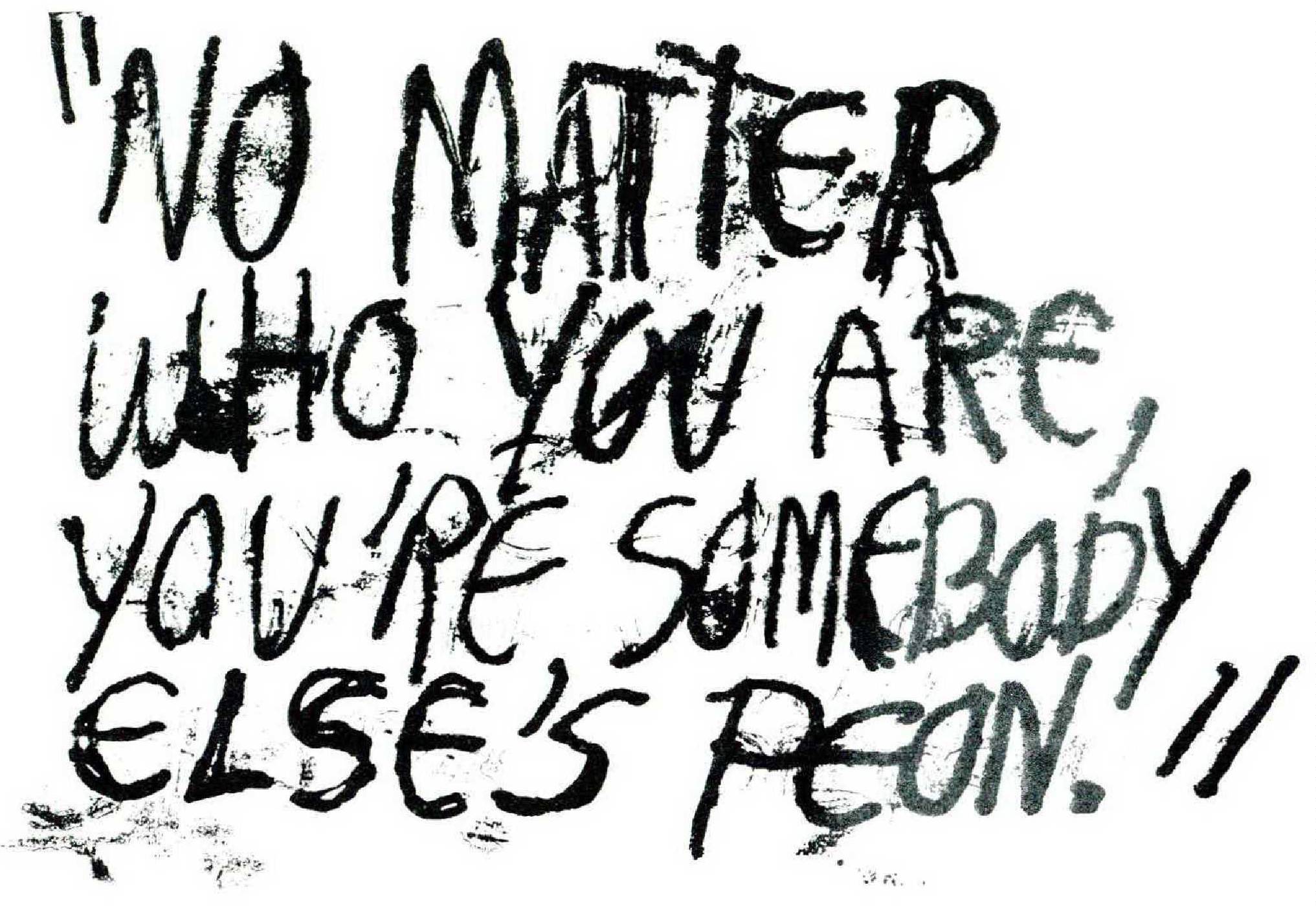
Surely we are entitled to some skepticism here. The hollowness, the mechanicality of the talk. The trouble, one might say, derives from the presumed disinterest, the scientific air: management theory is in service of something distinct from inquiry; it’s in the service of management. Tempting to see it all as just a skillful form of manipulation. But that is, no doubt, too easy. “If it were just deceit,” said a skeptical engineer, ”it wouldn’t be so bad somehow. But they believe in this stuff. You have to believe in it, and the higher you go the more you have to believe, because otherwise you’d have to face the truth.” “Which is?” “Well, ob-viously: that no matter who you are, you’re somebody else’s peon.”
Vague, pompous, the rhetoric of management development seems often to ask to be forgotten, but it’s probably a mistake to treat it dismissively. There is, after all, a theme continually sounded: attending to human needs solves corporate problems . . . attending to corporate needs solves human problems . . . what you can be, you must be: under this roof. People heed this message, men truly do participate in “growth teams.” And, in the simplicity and piety, some things of worth get obscured. You listen in vain, for instance, for acknowledgment of the moral ambiguity implicit in reconciling the needs of human beings and the needs of their offices. So much is promised, nothing less than selfhood; and the extravagance of the promise trivializes the very idea of self. Among other things, what is forgotten is the absolute interdependence of self and others, the way in which human growth depends not on the conscientious honing of the personality, or on immersion in the “team,” but on the crucial, infinitely complex relationship between a single identity and those that surround it. Benjamin DeMott has said this with force (while suggesting that the poverty of our sense of growth stretches beyond the corporation, is culture-wide):
The nation prates of self-realization, and rests in near obliviousness that my humanness depends on my capacity and my desire to make real to myself the inward life, the subjective reality, of the lives that are lived beyond me. The nation . . . possesses little knowledge, if any, of the steps by which the human being becomes itself, the separate, private acts of imagination on which the achievement of personhood depends.
You don’t have to spend much time in the interior of a large contemporary organization to realize that such concepts as Organization Development are only a fragile handle on what occurs there. But they are emblems of the peculiar situation in which this army of men finds itself, abstracted to a great degree from the nominal function of the organization, existing in the middle of a seemingly infinite chain of command, managing, but being managed, and longing for a dignified rationale for work, the center of which is too often the continual sophistication of styles of obeying, and of commanding obedience.
4
Picture a bail-point pen. It is unusual, made not of plastic but wood, with gold ornamentation; the wood has come from an exotic jungle tree—rosewood, I think, or teak. The pen is held before your eyes between the thumb and index finger of a man whose firm produces it. He complains of things that have gone wrong. The pen, an expensive item, twenty or twenty-five dollars, isn’t selling; the plant is idle. “The marketing guys blew it. Now my people are stuffing envelopes.” He’s explaining to me the importance of “communications” and “teamwork.”
But the pen itself has caught your interest. What about the pen: how does he feel about the thing; should it have been made? He says that you have misunderstood. The pen is just an example. “The product is irrelevant.”
Lunch at a Midwestern country club. Across the linen tablecloth, a marketing man, about thirty-five, with responsibility for several food products. “I have a friend who asks me, after a couple these,” he nods toward a martini, “ ’How can you devote your life to selling cereal?’ Well, it’s a real question. But we have bright people here who can talk about anything: books (my favorite author is Norman Mailer), politics. If I’m interviewing somebody for a job, I ask him, ‘Who’s the senior senator from Mississippi?' And there is family, community. Your life goes out in concentric circles, like a stone dropped in a pond, and . . .” Stopping, he seems, we both seem, to hear the accuracy of this old image: the emptiness where the stone drops, at the center of the circles.
It is curious how far one can read in the literature of management, or even in criticism of the corporate existence, and how long one can talk to managers, without really hearing about a product. Distanced from the end of his labor, an end that is in itself often trivial or something more ominous than trivial, the manager finds it appropriate to think of himself in terms of role, not function, as A Manager, not as someone who assists in the manufacture of this or that.
There are over 8000 items in the average supermarket; our arsenals of cosmetics, our weaponry shelves are famous: in how many products might a man find the merest symbolic concomitant to his dignity and worth? To how many products may a man even feel close?
The price of sophisticated production is that the fragmentation of jobs moves upward from the assembly line; it’s not at all uncommon now for a man to hold a Ph.D., earn $30,000 a year, and speak of “my boss’s boss’s boss’s boss.” On top-secret projects engineers are forbidden to talk to the man in the next office about what they’re doing, or even to know the nature of the whole project of which they are designing a part.
But the mind has a strategy to deal with the corporate situation: it uses its talent for abstraction. In the organization one likes to speak metaphorically about scenes of greater glory: empires, stadia, the forest and the jungle. A writer and executive named Antony Jay. in his new book Corporation Man, explains that the key to understanding life in the corporation lies with prehistoric man: we all in our genes long to participate in what Jay calls the “ten-group,” a small, closely knit team of men that derives from ancient hunting bands. An electronics industry executive recently in the New York Times described his ideal associates: “guys who are tigers, who approach their jobs like tigers on the prowl. Hungry guys, motivated guys. The kind of guy who’d be a great executive or inventive scientist because he has to prove something to himself or his wife. These are the guys I want working for me.”
A psychoanalyst named Michael Maccoby. studying managers in technological industries, has reported to the Harvard Program on Technology and Society that he sees the emergence of a certain new “social character” in these firms on the leading edge of corporate change. (The term “social character” is originally Erich Fromm’s, meaning the sort of ideal personality that a society encourages and values; the main determinant is the society’s mode of work.) Its elements, in Maccoby’s view, include a meticulously controlled aggression, flexibility, detachment, fairness, coolness under stress, an aptitude for teamwork, and—transcendently—an ability to see and feel in competitive terms and to experience the continued urge to win. Maccoby’s name for the syndrome he sees is game character:
Perhaps the most graphic way to describe the American organizational character is by examining the American’s favorite spectator game: professional football. At the risk of some exaggeration, football can be considered a paradigm and symbolic expression of the organizational character in operation, which max be one reason why this sport has increased in popularity during the past generation. . . . What is required of a professional football player. . . ? His aggressiveness and competitiveness . . . must be controlled; he must be able to turn himself on and off, so to speak. Even though he must maintain a high state of tension and alertness, he must be cool and detached.
Game character is composed of some obvious virtues, but virtues for which their owner pays a price. Maccoby’s psychoanalytic interviews with successful managers yield a richness of game imagery and unconscious violence. Their Rorschach tests abound in ferocious jungle beasts and scenes of turmoil, on occasion surmounted by a figure ascending from the strife, emblem of the subject’s victory. Asked to describe his character, the executive is likely to respond in the familiar language of winning: “What I like most is the big win. I like goading others on to greater triumphs, developing competitors.”
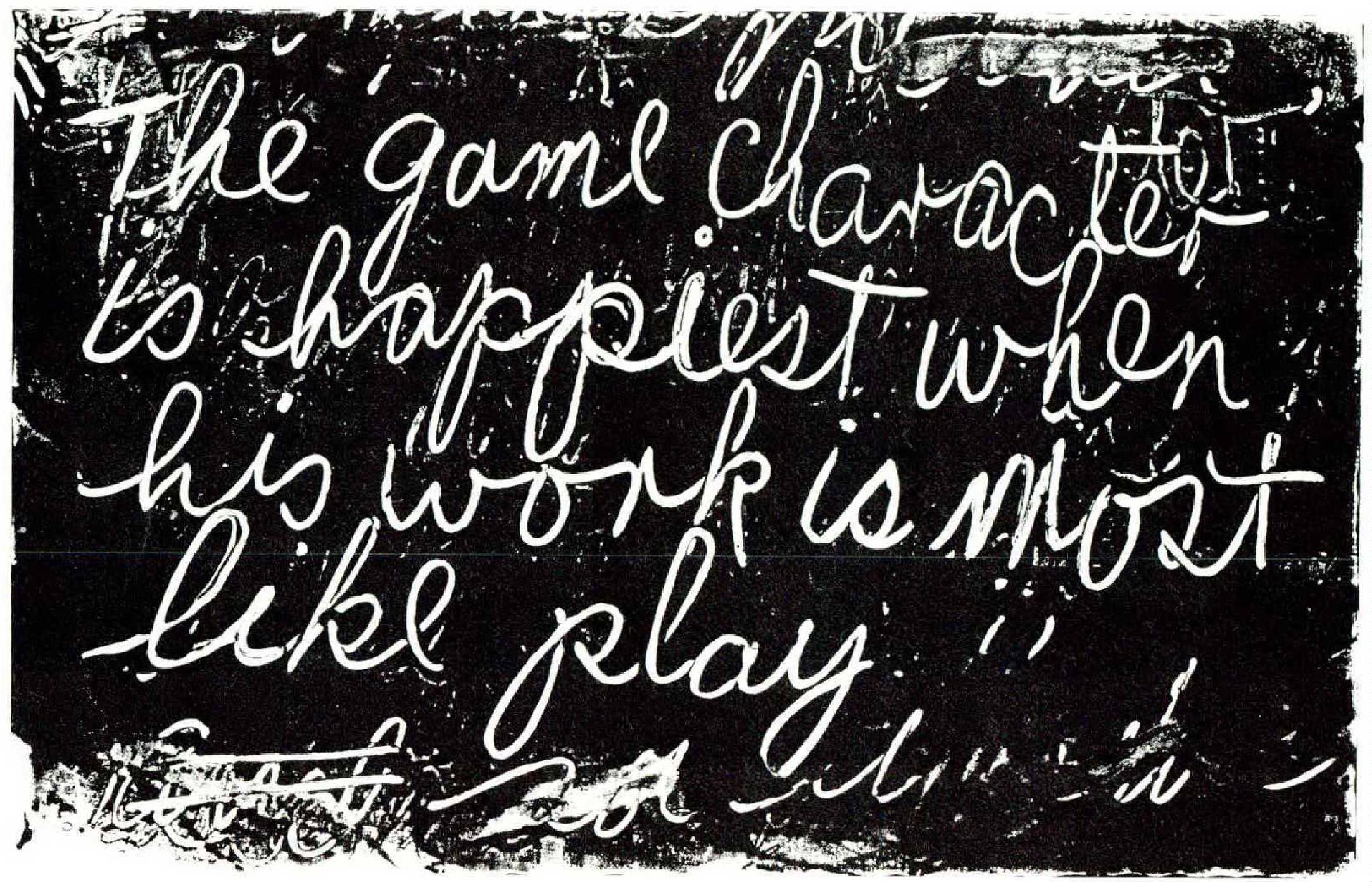
One way of viewing game character is as a highly successful psychological strategy in a situation where reality lies some distance from one’s work; “the game character is happiest when his work is most like play.”
A curious idea. In a way, it represents some considerable cultural growth: the end of the hated Protestant ethic, the emergence of the idea that work needn’t be noxious to be good. And yet, work isn’t play—it is not a diversion from life; it is life, has consequences. The abstraction of work from its product, process from content, is the heart of corporate experience. It’s the adaptive trick that makes life OK, sanity of a kind, a costly kind. “Game character is a character without a center, without strong beliefs, sense of identity, and goals.” That part of the man that is successfully competing tends to lose touch with the rest of his personality, with items of spiritual or intellectual importance that once mattered; the end of this process is the alienation of the player from himself.
5
I’m an admiral,” Stan said, “so why don’t we go to the Admirals Club?” It is a few hours now after the close of the Executive Development Lab at Osage House. Four or five of us, between planes in St. Louis, are waiting in the Danish modern lounge that American Airlines provides for its preferred customers. (Randomly one man says: “I have a problem and I wonder if anybody can help me. I’m tearing my teeth apart, grinding them in my sleep. The dentist says I’ll need caps in a year if I don’t stop.” Trust, a freighted word in sensitivity training, prevails.) Only time for a half drink, and the American Airlines attendant appears at our table to announce Stan’s flight. “We ask our admirals to go down fifteen minutes early,” she says. My flight too; we’re going home together.
Stan’s a tall, pale engineer (MIT ‘60) with a pink circle appearing at the crown of his head, a compensatory blond moustache started. On board, he’s anxious to talk about the last few days.
“This has changed my life. I used to be universally regarded as a son of a bitch. Would you like to see my last DOEB?”
DOEB: that’s the name of the rating form we’ve all filled out for one another—“Dimensions of Executive Behavior.” (“Place an M at the alternative which is Most like that individual’s behavior. . . . Place an L at the statement which is Least like his typical behavior. . . .”)
“Look,” Stan says, “I went from three M’s to three L’s on this, ‘insensitive to feelings of others.’ I find that very exciting. It’s exciting to be a nice guy. I’m beginning to experience joy. Not just contentment but joy.”
Our conversation, though informed by Stan’s happiness, is shapeless. He asks me what surprised me about the session. I tell him two things did: this, this conversation, this openness, the changes he says have been wrought in him. (“I’m one of their success stories. I guess; I’d be at the top of the curve, but then I had a long way to go.”) And the other thing: the competition. I hadn’t been prepared for it, didn’t know how quickly, automatically people would accept the terms of the game and fiercely play.
Stan smiles, suggesting that not to understand this is to understand nothing: “I wanted to win. I wanted to be president very badly. People like me need a club called Winners Anonymous, for people who still want to win but don’t want to be compulsive about it.”
Over Pennsylvania, Stan recalls his T-group’s last session. Their assignment was to write a newspaper account of themselves as they hoped to be five years hence. Stan showed me his: “Flash, Stanley—(Nice Guy Stan) experienced his 500th successful interpersonal encounter today. His wife and a few close friends joined in the celebration at home. NGS’s comfortable salary is sufficient to meet expenses.” Stan said, “I thought it would be good to put in some humor. Some of the others surprised me. Howard read his and it said just, ‘Howard Tompkins received the Father of the Year Award today. The judges were his wife and children.’ And Bob started to read and couldn’t finish. His report said: ‘Robert Cramer was appointed professor of corporate law . . .’ And his lower lip began to tremble and he said, ‘I don’t think I can read this.’ ”
Stan pauses; his eyes cloud.
I’m moved too. Look out the window, am silent. The modesty of these wishes. Some subsurface river runs in us all, where there is a longing to do the small and decent thing. Surely this, beyond “the win,” is what we all, corporate men or not, want out of work. But the sentiment turns inward on itself. These tears I could spill, they’re McNamara tears: recall the Secretary of Defense weeping improbably in public? I think I understand that: not the fullness of feeling that’s being experienced, only a reminder of how rare is feeling itself. Can we abruptly experience joy, change our lives, learn to triumph generously? Isn’t this wash of emotion evidence of the distance we keep between our lives and ourselves? I sense Stan next to me, full of possibility, but that is not my condition at all. The moment passes unarticulated; and as the plane descends into the Northeast, we turn again to “Dimensions of Executive Behavior.”