I WAS practically dead when I came to Tashkent that winter. That’s what I had come for, in fact—to die. And they returned me to the living for a while.
It was a case of a month, another month, and yet another month. Unconcerned, the pristine Tashkent spring came and went outside our windows and turned into summer, and everywhere was thick with green already, and it was quite warm when I started going out for walks on my unsteady legs.
I didn’t dare admit to myself that I was getting better; even in my wildest dreams I measured the span of life allotted to me not in years but months, and I slowly paced the gravel and asphalt paths of the park spread out between the wards of the medical institute. I often had to sit for a while, and sometimes an overwhelming nausea forced me to lie with my head hanging down.
I was the same and yet not the same as the other patients around me: I had fewer rights than they and was of necessity more silent. People came to visit them, relatives wept for them, and they had only one worry in life, one aim—to get well, but for me there was virtually nothing to get well for: at thirty-five years of age I hadn’t a single relation in the whole world. I didn’t even have a passport, and if I now recovered, I would have to leave this greenery, this fertile land, and go back to my desert, to which I had been exiled in perpetuity, under public surveillance, fenced to register once a fortnight, and from which the police chief’s office had not seen fit to release me for treatment, even when I was dying. None of this could I tell to the free patients around me. And even if I had, they wouldn’t have understood. On the other hand, with ten years of leisurely reflection under my belt, I was already aware of the truth that the genuine flavor of life is comprehended not in big things but in small. As in this uncertain motion of my still unsteady legs; in breathing cautiously so as not to provoke a pain in my chest; in fishing a single, unfrostbitten spud out of my soup.
Thus that spring was the most agonizing and wonderful of my life. For me everything was forgotten or never seen, everything was interesting; even an ice cream cart, even a road sweeper with water jets, even a street seller with bunches of elongated radishes, not to mention a young foal that had wandered onto the fresh grass through a break in the wall.
From day to day I plucked up ever more courage to leave my clinic and go further into the park, which must have been laid out at the end of the last century at the same time as these excellent brick buildings, with their pointed and unfaced walls. From the rising of the triumphant sun, all through the Southern day and far into the yellow electric evening, the park was filled with animated movement—the healthy shuttling quickly back and forth, the sick pacing hurriedly up and down.
At the point where several avenues converged to form a single one running out to the main gate their stood a large white alabaster Stalin with a stony smirk in his mustache. Further out toward the gate were other busts, spaced at regular intervals, somewhat smaller. Then came a stationers kiosk selling little plastic pencils and tempting little notebooks. But not only was my money rigorously accounted for; I had already had occasion to possess notebooks in my life, and they had ended up in the wrong place, so I judged that it was better to do without them.
Situated at the gate itself were a fruit stall and a chaihana or teahouse. We patients in out striped pajamas were not allowed into the chaihana, but the fence was an open one and we could look through it. Never in my life had I seen a real chaihana before—those individual teapots with green or black tea for each person.
The chaihana had a European section, with little tables, and an Uzbek one, consisting of a large dais. The people at the little tables ate and drank quickly, leaving the small change for payment in their emptied handleless cups and going away again. On the dais, however, on plaited mats and beneath a reed awning, they sat and reclined for hours, even days, emptying teapot after teapot, placing dice, just as though the long day called them to no obligations. The fruit stall was open to patients as well, but my exile’s kopeks cringed at the prices. I gazed with interest at the heaps of dried apricots, raisins, and fresh cherries and walked away. Beyond this there was a high wall: they did not let the patients past the gate either. Two or three times a day the sound of bands playing funeral marches would come over this wall into the medical colony, for the town was a million strong and the cemetery was right next door. For ten minutes or so they could be heard until the slow procession had passed the colony. The drum strokes beat out a fatalistic rhythm. The crowd was unaffected by this rhythm: its jerkings were more rapid. The healthy people merely glanced around for a second before hurrying on to where they were going (and they knew exactly where they were going). But the patients would come to a halt at the sound of those marches and stand there listening, or poke their heads out of the ward windows.
THE more obviously I was being freed of my illness and the surer it became that I would remain alive, the more despondently I looked about me: I was already feeling sorry to leave all this.
White figures at the doctors’ sports ground were sending tennis halls back and forth. All my life I find wanted to play tennis and had never had the chance. The muddy-yellow, turbulent Salar foamed at the foot of steep banks. The park was inhabited by spreading oaks that threw their shade over tender Japanese acacias. And an octagonal fountain hurled jets of fresh silver droplets at their tops. (And what grass there was on the lawns! In the camps it was ordered to be grubbed out like an enemy; in my place of exile none grew.) Simply to lie face down on it, peacefully to inhale the smell of grass and sun-warmed vapors, was bliss indeed.
And I wasn’t alone lying on the grass. Here and there were girls from the medical institute, studying charmingly out of bulging textbooks. Or, bubbling over with anecdotes, on their way back from their practicals. Or lissome, swinging their sports bags, on then way to the stadium. Indistinguishable in the evenings, and therefore three times as attractive, the girls in rumpled and unrumpled dresses walked around the fountain, rustling the gravel of the paths. I fell pierced with pity for someone: perhaps for my contemporaries, frozen to death at Demyansk, burnt to a cinder at Auschwitz, hounded at Dzheskazghan, pegging out in Siberia—that these girls would never be ours. Or perhaps for these girls—that I would never be able to tell them, and that they would never know.
And the whole day the gravel and asphalt paths streamed with women, women! Young doctors, nurses, laboratory assistants, registrars, matrons, female relations visiting patients. They passed me by in tenderly severe dressing gowns and in bright Southern dresses, frequently semi-transparent, the better-off ones twirling fashionable Chinese parasols overhead on bamboo handles—sunny ones, blue ones, pink ones.
Each one of them, flashing by in a second, made up a whole story: the life she had led before me and the possibility (or impossibility) of her becoming acquainted with me. I was pitiful. My emaciated face bore the marks of my past—the frown of surliness enforced by the camps, the deathly pallor of my horny skin, slow infection by the poisons of my illness and the poisons of the medicines, as a result of which my cheeks were also tinged with green. Out of the defensive reflex of always giving in and hiding, my back was bent. My idiotic striped jacket barely came down to my stomach, my striped trousers ended above my ankles, the corners of my socks, stained brown with age, hung out of my squat-toed, felt camp boots. Not even the last woman among them could bring herself to walk by my side! But I could not see myself. And my eyes, no less transparent than theirs, admitted to my inner self . . . the world.
And so one day toward evening I was standing by the main gate and watching. The usual torrent was rushing past: parasols swayed here and there, silk dresses flashed before my eyes, brightly belted shantung trousers, embroidered shirts and skullcaps. Voices merged, fruit was being sold, behind the fence they were drinking tea and throwing dice; and by the fence, leaning on it, stood an ungainly short man, like a sort of beggar, now and again gasping out. “Comrades . . . Comrades . . . ?” The colorful, busy crowd was not listening. I went up to him. “What’s up, friend?”
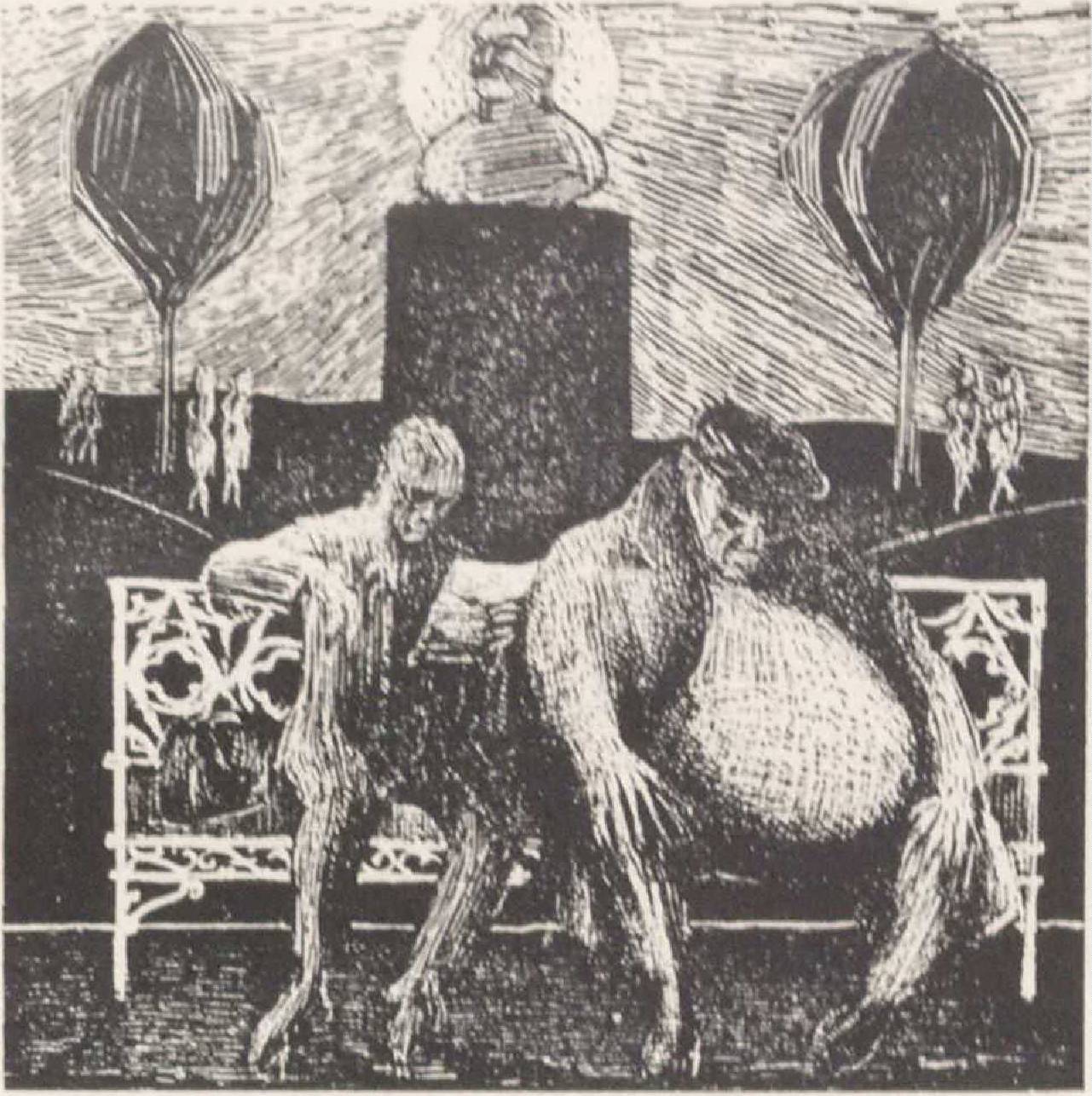
The man had an inordinate stomach, larger than that of a pregnant woman, which sagged like a sack and was bursting his dirty khaki trousers. His resoled boots were heavy and dusty. His shoulders were borne down by an unseasonably heavy, unbuttoned overcoat with a greasy collar and filthy cuffs. On his head was an ancient, tattered cap worthy of a scarecrow. His dropsical eyes were cloudy. With difficulty he raised one hand, the knuckle of which was clenched into a fist, and I drew from it a sweaty, crumpled piece of paper. It was an application by Citizen Bobrov, written in angular letters with a pen that had snagged on the paper, in which he requested to be sent to a hospital, and it was franked twice diagonally, in blue and red ink. The blue ink belonged to the city health authority and expressed a rationally argued refusal. The red ink, however, ordered the clinic of the Medical Institute to admit the patient to a permanent ward. The blue ink was yesterday’s, the red ink today’s.
“Well, all right,” I shouted at him loudly, as though he were deal. “You must go to the reception room in ward one. You go up here, look, straight past these . . . monuments …”
But at this point I noticed that at the very goal his strength had left him, that not only was he incapable of asking the way anymore, or moving his feet over the smooth asphalt, but he could hardly hold on to the threadbare three-pound bag that was in his hand. And I said, “OK, old chap, I’ll take you, come on. And give me your bag.”
He could hear all right. With relief he handed me his bag, leaned on my proffered arm, and hardly lifting his legs and scuffling his boots on the asphalt, started to move. I led him by the elbow through his overcoat, which was reddish-brown with dust. His swollen stomach was almost toppling him forward. He frequently uttered deep sighs.
And so we walked, two tramps, along that very avenue where in my thoughts I had walked arm in arm with the prettiest girls in Tashkent. We were slow crawling past the alabaster busts. At last we turned off. On our way was a bench with a back. My companion begged to sit down. I also was beginning to feel sick; I had been standing a mite too long. We sat down. From here that fountain was visible, too.
While still on the way the old man had told me several things, and now, having rested a bit, he added that he should be going to the Urals and that the visa in his passport was for the Urals—that was the whole trouble. For the sickness had taken him somewhere near Takhna-Tash (where, as I remembered, they were starting to build a canal). At Ugrench they kept him in hospital a month, extracted water from his stomach and legs, made it worse, and discharged him.
He had got off the train in Chardzheu and Ursavtyevskaya, but nowhere would they take him in for treatment. Instead they directed him to the Urals, where his visa was for. He hadn’t enough strength, however, to travel in the train, and no money left for a ticket. And now here in Tashkent he had managed in two days to get them to take him. What he was doing in the South what had brought him here, I didn’t bother to ask. According to the medical certificate, his illness was complex, and judging by the actual look of him this was his last illness. Having had occasion to watch many sick people, I could see clearly that he no longer had the will to live. His lips were flabby, his words were almost inaudible, and there was a lackluster look about his eyes.
Even the cap bothered him. Raising his arm with difficulty, he put the cap down onto his knees. Lifting his arm again, he wiped the sweat from his brow with his soiled sleeve. The dome of his head was balding, though a ring of uncombed, dust-caked hair, still blond, survived on the crown. It was not age that had brought him here, but sickness. On his pitifully wasted neck, chickenlike, the skin hung in folds, while his triangular Adam’s apple stuck out in front and moved independently. What was there to hold up his head? Hardly had we sat down than it slumped onto his chest. And so he froze in that position, with the tap on his knees and his eyes closed. He had forgotten, it seemed, that we had merely sat down to rest for a moment and that he had to get to the reception room.
A short way in front of us the almost noiseless jet of the fountain soared in a silver thread. On the far side two girls were walking abreast. I found them very attractive. My neighbor sighed audibly, rolled his head across his chest, and raising his yellow and gray eyelids, looked across and up at me. “You don’t happen to have a smoke on you, comrade?”
“Perish the thought, old fellow!” I shouted at him. “Even without smoking, you and I are going to have trouble; dragging our plates over the ground. Take a look at yourself in the mirror. Smoke! I myself gave it up last month, and hard it was too.”
He wheezed and then looked at me again from under his yellow lids, sort of doglike. “Well, give me a few rubles then, comrade!”
I hesitated, wondering whether to give it to him or not. No matter what, I was still a political prisoner, while he was willy-nilly a free man. How many years had I worked out there—and they had paid me nothing. And then when they did start to pay, there were deductions for our escort, for lighting the compound, for the bloodhounds, the administration, our gruel.
From the small breast pocket of my idiotic jacket I extracted an oilcloth purse and inspected the notes it contained. Sighing, I handed the old man a three-ruble note.
“Thanks,” he spluttered. Experiencing difficulty in keeping his hand raised, he took the note and stowed it away in his pocket, after which the disencumbered hand flopped abruptly down onto his knee, Then his head again slumped down with his chin digging into his chest. We sat in silence.
During this time a woman passed us, and then two girls. All three I found very attractive. For years you go without hearing their voice or the click of high heels.
“It’s lucky at least that they gave you a recommendation. Without it you’d be kicking your heels here for a week. It goes without saying. There are plenty like you.”
He heaved his chin off his chest and turned to look at me. Understanding came into his eyes, his voice shook, and his words became clearer: “Sonny boy! They’re admitting me because I’ve earned it. I’m a veteran of the Revolution. Comrade Kirov himself shook my hand personally at Tsaritsyn. They ought to be paying me my own personal pension.”
A faint motion of the cheeks and lips—the shadow of a proud smile—gave expression to his unshaven face. I took in Ids rags and him as well once more. “So why aren’t they paying you?”
“That’s just the way things turned out,” he sighed. “Now they won’t recognize me. Some of the archives got burnt, others were lost. The witnesses can’t be rounded up. They killed Kirov . . . It’s my own fault, I didn’t collect references . . . The only one I’ve got . . .”
His right hand—the finger joints were puffy and swollen, and the fingers got in each other’s way—moved to his pocket and began to thrust its way in, but at this point his momentary animation ceased, he again dropped his arm and his head and froze as he was.
THE sun was already setting behind the wards, and we had to hurry to get to the reception room (it was still a hundred paces away)—in my experience it was always difficult to find a place in clinics.
I took the old man by the shoulder. “Wake up, old chap! Look, see that door there? Do you see it? I’ll go ahead and say the word. Meanwhile, if you can, follow on after me; if you can’t, wait for me here. I’ll take your bag with me.”
He nodded as though he understood.
The reception room—a segment of a large shabby hall divided by crude partitions (somewhere behind it there was also a bathroom, a dressing room, a barber’s shop)—was always crowded during the day with patients measuring the long hours till they were received. But now, surprisingly, there wasn’t a soul. I knocked on the closed plywood shutter.
It was flung back by an extremely young nurse with a snub nose and with lips colored not red but with a deep-violet shade of lipstick. “What do you want?” She was sitting at a desk and reading what seemed to be a spy comic. She had darting little eyes, too.
I handed her the certificate with the two recommendations and said, “He can hardly walk. I’ll bring him over in a moment.”
“Don’t you dare bring anyone here!” she exclaimed sharply, without even glancing at the document. “Don’t you know the system? We only take patients after 9 A.M.!”
It was she who didn’t know the “system.” I thrust my head through the aperture together with, as far as it would go, my hand, so that she couldn’t slam the shutter on me. Then, sticking my lower lip out crookedly and screwing up my face to look like a gorilla’s, I hissed in a gutter voice: “Listen, miss. I’m not one of your labor gang!”
She was taken aback, moved her chair further awav into her room, and added in a different tone: “Reception’s not open, citizen! 9 A.M.”
“You read this piece of paper!" I urged hei in a low. malevolent voice.
She read it. “Well, what of it? I he system’s the same for everybody. Even tomorrow there might not be any room. There wasn’t any this morning.” There was a sort of satisfaction in the way she brought that out about there being no room today, as if to sting me with it.
“But the man was just traveling through, don’t you see? He’s got nowhere to go.”
As I backed out of the opening and ceased talking in labor-camp stele, her face assumed its former harsh expression: “All our people come from outside! Where are we to put them? Let him take a room in town!”
“Well, you come outside and see the condition he’s in.”
“Whatever next! Me go and round up patients? I’m not an orderly, you know!” And her snub nose quivered proudly. She was so sharp and quick with her answers that it was as if she had been wound up on a spring for that purpose.
“So what are you sitting here for?” I banged my hand on the plywood counter, kicking up a tiny puff of whitewash dust. “You might as well shut up shop!”
“Nobody asked you, big mouth!” she exploded, jumping up, she ran around and reappeared out of a passageway. “Who are you? Don’t tell me what to do! The ambulance brings them in to us!”
If it hadn’t been for those vulgar, violet lips and the same violet fingernails, she would have been quite pretty. That little nose was an adornment. And her eyebrows were very expressive. Her white coat was pulled wide open on her chest because of the heat, and a kerchief peeped out, pink and marvelous, and a Komsomol badge.
“What? If he hadn’t come here himself but had been picked up in the street by an ambulance, you would have taken him? Is that the rule?”
She inspected my ridiculous figure haughtily while I inspected her. I had quite forgotten that my socks were sticking out of my bools. She snorted, but assumed a distant expression and concluded: “Yes, patient, that’s the rule.” And went back behind her partition.
I heard a rustle behind me. I looked around. My companion was already here. He had heard and understood. Holding on to the wall and struggling to make his way across to a large garden bench placed there for visitors, he was just managing to wave his right hand in which he held a shabby wallet. “Here . . he muttered exhaustedly, “Here … show her this . . . let her . . . here . . .”
I managed to get there in time to support him and lower him onto the bench. With helpless fingers he tried to extract from the wallet his sole reference, but was absolutely incapable of it.
I took the tattered sheet of paper from him, which was glued across the fold to prevent it from falling apart, and opened it. A typewriter had written in violet letters:
This has been given to Comrade Bobrov, N.K., to certify that in 1921 he truly served in the glorious Special Services Detachment “World Revolution” of X province and with his own hand hacked down dozens of the bastards that were left. Commissar … … … … … … … … … … … … … … … … … (Signature).
Stroking my chest with immyhand I asked quietly, “What’s this then ‘Special Services’? What sort?”
“Aha,” he replied, barely keeping his lids from closing, “Show her.”
I saw his hand, his right hand—so small, with prominent blown veins, with puffed and swollen finger joints, hardly able to get tile reference out of the wallet. And I remembered how horsemen used to slash a man on foot with a backhand swing. Down and across.
Strange . . . In full swing the hand would twist the saber so that it carried oil the head, the neck, and part of the shoulder—that right hand. And now it couldn’t even hold … a wallet . . .
Doing up to the plywood shutter, I pushed it again.
The clerk never raised her head and kept on reading her comic book. Upside down on the page I could see a noble soldier jumping onto a windowsill with a resolver.
I quietly laid the tattered reference on top of her book and turned, nauseated, rubbing my chest the whole time as I went toward the exit. I had to lie down as soon as possible, with my head hanging down.
“What do you think you’re doing handing out pieces of paper? Take it away, patient!” shot the girl after me through the window.
The veteran had slumped tight down onto the bench. His splayed lingers dangled helplessly. His unbuttoned overcoat hung down on either side. His round swollen stomach lay in an improbable arc on his hips.
His head and even his shoulders had somehow subsided into his trunk.