The Education of Genius
THE time is long past when Alexander Pope was identified with his least impressive verse, and having been the eighteenth century’s supreme English poet, was adjudged in the nineteenth no poet at all. So precipitous a fall has been condignly discredited, so inverted a fate has been da//linglv revised. (Pope in every age, to be sure, has had fervent admirers.) Standing higher today than at. perhaps any time for almost two centuries, he has received the kind ol homage that serves him well: a fine seven-volume scholarly edition of his poetry and a five-volume one of his letters. Encomium and exegesis have walked side by side, one facet of Pope’s work matched with another. Professor Reuben Brower has very ably canvassed Pope as a classicist; Professor Geoffrey Tillotson has, perhaps rather excessively. traversed him as a moralist; and various scholarly publications abound in probings and analyses of one kind or another. If a decided gap yet remains, it is that Pope’s rehabilitation and even his renown haw been too largels academic. For however high their estimate of Pope and I would think it extremely high our recognized literary critics and port units, who for a good many years have written about such other I nglish poets as Keats and Blake. Milton and Wordsworth, Donne and Marvell, Hopkins and the moderns, have tended to pass Pope by; equally important, there has for over a generation been no full-length literary biography of the man and the poet. Thish has been very unfortunate, both in opening no door on Pope for a congenial, rather than specialist, audience, and in not providing a book where the man, and even more his period and its society, are organically joined to the poet.
Happily, though at the moment given only half a loaf, we now have Volume I of Peter Quennell’s biography of Pope, subtitled “The Education of Genius. 1688-1728” (Stein and Day, 87.95). I* would be extremely welcome if only for rendering Pope the kind of service I have just said he stands in need of; Mr. Quennell is an accomplished biographer, a seasoned man of letters, an urbane man of the world. He is also what might be termed a periodist: though much at home elsewhere, he is altogether so in Pope’s era and Pope’s world, having indeed written biographies of two of Pope’s contemporaries, Hogarth and George II’s Queen Caroline. Witat is important here, however, is less how well Mr. Quennell knows Augustan England than that Pope knew it even better. For every classical cadence and echo in Pope, there are perhaps two contemporary whispers and nudges: his finest poetry is seldom less than sprinkled, is usually studded, and is sometimes crammed with pseudonymous eighteenth-century figures, pointed references. enigmatic allusions, in a melee of Grub Street and grandees, of coffeehouses and country houses, of wan ing polities and rival Courts. Mr. Quennell brings home to us a great deal of all this in his portraits and vignettes of people and his recountal of incidents—a far more enjoyable way of treating them than in flavorless footnotes. This constitutes, moreover, the real-life subject matter which, fitted into a classicist background, brilliantly completed Pope’s “education.”
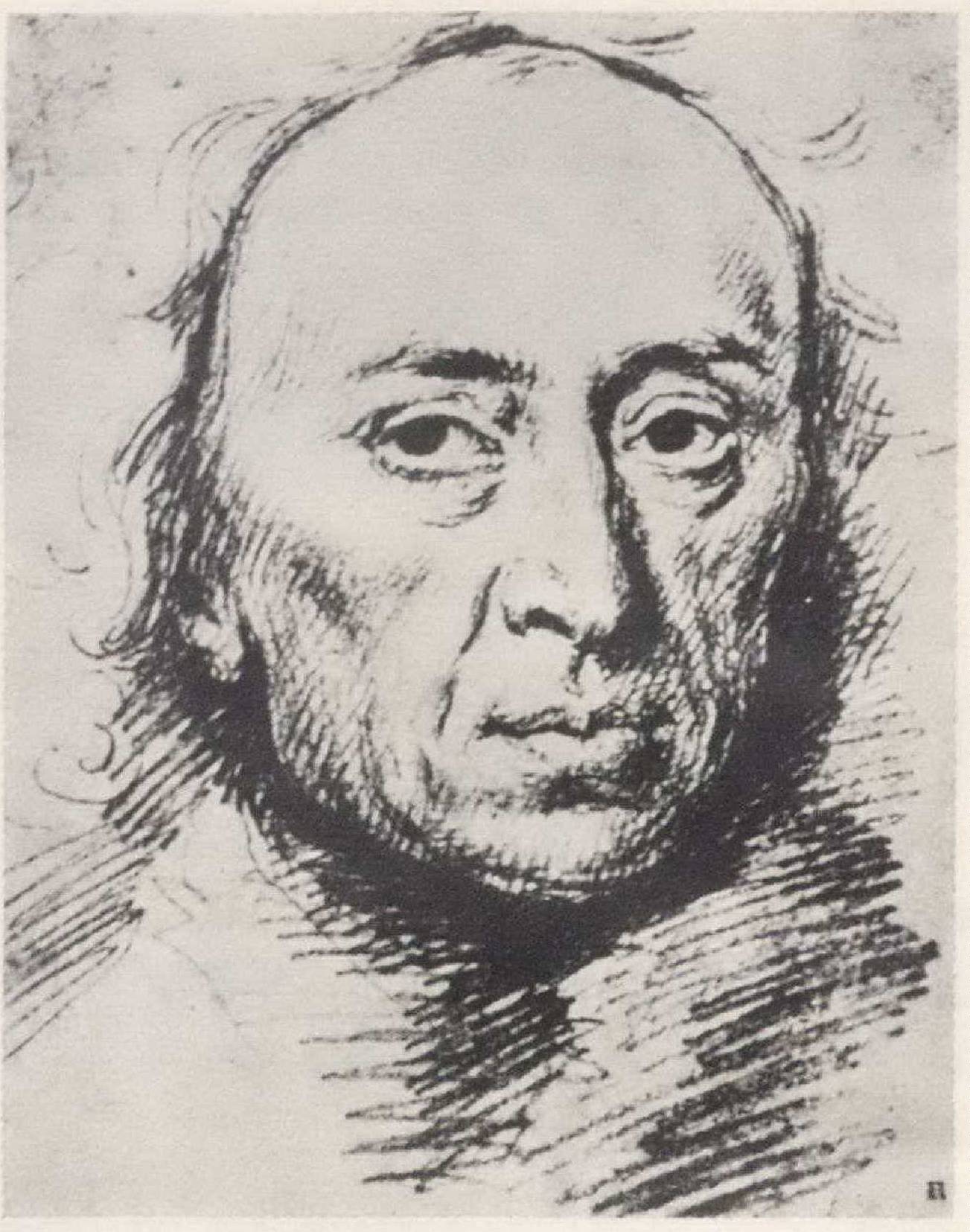
Drawing of Alexander Pope by Jonathan Richardson, 17>7. Courtesy Stein and Day, publishers.
Education until the age of forty may seem a peculiar word and need, all the more for how fantastically precocious, in social as well as artistic ways, Pope was, he having come of age able to boast equally a distinguished visiting list and a notable place in letters. Yet, as “the education of genius” the forty years are conceivably accurate, for though they include The Rape of the Lock and some fine shorter pieces, and culminate in the first version of The Dunciad, had Pope died at forty, very little of his greatest work would have existed. In a real if restricted sense, the man properly governs Mr. Quennell’s first volume, as the poet will doubtless dominate the second.
THE child of Roman Catholics, Pope grew up—it was one of the penalties of his faith—with irregular schooling, and at twelve developed a tuberculous disease of the spine which left him sickly and deformed, a four-foot, six-inch hunchback, for life. It would yet not immure his life, and it conceivably enriched his life’s work. Having at twelve written the still famous Ode on Solitude, he was in his midteens corresponding with landowners and lords and with so famous a playwright as Wycherley, whose manuscripts he “corrected”; and before he was eighteen was being wooed by the distinguished publisher Jacob Tonson. So early launched, Pope would, with some debt to his influential connections, be early laureled, and have written by his midtwenties that classic of battered and Bartletted gems, the Essay on Criticism; as, in The Rape of the Lock, he had written a small mock-heroic masterpiece. When he was not yet thirty, he published his Collected Works, and when just thirty, the final volumes of his translation of the Iliad. In terms of career, never perhaps had the course of true talent run more smooth; nor, more steadily, the climb to a place among the great. He could write at twentynine:
After some attendance on my Lord Burlington, I have been at the Duke of Shrewsbury’s, Duke of Argyle’s, Lady Rochester’s, Lord Percival’s, Mr. Stonor’s, Lord Winchilsea’s, Sir Godfrey Kneller’s . . . and Duchess Hamilton’s.
Add to this friendship with Addison and Steele, Congreve and Gay, and many others in the literary world, and we are not far distant from the era that came to bear Pope’s name.
Yet there was a decidedly dark side: every step upward was accomplished with physical pain, making life at best an invalid’s bed of roses; his appearance proved one way of Hogging his poetry and condemning him to a critical bed of spikes. The enmities came to be even better known than the friendships, and to beget greater verse. As it was the clash with the critic John Denniswho alluded to “a young squab short gentleman . . . bent almost double, like the bow of love” that drove in the first spike, so it was the falling out with Addison that produced Pope’s first masterpiece of denigration. Neither great fame nor great friendships could curb Pope’s resentment when ridiculed or attacked; he became, indeed, so touchy as to magnify small slights, so suspicious as to manufacture them, so rancorous as to remember them for life. This is a matter of far more than biographical interest, seeing that Pope was endowed with the greatest genius for rhymed vituperation in English literature. At times, to be sure, his revenges could be totally unrhymed and fiendishly crude, as with the “unspeakable” publisher Edmund Curll, into whose wine Pope dropped a strong emetic with the desired results; and then, still unsatisfied, concocted pamphlets in which he had Curll tell how “bloody sick” he got and Curll’s wife describe the occasion as the “greatest adversity that ever befell my poor man since he lost one testicle at school by the bite of a black boar.” But far oftener Pope’s tactics were both circuitous and subterranean: he methodically sought the return of his letters, that he might touch them up—and sometimes ink them out—for posterity; and he first published The Dunciad anonymously, that if it ran into trouble he might disavow it and provide an “authorized” version. And most of his personal revenges and retaliations were long delayed: no one could more rewardingly bide his time, to produce vintage defamations with anger, by now transmuted into art.
Although Pope could be wryly and even obscenely frank about his appearance, it yet cut very deep, and perhaps deepest of all where it came closest to pleasure, in his relations with women. He contrived, in a life abounding with contrivances, to make himself out something of a rake; why, he asked, should he, the “gayest valetudinaire alive”
Follow girls seven hours in eight I need but once a week?
He did not, Mr. Quennell concludes, “lack sexual experience,” but adds that it was “of a mercenary or transient kind.” With women in the social world Pope frequently established a gifted writer’s pendeep gallantries and flirtations; his deeper feeling for Martha ("Patty”) Blount and, even more, for that remarkable recipient of so many clashing adjectives, Lady Mary Wortley Montagu, made for a tightrope walk that, however adroitly and successfully managed, could bring no rewards. Indeed, the most famous and perhaps most plausible explanation of his quarrel with Lady Mary is that he made love to her and was laughed at. About women in general he had decided knowledge and pcrceptiveness; as Mr. Quennell suggests, from never thinking of him as a husband or a lover, they might reveal their inner selves and entrust their secrets to him.
Yet, for all his ill health and his ill luck in sex, the poet of genius proved also a man of many talents and considerable activity. Though having to pad his rickety legs with three pairs of stockings, and to keep a servant within call whom he might again and again ring for in the night, he went again and again on lengthy rounds of visits, he maintained a large and many-sided correspondence, he got wind of almost everything and came to know almost everybody. He won much more from his writings than literary fame; in the heyday of Chub Street, be won imam ial independence. A guest of the highborn, he played host to them also—even the Prince of Wales tame to see him, and the Queen hinted she would like to come. Pope’s garden and grounds at Twickenham, though much less well known than his grotto, have their place in the century’s annalsi landscaping. As in literature such figures as Swift and Gay were his close friends, so in architecture were Lord Burlington and Kent, and, among men of birth and battles and politics, Bathurst and Peterborough and Bolingbroke.
All this, which gives substance to Mr. Quennell’s book, bad importance in Pope’s career. For, in the half century between the decline of Restoration comedy and the rise of the social novel, Pope as poet is conceivably England’s brightest novelist of manners; and surpassing what may have been his textbook, The Spectator, is England’s most brilliant satirist of society. Indeed, to the classical ancestry of Horace in Pope’s work, we might subjoin a totisinship with Horace Walpole. If Pope’s individual portraits tan be jaundiced and envenomed and if Leslie Stephen might call Pope, not too exaggeratedly. “the most untruthful man of his age,” he was hugely truthful about the age itself. The world he portrayed shared bis taste, if not his genius, for scandal and calumny; it equally aspired, without bis gifts, to wit and elegance and a Palladian-cumPopian correctness. The critic of morals in Pope, as in any true satirist and student of mankind, was genuine enough; but the delineator of manners and homme du monde was oftener present in him and far oftener pre-eminent His most brilliant work of this kind is the stuff of Mr. Quennell’s second volume; but, master that he was of the heroic couplet, Pope had from his youth put it to fine social and satiric uses; to a mock-heroic
Dost sometimes counsel take—and sometimes tea;
or a swift body blow;
or a Squire-Westcrnish caricature:
Makes love with nods, and knees beneath a table;
Whose laughs arc hearty though his jests are coarse,
And loves you best of all things—but his horse;
or that delicately chilled absinthe frappé:
And without sneering, teach the rest to sneer;
Willing to wound and yet afraid to strike.
Just hint a fault and hesitate dislike.
But Pope, as a supreme master—rapier or wreath or looking-glass in hand—of his medium, would later excel himself with various Epistles, Satires, Moral Essays. Here we are given a tour of Augustan high life and a portrait gallery where not many sitters would wish to hang; for here even Pope’s personal faults make for poetic virtues, and to the poet’s genius are added a novelist’s inventiveness and a dramatist’s eye for effect. Brief quotation is irresistible, even if it reduces art to hors d’oeuvres. There is furious, ill-behaved Atossa:
The pleasure missed her, and the scandal hit;
unfeeling, superficial Cloe:
Can mark the figures on an Indian chest;
And when she sees her friend in deep despair,
Observes how much a chintz exceeds mohair . . .
Would Cloe know if you’re alive or dead?
She bids her footman put it in her head;
and mercilessly vilified, the effeminate Lord Hervey:
Half froth, half venom, spits himself abroad . . .
Fop at the toilet, flatterer at the board,
Now trips a lady, and now struts a lord . . .
Beauty that shocks you, parts that none will trust.
Wit that can creep, and pride that licks the dust.
And upon a kind of moral floor Pope, with fineedged satiric tools, reared an unsurpassed earlyGeorgian habitation. There we espy, for one example, his aging, pleasure-seeking, now haglike society women:
And haunt the places where their honor died.
and observe their fate:
A youth of frolics, an old age of cards;
Fair to no purpose, artful to no end.
Young without lovers, old without a friend:
A fop their passion, but their prize a sot:
Alive, ridiculous, and dead, forgot.
Even from these bits we get, I think, a sure sense of Pope’s choice of words and artistry in placing them: of his antithetical succinctness and his turn for style; and of his lethal use of scalpel and saber, dagger and poisoned dart. There is perhaps no one else whose verse so instantly strikes us with its force and stops us with its felicities; stops us cold, where perhaps more exalted poetry would carry us away. Pope’s poetry is hard to discuss except in comprehensive terms or very concrete ones; line-by-line study, if a dreary pedagogical mania today, in Pope’s case is rewarding for its line-byline or couplet-by-couplet effects. Unlike most fine poetry, Pope’s is of course very seldom romantic
or mystical or introspective; its worldly subject matter can easily obscure or devalue its artistry, and deprives the critic’s vocabulary of its habitual terms of praise, words like lofty, visionary, awesome (though not. surely, of haunting). It is poetry that is sometimes possible, Matthew Arnold fashion, to damn as fine prose; but at its best it has, in economy of means, intensity of treatment, stuuningness of effect, and perfection of utterance, the credentials of great poetry; or, to make an end by making an equivalent of it, the credentials of great literature or art. Pope is not for everybody or. it may be, for most people; what, like many other men of genius, he demands is a particular, not to say kindred, temperament and sensibility, just as what he bestows is a high and special pleasure found almost nowhere else. If factually Mr. Quennell’s book offers little that is new, that is of no consequence; what, for people who might find Pope move congenial than they think, could have great and infectious value is Mr. Quenncll’s cultivated command of literary biography, his characterization of Pope, his presentation of Pope’s world and the poetry that came out of it.