Letter From a Far Frat
If this is the era for assaulting university presidents and prancing nude in Harvard houses, can life in a typical college fraternity still be the same? To the hopflavored surprise of Mr. Gold, author of FATHERS, THE MAN WHO WAS NOT WITH IT, and other novels, the answer — at Chapel Hill, North Carolina, in any case — proved to be, Yes.
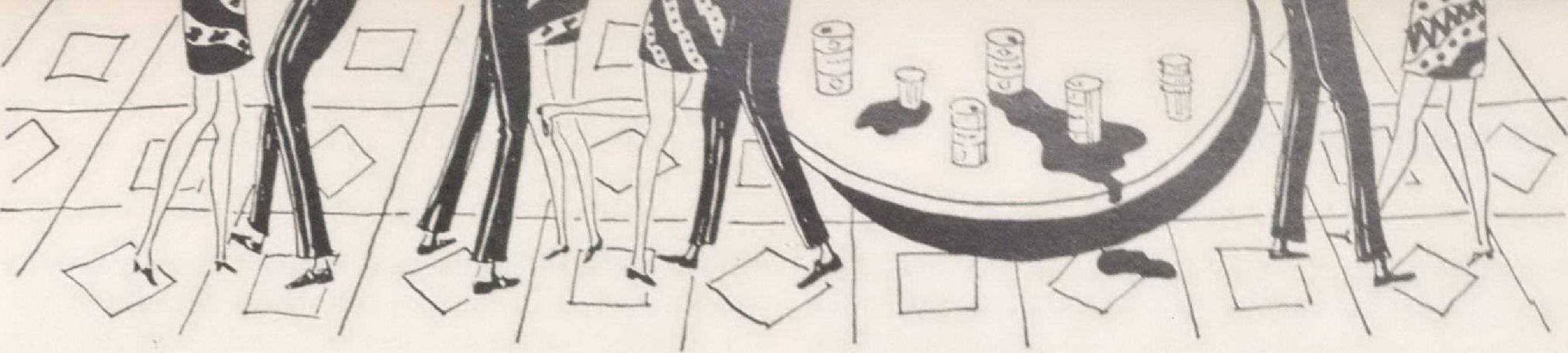
by Herbert Gold
WELL, the Fraternity House still exists. I almost thought it went out of fashion with Dick Powell and Jack Oakie and the great homecoming games of early MGM musicals, but by golly, the old beer-spraving, girl-harvesting, ear-splitting article can still be found on, say, the campus of the University of North Carolina at Chapel Hill, which is an excellent school with high standards. Because I was a guest in the house, I’ll invent a name for the occupants, Kappa Lambda Pi.
OK, on a Saturday night the fine old lovingly demolished mansion is surrounded by MG’s, Sprites, American convertibles; the lawn is covered with heartbreakingly—beautiful? well, cute—it’s covered with girls, and weaving about the girls are the boys, casting their spell, making time. The band is an amplified rock group, good strong sound, tough and nonpsychedelic, out of Carrboro or the country sin rounding—black, of course, and no one else is. The hospitality is immense and genuine. They are lovingly demolishing the place by hand; it’s a local craft. Echo says, and echo replies: “Have a beer, have a brew. Here, have a swig. Hey, sir, have a drink of mine. Aw, come on, have fun with us, sir.”
The boys of KLP are celebrating losing a game. On other nights they celebrate winning the game, or rush week, or the water shortage, or exam week, or the visit of Spiro T. Agnew to Raleigh, or it doesn’t make any difference. The faucet in the kitchen is never turned off. Since there has been a prolonged drought and a crucial water shortage which threatens to shut down the school, it has seemed a fine joke to some good old boy to get out of various academic problems by doing his best to drain the lake. Some of the would-be adults in the house think this is childish behavior, he hadn’t ought to do like that, but it’s a matter of esprit de corps. It would be finking on a good buddy to interfere. When one lellow twisted the faucet shut, his good brother got red-eyed and sore, silent; but that’s the limit of it. Well, it really means something to him, that water-lover, llurtie tough-titty feelings. Anyway, they might get the emergency pipeline from Chapel Mill to Durham in time to relieve the reservoir. And in a democracy every man should he free, shouldn’t he, to decide whether or not the town has any water?
During the festivities which I attended. sex and politics were the prime subjects. So far, so good. I’ve heard of them. Water and studying were a distraction from real life. The iuture is a slightly disagreeable consequence of the present, following it by association as “liver” follows “cirrhosis of the.” The smell of beer, which I thought had His appeared from campuses, is making its last stand in North Carolina. Beer was a stranger to me (I’ve spent a lot of time at California colleges). A tall, sandy, snub-nosed brother called Boyce explained about things: “We can’t be too cool, man. We can’t operate like them Ivies, you know, smoke a joint and then zap her upstairs. We got to plan and work out a three-stage campaign, not like those Ivies up north, man. I propped at LaWrenceville, I skied in Colorado, so I had that experience, those Ivies. We got to work a three-stage campaign, not coo], man, not. like those Ivies, man, sir.”
“I understand,” I said, almost understanding.
“First stage, we got to dance a little, get ‘em a little slushed up, you know, hot, not like those Ivies. That’s first stage. Love ‘em up a little. Then second stage: into the car. Sir, let me explain, that’s trouble, getting ‘em out of here and across the parking lot into the car. Now they want it as much as we do, don’t misunderstand me, sir, just like those Ivy girls, they want it, but they stumble, they make it tough crossing the parking—OK, into the car, man. Then we have these apartments in town—”
“You mean you can’t take the girls upstairs?”
He looked at me, shocked at my presumption. He offered me a swig from his can. Ife defended .Southern womanhood. “Here?” he asked. “In the house? In front of all everybody?”
“I’m sorry,” i said.
“Well, we drag ‘em out the door and through the parking lot. Course lots of times they yell and scream and laugh and throw up a lot, but we get ‘em out, because they want to as much as we do, you know, that’s human nature. So then we get ‘em to our apartments in town, oh, maybe three, four of us share an apartment, and then . . .” A grin lit up his face. It was like the sun rising over Georgia. “Man, can I just tell you what I did to that littlegitl over there—see, that one? No, not that one, sir—you like her? Cindy?no, the one next to Cindy.”
He pointed to a little flower of Southern womanhood stubbing out her c igarette against the veneered wood atop the TV.
“You don’t know her, do you? so it’s all right if 1 tell you. but listen, sir. if you’d like to meet her . .
First, however, hedescribed stage four in the three-stage plan.
I was also interested in his political views, but first we got involved about this girl.
Oh, well, I have prurient interest, too.
Come here, honey,”Boyce called to the girl (not Cindy). She came over, mussed and sulks, with a great hair-collector’s mane of yellow hair, and then shot me that marvelous easeful flirts Southern smile which nice girls down there give not only their men hut also girlfriends, pregnant ladies, small animals, and the short-answer questionsn a nursing exam. She had lieptid brown eyes, lovely, hystericeyes, soft stalks with contact lenses perched atop the irises. “I just been telling him what we did t’other night, honey.”
“Went to the movies,”she said.
“No, not that night—”
Saw Disaster Angels, with a revival of camp classic Suddenly t ast Summer
“No, the next night, night we had the party—”
“Oh, Boyce, you’re a, you’re a, you’re a—”
He grinned while she suffered her failure of vocabulary. But she seemed about to cry—hysteric, remember?—so he apologized gently, saying, “Aw, honey, don’t carry on like that. I didn’t show him the Polaroids.”
I was getting mired in interpersonal relations. It would l>e better all the way around, including my development as a thinking human being and a visiting writer, if I heard some of their views on wider topics.
Floyd Jones is an activist. He has been to Europe on his summer vacation. He thinks about local option and states’ rights (positive). Hair and hippies mash around in his emotions (negative). In Europe he noticed the happy faces in West Berlin, the unhappy ones in East Berlin, and that settled Communism for him. It was all clear now, roger and over, and this led him straight back to American politics. “I met these German men in a bar,” he told me, “good old boys, spoke good English, said why don’t we kick the shit out of those hippies and draft-card burners.”He had discussed everything from Vietnam to race with those happy faces, and they compacted together that Communism must be stopped.
Our conversation took place during the heat of the last political campaign, just after a Northerner, Curtis LeMay, native of my home state of Ohio, had been chosen to assist George Wallace in his mission. “He’s a good old boy,”said Floyd, as the dancers flailed about us. The cigarettes were falling into the carpet, the fastidious were drinking out of plastic-foam cups, the forthright were drinking out of their cans, and the group had me backed against the color TV. The sound was turned off, but the light show flickered and spattered against the screen. I reached behind to turn it off so that the radiation wouldn’t catch me behind while the vocal emanations and renditions took me a front.
Eloyd is the only man I know who was overjoyed by thethree major candidates for the presidency. Hubie was a good old boy. loyal to Lyndon, a virtue all iu itself, and of course Wallace had the clearest and finest ideas, but he personally was voting for Mr. Nixon. It’s a class thing, he felt; a duty to live up to the word “responsible”; and Mr. Nixon’s speeches nearly brought tears to his eyes. They were that sincere. Also, he hoped he’d kick the shit out of those draft-card burners and long-haired hippies.
“You really like all the candidates?”
“They’re loyal Americans, aren’t they? That’s what I ask of a man.”
I offered some objections to Floyd and the others, but mainly I tried to play Socratic: Method—questions: Is this a happy country? Do you really think more weapons for the police are the “answers” to law and order? What is your conception of America’s role? One very tall, horn-rimmed young mail, with a look of poetic angularity about him, hung on my words, and I thought I had an ally. He too seemed puzzled by America circa 1968. He suddenly burst out: “Wha yo so gol-darned negative? What is this negative bit?" Astonished by his own anger, he added: “Sir?”
A few girls had joined us. One of them was Cindy—eyes afire, that old golf club menace in them. There was some kicking and giggling going on below the level of the conversation. It was stage one and a half of the campaign. I decided, not like those Ivies.
I must have asked a question, because the sensitive-looking brother burst out, “Course I wouldn’t kick the shit out of ‘em! I just say that!” Then he smiled shyly. “Wouldn’t want to get my shoes dirty,” and nudged me. “Aw, sir, I just say that. They got the right to free speech, too, so long as they don’t go tearing down this country. You’re not always so negative, are you, sir?”
It was time to be their buddy, I decided. I too had done my term at Fort Bragg and elsewhere, though this was before their birth. I reminisced about Fayetteville, North Carolina, which we called Fagleberg.
“You mean Fayettenam?” Floyd asked. “When they call me there, I’m going. If they cancel my deferment, sir, I’m going. But I’m going to try to finish my education first, and get into a good position, and if the Lord is good to me, I won’t have to fight. I can tell what you’re thinking, sir. I got strong feelings. But like I already explained, killing’s just not in the American line.”
He was wearing tight maroon pants and a white button-down short-sleeve shirt with notched vents at the sleeve. One of his Hush Puppies was unlaced. He leaned on me a little, partly out of friendship and desire to be understood, saying, “Now don’t get me wrong, hear? They call me, I go. I got this deferment, no gol-darned evasion.”
“I’m not a pacifist either,” I said.
“But I never did meet any Marine from Vcetnam committed an atrocity who enjoyed it, hear? Hear me, sir? We just got to defend the American perimeter, it’s as simple as that. So I’ll go, I’ll go, sir, soon as they call me.”
When it came time to part, two of the brothers insisted on walking me home to the Carolina Inn. It had rained gleaming Burgie flip-top friendship rings on the Carolina earth. The brothers scuffed along, bumping and uneasy about the discussion. The men of the KLP house have a complex feeling about life—a minority on this campus, a majority in their own hometowns, but are they a majority in America and the world? It is no longer ease to find the tides of right and iioat back and forth on them. Kappa Lambda Pi is in trouble as a way of life.
There was a sh\ moment in the fragrant Indian summer evening, hot rods and Powering trees and sweet echo of amplified rock from the Carrboro Rhythm Ramblers. Something had been left tm said. Some generation gap had been left ajar, some culture gap unclosed, some stony silence in the metaphysics. We all wanted to be close and warm, and yet we were not close anti warm. We had kidded around, but what else? In a world of making out OK. and getting bugged by it, we had made out all right, and gotten bugged by each other, just like the Ivies; and yet there must be something more than paltrv victories in love and politics. There might he, for example, real victories. Stage five. Stage six. Stage seven.
On another part of the campus the 1.A.M. showing of underground art flicks was just beginning, and the Dandelion, a head shop, was just closing, and the Racial Confrontation group was continuing out under the famous Davie poplar. As we walked by, a tall black man in a denim suit, a refugee from Resurrection City, a pioneer of Freedom City, was smiling and saying softly. We’re sick of ttickeration, we won’t stand still for extermination, so we got to have communication; and an earnest young white student said. But we got to talk it all out first so’s not to frighten the other people; and the man from Resurrection City said, Son, that’s trickeration . . .
One of my escorts shook his head, grinning. “Man, oh, man,” he said to me. Some of these jerks were beyond his comprehension.
All over the campus the gritty Indian summer smell of autumn leaves was helping lovers and celebrants and reformers and late-night scholars fix die memory in their hearts, whether they knew it or not: This is it, this was college in my time.
As we walked along, beer fizzing in the jiggled cans, a member of my honor guard said, “It’s just, sir, we didn’t want you to get the one-sided impression about this school.”
“I appreciate your hospitality,” I said.
We were standing near the rocking chairs on the porch of the Carolina Inn (widows, conferences, and faculty visitors). “Don’t get us wrong,” he said. “We have strict rules at the house. We don’t always live up to them, but: we try not to be litterbugs. We might be Tarheels and we got a lousy team, but we have fun, too, sir.” He gazed wearily back across campus to the traditional Davie poplar, famed in song and story. Chapel Hill’s little Berkeley was still strolling and consulting near that spot, “fust didn’t want you to go away thinking we’re all a bunch of stupid intellectuals.”