The Journey of Philip Roth
This essay on Philip Roth places the writer and the man within the perspective of a personal memoir. Mr. Solotaroff is editor of NEW AMERICAN REVIEW and a contributor to many periodicals. Roth and Solotaroff grew up in northern New Jersey, studied together at the University of Chicago, and this article is dedicated to Napier Wilt, now retired, who was one of their teachers.
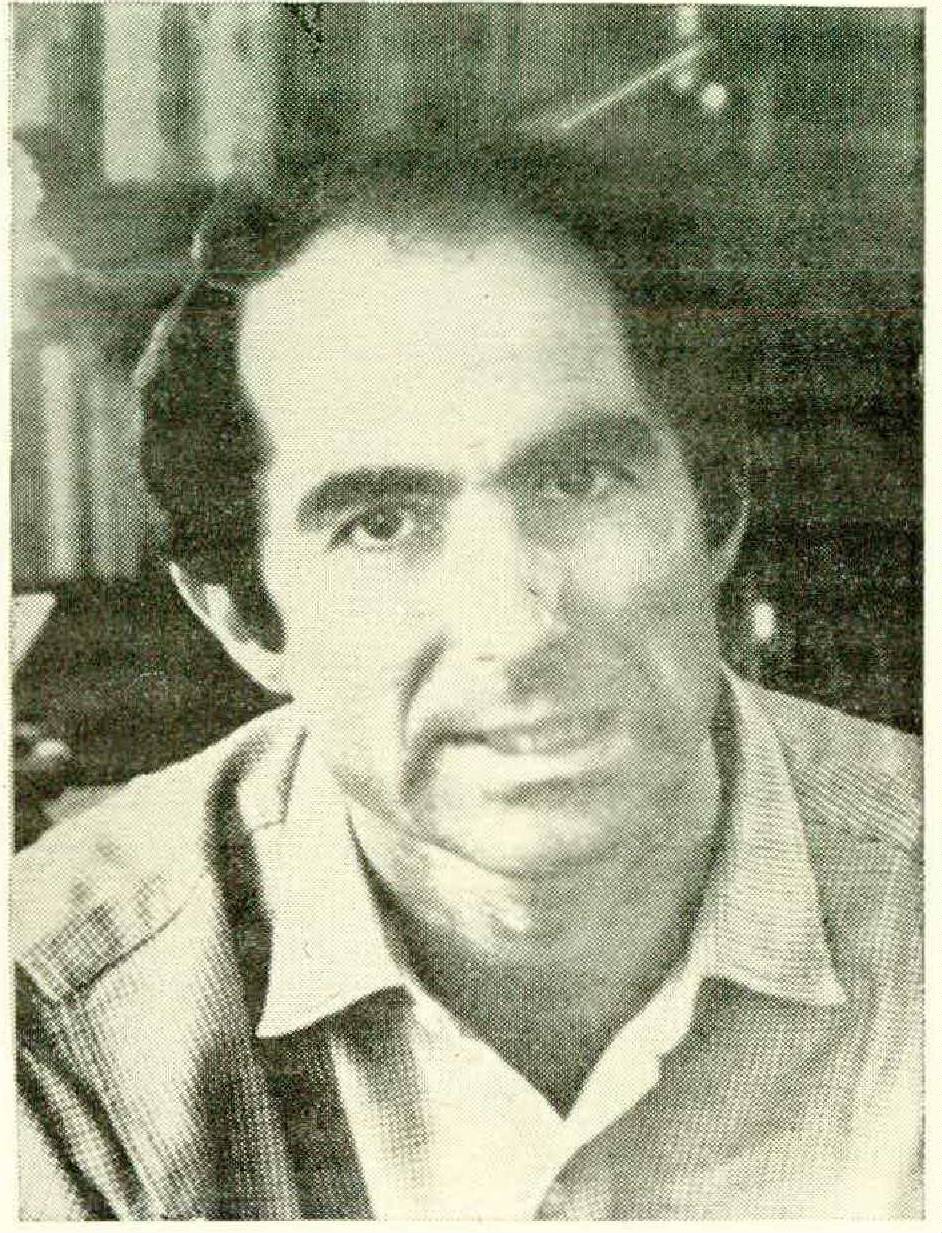
by THEODORE SOLOTAROPF
ONE day in the fall of 1957, I was sitting in a course on Henry James at the University of Chicago. The semester had just begun, and there were a few new faces: one that I had been noticing belonged to a handsome, well-groomed young man, who stood out in the lean and bedraggled midst of us veteran graduate students as though he had strayed into class from the Business School. The text for the day was Daisy Miller, and toward the end of the hour, one of the other new students began to run away with the discussion, expounding one of those symbolic religious interpretations of the story that were in fashion at the time everywhere but at Chicago. Eventually, the instructor asked me what I thought of this reading, and in the rhetoric I had learned from my mentors among the Chicago critics, I said that it was idiotic. I was immediately seconded by the debonair young man, who, in a very precise and concrete way, began to point out how such a reading turned the purpose and technique of the story inside out. Like two strangers in a pickup basketball game who discover they can work together, we passed the argument back and forth for a minute or two, running up the score of common sense. It was one of those fine moments of communication that don’t occur every day in graduate English courses, and after class we met, shook hands, and exchanged names. His was Philip Roth.
So began a relationship. Since we were leading complicated, busy, and quite different private lives, our paths didn’t cross that much. But almost each time they did, a connection was made and the current flowed. Though I was five years older than Roth, we were rather alike in temperament—aggressive, aloof, moody, and, as graduate students go, worldly. We also had a number of things in common that turned us on to each other. We were from roughly the same backgrounds—the practical, coarse, emotionally extravagant life of the Jewish middle class—as well as from neighboring cities in northern New Jersey. So there was an easy, immediate intimacy of a more or less common upbringing—Hebrew schools and YMHA’s, the boardinghouses and boardwalks of Belmar and Bradley Beach, the Empire Burlesque House in Newark; the days and ways of possessive Jewish mothers and harassed Jewish fathers, the pantheons of our adolescence where Hank Greenberg, John Garfield, Norman Corwin, and Longy Zwillman, the outstanding racketeer in Essex County, were enshrined; and so many other “Jewish” artifacts, experiences, nuances of feeling and attitude, about which we found ourselves to be about equally nostalgic and contemptuous, hilarious and burdened. At the same time, we were both involved in the similar journey from the halfway house of semi-acculturation, whose household deity was neither Sholom Aleichem nor Lionel Trilling but someone like Jack Benny, into the realm of literature and culture. In our revolt against the exotic but intransigent materialism of our first-generation bourgeois parents, we were not in school to learn how to earn a living but to become civilized. Hence our shared interest in James. And, finally, we both thought of ourselves as writers who were biding their time in the graduate seminars we took and the freshman composition courses we gave. Hence our quick hostility toward any fancy, academic uses of James.
All of which meant that we were also somewhat wary of each other. Since each of us served as an objectification of the other’s sense of position and purpose, we spent a lot of time secretly taking each other’s measure, comparing and contrasting. Also I had more or less stopped writing, except for term papers, while Roth was writing all the time and was getting published. One of his stories had even been anthologized in a Martha Foley collection: two others had just been bought by Esquire; and he was also doing movie reviews for the New Republic. After a quarter or so Roth dropped out of graduate school, in order to concentrate on his fiction; meanwhile, I slowly forged on through the second year of the Ph.D. program. To our other roles came to be added those of the creative writer and the critic, respectively.
During this year I read several of the stories in manuscript that were to appear a year later in Goodbye, Columbus. Raised as I had been, so to speak, on the short-story-as-a-work-of-art, the cool, terse epiphanies of the Joyce of Dubliners, the Flaubert of Un Coeur Simple, of Katherine Mansfield and Hemingway, I didn’t at first know how to respond to a store in which the narrator says:
Though I am very fond of desserts, especially fruit, I chose not to have any. I wanted, this hot night, to avoid the conversation that revolved around my choosing fresh fruit over canned fruit, or canned fruit over fresh fruit; whichever I preferred. Aunt Gladys always had an abundance of the.other jamming her refrigerator like stolen diamonds. “He wants canned peaches, I have a refrigerator full of grapes I have to get rid of. . .” Life was a throwing off for poor Aunt Gladys, her greatest joys were taking out the garbage, emptying her pantry, and making threadbare bundles for what she still referred to as the Poor Jews in Palestine. I only hope she dies with an empty refrigerator, otherwise she’ll ruin eternity for everyone else, what with her Velveeta turning green, and her navel oranges growing fuzzy jackets down below.
But my resistances quickly toppled like tenpins. It was like sitting down in a movie house and suddenly seeing there on the screen a film about the block on which I had grown up: the details of place, character, incident all intimately familiar and yet new, or at least never appreciated before for their color and interest. This story of Neil Klugman and Brenda Patimkin was so simple, direct, and evident that it couldn’t be “art,” and yet I knew that art did advance in just this way: a sudden sweeping aside of outmoded complexities for the sake of a fresh view of experience, often so natural a view and so common an experience that one wondered why writers hadn’t been seeing and doing this all along. The informal tone of the prose, as relaxed as conversation, yet terse and fleet and right on the button: the homely images of “stolen diamonds,” of the Velveeta and the oranges, that make the passage glow. Such writing rang bells that not even the Jewish writers had touched: it wasn’t Malamud, it wasn’t even Saul Bellow: the “literary” fuzz of, say, Augie March had been blown away, and the actualities of the life behind it came forth in their natural grain and color, heightened by the sense of discovery.
Such writing is much more familiar today than it was ten years ago: indeed, it has become one of the staples of contemporary fiction. But at the time, the only other writer who seemed to be so effortlessly and accurately in touch with his material was Salinger. For a year or so after reading Catcher in the Rye, I hadn’t been able to walk through Central Park without looking around for Holden and Phoebe Caulfield, and now here was this young semblable of mine, who dragged me off for a good corned beef sandwich or who gave me a push when my car wouldn’t start, and who, somehow, was doing for the much less promising poetry of Newark, New Jersey, what the famous Salinger was doing for that of Central Park West. Moreover, if Roth’s fiction had something of Salinger’s wit and charm, the winning mixture of youthful idealism and cynicism, the air of immediate reality, it was also made of tougher stuff, both in the kind of life it described and in the intentions it embodied. Salinger’s taste for experience, like that of his characters, was a very delicate one; Roth’s appetite was much heartier, his tone more aggressive, his moral sense both broader and more decisive.
WHAT fascinated me most about stories like “Goodbye, Columbus,” “Conversion of the Jews,” and “Defender of the Faith” was the firm, clear way they articulated the inner situation we sensed in each other but either took for granted or indicated covertly—by a reference to Isabel Archer as a shiksa, or by a takeoff on the bulldozing glottals of our fathers’ speech, as we walked away from our literature or linguistics course. In such ways we signaled our self-ironic implication in things Jewish, but Roth’s stories dealt directly with the much touchier material of one’s efforts to extricate oneself, to achieve a mobility that would do justice to individuality. Social mobility was the least of it. This was the burden of “Goodbye, Columbus,” where Neil Kingman’s efforts early in the story to latch and hold on to the little wings of Brenda Patimkin’s shoulder blades and let them carry him up “those lousy hundred and eight feet that make summer nights so much cooler in Short Hills than they are in Newark" soon take on the much more interesting, and representative, struggle to have her on his own terms, terms that lie well beyond money, comfort, security, status, and have to do with his sexual rights and ultimately his uncertain emotional and moral identity. At the end of the story, Neil stands in front of the Lamont Library and at first wants to hurl a rock through the glass front; but his rage at Brenda, at the things she had been given and has sacrificed him for, soon turns into his curiosity about the young man who stares back at him in the mirrored reflection and who “had turned pursuit and clutching into love, and then turned it inside out again. ...”
Neil’s prickly and problematic sense of himself, his resistance to the idea of being a bright Jewish boy with an eye for the main chance, for makingsure, an idea that was no stranger to other desires, well, this was not simply fiction to me. Nor was the Patimkin package, where horse shows and Big Ten basketball and classy backhands still came wrapped in Jewish conformity and ethnocentricity. In story after story, there was an individual trying to work free of the ties and claims of the community. There was Ozzie in “The Conversion of the Jews,” who would not have God hedged in by the hostility of Judaism to Christianity; there was Sergeant Marx in “The Defender of the Faith,” who finally refuses to hand over any more of his sense of fairness and responsibility to the seductive appeals of Jewish solidarity; or, on the other hand, there is Eli Peck, who refuses to close the book of Jewish history to be more at ease with his landsmen in Suburbia. Or there is even poor Epstein, who manages to pry apart the iron repressions of Jewish family life to claim some final gratifications for himself. Or there was my special favorite, a very early story called “You Can’t Tell a Man By the Songs He Sings,” in which a nice Jewish boy learns from two Italians—a juvenile delinquent and an ex-radical guidance teacher— that some dignities have to be won against the rules and regulations of upward mobility.
SUCH themes were as evocative to me as a visit from my mother, but I knew that I couldn’t write the stories that embodied them in the way that Roth had. It was not just a matter of talent but of the intricate kind of acceptance that joins one’s talent to experience so that one can communicate directly. Though Roth clearly was no less critical of his background than I was, he had not tried to abandon it, and hence had not allowed it to become simply a deadness inside him: the residual feelings, mostly those of anxiety, still intact but without their living context. That is to say, he wrote fiction as he was, while I had come to write as a kind of fantasist of literature who regarded almost all of my actual experience in the world as unworthy of art. A common mistake, particularly in the overliterary age of the late forties and fifties, but a decisive one. So if I envied Roth his gifts, I envied even more his honesty, his lack of fastidiousness, his refusal to write stories that labored for a form so fine that almost any naturalness would violate it. The gross affluences and energies of the Patimkins, the crudities of Albic Pelagutti and Duke Scarpa, even the whining and wheedling of Sheldon Grossbart turned him on rather than put him off. Once, I remember, I balked. There is a scene in “Epstein” where his wife discovers his rash that they both believe is venereal, and an ugly and not very funny description follows of their fight in the nude. “Why all the schmutz?” I asked him. “The story is the schmutz,” he snapped back.
Our relationship had its other ups and downs. After he dropped out of graduate school, Roth went on teaching in the College, an impressive post to me, if not to him (he was to give it up after a year and head for New York) . And since he was publishing his work and looked to be making good use of his bachelor years, he seemed, at least on the surface (which was where my envy led me to look) , to have the world by the tail. On the other hand, the world in those days seemed, at least on the surface, to have me by the tail. I was taking three courses at Chicago and teaching four at Indiana University’s Calumet Center, a glum building around which lay the oil refineries and steel mills to which most of my students returned from our discussions of Plato and Dante. On my salary of $3000 a year it was not easy to support my wife and two small boys. But having wasted a number of years after college, I felt that I was getting somewhere. My students were challenging, to say the least, and some of the charm of scholarship had unexpectedly begun to descend upon me. Still the fact remained that Roth was visibly well off and I was visibly not. and it made certain differences. At one point I borrowed some money from him, which made us both uncomfortable until it was paid back. One evening he and his date, my wife and I went to hear a lecture by Saul Bellow—our literary idol—and afterward went out for a beer. His girlfriend, though, ordered a scotch, and into the discussion of what Bellow had said and could have said there intruded an awkward moment at each round of drinks. Or there was a party he came to at my place to celebrate the arrival of bock beer (our version of the rites of spring) . As I’ve suggested, Roth and I shared our past and our opinions much more than we shared our present lives. When we met, it was almost always at his place. My apartment, over in the Negro section, with its Salvation Army decor and its harassed domesticity, seemed both to touch him and make him nervous. I remember him sitting on the edge of a couch, over which I had just nailed an old shag rug to cover the holes, waiting like a social worker while my wife got our oldest son through his nightly asthma. Then the other guests arrived, the beer flowed, and we turned on with our favorite stimulant—Jewish jokes and caustic family anecdotes—dispensed principally by Roth, whose fantastic mimicry and wit soon had us rolling in our chairs.
THAT evening came back to mind a few years later when I was reading Roth’s first novel, Letting Go, which is set mainly in Hyde Park and which deals with the ethos of the graduate student/ young instructor situation during the fifties: the “Age of Compassion,” as Gabe Wallach, the protagonist, aptly puts it. The story mainly follows Wallach’s involvement with Paul and Libby Herz, a needy young couple (money is only the beginning of it) and with Martha Reagenhart, a voluptuous and tough-minded girl who has two children to support and who is looking for some support herself. Attracted both by Libby’s frailty and Martha’s strength, and unable to make much contact with the surly Herz, Wallach, an attractive bachelor in comfortable circumstances, spends much of the novel sitting on the edge of his scruples, worrying whether too much or too little is being asked of him, a dilemma he shares with Herz, whose moral self-consciousness takes over whenever the point of view shifts to his side of the story. All of this reckoning of the wages of conscience is accompanied by cool, satirical observation, more successfully of the Jewish background of Gabe and Paul than of their academic life, which Roth used mostly to even a few scores.
Like a good many other citizens of Hyde Park, my wife and I furnished a trait here, an anecdote there, but the material was more thoroughly fictionalized in our case than in some others. What Roth was mainly drawing on, I felt, was a certain depressiveness that had been in the air: the result of those long Chicago winters, the longueurs of graduate school and composition courses, the financial strains, the disillusionment with the University (this was the period in which the Hutchins experiments were being dismantled and the administration was waging a reign of respectability in all areas), and the concomitant dullness of the societyat-large, which had reached the bottom of the Eisenhower era. But mostly this depressiveness was caused by the self-inflicted burdens of private life, which in this age of conformity often seemed to serve for politics, art, and the other avenues of youthful experience and experiment. One of the principal occupations in Hyde Park seemed to be difficult marriages: almost everyone I knew was locked into one. This penchant for early marriage and child-rearing, or for only slightly less strenuous affairs, tended to fill the vacuum of commitment for sophisticated but not especially stable young couples and fostered a rather pretentious moralism of duty, sacrifice, home therapy, experiment with domestic roles—often each other’s—working things out, saving each other. It was a time when the deferred gratifications of graduate school and the climb to tenure and the problems of premature adjustment seemed the warranty of “seriousness” and “responsibility”: those solemn passwords of a generation that practiced a Freudian/Jamesian concern about motives, pondered E. M. Eorster’s “only connect,” and subscribed to Lionel Trilling’s “moral realism” and “tragic sense of life.” In contrast to today, everyone came on as though he were thirty.
Some of this Roth had caught and placed at the center of Letting Go. As the title suggests, the novel is a study of entangling attachments, beginning with Gabe’s effort to release himself from his widowed father’s possessiveness and ending with his frantic effort to complete, and thereby end, his intervention in the life of the Herzes, through helping them to adopt a child. In between, a host of characters push and pull, smother and neglect each other, usually under the guise of solicitude or obligation. At one point, Wallach puts it for himself, Herz, and most of the others: “I knew it was not from my students or my colleagues or my publications, but from my private life, my secret life, that I would extract whatever joy—or whatever misery —would be mine.” By “private life,” he means relationships and their underlying Realpolitik of need, dependency, and control.
It was evident that Letting Go represented a major effort to move forward from Goodbye, Columbus. The theme of communal coerciveness and individual rights that dominates most of the stories had been opened out to deal with the more subtle perversions of loyalty and duty and creaturely feeling that flow through the ties of family, marriage, friendship. A very Jamesian theme: The Portrait of a Lady figures almost immediately in Letting Go, as a reference point for its interest in benevolent power plays. Also in bringing his fiction more up to date with the circumstances and issues of his life, Roth had tried for a more chastened, Jamesian tone. The early chapters have some of the circumspect pace and restrained wit of the Master: well-mannered passages of nuance and implication, the main characters carefully observed, the theme tucked neatly away in the movement of action, thought, and dialogue. The book sails gracefully along for about 150 pages or so. Then it begins to turn as gray and bitter as the Chicago winter and, in time, as endless.
WHAT went wrong? As I have indicated, the Hyde Park we had known had not been an especially chipper place, and there was plenty of reason to deal with it in terms of its grim domesticity. Still, Roth had laid it on and laid it on. If Gabe and Martha have the Herzes for dinner, the mutual strains will be as heavy as a bad Ph.D. oral, and afterward Gabe and Martha will fight about who paid for what. If Paul’s passion for Libby revives at a party, it will cool before they can get around the corner. If some children are encountered at a playground with their grandmother, it is because their mother has just tried to flush herself down a toilet bowl at Billings Hospital. In this morbid world, sibling rivalry leads to homicide, intermarriage to being abandoned by both the Catholic and Jewish families, adoption proceedings to a nervous breakdown. Not even a stencil can get typed without fear and trembling.
All of which added up, I felt, not only to an exaggeration of the conditions but to an error of vision. I wondered if this error might have something to do with the surface view we had of each other’s lives: his apparent fortune, my apparent misfortunes: clearly the germ, at least, of the Wallach-Herz relationship. As I was subsequently to realize, my view of him that year was full of misapprehensions; behind the scenery of ease and success, he had been making his payments to adversity: a slipped disc, for one thing: a tense and complicated affair, some aspects of which were to figure in Gabe’s relationship with Martha. On the other hand, behind the scenery of adversity in a life like mine, there were positive purposes and compensations that he had not taken into account, and that made the struggle of those years tolerable and possibly significant. Though Wallach is a scholar and Herz a novelist, they might as well be campus watchmen for all the interest they have in their work, in ideas, even in their careers. While this ministers to the central concerns of the novel, it deprives both of them of force and resistance, for, stripped of any aggressive claim on the world, they have little to do but hang around their women and guiltily talk about “working if out"—the true title of the novel. The only character who has any beans is Martha, which is partly owing to the fact that, having two children to support and raise, her life intentions are to some degree objective. Otherwise there are only the obsessive, devouring relationships and the malaise they breed: Libby perpetually waiting to be laid, Paul reminding her to put on her scarf, Gabe consumed by his sense of his obligations and his distrust of it. Martha demanding that payment be made for satisfactions given. From such characters, little natural dynamic can develop, and Roth can only forge on and on in his relentlessly bleak way.
In his essay “Some of the Talent in the Room,” Norman Mailer wagered that the depressiveness of Letting Go had to do with Roth’s “working out an obsession.” This seemed to me a shrewd observation. though who in these days of obsessive fiction would ‘scape hanging? In Letting Go, the obsession is with the power of women along with a male queasiness about it that keeps both Herz and Wallach implicated, endlessly looking for moral means to cope with their emotional vulnerability. As Wallach, for example, remarks at one point:
There must be some weakness in men. I thought (in Paul and myself, I later thought) that Libby wormed her way into. Of course I had no business distrusting her because of my weakness—and yet women have a certain historical advantage (all those years of being downtrodden and innocent and sexually compromised) which at times can turn even the most faithful of us against them. I turned slightly at that moment myself, and was repelled by the sex toward which at bottom I have a considerable attachment.
This sort of observation hardly leads to insight or movement. It merely maintains an ambivalence by shunting the anger involved off on some courtly, literary track and letting the historical situation of women screen the personal guilt, the deep characterological misery that keeps men like Herz and Wallach in place and wide open. As the novel wears on, the anger if not guilt is more and more acknowledged in Wallach’s case, as his priggishness is worn down by Martha and some of his true feelings begin to emerge. Still, the problem of coping with Libby and Martha, posited in moral terms that make it insoluble, nags away at the two men and their author. Guilt is what they can’t “let go" of, and it drags the book down with them.
WHEN Letting Go came out, I was working at Commentary, a job that had come my way as the result of an essay that the TLS had asked me to write on Roth’s recommendation. Since he hadn’t liked the essay at first and since I was as touchy as Paul Herz proved to be about such matters as gratitude and pride, there had been a falling-out. In New York, however, the relationship resumed, and with fewer of the disparities and diffidences that had made it tense and illusionary. As time went on, there were also reasons to level with each other: we were both separated, both in analysis, both in a state of flux. So we would get together, now and then, for dinner, and talk about problems and changes. One evening I dropped by his new place on East Tenth Street to borrow a book. It was bigger and much better furnished than mine, and he wanted me to know—screw the guilt—he intended to be comfortable here and to sink some new roots. But for all that, the place looked as bare and provisional as mine: we might as well both have been living in tents, neither of us bachelors so much as husbands manqués. A portable typewriter was sitting on the dining room table, and a lot of manuscript pages were spread around it.
“What’s that?” I asked.
“It’s a novel.” He looked at it without much pleasure. “I’ve written it once, and now I’m writing it again.”
It was strange to realize that he, too, got hung up. I had always assumed that he was like Chekhov, who said that he wrote “as easily as a bird sings.”
Perhaps he noticed my silly smile. “You know something?” he said. “There’s not a single Jew in it.” He went on about the strangeness of imagining, really imagining, a family that was not a Jewish family, that was what it was by virtue of its own conditioning and conditions, just as the Jews were, but which were not just those of “the others”—the Gentiles. Something like that—though he put it, as always, more concretely—acting out, with that gift of mimicry that was always on tap, the speech and the slant of some small-town citizen of middle America.
The novel, of course, turned out to be When She Was Good, two years, and several more revisions, later. It was easy to see why the book had been a trial for Roth to write. Liberty Center is so far from his line of territory that everything had to be played by ear, so to speak. The town hardly exists as a place, as something seen in its physical actuality; it is rather the spirit of the American Protestant ethic circa 1948, whose people and mores, interests and values, emerge from the impersonation of idiom and tone: Liberty Center as it might have been presented not by Sinclair Lewis but by Ruth Draper. In order to bring this off, Roth had had to put aside his wit, color, and élan, keep his satirical tendency tightly in check, and write the novel in a language of scrupulous banality. This impersonality was far removed from the display of temperament that animated “Goodbye, Columbus,” as the life of the bitchy heroine, Lucy Nelson, so meager and so arduous, is from that of the bitchy Brenda Patimkin.
Yet for all of the improvisation and guesswork, the surface of When She Was Good is solid and real, and though true to the dullness of Liberty Center’s days and ways, it is beautifully constructed to take on momentum and direction and to hit its target with shattering impact, like some bland-looking object in the sky that turns out to be a guided missile. As in Letting Go, its theme is the wages of possessiveness and self-righteousness, but as embodied by and embedded in Lucy Nelson’s raging, ball-breaking ego, it takes on a focus and power that had dissolved in the miasmic male earnestness of the previous novel. There is no false gallantry or temporizing about Lucy. Any ambivalence has been burned away, and Roth presents her and her will to power dead-to-rights. Because of this sureness of feeling, he can also present her in the round—terrible when crossed but touching in her aspirations and inexperience, her baffled need for a fathering trust, the victim as well as the avenger of her grandfather’s wishy-washy Good Samaritanism, of her parasitic father’s disgrace and her mother’s passivity, of the family’s stalled drive for respectability, and, eventually, of her husband’s arrested adolescence. But from the moments early in the novel when Lucy turns in her drunken father to the police and then bars his way back into the family, the blind force of her aggression, screened by her faith in duty and responsibility and in her moral superiority, begins to charge the novel and to shape her destiny. She is unable to break off her romance with Roy Bassart until she has him safely installed in photography school and thereby ends up pregnant. She refuses the abortion she herself sought when it is offered by her father and when she learns that her mother had had one. She enters into a shotgun marriage with Roy, whom she has come to despise, with herself holding the gun. At each turn of her fate, skillfully paired with another and better alternative, it is Lucy’s master emotion—her rage against her father—that directs her choice as surely as Nemesis. And some years later, when her father writes home from the jail he has landed in and thereby pulls her mother away from marriage to a man Lucy can finally respect, she turns it all against Roy in a climactic outburst of verbal castration, and then lets loose the furies of self-righteousness that drive her to madness and death. Like her grandfather’s demented sister who had to be sent back to the state hospital because she followed Lucy to school and created a public nuisance, Lucy has been unable to understand “the most basic fact of human life, the fact that I am me and you are you.”
In telling Lucy’s story as circumspectly as he could, Roth placed it within a context of cultural factors. Her grandfather had come to Liberty Center to escape from the brutality of the Northern frontier, and the town stands in his mind, as it comes to stand in the reader’s, as the image of his desire: “not to be rich, not to be famous, not to be mighty, not even to be happy, but to be civilized.” Though Lucy rejects the tepid Protestantism on which Willard stands fast, she worships at the same shrine of propriety, which is the true religion of Liberty Center, and whose arbiters are the women. If men like her father and her husband founder in the complexities of society, it is the women who are supposed to straighten them out. They are the socializing agents, and the town’s football stars and combat heroes, its reprobates and solid citizens alike, bow to their sway. When the high school principal says to Roy and Lucy, “So this is the young lady I hear is keeping our old alum in line these days,” he is referring to the community norm which Lucy will carry to an extreme.
Still, the cult of momism in Liberty Center hardly added up to a pressing contemporary note, and the novel tended to be dismissed by most of the influential reviewers as slight, inauthentic, retrograde, or otherwise unworthy of Roth’s talents. Coupled with the mixed reception of Letting Go, this criticism indicated that, as much as I liked When She Was Good, it was further evidence that he was locked into this preoccupation with female power which was carrying his fiction into strange and relatively arid terrain. I knew that he had been writing plays in the last few years and had spent a lot of time watching the improvisations of the Second City Group—another part of our Chicago days that had accompanied us to New York—and I wondered if his latent theatricality would lead him in that direction. But we seldom saw each other during this time. I was editing Book Week during the long newspaper strike, hadn’t written anything for a year, and was going through a crisis or two of my own, and if we met at a party, we exchanged a word or two and looked around for more cheerful company. I remember thinking that we had both come a long way since Chicagomuch of it out to sea.
A FEW months after When She Was Good, Roth published a sketch in Esquire. It was a memoir of a Jewish boyhood, this time told to an analyst, and written with some of his former verve and forthrightness. Even so, it ventured little beyond a vein that had been pretty well worked by now: the beleaguered Provider who can’t even hold a bat right; the shatteringly attentive mother; the neglected, unhappy sister; the narrator, who is the star of every grade and the messiah of the household. In short, the typical second-generation Jewish family; and after all the writers who had been wrestling with it in the past decade, Roth’s latest revelations were hardly news. Nor did a psychoanalytic setting seem necessary to elicit the facts of Jack Portnoy’s constipation or Sophie’s use of a breadknife to make little Alex eat. After five years of reading manuscripts at Commentary, such stuff was coming out of my ears. Perhaps Roth was only taking a small writer’s vacation from the labor that had gone into his last novel or returning to the scene of his early success for a quick score. I hoped so.
But soon after came “Whacking Off” in Partisan Review: hysterical, raw, full of what Jews call selfhatred; excessive in all respects; and so funny that I had three laughing fits before I had gone five pages. All of a sudden, from out of the blue and the past, the comedian of those Chicago sessions of nostalgia, revenge, and general purgation had landed right in the middle of his own fiction, as Alex Portnoy, the thirteen-year-old fetishist:
Jumping up from the dinner table, I tragically clutch my belly—diarrhea! I cry, I have been stricken with diarrhea!—and once behind the locked bathroom door, slip over my head a pair of underpants that I have stolen from my sister’s dresser and carry rolled in a handkerchief in my pocket.
Discovery is always imminent. This time the sperm lands everywhere (“I am the Raskolnikov of jerking off!”) . But a few minutes later, Alex is back at the scene of the crime, doubled over his flying fist, his sister’s bra stretched before him, while as his parents stand outside:
“Alex, I want an answer from you. Did you eat French fries after school? Is that why you’re sick like this?
“Nuhhh, nuhhh.”
“Alex, are you in pain? Do you want me to call the doctor? Are you in pain, or aren’t you? I want to know exactly where it hurts. Answer me.”
“Yuhh, yuhhh—”
“Alex, I don’t want you to flush the toilet,” says my mother sternly. “I want to see what you’ve done in there. I don’t like the sound of this at all.”
“And me,” says my father, touched as he always was by my accomplishments—as much awe as envy—
“I haven’t moved my bowels in a week. . . .”
This was new all right, at least in American fiction—and, like the discovery of fresh material in Goodbye, Columbus, right in front of everyone’s eyes. Particularly, I suppose, the “Jewish” writers’ with all that heavily funded Oedipal energy and curiosity to be worked off in adolescence—and beyond. And having used his comic sense to carry him past the shame that surrounds the subject of masturbation, and to enter it more fully than I can suggest here, Roth appeared to gain great dividends of emotional candor and wit in dealing with the other matters in “Whacking Off.” The first sketch had kept a distance of wry description between Portnoy and his parents, but here his feelings—rage, tenderness, contempt, despair, and guilt—bring everything up close and fully alive. And aided by the inadvertent comedy team of fack and Sophie Portnoy, the familiar counters of Jewish anxiety (eating hamburgers and french fries outside the home leads directly to a colostomy; polio is never more than a sore throat away; study an instrument, you never know; take shorthand in school, look what it did for Billy Rose; don’t oppose your father, he may be suffering from a brain tumor) become almost as hilarious as Alex’s solo flights of passion. Against the enveloping cloud of their fear and possessiveness, his guilt, and their mutual hysteria, still unremitting twenty years later, Alex has only his sarcasm and, expressive phrase, private parts. He summons the memories of his love as well as of his hate for them, but this only opens up his sense of his vulnerability, and from that, of his maddening typicality:
Doctor Spielvogel, this is my life, my only life, and I’m living it in the middle of a Jewish joke! I am the son in the Jewish joke—only it ain’t no joke! Please, who crippled us like this? Who made us so morbid and hysterical and weak? . . . Is this the Jewish suffering I used to hear so much about? Is this what has come down to me from the pogroms and the persecution? . . . Oh my secrets, my shame, my palpitations, my flushes, my sweats! . . . Bless me with manhood! Make me brave! Make me strong! Make mewhole! Enough being a nice Jewish boy, publicly pleasing my parents while privately pulling my putz! Enough!
But Portnoy had only begun to come clean. Once having fully entered his “Modern Museum of Gripes and Grievances,” there was no stopping him. Or Roth. Having discovered that Portnoy’s sexual feelings and his “Jewish” feelings were just around the corner from each other and that both were so rich in loot, he pressed on like a man who has found a stream full of gold—and running right into it, another one. Moreover, the psychoanalytic setting had given him now the freedom and energy of language to sluice out the material: the natural internal monologue of comedy and pain in which the id speaks to the ego and vice versa, while the superego goes on with its kibitzing. At the same time, Portnoy could be punched out of the analytic framework like a figure enclosed in cardboard and perform in his true role and vocation, which is that of a great stand-up comic. Further, those nagging concerns with close relationships, with male guilt and female maneuvering, from his two novels could now be grasped by the roots of Portnoy’s experience of them and could be presented, not as standard realistic fare, but in a mode that was right up to date. If the background of Portnoy’s Complaint is a classical Freudian one, the foreground is the contemporary, winging art and humor of improvisation and release, most notably that of Lenny Bruce.
In short, lots of things had come together, and they had turned Roth loose. The rest of Portnoy was written in the same way—as series of “takes"— the next two of which were published in New American Review, the periodical which I was now editing. It may be no more than editorial bias speaking here, but I think these are the two richest sections of the book. “The Jewish Blues” is a sort of “coming of age in Newark, New Jersey,” beginning with the erotic phenomena of the Portnoy household and carrying through the dual issue of Alex’s adolescence: maleness and rebellion. On the one hand, there are those early years of attentively following Sophie Portnoy through her guided tour of her activities and attitudes, climaxed by a memory of one afternoon when, the housework all done “with his cute little assistance,” Alex, “punchy with delight” watches his shapely mother draw on her stockings, while she croons to him “Who does Mommy love more than anything in the whole wide world?” (a passage that deserves to live forever in the annals of the Oedipal Complex). On the other hand—“Thank God,” breathes Portnoy—there are the visits with his father to the local bathhouse, the world of Jewish male animal nature, “a place without goyim and women [where] I lose touch instantaneously with that ass-licking little boy who runs home after school with his A’s in his hand. . . .” On the one hand, there is the synagogue, another version of the dismal constraints and clutchiness of home; on the other, there is center field, where anything that comes your way is yours and where Alex, in his masterful imitation of Duke Snider, knows exactly how to conduct himsell, standing out there “as loose and as easy, as happy as I will ever be. . . .”This is beautiful material: so exact in its details, so right in its feeling. And, finally, there is the story of this cousin Heshie, the muscular track star, who was mad about Alice Dembrowsky, the leggy drum majorette of Weequahic High, and whose disgraceful romance with this daughter of a Polish janitor finally has to be ended by his father, who informs Alice that Heshie has an incurable blood disease that prevents him from marrying and that must be kept secret from him. After his Samson-like rage is spent, Heshie submits to his father, and subsequently goes into the army and is killed in action. But Alex adds his cause to his other manifold grounds of revolt, rises to heights of denunciation in the anti-bar-mitzvah speech he delivers to Spielvogel (". . . instead of wailing for he-who has turned his back on the sage of his people, weep for your pathetic selves, why don’t you, sucking and sucking on that sour grape of a religion. . . .”) , but then is reminded by his sister of “the six million" and ends up in his native state of ambivalence.
Still circling back upon other scenes from his throbbing youth, as though the next burst of anger or grief or hysterical joking will allow him finally to touch bottom, Portnoy forges on into his past and his psyche, turning to his relations with those mysterious creatures known as shiksas as his life moves along and the present hang-ups emerge. His occupation is that of Assistant Commissioner of Human Opportunity in the Lindsay Administration, but his preoccupations are always with that one thing his mother didn’t give him back when he was four years old, and all of his sweet young Wasps, for all of their sociological interests, turn out to be only an extension of the fantasies of curiosity and self-excitement and shame that drove Alex on in the bathroom. Even “the Monkey,”the glamorous fashion model and fellow sex maniac, the walking version of his adolescent dream of “Thereal McCoy,” provides mostly more grist for the relentless mill of his narcissism and masochism. All of which Portnoy is perfectly aware of: he is the hippest analysand since Freud himself; but it still doesn’t help him to give up the maddeningly seductive voice inside his head that goes on calling “Big Boy,” or to end the maddening debate in his head between the contemporary American male (“everything is permitted”) and the ancestral Jew (“Look who wants to be an animal!”) . And so, laughing and anguishing and analyzing away, he goes down the road to his breakdown, which sets in when he comes to Israel and finds that he is impotent.
I could go on writing about Portnoy, but it would be mostly amplification of the points I’ve made. It’s a marvelously entertaining book and one that mines a narrow but central vein more deeply than it has ever been done before. You don’t have to be Jewish to be vastly amused and touched and instructed by Portnoy’s Complaint, though it helps. Also you don’t have to know Philip Roth to appreciate the personal triumph that it represents, though that helps too.