Lester Drentluss Turns Black With Desire
by Calvin Trillin
I JUST found out today that a black man invented one of the parts absolutely essential to the air brake,”Marcia Ann Grentner said loudly. “I think it’s shocking that white Americans simply weren’t told about that. Don’t you?”
They were gathered at the apartment of Howie Fox, an indefatigable amateur pianist, and they had to speak loudly to be heard over the noise of Howie playing his own adaptation of an Ibo war chant.
“Yes, where would we all be without the air brake?” Ardy Mandling said, nodding his head vigorously.
Standing at the edge of the group, Lester Drentluss wanted to add something, but all he could think of to say was “It’s the only thing stopping us,” and he was afraid that wouldn’t be appropriate.
“Tell us whites that a black man wrote Eugene Onegin, and we’re shocked out of our precious skins!” Elliot Bendel said.
Lester wondered why he could never think of anything to say when Marcia Ann Grentner, whom he worshiped, was in the room. “How about ‘Carry Me Back to Old Virginny’?” he finally blurted out. Across the room, Howie Fox looked momentarily puzzled, and then shrugged and began to play “Carry Me Back to Old Virginny.”
“No! No!” Lester said, when everybody turned to stare at Howie. “I meant that a black man wrote ‘Carry Me Back to Old Virginny.’ James A. Bland. He also wrote, ‘Oh, Dem Golden Slippers.’”
“And also The Amos ‘n’ Andy Show?” Marcia Ann said sarcastically.
“No, I think ‘In the Evening by the Moonlight’ was his only other well-known work,” Lester said, but by the way Marcia Ann glared at him he realized he had fumbled again.
When the subject of race had first become popular at Howie Fox’s parties, around 1963, Lester was reasonably certain that if he attended the March on Washington he would be marching in step with (even if not precisely at the side of) Marcia Ann Grentner — although, as it turned out, he missed the March on Washington, having been arrested for speeding on the New Jersey Turnpike by a vicious-looking Negro state trooper. Marcia Ann had definitely been in Washington for the March; Lester later heard her express outrage at a girl they knew named Rolly Rawlings for sending three dozen picnic lunches from the Brasserie to members of the Moss Point, Mississippi, NAACP Youth Council. “How could she bring herself to trade there after the way the French tortured an oppressed majority in Algeria?” Marcia Ann had said.
For some time after the March, Lester could be certain of Marcia Ann’s presence at parties where whites gathered to be castigated by some prominent Negro for their part in four hundred years of rape and genocide, but he couldn’t seem to get invited himself. “I can’t understand it,” he told Wendell Hammer, his friend and mentor. “I don’t like to blow my own horn, but I do think I’m as guilty as anybody.”
Lester could, of course, go to the public meetings that Marcia Ann was likely to attend, but he found them nerve-racking: Marcia Ann’s views on race advanced so quickly that Lester never knew whether to go to a meeting prepared to applaud every speaker vehemently or to picket all of them as racists. After a while, he couldn’t even count on Marcia Ann’s presence at public meetings. One night, he attended a benefit concert given by Friends of the NAACP, only to discover the next morning that Marcia Ann had spent the evening denouncing the NAACP at a discotheque benefit called “An Evening of Frugging for the Student Non-Violent Co-ordinating Committee.” He made it a point to attend the next SNCC benefit, but someone there told him that Marcia Ann was attending an oud recital held to raise bail for some members of the Black Vengeance Patrol.
Lester did occasionally see Marcia Ann at Howie Fox’s, but he was beginning to feel that by the time he did enough research to be able to present a confident speech in support of one of Marcia Ann’s positions, she was bound to be militantly committed to the opposite view. After he heard Marcia Ann rage at the de facto segregation caused by a slavish adherence to neighborhood schools, Lester made himself a lay expert on the subject — taking care to sit near a Negro, or at least a Puerto Rican, whenever he went to the library — and when he considered himself just about ready to offer a distinguished explanation of just why the concept of neighborhood schools was not really an integral part of American educational history, he heard Marcia Ann say that only a racist would deny that people in black neighborhoods have the right to run their own schools for their own children. On the night Lester felt prepared to leap into the conversation with a speech about the sucess of a multiracial society in Hawaii and the findings of a renowned ecologist that the birds of the air and the beasts of the field actually do go around in intergrated groups, Marcia Ann captivated the guests at Howie Fox’s by reciting a poem entitled Black Panthers Must Stalk with Black Panthers; Let White Buzzards
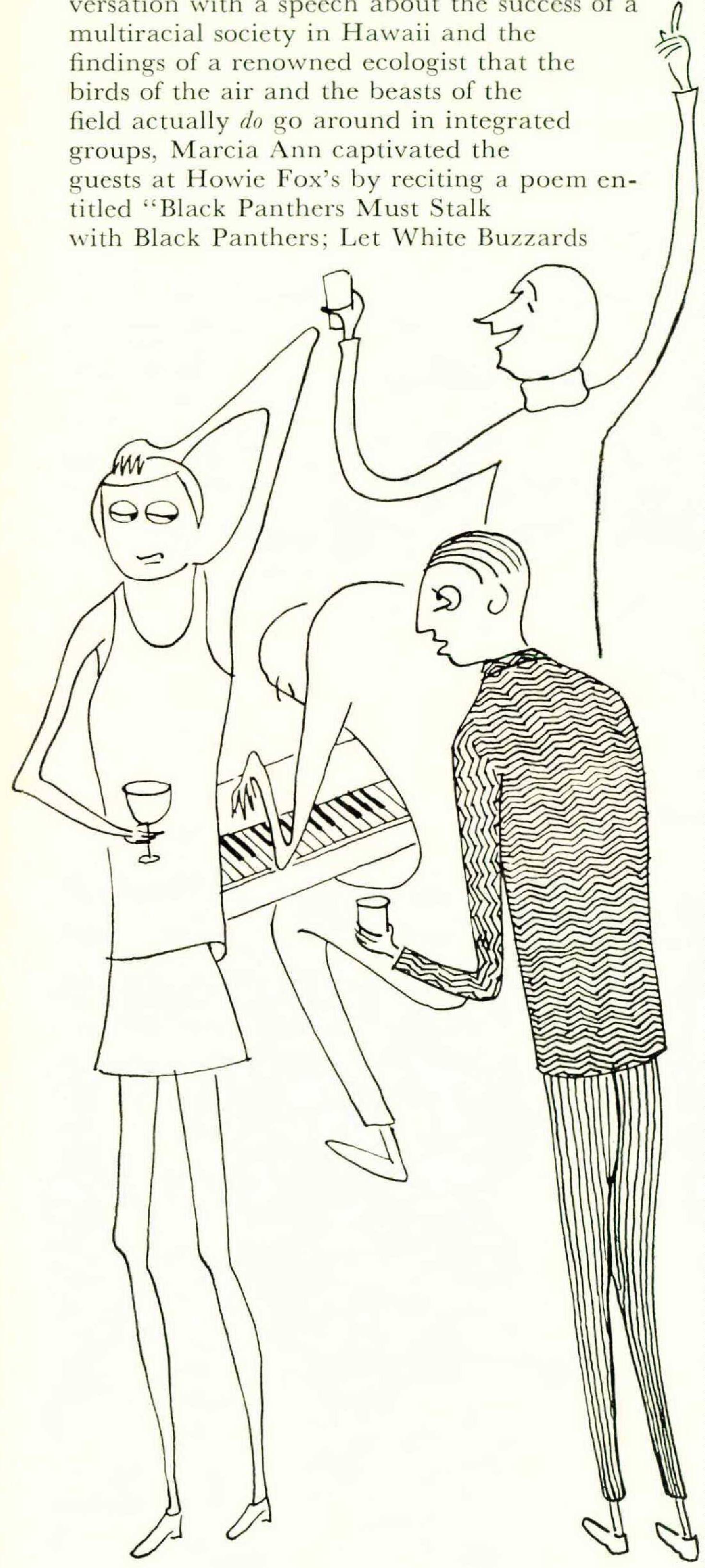
Keep to Their Flock.” At one point, Lester felt pretty knowledgeable about an insurance company’s project to create jobs for Negroes outside the ghettos, and at that point Marcia Ann let it be known that the only economic answer was to provide investment capital for Negroes inside Harlem. Lester immediately began looking into investment possibilities, and finally, months later, he was able to announce at Howie Fox’s that he had joined a group of young white businessmen who had gathered together to back a Negro clothes designer and a Harlem dress store in a new line of maternity clothes called “Mother Jumpers.”
“How does it feel to be a neocolonialist?” Marcia Ann said.
“It’s impossible to keep up,” Lester said to Wendell Hammer one night. “Whenever I was about to quote Martin Luther King, she was quoting Malcolm X. When I got the people in my office to sign a resolution against the poll tax, she had already persuaded her friend Marlene Golbhelder to start a Crispus Attucks Chapter of Hadassah in Larchmont. The other night, I was about to tell her about my Frederick Douglass poster when I noticed that she was wearing a button with a picture of Menelik II of Ethiopia. I don’t know where to go from here.”
“Why don’t you invite her over for dinner?” Wendell asked.
“I don’t think this is a time for joking,” Lester said. “Why should she come to my house for dinner?”
“I think she’d come if you told her you were having a bunch of militant spades,” Wendell said. Wendell was considered by far the most sophisticated of Lester’s acquaintances in racial matters, having freed himself from white middle-class guilt to the extent of being able to refer to Negroes by what Marcia Ann had formerly referred to contemptuously as “derogatory racial appellations.” Wendell had, in fact, suggested that Lester do the same if he wanted to impress Marcia Ann, but Lester couldn’t bring himself to use the words — although once, desperate to be noticed, he had mumbled something about “darkies,” but too softly for anybody to hear.
Lester decided to follow Wendell’s advice. He turned for help to his only Negro friend, Wash Jefferson, an advertising man he had met in the Army. “I don’t know what you see in that girl,” Wash said, when Lester presented him with the plan. “Surely you’re not impressed just because she has the only natural-blond Afro haircut on East Seventy-Fourth Street?”
Lester Drentluss was introduced to our pages last January. His creator is a frequent contributor to the NEW YORKER and other magazines.
Lester didn’t know how to explain his feeling for Marcia Ann. What could he say, except that he was willing to sit through a four-hour debate on open-housing ordinances just for the opportunity to catch a glimpse of her? There was no way to describe what he felt as he stood in the rain in front of the school-board building and watched her pass up and down with a placard saying “Go Back Where You Game From, Honkies!”
“Oh, what the hell,” Wash finally said, as Lester looked more and more dejected. “I’m probably just overreacting to that time she lectured me for not knowing more about the contribution of the Negro cowboy to the development of the Southwest. I’ll do it.”
Within a few weeks, Wash had managed to collect dinner commitments from a biographer of Marcus Garvey, two young Negroes under indictment for criminal anarchy, a Liberian accountant who was also a poet, and the cousin of the first Negro Lincoln-Mercury dealer in New Jersey. Lester planned to have the dinner catered by a midtown soul-food restaurant. That left only the problem of how to ask Marcia Ann. At first, Lester thought he might say casually, “I’m having a few people who happen to be Negro over for dinner next week,” but then he remembered that Marcia Ann despised people who said “happen to be Negro” — as well as people who said “Negro.” He thought it would be better to say “black.” How about, “Say, I’m having a few black cats over for dinner”? But “black cats” sounded ambiguous. He still was not sure of his approach when he went to Howie Fox’s next party in hopes of being able to put his invitation to Marcia Ann.
“I’m going to ask her tonight,” he said to Elliot Bendel, the first person he saw as he walked in the door.
“Ask who what?” Elliot said.
“Ask Marcia Ann to dinner with some militant colored people,” Lester said.
“Haven’t you heard?” Elliot said. “Marcia Ann just fired her Negro maid for being willing to work for a white. And she cut Wash Jefferson dead on the street this afternoon. She says that any Negro who has no more self-respect than to talk to a honky woman is not worth talking to.”
Lester had a drink with Wash the next night. “I probably wouldn’t have had the nerve to ask her anyway,” Lester said.
“Forget about her,” Wash said. “Let me tell you about some of the more bizarre contributions that Negro cowboys made to the development of the Southwest.”
“Actually, I really don’t think it’s that bad for you to talk to me,” Lester said. “Although naturally I would understand perfectly if you preferred not to.”
“As a matter of fact, I’m so filled with selfloathing I can only stand to be around someone as guilt-ridden as you,” Wash said.
Lester knew he would have trouble making the adjustment from being ashamed of having only one Negro friend to being ashamed of having a Negro friend, and he and Wash decided to continue to have a few drinks together regularly — although Lester planned to have the drinks in bars where there was no chance of being seen by anyone who knew Marcia Ann Grentner. There was no danger of being seen by Marcia Ann herself. Lester had learned from Elliot Bendel that Marcia Ann, as a gesture of further support to the black struggle, no longer entered bars that served Negroes.