Jerusalem
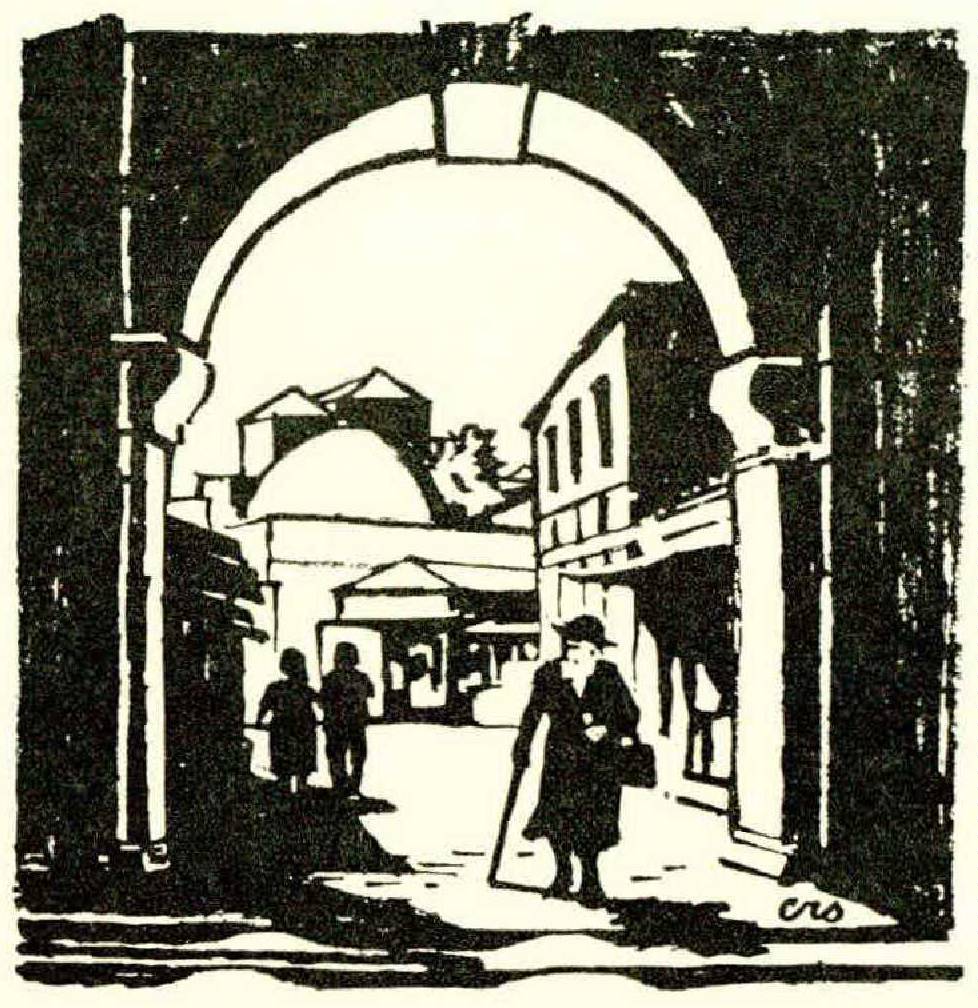
Peace remains elusive in East Jerusalem and the West Bank of Jordan, conquered by Israel a year ago. The twentieth anniversary of Israel’s birth and the end of the first year of its occupation of all of Palestine have passed. It has been a season of celebration, and the government has made every effort to feature its twin victories. But there is no peace.
On the bright side, the barbed wire is down in Jerusalem. It is exhilarating to move freely both ways — into the western side of the city, where modern Israeli buildings line the hills surrounding the core of central structures left by the mandate government, then back into East Jerusalem, where another new town has grown up outside the walled city under Jordan’s rule since 1948.
There is much movement between the two sides today. But there are invisible barriers too. In spite of Israel’s annexation of greater Jerusalem last June, and even with the best efforts of Israeli Mayor Teddy Kollek to integrate the city’s people, there is a gap. The atmosphere in the western city is that of Mediterranean Europe, with Eastern touches. The other side of the city remains a capital of the East, following the pace and rhythm of its natural Arab hinterland. Of 70,000 Arabs resident in this Jerusalem up to June, 1967, about 5000 have either left or were absent at the time of the Six-Day War. The rest remain, tentatively accepting Israeli control but regarding it as occupation rather than a natural condition of life.
This view of themselves as passive guardians of their Jerusalem is sustained by repeated affirmations from both East and West, and from the United Nations, that unilateral Israeli measures cannot alter Jerusalem’s international character. Each time the issue is put, the hopes of Jerusalem’s Arabs rise. But they admit freely that this international interest is not very concrete and that they may have a long wait before resuming their position in the city as the representatives of Christianity and Islam.
Blueprints
Meanwhile, in the western city Israeli planners are speeding blueprints for new housing for Jewish settlers and putting some government functions into East Jerusalem. The Ministry of Police is being moved from Tel Aviv to the new Jordanian government hospital building. At the same time the Israelis have expropriated 838 acres of land owned by the Jordanian government and some private owners. This property runs from Mount Scopus to the former armistice line adjacent to the Sanhedrin sector of Jerusalem. Here 1000 housing units for Jews and 400 for Arabs removed from within the walled city last summer will be built.
The housing scheme was envisioned in a master plan for greater Jerusalem drawn up for the mandate government in the forties by Britain’s Henry Kendall. Much of this plan has been followed by the Jordanian government in its own reconstruction and extension of the city since 1948. The result has been the harmonious pattern of housing extending almost to Ramallah, faced with or built with local stone, and kept at low heights to preserve the approaches to the city. The same urban planning guided Jerusalem’s last Arab mayor, Rouhi al-Khatib, in undertaking reconstruction at the Damascus Gate to the walled city. Excavation was completed before the Israeli take-over. The Kendall plan called for a parked, wide approach to the Old City. Here Mayor Kollek has indicated that he will follow the same general plan and extend it.
Mayor Kollek has suggested that an international rescue operation in the style of those carried out for Abu Simbel and the city of Florence should be begun for the Old City. He believes that the secular antiquities of Jerusalem deserve the same sort of worldwide support. Implicit in this appeal is the recognition that Jerusalem has great archaeological as well as religious significance. As Kollek points out, “The secular sites are part of the cultural inheritance of the whole world.”
Exclusive
The Israeli government has not yet faced the full implications of its political annexation of all Jerusalem for world religious interests there. In the census taken late in 1967 it was found that there were 65,857 residents in East Jerusalem of whom almost a third lived inside the walls of the Old City. Of the total, 82 percent are Muslim, 17 percent Christian. It was one of the glaring mistakes of the Jordanian regime in Jerusalem that it excluded Jews from the Old City when it gained control in 1948. Today there is an effective exclusion by the Israeli conquerors of Muslim pilgrims. In the absence of peace treaties, no Muslim from the Arab world will be able to make his way to Islam’s third most important shrine, the Mosque of Omar. There are many hurdles to peace between Arabs and Israelis already. The effective isolation of Islamic holy places adds another. The chorus of protest from Saudi Arabia and Pakistan has already begun.
Christians may find it easier now to make their pilgrimages to the holy places since they can enter without restriction from the Mediterranean side. The ecumenical movement, which has begun to bring some rapprochement between Christians and rabbis, may possibly further Christian acceptance of an Israeli-controlled Holy City. But it is too soon to say; there are inauspicious signs. Christians did not flock to Jerusalem as usual last Christmas. Even the Easter celebration had a subdued flavor this year. The Vatican has not accepted the change, does not recognize Israel diplomatically, and has so far refused Israel’s offer to cede to it control of all Christian shrines in Jerusalem and Bethlehem.
Two UN resolutions on Jerusalem in 1967 cloud Israel’s title to Jerusalem. They called on Israel to rescind all measures taken to alter the city’s status and specifically enjoined Israel from unilateral action. London and Washington have been equally opposed to foreclosing the situation in the city, which President Johnson has described as being “over and over a center of conflict. . . . Men of all religions will agree that we must now do better. The world must find an answer that is fair and recognized to be fair.”
There is no real communication between Israel and the rest of the world on this matter. In the euphoria of victory a year ago all practical considerations were swept aside. By conquest Israel increased its territorial control in Jerusalem by two thirds. It acted at once to consolidate its rule by moving the High Rabbinical Court to East Jerusalem, assuming jurisdiction over Muslim religious courts and over the content of sermons in mosques. The Arab Municipal Council found itself dissolved. A customs barrier was set up for goods coming to the city from the West Bank. Arab families were uprooted from the former Jewish quarter of the Old City, as Jewish families had been in 1948. Many of these families were part of the early summer exodus to Jordan. They left knowing that they could not return, a condition for any Arab Jerusalemite today.
Business controls
By fall Israel had extended control to nearly all business throughout the city. Arab doctors could practice, but patients had no money to pay. Arab banks remain closed because Amman will not free them from connections with their home offices there. Arab hotels have a sprinkling of guests where formerly they were full. Distribution agencies for overseas goods have been taken over by Israeli firms. An inventory tax, retroactive to June, 1967, was immediately imposed, along with licenses and taxes at rates prohibitive in Jordanian terms.
It was the abrupt imposition of such taxes and restrictions which made adjustment impossible for East Jerusalemites. Income tax rates hit everyone. The Israeli rate after the first I£ 800 goes up steeply to 60 percent. Thus a man with two children on a salary of I£ 1600 a month pays I£ 500 a month in income tax. Charitable institutions are likewise now subject to tax.
Inevitably some Jerusalem Arabs were driven out, moving to Amman, where they have access to their bank accounts even though employment prospects are dim. Once they leave Jerusalem they forfeit their real property, which is tagged as absentee and put under an official property custodian. There is no return to Jerusalem and no recapture of property once an owner leaves.
Those who remain face unemployment and uncertain status. They may now be offered Israeli citizenship, which means conforming strictly to Israeli ways. Arab lawyers in Jerusalem, for example, must pass a bar examination in Hebrew within two years. This stipulation, plus the removal of their appeal courts from the city, has caused them to refuse to practice.
Grip
It is possible to interpret these measures as a sort of shock treatment to impress on the world Israel’s unyielding grip on Jerusalem. But from the point of view of long-term relationships the Israeli take-over in Jerusalem raises many questions. Arab leaders there differentiate between a military occupation, such as that in the West Bank, with which they cooperate, and the civilian incorporation of their Palestinian capital city into Israeli Jerusalem. Their position was explained to the personal representative of UN SecretaryGeneral U Thant last September when he visited Jerusalem. Ambassador Thalman reported that the Palestinian leaders regarded this incorporation into the Israeli state system as a violation of the acknowledged rule of international law. Under such law occupying powers are prohibited from changing the legal and administrative structure in occupied territory and they are required to respect private property and personal status. This reference to the Geneva Conventions on occupied lands has been repeated with increasing insistence as the months have passed and has been used in the latest protests from Washington against Israeli policy in Jerusalem.
Political debate within Israel reflects uncertainties in the government’s position on overall occupation policy but little argument over shaping Jerusalem to Israel’s desires. Only a rare leftist dissenter questions the annexation of the city and the drastic steps being taken to consolidate victory. But West Bank policy is a subject of frequent and troubled dispute.
It cannot be otherwise. For how shall Israel continue to assure its security within its greatly expanded borders and still deal with nearly a million Arab Palestinians now within its jurisdiction? Many approaches have been considered. One is a return to the partition idea of a Palestine entity on the Jordan River’s west bank. But such a creation would have to be demilitarized and kept from returning to Amman’s authority. Its possible role as a bridge to the Arab world appeals to many Israelis. But how can they be sure that it will not become a bridgehead for nationalist subversion directed against them? They cannot; and so the idea has been dropped. This leaves them with the conflict between territorial safety and demographic purity.
Territorial imperative
Looking at the map of Israel’s conquests last year one sees the Jordan River as what Prime Minister Eshkol has recently called Israel’s “natural border.” To the north another conquest has put Israel in control of Jordan headwaters at Banyas and along the Yarmuk tributary where Jordan had the important Mukeibeh Dam under construction. Thus control of West Bank water resources is now in Israel’s hands. It was access to this water, plus use of financial remittances from Palestinians abroad, which made possible the revolutionizing of agriculture in the Jordan Valley in recent years. Both the water increases and the remittances are suspended in this productive region while its status remains unsettled.
It does not reassure Jordan Valley farmers here to learn that Israel contemplates a live-year plan for West Bank agriculture designed to fit it into Israel’s own production. This looks to them more like a prolonged occupation and eventual annexation.
Even while the political debate within Israel goes on, administrative changes indicate the popular view. When the status of the conquered areas was changed last February from “enemy territory” to “militarily occupied territory” and the old biblical names for Samaria and Judea came into official use, it looked in Arab capitals as though Israel had already chosen the territorial imperative and postponed the demographic problem. Perhaps the change was designed to spur the Arabs into peace talks. But it worked the other way, and the UN’s Ambassador Gunnar Jarring, special representative of the Secretary-General, found his efforts to start negotiations blocked once more.
If even indirect talks cannot be achieved Israel will inevitably tighten its hold in occupied areas. This in turn will lead to further Arab resistance and possibly to the collapse of the Jordanian government. King Hussein can only survive now by tolerating the Arab commandos along the Jordan. It is held by many observers that it became impossible for Hussein to contain this raider movement after Israel’s massive spring attacks in East Jordan. At best his government may be taken over by militant Palestinians (as Syria has long hoped). These leaders, with so little left to lose, could well agree to the Syrian proposition that only an Algerian-style struggle can finally free Palestine from its Israeli masters.
Fatalistic duel
Such a prospect explains the anxiousness of the great powers to put a damper on the guerrilla exchanges along the Jordan by the interposition once again of UN observers along the cease-fire line. Both Jordan and Israel object to this. Both seem to be opting for a fatalistic duel of wits and arms along the line. The dangers of this contest are obvious. Now that the young guerrillas have tasted action and found, as one of them put it, a “purpose” in their lives, it will be doubly hard to hold them down. The Israeli Army and Air Force could simply take the East Bank, of course. But sane minds in Israel boggle at the prospect after that. King Hussein remains the key figure in this frightening tangle. He can still talk to East and West, and he remains a symbol to many Palestinians.
In all of this turmoil the civilian victims have once again had to retreat. Some 300,000 refugees from the West Bank and Gaza have moved farther and farther east. Among them are hundreds of youths from Gaza, unemployables made to order for guerrilla training. As the hopelessness of the refugee population increases, the pressures on Amman become crucial.
It would be tragically ironic if Israel, whose own commandos of the forties succeeded in driving the British from Palestine, should itself be confronted now with a concerted Arab activist movement. At the minimum such activists in occupied territories would disrupt civilian and economic life, frighten away tourists, and reduce all chances of reaching a modus vivendi in Jerusalem and the West Bank. It occurs to some Israelis now, and to some of their friends abroad, that one way to check this danger is to yield somewhere, to make the first peaceful gesture. Such a gesture would be hard for Israel to make. But it alone has the power to break the present impasse.
Israel is the only country in the region with any positive choices left. It could restore its aim of coming to terms with its bitter neighbors. It could still start in Jerusalem, with a fresh look at the condominium idea being put forth among church leaders. Or in the Jordan Valley, where most of the Palestinians are still in their “home” and only need to feel secure there.
REPORT CONTRIBUTORS
Elizabeth B. Drew writes regularly from Washington for the ATLANTIC. Loren Jenkins has been an American correspondent in Spain since 1966. In future issues, as in this one, some reports will be unsigned at the request of their authors. The ATLANTIC, of course, assumes responsibility for them.