The Collector
A Story by JESSE HILL FORD
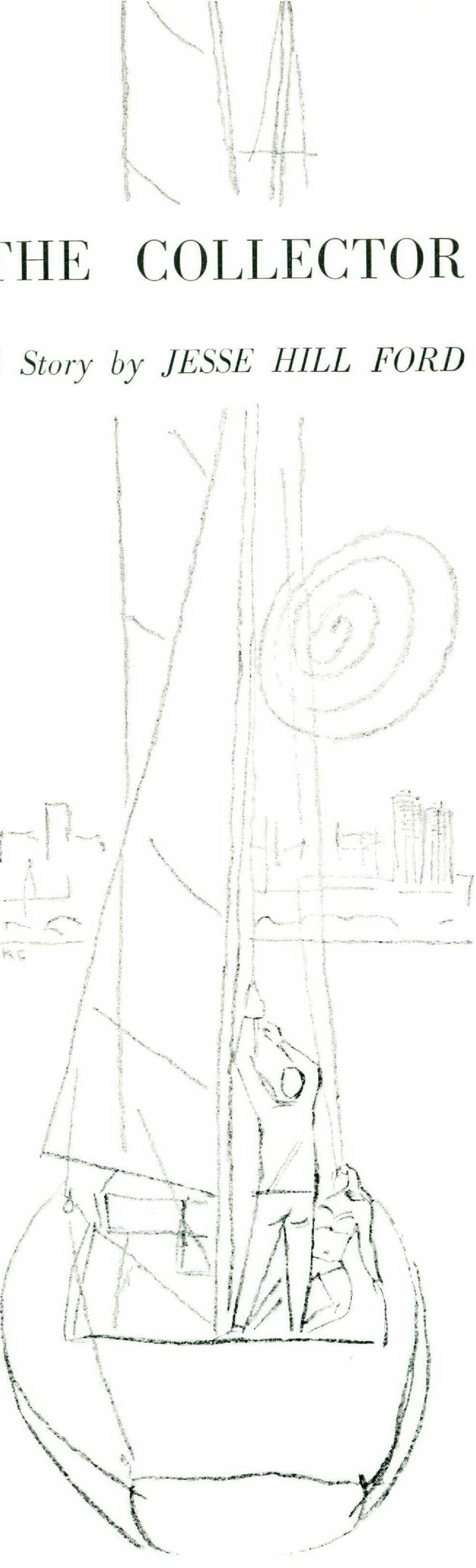
EASE the mainsheet,” I say. Almost a whisper. My girl says something. Somebody laughs. My friend Murray comes from belowdecks with a beer.
On my boat everything is clean, everything shining and white, and I am thinking as usual that we could sail on and on forever. Never grow old. Never grow tired — if only the world were made so you could put two happinesses back to back and hold them there forever. I mean Chicago and the summers.
Behind us Lady Chicago at rest and her towers rising like beautiful arms against a bowl-blue sky. Anytime it pleases me I can look over my shoulder and love her with my gaze. At this distance a few miles out beyond the breakwater of Chicago Harbor, the wind has started gusting. The great silence even at so short a distance from the city has begun to be buckled by slapping waves and the hushed sound of shearing water.
“Forty-three feet,” says Murray, who is not very familiar with sailboats. “You could go anywhere in the world.”
As usual we come about just before nightfall. On the return tack the wind is up and we run close-hauled; the whitecaps are running and the boat starts to drive and roll, drive and roll — she’s like an antelope. Nightfall then. And Chicago ahead of us in mounds and soft strings of precious gems. The boat herself nothing jealous goes on driving and driving home eagerly until, as always happens just inside the breakwater, inside again, we get the sudden flat-water calm, like sudden, beautiful death.
“Once I knew of a poem that called Chicago a hog butcher,” says Murray. “Either this poet never knew the lake or else he was trying to be cruddy at Chicago’s expense. But I tell you she couldn’t care less.”
I have begun thinking of my niece Alabam who wasn’t really my niece but was some kind of cousin to my first wife. This girl — this very nice girl who came straight out of Alabama to Chicago.
Alabam. Probably she was beauty queen of Jasper, where my first wife was from, and Alabama girls can be beautiful as I am already aware because I married one. Presently I’m telling Murray about it again. I see the glow of his cigarette in the darkness. He listens and again I’m telling him about this girl Alabam.
She of course knew of me, and whereas my first wife didn’t really feel she had room for the girl, wasn’t positive, so to speak, that an apartment hotel on the Near North would be the right brand of environment for a tender chicken just lately out of Walker County High School, it was arranged as follows. After I met Alabam she came to live with me and my third wife.
Listening, Murray has reason to know already that my present wife comes from near Chattanooga and that she was first married to an Italian sadist. Garlic boy made her marry him. Then he tortured her all the time — a beautiful girl scared witless of this bum. He was two bits worth of highly seasoned grease, that familiar kind who swaggers around beating up women — girls.
About two weeks after we finally get my third wife’s divorce from the Italian, I was having to keep my bride in a downtown hotel. The wop was making threats. We got the obscene phone calls. Everything nasty he could dream up and everything getting very, very unreasonable. I’m also keeping both former wives and all the wonderful children in downtown hotels. Had to take the children out of school. You name it. The gentleman was trying to drive me crazy.
Ten cheap miserable days of this and they found garlic boy in the trunk of his automobile in a nice leakproof plastic bag; but as to who did it or why — you tell me. I always say that, and I have to assume that somebody who knew me and was aware of the whole ridiculous situation — somebody who liked me decided that somewhere along the bus line this kind of ridiculous garbage had to be disposed of.
A month after that here comes sweet little Alabam to Chicago. My first wife, with whom I’ve remained friends, introduces me to the girl, and I take Alabam out on the boat a couple of weekends. She wears a nice bathing suit. She’s beginning to learn the language — getting rid of the you alls and the ah-moes, ah-moe bah mah seff a new dress; ah-moe come long sailin’ with you Be-yul dahlin' sho, co’se ahm comin’ sweet hot.
I don’t have it in for the South. Don’t misunderstand. I married three of them after all. That should prove something — but the point is Alabam was learning that the letter “r” actually appears in the alphabet, whereas when they first get here it’s as though they learned to talk on a twenty-five-letter alphabet. Yet the smart ones, the good little broads like Alabam, pick up the American language pretty quick.
She was making progress, and I said to my first wife, I asked her why Alabam shouldn’t come up north with me —meaning me and my third wife because we have a house in Wilmette and whatthehell rooms to spare, so what’s another mouth to feed, I say; or another way to say it would be why not be generous if you can help somebody? Besides, Alabam wasn’t at all bad-looking. Beauty never hurts.
ALABAM moves in. My third wife Margaret Ann who wasn’t pregnant yet for the first time, she likes Alabam. They seem to hit on most of the same cylinders, so I tell myself Chattanooga must be close to Alabama because pretty soon the girls have their knees together all the time drinking margaritas, and Alabam catches on to the fact that we’re pretty civilized here in Chicago after all.
So Margaret Ann says, why shouldn’t Alabam go to school? How about some college for her? They’ve already talked it over with my first wife. The three girls have it already decided before they come to me with the idea. I hesitate, but it gets to be like a tack driven into the roof of all three of their mouths. Alabam should go to college. They don’t have the money, and God knows nothing green is ever in any of the envelopes coming out of Alabama, where, I suppose, all the beautiful broads like Alabam are raised for export. Down there they have pride; they have this great long family tradition about the waugh (the waugh is the Civil War, which has been over so long that most of the rest of us don’t remember it). But get south where I have never been, if you want to discount Miami, go below the Mason-Dixon, where I never intend to go, and the atmosphere is so heavy with shades of that waugh — well I tell them they seem like they have grits and banjo strings running out of their ears. I ask them: “Do you really think that waugh ended last Thursday at one P.M.?” That can serve to jar them out of it sometimes. As a general policy, though, I avoid mentioning war in their presence.
What the hell. Finally I put her in school. Here’s a girl with brains. She can wear clothes. She wants an education.
We buy her some decent clothes. I give her a car. Alabam goes to school and time passes thus, with Alabam driving down to Evanston every day. She lets her hair grow out long like Margaret Ann’s until I can hardly tell the difference between them. Alabam has the lead on my wife by a few years — that of course. With Alabam’s hair long they could be sisters. It’s a happy time.
Nights when I have a date, Alabam is home to keep Margaret Ann company. Nights when I don’t have anything on, the three of us go to some decent place. We have a few drinks, some food, some laughs. I like to dance. It’s almost two broads for the price of one.
Another beautiful summer. By now Alabam’s a sophomore making her grades. She and Margaret Ann work to get all-over suntans. They talk me into building the sauna. We have the sauna going. Here I’m in the house with two golden beautiful women but straight — all on the up and up; maybe I’m kidding Alabam a little, but no bouncing around. The girls have become such friends. Then—? Boom!
Downtown at my office one morning, down in the Loop, the phone rings.
Margaret Ann: “Come home right now.”
“What?”
“Because it’s Alabam, she’s sick. I made her two margaritas. She drank both of them. She’s still sick! I think she must be running a terrible fever. I don’t know if she might be very serious or something !”
All the way from the Loop to Wilmette, standing on the accelerator. My heart beats so it gives me a headache. I get there. Margaret Ann has put the girl in the sauna and given her another margarita — still no help. So when I phone the doctor and tell him the outline of the symptoms, he says get her in the car. Come straight to the hospital.
It cracked down on us — thunder out of a clean sky. They put her in a room. They started throwing drugs into her. Margaret Ann starts crying. The doctors have to tell us that Alabam may not make it. Then they tell the rest. The whole trouble is that the poor girl has had a cheap abortion.
“Alabam,” I’m saying, “Alabam, why didn’t you come to me?” I take her hand, feel the illness in her, burning her up, killing her. “You think I’m going to blame you if you got slightly knocked up?”
“Ahm sorry. Awful sorry, Bill,” she says. Sweat floods her face. Lying helpless, she’s almost dying, and here she goes apologizing to me and the doctor comes in and wants me out of the room. The nurses move strangely. The nurses too are worried.
“Who is he?” I ask.
“Just a guy. It’s mah fault much as his, Bill. Ah didn’t wanna be any trouble.” Sick as she is she tells me the whole lousy story. It’s so cheap, so tawdry and sickening. She’s half dead in that hospital room, dying in the biggest best room on the best floor. But we haven’t been there ten minutes it seems until they start moving the flowers in out of the hallway from every friend I have in all the Chicagoland area. Finally it takes one nurse her full time just to water the flowers and arrange them while Margaret Ann takes off the greeting tags to make a list so we can send everybody a telegram of thanks. Which is the meaning of friends. They come to your aid at such a time, when you are receiving a blow like that.
Just when we think she’s all right Alabam has a reaction to the drugs. She takes a nose dive. She’s like a beautiful craft about to be splintered unnecessarily against a piling, already taking water, and I get such a feeling. I don’t know what to do. I can’t drink; can’t eat; sleep is out of the question. I spend so much time at the hospital my belt runs out of notches. My clothes hang on me. My eyes get so big it scares me if I happen accidentally to look in the mirror. I haven’t shaved. I’ve been crying. It’s like my nerves have begun to eat up my guts.
So I asked Alabam one day, I said: “Who was it?”
By now she’s so far gone she’s gotten very quiet. When she talks, it’s from the strange midst of her waking and sleeping. She knows. She’s very close to the big one, and she’s having such a lousy time she really doesn’t care. She gives me the bum’s name. Between sleeping and waking bouts she tells how he stood her to a cheap hundred-andfifty-buck nigger abortion. I keep asking myself, can this be me this is happening to? Can practically a member of my own family be dying because some stupid jack-off college bum dug down for a lousy hundred and fifty bucks after he had knocked little Alabam up? Now he’s killed her on top of that?
Next day I pulled myself together. I went down to the office and called him. I told him the good news, that thanks to his cheap ideas and his morals, which must have been manufactured out of dog manure, thanks to his preference for nigger abortions, that a beautiful girl named Alabam is dying a very slow death.
“What can I do?” he asks. “Let’s say I’m sorry about that,” says he. He hangs up in my face. That dial tone runs through me like a hot spear.
I dictate a letter dear mister Calton in view of the circumstances the very least you can do is pay for the medical expense—blah, blah, blah — but very nice. Very nice.
No answer. My secretary calls him. He shafts her with a couple dozen dial tones. Mister Calton is a pretty character as I discover when I go to the school personally. I go through the whole routine. Having him looked up, making an appointment — all just to talk to him.
He’s the beard and blue jeans brand. The new type of old tennis shoes college bastard. We have quite a talk. I’ve got good news for him by now. Alabam is out of the hospital and she’s getting well. In fact that very day she had had her first margarita. Which is how I remember it so vividly.
“Well, nice,” says Mister Calton. “I’m very glad she didn’t die.”
I’m wondering who the Christ he thinks I am; what the hell he thinks I’m made of — cheese or something?
“The hospital and the doctor came to fifteen hundred in all,” I tell him, and I show him the entire bill itemized and marked paid. I show him my canceled check for the entire amount.
“Let me talk to my father,” he says. “We’ll send you your money.”
As will happen sometimes, my heart begins to lift a little, to be filled again like a sail that’s been hanging slack. I can eat; I can sleep; I watch the girls drink their margaritas and play cribbage. The sauna is a special help now for Alabam. I witness the return of the old happiness in our household. I get them a couple of pooches, some poodles, and get each of them a kitty cat, the very best of both beasts. Alabam is ready to decide if she will try the same school again or go to another one when it suddenly dawns on me. Three months have slipped through my fingers. No fifteen hundred dollars. No word, not even a murmur from Mister Calton.
So now I take the time and the trouble to locate his father. I write them both, father and son, a very nice letter enclosing copies of the bill, copies of my canceled checks, the letter politely explaining the situation in full. All I want is my money —no interest on it, no baloney. Just a nice letter to the both of them on the right kind of correct light-blue stationery.
Papa Calton’s address? Way the hell out west somewhere in the boondocks. That should have served perhaps to warn me — well, it didn’t.
Margaret Ann is pregnant now. She’s taking mother-baby vitamins with her margaritas. It’s a very nice time for me because starting a new family is like starting a new business or going on a vacation when your plane lifts from the runway at O’Hare. In your mind’s vision you see Acapulco and L.A., you see Vegas or maybe the Islands —• beautiful, exotic. So what if you have busted forty? It’s like starting a new series of exercises down at the health club or taking flying lessons. I look at Margaret Ann’s little belly, round and gold and just starting to show, and a voice comes out of my guts and speaks to me and tells me: “You did. that. Inside there that life —you did it. You procreated.”
The utter fulfillment for a man. As long as he can keep procreating, life will sing for him.
Alabam’s practically built back up to normal and looking better than ever when I get a phone call. It’s Papa Calton. Right away when he starts talking, I know the type. Chicago is loaded with Papa Caltons. The world is all too full of them. You can’t mistake them because each has a mouth that weighs two hundred pounds, give or take two ounces either way.
“What is this and who the hell you think you are writing me letters telling us we have to pay that little whore’s hospital and doctor? You think Jimmy was the only one?”
“If he wasn’t, then why did he try to kill her with a cheap, lousy, hundred-fifty-buck abortion then?” I says.
“Look, bastard,” says this heavyweight mouth champion. “I don’t know who you are. I never heard of you — understand me? Your name means nothing to me ! And right now as of now I’m telling you, whoever you are, whatever you are, that my son and I don’t intend to make a career of paying the hospital bills for all the whores on the Evanston campus, including that little hooker you’re living with — ”
I let him talk. Then, very quietly: “I think you better pay it.” Almost a whisper.
He unloads another collection of garbage. Me: “I think you better pay it.” He calls me a couple of names. That’s the end of the conversation.
Next day I write Papa Calton a polite note again: dear mister calton in spite of your conversation last evening I think you have a moral obligation to pay, et cetera.
By now we’re getting to the end of the sailing season. Soon the boat comes out of the water to go into storage. Alabam is on my side for talking Margaret Ann into a winter vacation for the three of us. Alabam can get her health back before she tries school again. If she decides on school, I’m telling Alabam I just want one promise that she will keep her legs crossed, or barring that that she will either reproduce or do something besides let a nigger operate on her with a rusty coat hanger, but of course this is put to her as a joke, in a very polite way.
MURRAY came on the boat that next Saturday with his girl. I left the girls at home in Wilmette, happy, drinking margaritas, and plotting out the vacation for November. I had my new girl, Lois, a nice honey blond from Cincinnati. It was the weekend with Murray and his girl at the time — a very nice high-bred young Italian girl named Maura — Maura and Murray — that’s perhaps what first appealed to him when he met her. Although Murray’s well into his fifties and Maura’s just twenty-five and just about two months out of her first divorce, it’s had the makings of a very nice arrangement. Maura’s living in the same apartment building with Murray.
We left the mooring at noon sharp. The girls were below fixing lunch. We passed the breakwater. It was one of the very fine days that come always near the end of the season, cool without being cold and the wind fresh as ice and the sky so blue it’s like the almighty God is plotting to break your heart like a plate, on the pure hard beauty of the occasion. All sailing is good; but late-season sailing is always best. In October the boat has an urgency about her. It’s as if she knows it, as if she realizes the yard is there waiting for her and she must submit soon to that long winter sleep and she wants you in her and with her, wants to contain and cuddle you these last few days before the two of you undergo the terrifying little separation that will make you both seem like strangers when you meet her again next spring. And always, underneath it, wearing at both of you — yourself and your boat — is that nagging possibility that something else will grab you meanwhile. She might get traded in on something bigger, something more boss, and the next time you see her after this October she might be at a strange mooring. The new one will be under you, and something passing for sadness will slide through your chest for a while every time you pass her riding there, awaiting her new owner.
Thus October sailing is exciting and it’s frantic, and I’m thinking that as soon as the girls get the chow served and I can find a safe steady course that Murray can manage without too much trouble — maybe Murray and Maura together — then I can go below with my new girl because the urge is there like a pressure. Looking down now and then through the hatch I can see my new girl, Lois — a glimpse of her hair and the nice shape of her face and her smile when she throws her head back a certain way — she’s very classy. She has the lines of an aristocrat, nothing cheap about her.
“What you thinking?” says Murray. “You looking sad.”
“No. I’m fine,” I say.
“Beautiful, beautiful,” he murmurs. The boat and the weather, everything has begun combining to get at Murray. He gazes back at Chicago. “God,” he says. And then: “Business is OK?”
“Fine with me. You?”
“Business is fine,” says Murray. “And nothing’s troubling you? How is Margaret Ann?”
“Pregnant and beautiful,” I say.
“That Alabam — she’s some beauty,” Murray says. “I don’t see how you stand it all together like that in the same house. She’s getting OK from her trouble? That you told me about last time?”
“Oh, fine,” I say, thinking about Lois. Just then I hear her laugh. I let out the mainsheet a little and trim the jib. Then I come to port a couple of points and set the boat on a broad reach.
I explain a little to Murray about the wind indicator and the compass. Then I let him have the tiller.
I can tell he’s slightly nervous, but of course for my sake he’s willing to sail the boat at least long enough for me to go below with Lois. I tell him Maura will help him.
Murray nods. “Did he pay you?” Murray says.
“Who?”
“The son of a bitch,” Murray says. “And his father. Alabam’s medical expenses — the fifteen hundred?”
It came back to me. Rushed at me a little. I shook my head. “Not yet,” I told him.
“Let me try a thing or two,” Murray said. “Haven’t you been nice and patient long enough?” “I don’t know,” I say.
“Why not leave it to me for a while until I call you? You’ve done me favors. Maybe I can do you a favor. OK?”
NOTHING more was said. The girls came up to the cockpit about then. We drank a beer and ate the shrimp salad and the skinless Portuguese sardines and the corned beef sandwiches. Lois sat so her hip rested against mine while she looked at Murray and Maura the whole time. She talked to them without looking at me, but her hip of course was telling me without words everything a man wants to hear from a beautiful girl. It had already been agreed. Lois and I would go below to the cabin when we finished eating, so of course Lois talked a lot and ate very slowly, and the motion of the boat kept rubbing her against me; the round curve of her against my hip where she sat half turned, never looking at me, and creating the luxury (which is the best part of any illusion) that you’ve got all the time there is in the world when just the opposite is the truth . . .
Finally the plates went overboard. Murray opened my marlinespike and punched holes in the bottom of the beer cans the way he had watched me do it. The cans went over and were washed under, making their way down and down slowly to the lake bottom through the clear, clean water.
Murray took the tiller.
Lois paused a moment with her hand on the hatch. She looked back at me and her head went back and she smiled and the wind moved her hair, making shadows on her face. Then she went below.
“We’ve got it, Bill!” Maura said. She had taken the tiller. Maura was enjoying the moment too. Our happiness must have entered Maura the way happiness sometimes can. “Go on — I’ve sailed — more than Murray!”
I went below.
We took a very long time. I held back and delayed her, holding off, holding back and putting off the final moment just as she had dawdled over lunch, delaying and delaying the same way until her legs finally caught me. I felt all her strength begging me. Then and only then. I let her draw me down. The waves slapped and rushed against the bulkhead beside us. Toward the end she moaned, finally she cried out; her fingernails were like sharp teeth just below my shoulder blades. Her slender arms moved. She put them about my neck and pulled me down.
We lay for a long time, kissing and listening to the water. Then we sat up, she on a towel. She drew up her knees and sat with her back against the bulkhead. She smoked a cigarette and talked about her childhood, looking straight into my eyes now and then and smiling. She had fine brown eyes and a small dimple at the edge of her mouth. “I love you,” she said, now and then. I began wondering if I ought to marry her. I wanted to marry her. She was so beautiful, and the way she talked kept me smiling inside at myself. It was a very happy interlude.
Presently, after we had made love again, she tidied up. She slipped back into her tight white slacks. She didn’t wear her bra. She put on a loose-fitting blue jersey pullover with a hood and one pocket in front over her tummy, one handwarming pocket; the kind of jersey fishermen and sailors wear.
I followed her back out, through the galley and up the ladder to the cockpit. Maura had the tiller. Murray had gotten some music on the radio. The wind had died a little, and Chicago was still there like a smile on the distant shore.
Murray looked up. “About that other thing,” he said. “Leave that to me and I’ll phone you sometime, say like Tuesday.”
I only nodded. I didn’t say anything. The rest of the weekend went like a picture of paradise. We got a slip in the harbor of a club high on the north shore. Late that night when Lois and I had had a few drinks we went swimming, and it was Sunday night before we saw Chicago again.
Because I couldn’t bear to leave Lois I phoned Margaret Ann Sunday night from Chicago Harbor dock and told her not to expect me before Tuesday. “How is Alabam?” I asked.
“Alabam’s lovely,” Margaret Ann said.
We crossed the outer drive, the four of us walking together, to the parking lot. Lois and I told Murray and Maura good-night — Murray wanted everybody to go somewhere for drinks. He seemed restless, and I felt sorry for him because it was rather obvious that perhaps he was getting a little tired of Maura. Perhaps he didn’t want to be alone with her. He couldn’t help but notice, besides, that it was just the opposite with me and Lois. It may be he was a little jealous. Anyhow we said good-bye. Lois and I had the whole night then. We had that Sunday night at her place. Monday night I took her out — drinks, dancing, dinner. Back at her place afterward, in the very midst of everything going between us, she cried. That’s when it came to me that I was probably going to marry her. It was like a seed dropping, falling into a bed of soft earth. After she had cried a while we came together again. It was very strange and very strangely marvelous because she knew without my telling her that now it was forever.
Which is not to say that anything, really, is forever; but it is to say that the finest moments of all are the ones when it seems that way and you both believe it; and who knows maybe it was, because how many families can one man support no matter who he is or how hard he works at it?
ANYHOW, it was Tuesday when Murray phoned me at the office. “I broke out the picture window in the front and the picture window in the back,” Murray said. “No trouble at all.”
“Thanks,” I said. “What now?”
“Drop him a very polite letter and ask for the payment,” Murray said. “That ought to be all there is to it.”
I thanked him and wrote the letter, on blue paper again.
Thursday the mouth called me at the office. I knew who it was when I saw the button on my phone flashing. I answered. My secretary: “It’s Mister Calton? Will you speak to him?”
“All right,” I said. “Hello?”
“Get this—I don’t know who you are and I don’t care. But I’ve got friends in this town . . .”
I let him shoot his wad. Then I called Margaret Ann and told her to take Alabam and move downtown to the hotel. They didn’t want to go to all the trouble.
“Look,” I said. “You just don’t take chances. You know that from your first husband!”
Alabam came on the phone saying she was sorry about all the trouble she was causing. She started crying.
“It’s no trouble. The only trouble is if the two of you don’t do exactly what I tell you. Now move. Pack your things. Now! Take the dogs and the cats to the vet. Board them. Then go straight downtown to the hotel. Call me when you get checked in —”
They finally agreed. Maybe it had dawned on them to be slightly scared. I phoned the hotel manager, a friend of mine, and got a nice suite big enough for all of us. Then I phoned Murray.
“OK,” Murray said. “When you leave the office this evening go to the hotel. Stay there until I phone you.”
I told him I would. Then Lois called, and we talked a long time and I told her about the whole mess. I decided to leave early and go by her place for a drink first, before going to the hotel. “Why not meet me downstairs in the bar?” I said.
“No,” she said. “Come up to my place. I don’t like to share you.”
Of course I was still there, with Lois at her place, when Murray phoned much later and asked me what the hell? I told him I was sorry. I told him the time slipped by me.
“You’re sweet on Lois,” he said.
“Yes,” I said. I had my hand resting on her belly. I could feel her breathing. Her cheek was against my arm.
“Margaret Ann and Alabam are getting slightly worried,” Murray said.
“I’ll phone and explain that I’ve been slightly delayed,” I said.
“Good idea,” Murray said. “You could tell them it’s safer that you stay another place instead of coming down there where they are. Tell Margaret Ann you might be followed. Say I said so because that’s what I already told them you were probably going to do. I already told them it probably wasn’t safe. Alabam is hysterical though. So maybe you should phone her and Margaret Ann, Bill,” Murray said.
“I will,” I told him. “I’ll call them right away.”
“Well,” Murray said, “I went and called on the Caltons again. This time I opened the garage first and squirted lighter fluid all over the inside of the car — ”
“God,” I said. “That’s wonderful.”
“No — let me tell you. Then I cut the back screen and went through the kitchen and right into the hallway by the telephone. I can see Calton sitting in there with his wife watching teevee. I squirted the phone and the walls, a couple of chairs. The carpet. All the time I can see him in there watching the teevee. He was in his undershirt.”
“Christ,” I said. “This is wonderful.”
“No — wait. Then I went back to the kitchen door and dropped a match as I went out. Then I dropped a match in the car and walked right down the driveway to the sidewalk. My car was two blocks away. I didn’t get to my car before I heard the engines coming, the sirens.”
I feel the blood in my cheeks. “Pal,” I tell him. “You got balls.”
“I enjoyed it,” Murray said. “So you don’t get the fifteen hundred anyhow you got fifteen hundred worth of revenge? Somewhere in that neighborhood.”
“I appreciate the favor very much, Murray,” I said.
“My pleasure,” he says. “I’d write Mister Calton another letter now. Nice polite one like the ones before.”
“I will,” I said.
“But maybe wait a day or two. Another letter may not be needed. You never know.”
“Thanks again,” I said.
Next I phoned Margaret Ann. I got Alabam calmed down a little. “Maybe sometime this week you can move back up to Wilmette,” I told Alabam.
She moaned some more about all the trouble. I told her to forget it, to look out for Margaret Ann for me. “Forget it, pretty girl.” Then I put the phone down. Lois took my hand in both of hers and started kissing the tips of my fingers while we talked.
When I tell her about the car and the lighter fluid and the son of a bitch, old Calton, in there watching teevee all this time while Murray squirts the lighter fluid like he’s peeing on the walls or something, she gets very amused and laughs. Then she is sad again. I know she’s wondering about us, wondering how it will work out if ever it works out at all. I don’t say much. But late that night when we neither of us can sleep because it’s just too much, just too powerful, I think she begins realizing it is going to last.
As usual I got to the office by eight the next morning. As will sometimes happen, I promised God on high that if Calton paid me the fifteen hundred today then I would marry Lois and tell her the decision before midnight. Maybe I already knew how it would turn out because just before nine o’clock the light on my phone blinks, I answer. The secretary puts on Mister Calton.
“I’ll pay! I’ll pay! You’ll have the goddamn money before noon!” The great mouth is shouting, pleading. “Please! How did I, how could I know who you are? Why didn’t you tell me something !”
“Noon will be fine. Or anytime tomorrow,” I said. He was ten more minutes apologizing for any inconvenience he or his son might have caused me and my family.
A messenger brought the money — cash — before noon.
I called Murray and told him. We had a laugh or two. Then Murray got serious. “You going to marry the girl — Lois?” he says, rather sadly.
I told him yes.
“When?” he says.
“Well,” I told him. “It can’t be right away. I’m taking Margaret Ann and Alabam to Mexico first, in November. Before that the boat has to come out of the water. Then Margaret Ann has to have the baby, my kid. So . . .”
“Yeah,” said Murray. “It is going to take a little time, isn’t it? But it’s definitely Lois?”
“Definitely,” I told him. Then I ask him if he wants to sail tomorrow — Saturday. He says yes, but probably he won’t be bringing Maura, if I don’t mind. Probably he’ll bring some other girl, he says.
“Sure,” I said. “Anything you want to do will be quite all right.”