Under Another's Sky
SOMEONE was ringing impatiently from below, and Jeremy was trapped with the bell in the elevator when he slammed shut the door. Someone was calling from the warehouse dock, leaning on the button.
Jeremy had taken the elevator to the fourth floor as soon as he had punched in; he still wore his gray jacket with elastic cuffs. He wanted to start early to help the day go more easily. The rest of the morning workers, hushed with hurry throughout the five floors of the warehouse, were finishing orders halfpacked and piled the day before, boxes of hardware with gummed labels slapped wetly askew when the horn had blown at five. Occasionally a finished order in a tight box rattled down a ramp of chrome rollers to the shipping room. The dark plank floors sounded with short, heavy heelsteps as men turned from aisles of wholesale hardware to load pallets for Jeremy to run to the dock with his forklift. The upper stories were still cool from the night; electric fans had cleared the indoor air of diesel fumes from the previous day of shipping and receiving. The building muttered like a bedtime house, wood floors creaking, solitary footsteps going for drinks of water; but the elevator bell still hammered beside Jeremy’s right ear.
With one foot on the rattling load of shovel handles from the fourth floor, Jeremy slid the control lever to D and sank to the ground floor, He hauled on the canvas-web belt, and the front wall split in two, half sliding up, half sliding down; the bell stopped ringing. Al Bailey stood exposed, leaning on a trash barrel, grinning at Jeremy like a man on stage. Tilting the barrel, he rolled it to one side of the elevator door. As Jeremy stepped from the elevator to lead out his lift, he heard Bailey gurgle his tobacco juice. Bailey spat, and the spurt of juice, spreading like a tiny fisherman’s net, flattened on the toe of Jeremy’s boot.
Unspeaking, Jeremy watched the juice darken the worn leather of his ankle boot. The day had not even begun; he had not even hung his jacket in his locker. Still staring at the floor, he balanced on the tip of the forklift, above the single front wheel, and rolled out the load. The cold control lever felt strong in his palm. Bailey stood aside, the fringe of his blond mustache tipped with tobacco juice.
“Sorry about that, Germy,” Bailey said.
Jeremy steered the lift along the dock, not looking back at Bailey. He rode near the edge of the platform lined with splintering timbers that buffeted the rude rear bumpers of the trailers backing in, starting at nine (still half an hour away), to make their first deliveries and pickups. Bailey swept out the parking area each morning before the big warehouse doors opened. He had been on his way upstairs with empty trash barrels when Jeremy had met him at the elevator.
Jeremy dropped the pallet of handles at the bin for Cleveland’s Express, always the first to make a pickup, leaving then for the mills in next-door Chicago. He inspected the brown stain on the toe of his boot. Bailey always said he would spit his Copenhagen juice anywhere, even on the company president’s white shirt, if he felt like it. Jeremy had heard him say it regularly for three months, since he had quit his nonthinking, private-minded assembly-line job at Westinghouse and had come crosstown to work at the hardware wholesale warehouse in Concordia, Indiana, and had met Bailey, whom the other workers seemed able to ignore.
Jeremy knew Bailey would come back down in a few minutes to sweep off the asphalt. Bent over the broom, he would not be able to see over the top of the dock. Jeremy mounted Big Bertha, the orange heavy-duty forklift, and waited for Bailey to enter the parking pit.
The electrical connections in Big Bertha were loose; the Forward pedal often had to be pumped to connect. The brakes were soft: often Big Bertha rolled ten feet before stopping. When Bailey came from the elevator and jumped off the dock, broom in hand, and prepared for his first swath along the edge of the dock wall, Jeremy angled Big Bertha toward the bobbing head. He had slipped the forks into a pallet of fifty-pound bags of Sakrete. It was part of his job to align the heavy skids at the dock’s edge for the early pickups.
Bailey was crouched low by the wall, scuffing at a flattened cigarette pack, when Jeremy rolled Big Bertha toward the edge. The battery engine whined with the weight of the load, but Bailey did not look up. Just as Big Bertha neared the edge, when the pallet was in position to be dropped, Jeremy pretended to pump the brake, in case someone might be watching. Gracefully he stepped back off the orange machine as it toppled over the edge and crushed Bailey with a conglomerate ton of machinery and Sakrete — just as the dock workers had always said it would kill someone with its loose brakes; just as Jeremy had known it would kill Bailey when he felt the smack of tobacco juice on his boot.
He shouted and waved his arms convincingly afterward. The foreman sent him home for the day (because, Christ, he was only twenty-four, had only been working three months, and had just killed a man; no one could expect him to work through the afternoon); and the police forgot him after an hour of routine questions because Bailey had no relatives, owed no money, and, they suspected, was not even using his real name since no one seemed to care who he was. And the warehouse bought a new, heavy forklift.
Bailey was the first man Jeremy had ever killed, and lying awake on his cot in the room over Oppenheimer’s Delicatessen, he decided he would be the last.
Killing him had been easy, dreamlike. Four years earlier, Jeremy had left his dead grandmother in Valparaiso and had taken a job vacuuming penthouse apartments in Chicago. Alone in a twenty-second-story living room one afternoon, the high sky pounding his brain blue through the picture window, he had held a tenant’s cat out a small side window. He had wanted to show it, a cat that never felt grass, the big world below. The cat had raked Jeremy’s hands and wrists with fishhook claws, and Jeremy had for a second imagined accidentally dropping the cat. He had replaced it safely inside and washed his wounds in the bathroom sink, thinking how easy it would have been simply to let go of the fur and drop the parcel twenty-two stories and watch it fall out of sight. Killing Bailey had been as easy as that daydream.
Jeremy’s fellow dock workers appointed him their spokesman after the death, and using Bailey as their martyr (saying in cold breath over stale coffee from the smoking-room vending machine that if it had to be anyone, it was good it had been Bailey), they pressed the management with an ultimatum of complete renovation of the ancient elevator and all heavy forklifts, or a ten-cent raise for all those who worked around and under the half-ton loads and behemoth tractor-trailers. The management chose the raise. Jeremy bought a silk necktie with his first extra four dollars and wore it to work one morning as a joke. The men in the smoking room said he looked as sharp as any of the buyers or salesmen in the warehouse. They started calling him “Jerry.”
When Jeremy had worked four months, he earned two full days off without pay in July. Leaving the dock at five on a Wednesday, planning to walk to his room over Oppenheimer’s, pull down the shade, and sleep until Monday, he was stopped by Julio Morretti on his motorcycle. While Jeremy had remained a civilian since eighteen, listed as the sole supporter of his mother, her husband noted as dead (not knowing, however, where exactly his mother was supposed to be living or where his father was supposed to have died), Julio, just twenty-three, had already served his time as a paratrooper, and had saved his jump pay and bought the biggest motorcycle sold in Concordia.
Julio drove Jeremy to his room, and they sat on the floor killing the last of Jeremy’s cheap California wine. When he was smoking, Julio said, “You know, mon, what you wanta do is take my bike and go off somewhere, hey? You wanta sit around here? Mon, that’s what they want you to do. But look: you go somewhere and come back and talk about it . . . yeah! Then ever-body knows you had a great time. And you earnt those two days.”
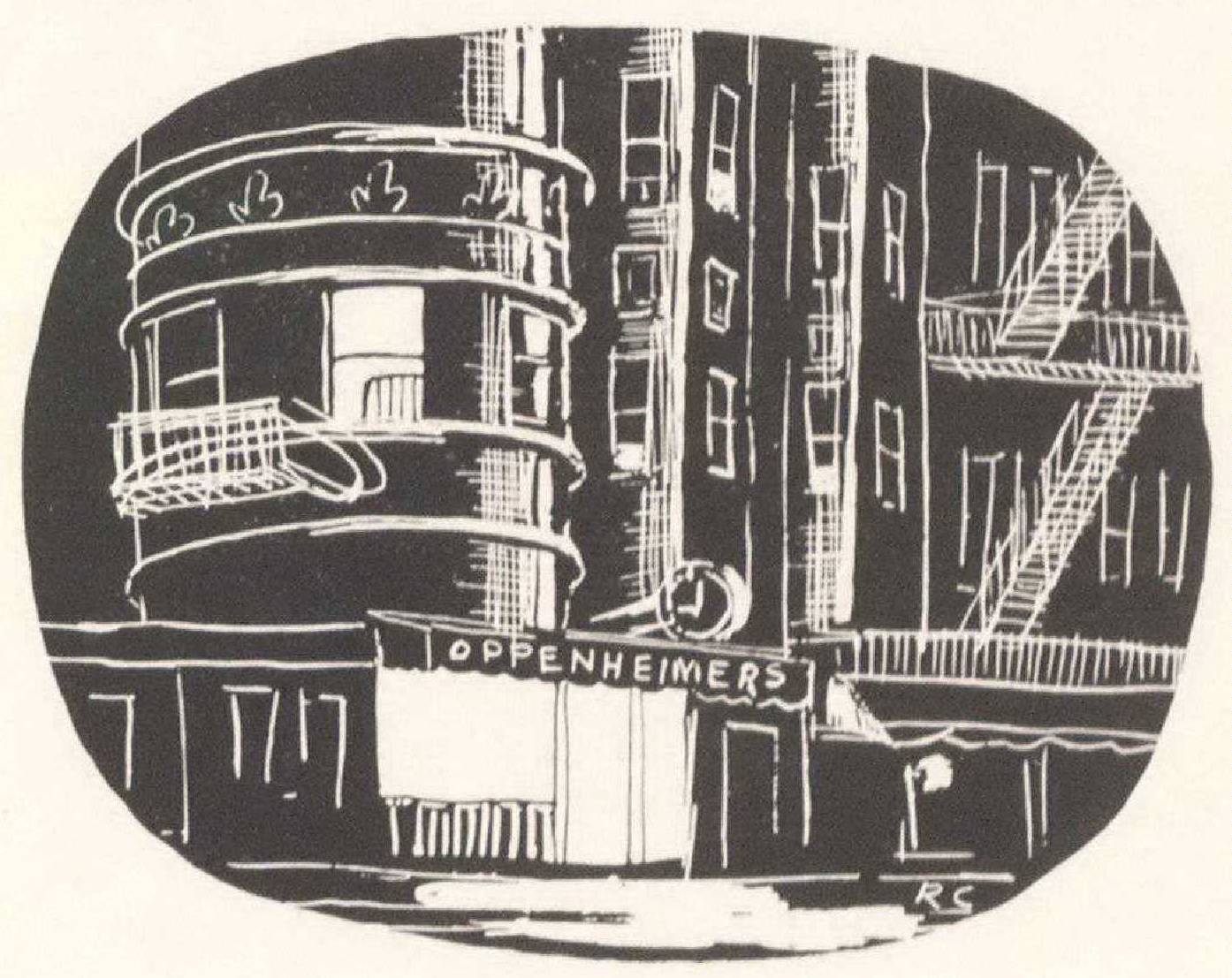
Julio’s plan was to loan Jeremy the motorcycle for the long weekend in return for the use of his room while he was gone. Julio lived with his father, who refused to let him bring his girls home.
“I got a gorl, see,” Julio said, “and she come to my place and my ol’ mon say, ‘No beetches when I wanta sleep!’ so what to do, huh, mon? I take my gorl to your place here, see, and when she think she gotta go, but she still say, ‘Hog me, Julio, hog me. Don’ make me go,’ I say, ‘OK, baby, you stay all you want.’ See? Great, huh? No ol’ mon . . . great chick to fool around with . . . you got my bike . . . everything great for a couple of days. Pretty good, huh?”
They exchanged keys the next morning, and Julio provided brief lessons on a quiet street, unnecessary because Jeremy had learned to drive a cycle from a next-door boy in Valparaiso. With an extra pair of denim pants rolled in a big blanket, and fifteen dollars folded in a secret leather-belt compartment used only for trips, Jeremy drove away from the delicatessen, headed for Pennsylvania.
Twenty, he thought, maybe eighteen years ago, his father had come back from the Pacific with a few service ribbons, no medals, no wounds, no good stories, and one Japanese flag with a faded Rising Sun. Jeremy, old enough to understand that the man called Jack was also his father, had been taken to the Gettysburg battlefield at the edge of the southern Pennsylvania line, where in a creosoted cabin he had slept with his parents for the last time. The still-uniformed man, tall enough to spring to the open beams in the cabin and chin himself, had rented a convertible coupe and driven his wife and son around the battlefield, drinking from dark bottles of beer that warmed in the sun on the floorboards. Jeremy had seen him that whole day, and the next morning the man Jack had gone away because, Jeremy’s mother explained, they had decided not to love each other anymore. And Jeremy had been given to his grandmother in Valparaiso. When she had died, he had been old enough to get the vacuuming job in Chicago. After a month he had realized cleaning was a woman’s work and had hitchhiked with a pencilcircled want ad in a folded newspaper to Concordia for the Westinghouse job. He had smothered within himself for three years, making enough money to know he did not care about being rich, and had crossed town to begin work at the warehouse.
He kept no photographs of his parents, but he remembered the hot-wood cabin at Gettysburg; and with Julio’s big machine he decided to drive to Pennsylvania and look at the battlefield and the cabin again. Julio had said he should go somewhere. Gettysburg was as good a place as any because if the dock workers asked him why he had gone there, he could say, “I got my reasons,” and make them wonder and fabricate stories. Their imagined stories would be better than the truth: that Gettysburg was the only distant name Jeremy could speak with familiarity, and that he thought when he got there no one could make him leave even if he were unshaven and broke, because he could say, “Listen, I was almost born here. I belong here, like those white statues you got of soldiers shooting through the trees.”
It took two full days of slow riding without a road map for Jeremy to reach the national park, The first night he stopped near the Pennsylvania line outside Hubbard, Ohio, and slept alone under a farmer’s tree and a warped paper notice on a board saying “No Trespassing — Hunting — Fishing — Violators Will Be Prosecuted.” He passed the pasture by the highway at dusk, the sun slipping unnoticed behind a building cloud bank on the horizon, and rode on into town to eat a sandwich before going back to the open field to sleep.
Breaking through a front-step trio of dogs nosing each other in a circle chain, Jeremy carried his bedroll into a Hubbard diner and ate a baconand-egg sandwich in a back room next to a bar where nondrinking boys played the pinball machine and scuffed on the sandy wood floor to jukebox music. He had borrowed Julio’s green goggles and white helmet with a colored cutout of the Virgin Mary pasted on the front, and these he set to the right of his plate. When the waitress returned with the check, Jeremy watched her eyes slide down like weighted marbles to the goggles and helmet, but she said only, “Anything else?”
“You know where I can get a motorcycle fixed?” Jeremy said. He focused on the waitress’ dry red lips; she glanced at his face, but her eyes, again heavy, sank back to the helmet and goggles on the table.
“What, by a garage?” she said.
“By somebody that knows good motorcycles,” Jeremy said.
“Not in Hubbard,” the waitress said.
“I got a motorcycle that needs somebody to fix it,” Jeremy said. “I’m riding to Pennsylvania.”
“Throw out your chest and you’ll be there,” the waitress said, setting down the check. “Pay now,” she added.
Jeremy paid and left the diner, the bedroll under one arm, swinging the goggles in the other hand, the helmet already on his head. Maybe, he thought, he should have told her he was going to New Orleans, or Maine. Or maybe he should have said it was a very special kind of motorcycle that needed tuning every hundred miles. Or that he had come from San Francisco. Or Canada.
Lying awake beneath the No Trespassing sign, while the knee-high grass grew damp under the lightless sky, Jeremy made up the story he would tell the farmer who might come to prosecute him: he was an orphan monk on his way to a big monastery in Virginia especially for orphans, and the motorcycle was the cheapest transportation he could find since monks were not allowed to hitchhike. The story became a long dream as Jeremy pulled the blanket tighter around his shoulders and over his chin to hide from mosquitoes. He dreamt he was head of the monastery because one night after work at the warehouse he had seen God looking in his window, and the Virginia monks had heard of this and written him to come be their leader.
God’s face had been Bailey’s. Jeremy laughed aloud in his sleep when he saw God with a tobaccostained mustache. The laugh woke him just before dawn, and in the gray light, the ground mist combing through the wet grass, Jeremy rolled up his blanket. Stuck to the damp underside he found dozens of tiny slugs — soft, shell-less snails — and flicked them off with a fingernail, deciding to sleep the next night in a Gettysburg cabin on a dry bed, off the ground.
IT WAS dark when Jeremy found his way to the battlefield town; he traveled without road maps, asking at gas stations, “Am I headed for Gettysburg?” and answered by bemused attendants, “Well, you’re headed in the general direction.” In the late afternoon he knew he was going east if he followed his shadow, keeping the thin front tire on the black stretching image of him hunched on the machine. Once in Pennsylvania, he got more specific directions, but lost two hours by having started out on an angle too far to the north. He had known the town was southeast from Concordia, but had been afraid of shooting too far south to the strange land of Virginia with his dream monastery, and beyond; beyond to Florida and the end of the country. He nosed cautiously east, holding the cycle between forty-five and fifty, as a thin-legged boy edges into the shallows of the ocean, scared of letting the dark water lap over his knees and hide his feet. When he found the town, Jeremy parked Julio’s machine at a drivein hamburger stand and asked the cook where he could get a cheap cabin for the night.
The man behind the order window said there were no small cabins on the edge of the battlefield, not like the ones Jeremy described: far apart from each other with grass between, small and green-painted with one heavy shutter to cover the window. Only some modern cabins, the man said, within sight of the monument of the Eternal Flame.
Jeremy took his bag-wrapped hamburger and paper cup of coffee to a picnic table beside Julio’s motorcycle. He ate silently, wondering why the counterman would lie to him about the cabins, until a pink-faced waitress came to sponge off the tabletop.
Jeremy lifted his cup, and the waitress swabbed the sponge beneath it. She was sixteen, Jeremy thought, maybe fifteen. Her face was flushed, as if it had just been scrubbed.
“Do you live here?” Jeremy said. “In Pennsylvania?”
The girl did not answer, but smiled nervously, as if she had heard a dirty joke.
“I come from Indiana,” Jeremy said. “Concordia.” He gestured with his coffee cup at the black machine. “I rode that.”
The girl studied the sponge, and said, “That’s pretty far,” with a quick flicker of blue eyes that looked away when Jeremy moved his head closer.
“It’s a hell of a ways,” he said. “And I think I might keep on going.”
“Well, then . . . good-bye,” the girl said, pleased with herself.
She turned, and her cardboard-stiff uniform seemed almost not to move, as if she rotated within it. Jeremy stretched across the table like a pool player flattened over the felt, and his fingers just missed the retreating uniform.
“Hey!” he said, trying not to sound panicky. “I want something ... I mean, I want something else.”
The girl turned and posed with her order book and pencil. Jeremy relaxed back on the bench.
“I come from Indiana,” he said. “I don’t know so good what you got here. Name me something except what I had before.” When, the girl said, “Fish-Burger,” Jeremy said, “That’s it. That’s what I want.”
While the girl was gone, Jeremy smoked a stale cigarette, not inhaling. Then, as if remembering an appointment, he flattened a napkin on the table, stretched it tight with thumb and index finger, and wrote carefully on it with a ball-point pen from his shirt pocket. When the girl brought his second sandwich, Jeremy slid the napkin across the table at her. Not picking it up, she read, “How old are you? Have you ever killed anybody?”
“What is this?” she said.
“It’s just a question,” Jeremy said, trying not to frighten her.
“No,” she said, sounding old. “Oh, no. This is some kind of line.”She looked over her shoulder at the counterman. “I don’t have to take this stuff.”
She swept around inside her stiff uniform, and Jeremy leaped to her side of the table so swiftly that she involuntarily stopped, to listen. “I’m sorry,” he said. “I’m really sorry. You’re probably only sixteen. I should’ve known you’d never killed anyone. I’m twenty-five or so. Maybe thirty. I lose count . . .” He held a five-dollar bill to her pink face. “I don’t want to eat anymore,” he said. “Keep the change, and buy something for yourself with it.”
The girl looked back to the counterman, who was taking orders, and took Jeremy’s money. “I can really bring you change,” she said, moving to go. “It’s no trouble.”
Jeremy lightly touched the flank of her uniform with a flat hand, then withdrew it. “I didn’t want to scare you,” he said. “I just wanted to see if people in Pennsylvania were the same as people in Indiana. I just wanted to hear you talk. I haven’t been here in a long time.”
When the girl was gone, Jeremy threw the untouched Fish-Burger in a trash barrel so the waitress would think he had eaten it. He rode the motorcycle into the battlefield, entering between two stone piles on Confederate Avenue. A carved wooden sign said the park closed at ten. Jeremy followed the narrow road, dipping into chill air in the hollows, until he found a dirt road to the right. He wheeled the thin tires around a log blocking the path, and rode until he could not see the paved avenue behind him.
Cutting the headlight and cresting a small hill at the edge of a tall woods, Jeremy surprised a family of deer couched sphinxlike in the grass. Where he found the ground warm from their bodies, he stretched out his blanket to sleep alone under the lightless sky.
The clouds had followed him since Concordia. The morning he left, he had been warned by Julio of the sun and the “peasants”; he said, “The sun burn you hot as a bectch. Keep on the goggles. And don’t hit no peasants. I hit a peasant once, mon, and just about wipe-out. They start to fly across the road, and you think, ‘Yeah, sure, I can miss it,’ but I hit that goddamn bird right with the headlight. Scare me shitless. I know a guy got his face tore right off — hit a bat at night. Didn’t have no goggles.” But the sky had started to lock in with gray clouds as soon as Jeremy had entered Ohio, He had lost his shadow, his east-pointing arrow, and made two wrong turns, trying to avoid the cities with names he recognized, cities he knew would be jammed with smoking traffic and sweating pedestrians. He had seen no animals along the road, although for a hundred miles he had watched carefully for birds and bats; the first wildlife to approach him (except for a collie dog that had chased his rear tire) had been the snails in the wet field.
Julio had been wrong: the goggles had been unnecessary. But Jeremy had hung them around his neck while riding, and swung them in his hand when he walked into gas station rest rooms and strange diners where no one knew him; because he knew they made him look alien: they announced that he was not traveling by bus or by foot or even by car. Even so, Julio had not known everything about everything.
LYING stiffly on his back, Jeremy felt the cloudblocked sky within arm’s reach; he sensed the dark tufts just beyond his face, as if he were lying in the lower berth of a bunk bed, breathing at the underside of the upper-berth mattress that bulged in square tufts between the cross springs. Like the bunk bed in a cabin.
The moon and the stars were somewhere far behind the clouds; Jeremy watched the nothingsky to see something. Able only to sense the clouds, he imagined them descending on him like a quilted comforter to smother him to sleep.
When he imagined the clouds might be so low that he could simply puff a hole through to the light beyond, he heard a man walking cautiously through the woods behind his head. The footsteps sporadically rattled dead leaves, as if the man were unsure of the path. Jeremy did not move; had he turned, he would have seen the edge of the woods as only a darker wall; he knew he could not see the man.
As the scuffing leaf-sound grew louder, Jeremy assured himself that he too could not be seen, such a small thing was he, flattened on the ground. Even if he were discovered, he thought, he could only be told to leave. He could say he had not known the rules; he could use the traveling-monk story. It was a good tale; no one ever bothered monks.
With three quick steps the man from the woods left the trees and entered Jeremy’s field. Jeremy knew he had stepped out of the noisy leaves; he thought he felt through his back the vibrations of footsteps on the ground. He lay fifteen feet from the edge of the trees, head pointed slightly uphill to the dark row. The man from the woods could not avoid finding him; he might even stumble over him, putting a big, booted foot in Jeremy’s mouth.
“There’s a person over here,” Jeremy said aloud finally, not moving his head.
The silence that followed told him the man was listening. Afraid the statement might have sounded like a threat, he added, “No one here’s hurting anything.”
When no answer followed, Jeremy chose his words carefully and spoke again, trying to sound conversational: “Good Christian here . . . good Christian monk.”
Jeremy knew the man was sneaking up on him under the noise of his voice. He lay tight as an ironing board and tried to hear human sounds. His blood’s pulsing seemed to swell the wrapped blanket; he could not hear through the blood in his ears. To move, he knew, would be fatal: the man was waiting for him to stand up as a target. Even in the dark a shotgun blast would find him out. He could only talk to save up time, to decide what to do next.
“This monk thought he could sleep here,” Jeremy said. “He’ll go if he’s told plain and simple.”
He heard a squirrel chatter far away, as if it were day. If his drumming ears did not still, he would never hear the man move. He had to talk him away; he spoke straight up at the unseen clouds.
“Mister?” The beating of his pulsing body seemed all the footsteps of the world aimed at his head. “This your land? Mister?” The man seemed to be waiting for the right words; perhaps deciding whether to kill Jeremy straight off, perhaps silently laughing at his stubborn voice. “Who is that?” Jeremy said. “I got a right . . .”
He tried to calm himself; he had no right in anything. He had to remember who he was. He held his breath, closing his eyes to listen.
“That . . . that you?” he said finally. “Julio?”
What the hell Julio was doing in Pennsylvania, even as a joke, Jeremy did not know. But he had driven for two days, gotten lost, to come to a place where he thought he could find the cabin with the low beam on which his Navy father had chinned himself; and a hamburger man with greasy hands had told him there were no cabins like that, making him sound like a crazy man. And maybe he was crazy. And if so, Julio could certainly be sneaking up on him in the dark. Maybe to spit tobacco juice in his eye.
“Bailey?” Jeremy said softly, questioning himself, remembering the brown stain on the toe of his boot — an old shoe already dirty with deeper stains — and the man, so far the last, who had called him “Germy.”
“Bailey?” Out loud the name sounded appropriate. Bailey was dead, crushed flat as the cigarette pack he had stooped to pick up — his last gesture: bending to a piece of trash. Bailey was not standing back in the dark. But his name seemed to fit the silence.
When he spoke the name, Jeremy heard the night sounds fall back on him; his ears were cleared; he heard two squirrels and the spring peepers and, echoing far off, an auto horn. He knew the man was gone. Coming out of the woods he had brought the silence with him, and now the silence was gone, and so the man was gone.
Jeremy loosened his locked limbs; he felt the night air cool on his sweaty face. Still on his back, a roll of the blanket under his head, he saw the sky move just before he fell asleep. He saw the clouds, full and tufted as he had imagined, when a keyhole opened above his head and moonlight seeped around the edges. The hole opened like an eye, and through it, in direct line with Jeremy’s face, shone a single star. Then the hole squeezed shut, and the clouds were gone again, and the sky all black. Jeremy slept, not dreaming, waking at daybreak with a crick in his neck.
He woke to the sound of leafy footsteps. In the gray dawnlight it was, of course, not a man but a gray squirrel leaping sporadically in bounds the length of a man’s stride. The squirrel broke from the noisy woods and silently crossed the field.
The hell! Jeremy thought, He could never tell anyone of the incident. They would say he had been fooled by a lousy gray squirrel barely big enough to reach up and bite your ankle. Even if he told them that the pounding of his blood might have covered the human sounds that he knew he would hear, they would say he had been fooled. Even if he told how he could almost hear the man’s breath, how the man had waited for him to say the right word and had gone away with his awful silence when the word had been said, they would misunderstand.
It did not matter that the gray squirrel came out at dawn to reveal the trick. What mattered was the star that had shone through the keyhole in the clouds, pinpointing in Jeremy’s eye, picking him out, showing him that the perhaps-dead Navy man exercising in the nonexistent cabin, the mother who explained to the boy the man’s good-bye as she might explain a movie too old for him, the grandmother in Valparaiso who ignored the boy by dying — all these had nothing to do with why he, Jeremy, had killed Bailey because of a small tobacco stain, but that that killing, that dreamlike decision to drive Big Bertha over the dock and on top of Bailey, had been the beginning, twentyfour years belated, of everything.
Jeremy rolled up the warm blanket. His body had smoothed out the tall grass, and he left it flattened to invite back the frightened deer. He had thrown them from their sleep with his rude motorcycle, and now he returned the field to them and the squirrels and the spring peepers. And the monumented park he left to the tourists and to the buried dead. On the highway, in the 8 A.M. sun, he found his west-pointing shadow and followed it.
THE sky had unchoked in the night. Now Jeremy rode in the sun under a blue that did not, as he usually saw it, seem to are with limit — an enclosing sphere—but that had no form at all, no flatness or roundness; and that suggested only a depth, as if something were hidden behind the blue: another color, or a star. Jeremy knew stars did not set like the sun; they were always overhead, waiting to be turned on. He crossed Pennsylvania heading west, not asking directions; as if, because he had already made the trip east, on the return trip a long geographical arm from Concordia would reach and guide him to its boundaries.
The road was little used. Jeremy passed straining foreign cars without sliding into the opposite lane, aiming Julio’s motorcycle two feet to the left of the little cars’ fenders, passing with his right hand on the throttle within reach of the driverwindows. No cars passed him from behind. Tractor-trailers loomed at him from the opposite lane, Atlantic-bound, knocking great earsful of slipstream wind at him, rocking slightly his dwarfed machine. He recognized few trucking names; he was still in a foreign state, even into Ohio.
He was going back a day early — maybe he would catch Julio in bed with some Maria — but he did not know if he might have a flat tire or burn out a spark plug or get very lost, more lost than on the trip east. He would not take a road map; he would rather spend a day getting lost. A map would make the trip meaningless, like the black-eyed girl with hair in a bun that could not be let down, with whom Jeremy had slept one night of his Chicago month; who had guided him officiously saying, “Now do this. Now this. Now you’ve got to do this,” making Jeremy think, So this is all the hell kids are sweating their pants about before they have it. Hell. I’d rather go to a movie.
Just outside a town near the Indiana border where the speed limit dropped to twenty-five, Jeremy stopped at a small yellow-windowed store with a blue Pepsi shield on the door. Inside, helmet and goggles in his left hand, he found the Pepsi machine and drank one bottle quickly. He bought a package of cheese-and-peanut-butter crackers from the humpbacked storekeeper.
The hunchback came from a back room, shoving a lifted shoulder through a dark curtain in the doorway. He walked with one leg twisted so only the toe of his shoe tapped the floor. Before the hump, his head was sunken, cocked slightly to the raised shoulder as if he were ready to fall asleep on himself. Across the counter he looked up with a delicate face at the taller Jeremy. Between his half-closed, concentrating eyes, the hunchback’s thin, straight nose looked fragile; it would not have lasted one minute in a fistfight. So this, Jeremy thought, is what they mean when they call a man handsome; it would not be bad to have a face like this man’s.
“Can I get to Concordia, Indiana, from here?” Jeremy asked.
“Suppose so,” the man said. “You can’t miss Indiana anyways.”
Jeremy ate an orange cracker; he offered one to the hunchback, who shook his head, trying not to smile; as if he knew the crackers were stale, or had already tasted everything in the store and were content to watch others eat. “I come from there,” Jeremy said. “I’m going back now. I been to Gettysburg.”
“Hitchhike?” the storekeeper said.
Jeremy swung the helmet and goggles up on the counter. “Rode a motorcycle,” he said.
The hunchback fixed on the green goggles, not touching with his hand. His eyes opened like a little boy’s, and except for his weathered, fatherly face, Jeremy thought, he could have passed for a boy: just over five feet tall, harmless and weak. For a second, like the second he thought of dropping the cat from the Chicago penthouse window, Jeremy thought of robbing the man. He wondered why the tough travelers stopping for cigarettes did not just knock the little man on the head and rifle his cash register. It had apparently never happened; the hunchback was not at all guarded or nervous.
Jeremy thrust his hand into the man’s gaze and held the goggles to him. “They keep the sun and wind out of your eyes,” he said.
The little hunchback held them at arm’s length to the light, his mouth twisting to stop a childish smile. While Jeremy watched, suddenly knowing that any made-up monk stories would be out of place in the world of the hunchback, who would probably never have a woman and who might, in the next hour, get his beautifully undeformed head broken by a thief, the man put the goggles to his face without hooking the strap. He held them to his eyes and grinned as if alone. Then, after he had finished whatever he had been seeing or doing in his mind, he set the goggles back by the helmet. He coughed into a fist to kill his grin.
“You can still tell red and green lights apart?” he said.
Jeremy said, Sure, they didn’t change colors that much.
The hunchback stared at Jeremy’s face, as if he had just been given something for keeps, the green goggles perhaps. “Do you go very far on your motorbike?" he said.
“It’s not mine,” Jeremy said. “It’s Julio’s. He’s a guy I work with in Concordia. That’s where I’m going back to.” The hunchback waited, as if Jeremy were beginning a story. “I had Thursday and Friday off. Just went to Gettysburg. I was there a hell of a long time ago, but I forgot what it looked like.”
The hunchback’s silent listening made Jeremy talk, as he had talked out loud the night before to fill the silence. “Julio and Al Bailey and I were dock workers . . . loading trucks. You know.”
“Who are you?" the hunchback said eagerly.
Jeremy gathered the helmet and goggles under an arm. “I’m the guy that killed Bailey,” he said easily.
The hunchback’s mouth opened in a stupid smile. He waited for the punch line, the clue to the joke. Jeremy left him with a half-wave from the door. He could have given him a dollar for the hell of it, he thought, but a wave was enough.
Stopping for gas fifty miles further west, Jeremy washed his hands and face in the disinfected rest room; he watched two mechanics pump grease into the steering column of an old car, and wasted time in a diner across the highway, spending leftover money and dozing over coffee; he passed through Indiana in the early evening. He had felt himself too far south, knowing he should soon start heading north to Concordia; but, the motorcycle’s belly filled with new gas and the engine running smoothly at sixty, the quiet, west-leading road slipping like a carpet beneath his feet, he had decided not to turn. As white-lettered signs began to tell the short distance to Illinois, the sun started to set in front of Jeremy, and with one hand on the throttle, he zipped up his jacket with the other.
The road rolled ahead to the horizon, disappearing into the red, sinking sun. The sun settled into the distant asphalt. As its flattened shape like a squeezed balloon fell behind the horizon at the pinpoint end line of the highway, great widening spokes of pink rayed out from it like the outspreading beams on the Japanese flag. The sunset sky was reflected in whorls of red on the chrome of the motorcycle. Jeremy felt himself riding on one of those red rays, one that shot from the sun’s center and coursed the highway and passed through him as if through glass, and went on, past and behind him.