A Possibility of Paradise
The legend of the South Seas, whether the time be 1762 or 1962, resurrects a vague but distant place of scented breezes and ivory beaches, tiny scrubbed islands ringed with pink coral and peopled with slim, carefree natives who swim and dance and make love, a myopic vision relentlessly perpetuated by film directors and travel editors.
The muddled carnival is complicated by names like Pago Pago and Raratonga, the exotic sniffs of gardenia and sandalwood, torchy barbecue fiestas with ukulele music by Rodgers and Hammerstein — a languid ecstasy only occasionally disturbed by a typhoon or tidal wave.
Indeed, since its haphazard discovery by Samuel Wallis in 1767, Tahiti has prompted more inspired wordage than any other island except Great Britain. And yet Tahiti and the islands of French Polynesia, sprinkled over a watery immensity bigger than Europe, have been all but incommunicado. Before World War II only two steamships reached Papeete’s quays each year, and a wearying sixty-day passage from Marseilles scarcely conditioned the voyager for objective inquiry.
So the quaint legend proliferated, until Charles de Gaulle, that austere spoilsport, ruled that France’s “poule de luxe,” so jealously pampered by her previous masters, should start to pay her own way and ordered the jet airport of Faaa, a formidable 12,000foot strip on a bank of crushed white coral. It was completed in 1960.
Whisked above the clouds, banqueting on beluga and truffled capon, the visitor now finds his DC-8 dipping over the volcanic peaks of Michener’s Bali Ha’i just twenty-five hours and 10,000 miles after departing Orly Airport.
During the past twelve months airliners dumped some 20,000 tourists on Tahiti (there were a scant 700 in 1957), all bursting, presumably, to discover truth.
Checking his guidebook, the visitor notices that Tahiti is indeed beautiful, rising from the ocean in a sharp thrust of kneaded green mountains, its valleys luxuriant with flamboyants and breadfruit, pandanus, guava, ironwood, and monstrous ferns; a mad vegetation where grapefruits swell like footballs and hibiscus grows wild.
Slightly mystified, he discovers that Papeete hardly compares with Portofino, that the township remains little more than a Pacific trading post with a pleasantly shaded waterfront, a dilapidated pastiche of Wild West clapboard and grubby Chinese stores, rusting tin roofs and flaking colonial porches, slightly enhanced by a new supermarket which sells plastic lilies, and a new bank ready for his money.
On a tour of the island he admires the craggy powder-blue outline of Moorea, Tahiti’s twin island; a blowhole; and Mount Orohena, twice Snowdon’s height; a sign which reads, “École: 2 + 2 = 4”; Pointe Vénus, where Captain Cook traced the planet’s orbit; and the tidy pink-washed leper colony at Orofara, possibly noting that the only white beach is ten miles from his hotel and that Route Nationale No. 1 ends where it begins.
The observant tourist remarks that coconuts crash to earth like pistol shots while mangoes drop with a softer, plumper sound, that the natives eat barracuda and raise their eyebrows instead of saying yes, that elephantiasis is not pretty, that the most decorative vahines are Chinese mestizas, and that the fragrance of tiare, Tahiti’s special gardenia, is often stifled by the rancid butter smell of copra.
During his quest, the myth stalker will find that the islanders’ staple, which the French call poisson cru, is in fact marinated in the juice of fresh limes, that one in two Tahitians owns a car or motor scooter, that the tamure, which passes for a dance, would never please the Lord Chamberlain, and that the word marié actually means they are just good friends.
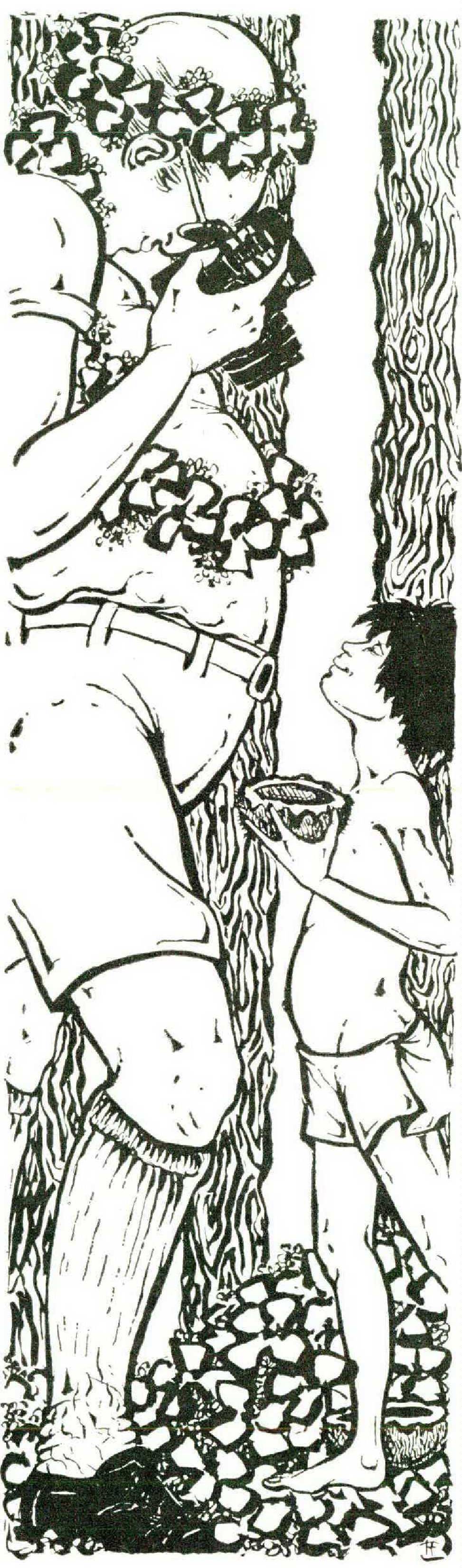
In the evenings he will go to Quinn’s Bar, where the guitars are loud and the behavior uncomplicated, tip a flowered wreath over his eyes, and drink an immoderate amount of Hinano beer, probably to blunt reality. Before leaving he is also likely to take a snap of Emile Gauguin, the painter’s gross, bloated son, so he can say, “Look at the Gauguin I got in Tahiti.”
On settling his hotel bill, he will remember the migrant land crabs that visited his bungalow, the ant column that devoured the aspirin, and the lizards that looked like teen-age iguanas. He will also be reminded that a scrappy bistro dinner cost $6 and that the thatched home which he shared with the termites rated $20 a day.
“It’s not an either/or place,” says Barnaby Conrad, the American writer. “If people are thinking ‘either we go to Jamaica or Palm Springs or Tahiti,’ well, they’d better skip it. They would gel lost on the way.”
Tahiti may expose its eccentric character without haste, yet the initial mirage can become obsessive. The extravagant backdrop is incidental, for it is the people who are unique.
In a constipated world, where Europe’s persuasions get reflex approval, the Tahitians have judged the ways of the popaa (their slightly disparaging term for the white man) and found them obnoxious. Without fuss they accepted the free gift of a civilization, picked out the convenient details, and rejected the rest, preferring their own singular morality and standards.
Untroubled by Christian preaching and popaa complexes, most Tahitians remain direct, practical, and enviably relaxed, immune from sentimentality and inhibition, engaged in a genial hedonism which finds it convenient to ignore the despotism of work and money, the uncertain benefits of ambition.
By drawing-room standards the islanders have, of course, been prodigiously fortunate, indulged by the prodigal god Taaroa with a climate and vegetation which made survival a pastime, spared the muskets of Mendaña and his missionaries, opportunely discovered at a wellintentioned time, and coaxed along by eighteenth-century philosophers with a real attachment, on paper at least, to “these splendid savages.”
Since the days of Wallis, the Tahitians have never known real fear or want or slavery. Coddled by history, these spoiled children can be moody, irresponsible, capricious, and hopelessly blasé, yet they have preserved the impulse of generosity and a courteous pride.
Impervious to future profit, disinterested in status or property, they cheerfully flaunt their preference for personal choice and instant pleasure, uncomplicated by guilt or greed. They are also happy.
Isolated, comatose, the victim begins to appreciate with growing amusement how Tahitians twist the tail of civilization, practicing a deadpan logic which can be devastating.
The evasions of Tetuanui, Papeete’s deep-sea diver and a sharp judge of his own value, are consistently typical, for on most Mondays he is prostrate from the weekend’s pleasures. Climbing into his harness, Tetuanui plunges to twelve fathoms, where it is cool, quiet, and where the rates are highest. On the soft, sandy bottom he rests, sleeps a little, and assures his income.
More than once Tetuanui has been surprised by an apoplectic supervisor, yet his charmed career has endured. For he is also Polynesia’s only professional diver.
In the remote Marquesas I happened to be discussing religion with a chief who was convinced England became Christian after burning Joan of Arc because “the people saw a great light in the sky.”His daughter, Potini, who was just fifteen, proudly interjected that she was still pagan, and when asked why, smilingly replied, “No baptism: no sins.”
During my recent visit I asked my maid, Tina, a sleepy creature, to bring a five-kilogram block of ice each morning, yet her progress was so slow that invariably only a dollsized cube survived. I chided her gently and without success, until a ruffled brow produced its own answer: “Well, why not buy a tenkilogram block?” Tina had also been known to claim that eggs were “out of season” when the Chinaman’s store seemed too distant.
Under such ground rules, the popaa seldom emerges with honor. There was Tautira, a neighbor, who sold a strip of land, collected cash, spent it, discovered overnight he had neither land nor cash, so promptly assured everyone he had been robbed. And there was his cousin Tahea who sold a swamp. The buyer, a Frenchman, drained the water, cultivated the land, and resold it at a profit, convincing Tahea he had been victimized by le farani, a patronizing epithet which covers all things French.
As the weeks slumbered past, one even hesitated to criticize the stout Tama, a nacre diver from the Tuamotu, who earnestly saved for three years to buy a secondhand Cadillac. At huge expense, the car was shipped to his distant atoll, unloaded by whaleboat, and manhandled over the reef. Tama drove it some three hundred yards before it skidded off the island’s only track and wedged itself between two coconut palms, where it still rests. “I never wanted to drive a Cadillac,”insists Tama, quite happily, “I just wanted to buy one.”
Such laissez alter prepares one for the freakish state of the Tahitian language, where the soul is placed in the belly (the word opu covers both), where ao means cloud, grease, paradise, and goose, as well as ten other things, where a thief becomes “a-man-with-clever-fingers,” where there are seventeen terms for avarice and not one for goodness.
I observed a U.S. Navy captain, perhaps stirred by such nihilism, stare across the harbor at his command, tenaciously sink a fifth Hinano, spin on his heels, and roar, “Anybody want to buy a submarine?” There were no takers, but the majority were sympathetic, for exposure to Tahiti can be damaging. The worthy captain may be forgiven, for he must still be unaware of the two cardinal imperatives which bring a hint of order to the apparent anarchy of an island.
First there is aita peapea, synonymous with Russia’s nitchevo, usually associated with slouched shoulders and an inquiring eyebrow. This practical instinct (literally, “no troubles”; actually, “I couldn’t care less”) combines a smudge of fatalism with a unanimous distaste for any decision or concern which might disturb an epicurean present.
Untouched by envy, most Polynesians feel the popaa is an odd species whose faulty mechanism simply runs too fast, unavoidably driving him into inhuman efforts which bring no conclusive results.
When an island family needs food, the husband will dutifully collect some breadfruit or paddle his canoe into the lagoon; but he will only engage himself at a salary if his immediate fancies include a sewing machine, a scooter, or, more probably, funds for a party. He will even work hard and skillfully when the job becomes a pleasure, moved by a momentary desire to excel or by the ribald taunts of an audience. Yet he will barter a morning’s catch of bonito for a single tin of corned beef if the appetite prevails, and the scooter will end on the junk heap. Tahitians don’t repair; they discard.
In the months I was there I met not one Tahitian who listens to a news broadcast, indulges in politics, or even buys France-Dimanche. Such projects seem far too complex, too tedious, and too remote. Although Papeete boasts an Assemblée Territoriale, quaintly dumped above the waterfront customs, most citizens view its elected members with derision, sharing E. E. Cummings’ conviction that “a politician is an arse on which everyone has sat except a man.” They would also contend that future wars should be fought by the farani and others, an opinion imported by the veterans of the Pacific battalion, who served bravely but were unimpressed by the gutted chaos of Europe.
Yet in the simplest homes, under a roof of tressed palm leaves, the visitor will discover transistor radios and running water, stereo record players, even washing machines. These foreign incidentals won instant approval, as did le twist.
With equal expediency Tahitians have accepted the Bible and rejected the concept of original sin. Hustled by insistent missionaries, Catholic and Protestant, they grudgingly abandoned their congenial gods and tikis, picked up vague notions of the catechism, and now pay nodding tribute to the commandments, enjoying the ritual practices while flagrantly ignoring their moral obligations.
In Tahiti there are still only 3500 lawfully married couples, for the majority prefer a more elastic rapport; and even the most world-weary still believe that the toupapaou, those ubiquitous phantoms, can be discouraged by spitting, and that coconuts have eyes. I also happen to know a convent-educated vahine who cannot decide whether to become a nun or join her cousins in Hong Kong, and a pastor who will marry a pair only if they already have two children.
The islanders may be religious but they are not Christian, and worship can lapse into a most unorthodox affair. In the Leeward Islands I once visited a chapel where the congregation sat on the wooden floor, buoyantly joining in the hymns and free-for-all Bible discussions. Between these highlights, the people dozed, chatted, cradled their babies, scratched their dogs, and smoked cigarettes. Eluding the ethical straitjacket, Tahitians are noticeably susceptible to the Mormons, who now reputedly offer a $600 cash bonus per conversion, while the writer t’Serstevens notes a mass migration from the churches to the cinemas, where their Hogarthian natures find less compromising distractions.