The Peripatetic Reviewer
by Edward Weeks
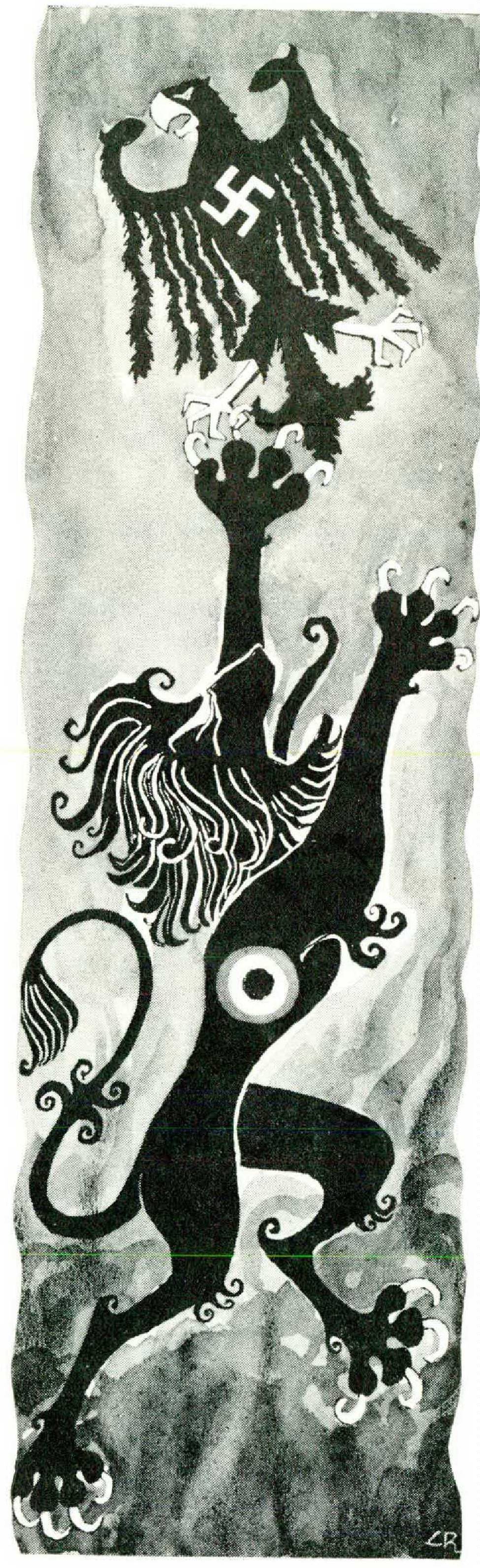
Admirals or generals, it is a hard question, which were more set in their ways in 1940? Of this we may be sure, that both ranks, steeped in tradition, resented and opposed a working partnership with their jaunty junior the air marshal. In Billy Mitchell’s day such a partnership was out of the question; airmen were adventurers, daring in their dogfights with each other but unessential when the fighting got down to the bayonet. Even after Hitler’s blitzkrieg had demonstrated the overwhelming power which was produced when dive bomber and tank, air force and ground force were perfectly coordinated, the British admirals and generals, who should have learned, continued to fight their separate engagements, and it cost them plenty. The man who put a stop to this was LORD TEDDER, who rose to be marshal of the RAF and who feared neither God nor Churchill nor any of the seniors who outranked him. He was the last of the great leaders to speak his mind about the war, and his memoir, WITH PREJUDICE (Little, Brown, $10.00), preserves a glorious candor and the sense of urgency thanks to his spicy, explicit journal which he began writing in the late thirties and from which he freely quotes.
Tedder had earned a reputation for being forthright when as a young instructor he was moved up to command the Air Armament School at Eastchurch. Every squadron came to the camp for a month of bombing and gunning exercises, and Tedder was as careful to judge the performance of the squadron leaders as he was the inadequacies of aircraft design. “Wood and fabric were on their way out,” he wrote; “the monoplane was replacing the old box kite; the undercarriage was retractable; and these and other developments all had a direct bearing on the armament. . . .”But any major change was at the mercy of the Ordnance Board of the War Office, and after his first attendance at that august body, Tedder wrote, “One found it hard to believe that in the twentieth century there still existed such organisations. . . . The meeting of the Ordnance Board reminded me of nothing so much as of the tea party in Alice in Wonderland—except that there was certainly more than one dormouse.”
When Fedder was promoted to command the Far Eastern Air Force, he was invited to the ceremony celebrating the installation of the fifteen-inch gun turret at Singapore, and he could not resist saying that the gun would never fire in anger, for it covered the main entrance to the Singapore Straits, “and one would not expect an enemy to break in the front door.” In 1938, he was recalled to be director general of Research and Development; he cemented his lifelong friendships with Wilfred Freeman (it was Freeman who ordered fifty Mosquitoes straight off the drawing board, a gamble that paid), and with Charles Portal, who was to be his closest associate when the fighting began. He encouraged young Whittle, who had been installed in a small machine shop, to make his first prototype of the jet, and he disabused Winston Churchill at what were known as“the midnight follies,”when Churchill, with schoolboy delight, reviewed the gimmicks — “war winners,” as he called them — many of which were cockeyed, but one or two of which, like the artificial harbors for the Normandy Coast, did indeed turn the tide.
Churchill’s most calculated risk after Dunkirk was to send everything that could be spared from home defense to the Middle East, and it was here that the irrepressible Tedder, as acting air commander in chief, had his hardest innings with Admiral Cunningham and General Wavell. Both were his senior, both wanted him to supply an impenetrable air umbrella as their needs arose, and both were reluctant to confide in him as a partner. Wavell and Cunningham were chronically short of equipment, but then so was Tedder, whose planes had to come out either by carrier or on a land route of 3200 miles across Africa. The plain truth was that neither the admiral nor the general could adapt himself to the new tactics, and they both had suffered so many reverses that the resilience had worn thin.
Tedder could not suppress his indignation over all this either in his communications to Portal or in the privacy of his journal: when Cunningham had lost half of the Mediterranean fleet in his attempt to attack a German convoy without even asking for air cover, Tedder told him bluntly that “it was not an operation of war to employ surface ships in an area surrounded by enemy shore bases”; when Wavell on the opening of the desert offensive became temporarily lost at the front with his second in command, “I told him politely that this had been an act of criminal lunacy.” The provocation was great; so is the plainspeaking. In one other vital matter he should have been respected: he was swift to assess the ability of his subordinates, and when any officer showed that he had been under too much strain, he was promptly relieved of his command. This was something that Wavell, dead tired as he was, could not bring himself to do.
His belief in mobility, his thorough, confident knowledge of the RAF, and the unsparing honesty with which he dealt with other commanders, British and American, made Tedder the right choice for Eisenhower’s deputy. When rivalry broke out within the Allied expeditionary forces in North Africa and there were sharp words, it was Tedder who calmed down and suppressed the report of the angry Coningham and soothed George Patton, so that the meeting ended with the three of them arm in arm. It was Tedder who needled Montgomery for his dilatory behavior outside Caen; it was Tedder, fretting and driving in _ his eagerness to disrupt the enemy’s railway network, who reported in May of 1944 that the servicing capacity of four thousand locomotives had been destroyed and fourteen ammunition trains exploded. This keen, wiry man, with his dark eyes and his impudent sparky humor, was as indispensable for victory as anyone in British uniform, and his book with its brisk active prose is a monument to his firmness and forethought.
The converging fleets
Everyone — except the top dog — likes to see the underdog win, and this is particularly true if the odds are formidable. In the Battle of Midway the odds against the Americans were nearly hopeless. We had no battleships, the Japanese had eleven; we had eight cruisers and they twenty-three; we had three carriers, one of them a cripple, the enemy had eight; none of the Navy pilots of one of the carriers had ever been in combat, and of the Marines, seventeen of the twenty-one new pilots were just out of flight school, whereas the Japanese pilots numbered many veterans of Pearl Harbor. Finally, Admiral Bill Halsey, whom his men adored, was in sick bay in Hawaii, his carriers entrusted to a stranger, Admiral Spruance. These are the sea dogs, Japanese and American, whom WALTER LORD writes about in his very human, fast-moving narrative INCREDIBLE VICTORY (Harper & Row, 55.95). His method is to tell in alternating chapters of the advance of the Japanese fleet and of the desperate defense of the Americans; his details are drawn from interviews with some four hundred survivors of the action and from war diaries, charts, and letters. Written in his graphic, breathless style, the story, as true as he can make it, mounts with almost unbelievable tension as the converging fleets draw near.
The book begins aboard the flagship Yamato, with dark, scowling Admiral Nagumo, the commander of the four powerful carriers, holding a previctory celebration for some two hundred officers on the quarterdeck. The Japanese armada, totaling some 190 ships, was about to sail, and its mission was to capture the American base at Midway, lure the weakened U.S. fleet into a combat which hopefully would win the war for Japan. As they toasted victory in the warm sake, they could look back on an unbelievable six months — Pearl Harbor, the Repulse and the Prince of Wales, Hong Kong, Singapore, and Bataan. Small wonder there was a feeling of overconfidence.
One powerful factor the Japanese were unaware of was the Navy Combat Intelligence Unit working under Commander Rochefort in a basement at Pearl. Rochefort had helped crack the top Japanese naval code, JN-25; he knew the language well, and all through April he and his team had been listening in on the Japanese flag officers’ system. The intercepts kept referring to “AF,” which Rochefort was sure meant Midway, but Washington was skeptical. Around May 10 Midway sent out a fake message in plain English saying that their fresh-water machinery had broken down, and when two days later a Jap intercept reported that “AF” was low on fresh water, Admiral Nimitz was convinced, and began calling in his ships, the carriers Enterprise and Hornet under Halsey and the Yorktown, which had had its innards ripped out at Coral Sea. The tiny atoll of Midway, with its three square miles of dry land, was crammed with guns and planes however obsolete.
There was another imponderable working for the Americans: thanks to the intercepts, the search planes and Jap subs sent out to spot the American ships did not find them and did not report until too late.
No quotations can anticipate the thrill of excitement in Mr. Lord’s text. In his interviews he has picked up a thousand incredible happenings: of dogged heroism, grim humor, and endurance. The Marine pilots were bowled over by the Zeros, and in Hornet’s “Torpedo 8,” twentynine of the thirty airmen were lost. Having blown apart five successive waves of American attackers, the Japanese carriers were reloading their planes to assault the American fleet when the last and telling wave of American dive bombers dropped from the skies. It is a brave story and a fantastically true one, down to Admiral Kusaka’s desperate efforts to prevent his superiors from committing hara-kiri.
Criticism and emotion
GEORGE STEINER, who was born in Paris in 1929, is an exciting and excitable critic. His education, begun in France, was furthered in this country and took him as a Rhodes Scholar to Oxford, after which he served for a time on the editorial staff of the London Economist. His early books, Tolstoy or Dostoevsky and The Death of Tragedy, were planned at Princeton, and today he divides his teaching between New York University and Churchill College, Cambridge. He is a gifted phrase maker, and his vast reading, his vigilant curiosity, and his Jewish sense of outrage give depth and intensity to his new collection of essays, LANGUAGE AND SILENCE (Atheneum, $8.00).
The recurring theme in these papers is that the sphere of language comprises an ever narrowing domain, and that in the brutalization of life as the mass man took over the world, language has been defiled and debased: “What,” he asks in the foreword, “are the relations of language to the murderous falsehoods it has been made to articulate and hallow in certain totalitarian regimes? Or to the great load of vulgarity, imprecision, and greed it is charged with in a mass-consumer democracy?” These questions were foreseen by Ortega and acknowledged by Orwell. Mr. Steiner presses them home with special reference to the hideous abuse of the German language during the thirteen years of Nazism. In one of his most interesting papers. “The Hollow Miracle,” he argues that the lies and the filth injected into German by Hitler and Goebbels finally killed it. “The language,” Steiner wrote in 1959. “is no longer lived; it is merely spoken.”
He alludes to the Prussianizing of German under Bismarck, the revival in the 1920s under the Manns, Kafka, Rilke, and Brecht, and then the unspeakable bestiality of the gas chambers and the mass torture of six million Jews; he stresses the effect of exile on the German authors who escaped and the castration of those who remained. This is brilliant pyrotechnics; and five years after it was written, along came Günter Grass to prove that there is life in the old girl yet, as Mr. Steiner gracefully acknowledges in the essay that follows.
There are many fine things in this big lump of stimulus. “Night Words” is unquestionably the best essay that has yet been written on pornography, and I could not fault a word in it. “On Reading Marshall McLuhan” is sharp and right and amusing. And the power and lamentation in “Postscript,” one of the more recent pieces, is deeply felt, though marred for me by hysterical touches, as when he condemns the RAF and the U.S. Air Force for not bombing the gas ovens and the rail lines leading to the death camps. At his best Steiner is penetrating; at his second best, challenging and likely to be carried away by the overloaded phrases generated in his excitement. And there are curious shifts in mood, most noticeable in his essay on F. R. Leavis. The paper begins in a mood of undergraduate adulation. “The Muses,” he writes, “have conferred only two doctorates, his [Dr. Leavis’] and Dr. Johnson’s.” But Leavis was never as good as that, and in the second half of this essay Steiner proves that he isn’t. The critic refers to Leavis’ prejudices, his blind spots —Yeats and Dickens — his overevaluation of D. H. Lawrence, his neglect of James Joyce. This denigration was probably touched off by Leavis’ intemperate attack on C. P. Snow, but it results in about as contradictory an evaluation as I have ever read.