Manny Gelder: Slumlord
Manny’s two buildings “are so desolated by age, decay, misuse, negligence, his own greed, and the shoddiness of their original construction that about all he can do .. . is milk them regularly for their RENTS.’THE POORHOUSE STATE, Mr. Elmans first nonfiction book, from which this chapter has been drawn, will be published later this month by Pantheon.
by Richard M. Elman
MANNY GELDER is big in the chest but stands only five feet two inches tall. In elevator shoes he would look as if somebody had sawed off his legs from the knees down. Short and stocky, Manny walks with a stiff-legged strut, and his face is usually tinged with a deep angry blush, but he is a shy man. At the end of World War II he weighed ninety-one pounds. Now he weighs a hundred and fifty, and he looks like he has on too many sweaters. None of Manny’s suits seem like they quite fit, and he is usually careless about being neatly dressed. At forty-six he has neither wife nor child. Gelder inhabits a residence hotel on Riverside Drive and spends weekends with his uncle in Rockville Center. Within the chivalric order of slumlordship he is a very minor vassal. He owns two buildings on the Lower East Side, both nearly a hundred years old; they are separated by many blocks of slums, which explains why Manny’s face is always red as he runs back and forth from one to the other, attending to his business.
Tenements are often sold at approximately five times the rent roll, and Manny has a combined rent roll of nearly $10,000. On paper, then, he is one twentieth of the way along to being a millionaire — if only somebody would buy his buildings. If his tenements were adjoining, Manny could sell them as a “parcel” to a speculator. If they were even on the same block, he might be able to trade with another, adjoining landlord, adding on a little cash as a bonus if necessary. But, like so much slum real estate, Manny’s two buildings are distinct infestations; they are so desolated by age, decay, misuse, negligence, his own greed, and the shoddiness of their original construction that about all Manny can do with his buildings is milk them regularly for their rents, move the tenants in and let them move out again (hoping that others will come to take their places), keep his overhead down, and wait to be bought out one at a time — picked off, as it were, by one of the larger realms of slumlordship that are constantly amalgamating along the Lower East Side.
This does not mean that Manny could not do a lot more if he were an altruist. But how many of us are altruists? How many of us own slum property? If we did, how many of us would be so altruistic that we would redecorate all the apartments, put toilets in the flats, install copper plumbing, pipe in rock-wool insulation, put up storm sashes, or, even better, “run a bulldozer through the dreck and then wait for somebody else to do something with the empty lots?”
“But then,” Manny could always point out with solemnity, “where would my tenants live?”
When Manny said this to the judge who gave him a suspended sentence for trying to bribe a building inspector, he was perhaps being a bit disingenuous, but there was some truth to his statement. The fact was that Manny’s tenants lived in his buildings because they could not pay the rent anyplace else. So the extent of Manny’s altruism was that he and his tenants needed each other: Manny made his living solely from his tenements, and the tenants were given their shelter solely by people like Manny. If Manny charged the maximum rent for the minimum service the law allowed, most of his tenants could not honestly complain — they did not pay the rent. And Welfare, which did pay the rent, did not care to complain either, so long as none of the money was going to the tenants. Besides. Manny was also prepared to be obliging to his tenants whenever the law insisted that he be; and he was just as happy to pay off a Welfare inspector to ensure that a tenant would be allowed to move into one of his buildings as he was to pay off the building inspector to forestall his summons for violations.
“I don’t say I’m an angel,” Manny told the judge. “What do you think I got for tenants?”
But while it was true that he was spreading it on rather thickly, there was fact supporting his fictionalizing. Manny knew that he was the only kind of person fit to do this kind of work. If there were no more poverty and no more tenements, there would be no more Mannys. But what else could a man like him do if he were not a slumlord? In 1946, when he came to this country, it was already too late for Manny to go into any other business. At his Uncle Harry’s urging, he borrowed $2000 and bought his first tenement. Living very cheaply, Manny was able to repay the bulk of the loan in less than two years. Then, with another loan of $3250, Manny bought his second property. (He eventually paid back his uncle with restitution payments from the German government.) But neither tenement proved to be such a good investment that Harry wanted to encourage his nephew to buy still another. He now calls Manny’s buildings “crap,” and more and more he has advised his nephew to “get out from under that crap” and invest his capital in second mortgages. Manny just will not listen to his uncle. The fact is that Manny is afraid that he would not be able to sell. Nobody ever makes him offers. He is afraid that some of the bigger slumlords are waiting to starve him out, so he cuts corners and tries all the harder to make his “crap” pay.
After taxes Manny is usually able to chisel between $4500 and $5000 a year, but he cannot chisel on his mortgages (on which he still owes $3000), and the judge said that he had no right to chisel on his landlordly obligations and fined him $500. Manny paid the money. He was not so badly off that he could not raise $500, but he knew he was not such a “success story” that he deserved “that kind of a fine.” After his appearance in court he went back to his tenements and decided he would stick it out a while longer. As he put it, “It’s a hard life when you got nothing to do. You don’t get nothing for nothing . . . only this way I got a little chance.”
Or so Manny thought until his larger building went out on rent strike. (In New York City, courts have held that tenants may withhold their rent from the landlord and may pay rent cither to the court or to an escrow fund, pending correction of alleged violations by the landlord.) Manny did not like it, but he shmeared a little here and a little there, and in the end, grudgingly attended to his violations under a court order. But the strikers only discovered more violations, and Manny had to take out a small second mortgage on his other tenement to pay for the repairs. Since then Manny has been deathly afraid that both of his buildings will strike at the same time, leaving him so destitute that he would have to default to the city. This fear has bred a certain paranoia in Manny and has confused him about who his adversaries really are. Sometimes he claims that the politicians are afraid of the Negroes, and at other times he maintains that they are stirring Negroes up for their own political gains. By Negroes Manny means anybody who lives in his buildings, whether black or white, Englishor Spanish-speaking. Manny does not discriminate. He believes that the Negroes have been more sinned against than sinning, but he also believes that he has been sinned against more than anybody else.
“Look at me. I pay taxes just like everybody else. I even pay welfare — Take a good look at me,” Manny will insist, “because you are looking at the man who has been twice a victim. All the tenants will say is what they want, and I’m paying income taxes, real estate taxes, sales taxes. I even pay a special tax on the hotel room. So look how I’m treated — It’s because there is only one of me,” Manny insists, “and there are so many of them. They got all the votes.”
Manny usually whispers such accusations, but sometimes he does not, and sometimes he will be aware that there is more than a scintilla of truth to what he is saying. Of his sixteen tenants, nine are collecting welfare. Without Manny’s taxes it would be harder for the city to maintain them in Manny’s buildings. But it is certainly just as true that without welfare it would be more difficult for Manny to find tenants. Renting to welfare tenants is risky because the Department of Welfare will not cosign his leases, so when a tenant defaults, Manny is usually unable to collect his rents. Such a risk is compensated, however, by the fact that few people other than welfare clients would live in such quarters. Of his seven tenants not on welfare, two are old ladies on social security; the third, an elderly Albanian man, gets his rent free for helping out as super and handyman. Of the rest, Manny says, “I don’t want to know their business so long as they pay their rent.” Succinctly, he will point out, “If they want low-income housing, that’s what I got. Where else do you find anything like this in the city of New York?”
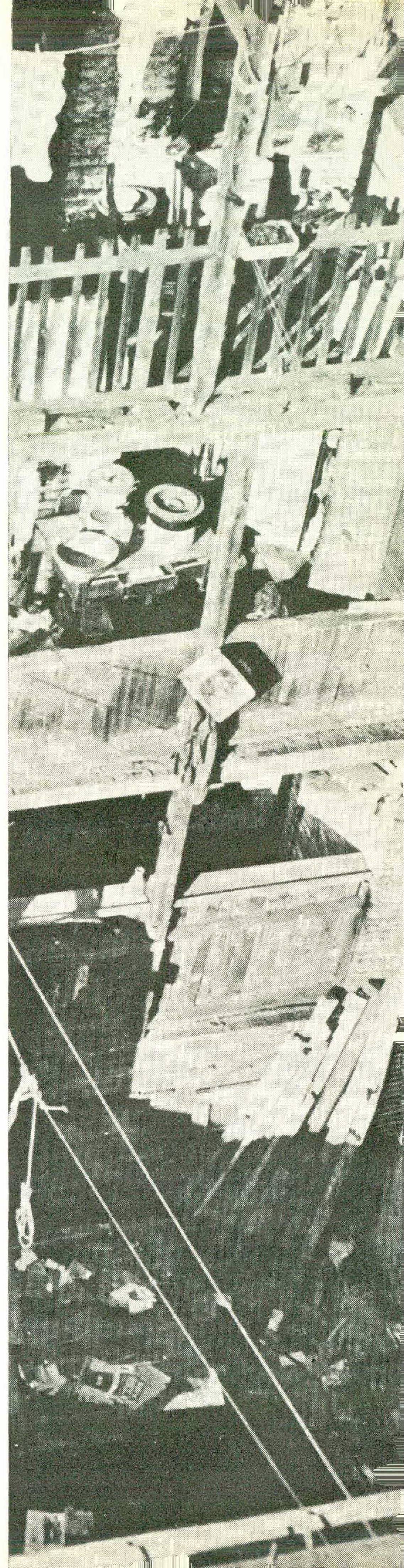
Where else indeed ! Once again, there is a great deal of truth to Manny’s flagrant assertions. Some of his tenants are paying less rent than they would pay in a project and much less than they might pay in some of the “renovated” tenements. One of Manny’s three-room railroad flats recently rented for $36 a month. How much can a landlord be expected to provide for that kind of rent? Manny’s tenants get very little of anything; they can expect to be without heat or hot water at least one week in every month while his workman struggles over the furnace, there are no lights in the hallways, the refrigerators are converted iceboxes, and the pilot lights on the stoves leak gas. When the heat comes up his houses chatter. In the evening the lights are the color of American cheese because of the faulty wiring. The flats are tiny and stifling in summer. The views are appalling— uncollected garbage heaps that support a population of rats. The toilets are always backing up; if one does flush, the whole house groans as if some giant were choking on his phlegm. When it rains, the plaster sweats. Then it dries and flakes all over the rooms. In the past, Manny’s tenants have committed numerous acts of vandalism. They have passed out from overdoses of narcotics in his hallways, pawned his mailboxes, and defecated along his stairs. Manny is no longer upset by such occurrences.
Manny knows he could get more money if he furnished the apartments, but he says, “I don’t want to tie up my money in garbage . . . and that’s what it would be.” Once he dreamed of a tenement empire, but now, faced with rent strikes and rising expenses, he has come to accept a more limited ambition. He would like to be a better landlord to the tenants “if it would pay,” but “blood from a stone is impossible.”
Poor Manny! Poor stone!
He once had an option to buy a better tenement on Third Street, but he did not buy it. He put the money in mutual funds and hoped the market would go up. When former Mayor Wagner announced a campaign against rats, Manny’s tenants sent him a dead rat in a package. Since John Lindsay took over, Manny is becoming more and more paranoid. He thinks that some of the crusades against slumlords are anti-Semitic, and he is also very bitter about the treatment he receives from building inspectors and social workers. The former hold him up for a lot of money. He claims not to know what the latter want, but he believes that they put the tenants up to sending him the rat.
When Manny is asked how much he must pay off each month in bribes, he will say he is not a rich man; then he will tell how he almost had a chance to get rich once, about ten years ago, when a well-known “action” painter was living on the top floor of his Ridge Street tenement, and Manny had to take forty canvases in lieu of back rent. Then he considered himself lucky in unloading the canvases for $500, but they now sell for more than $10,000 a piece.
Manny says he is not bitter because “it was never meant that I should be an art collector,” but he is not so forgiving about his treatment at the hands of the social workers. “Who the hell they think they are?” Manny will demand just as soon as Mobilization for Youth is mentioned. Then he will say, “They don’t like how I run things, let them buy the buildings and see how they like it.” But when you ask Manny for a price, he will snap, “Don’t be so funny!”
“What I got? What am I going to do?” Manny will declare, but he will never let you pin him down to a price. “I’m all alone,” he’ll say. “There is nobody on my side.”
Sometimes one gets the feeling that Manny must tell himself these things as he climbs up the dark stairs to collect his rents. Other landlords can get loans to rehabilitate their properties, but nobody wants to rehabilitate Manny’s dreck. If he gives up now, perhaps some speculator will grab his buildings for a song. Manny knows that under current rent-control laws the only way he can raise the rent is to move his tenants out, but he cannot be sure that he will get new tenants. He tells himself that if there were no welfare, he would have no tenants, but he also hates welfare every time a check is delayed and he has to go climbing up the stairs to dun one of his sullen, squalid tenants. Manny says, “I make more home visits than the social workers.”
Not too long ago one of Manny’s tenants dropped a garbage can down on him as he came up the stairs, and he had to stay in the hospital overnight; but Manny refused to press charges when the woman swore she thought he was her welfare worker. “You got to expect such things,” Manny said, although he had the woman evicted as soon as he could when she failed to pay her rent the next month. Then the apartment lay vacant a month and a half, and he had to pay $20 to the inspectors before the new woman would move in with her children; but Manny got an increase from the Rent Control Board that pushed the rent up. Even though he is now convinced that his buildings are not worth anything, Manny still likes to multiply his rent rolls.