A Dog for Rock
This short sketch shows what can happen to a free, savage young man when feeling enters his spirit. Mr. Senesi is a young Italian writer whose first work appeared in the ATLANTIC five years ago.
A Story by Mauro Senesi
IF HE found a chicken by the road, he would take it, but sometimes he would go right into the chicken coop. If he met a girl who was alone, he would bother her, and not all of them, to be sure, had been able to run away.
Strong he was, and bad. He would hit you with his fists and his knees and his feet. We had all been put to the test at one time or another. Now we tried to keep away from him, or else we would smile and call him “Rock,” the way he wanted us to.
He seldom stayed in town, preferring to go wandering about the surrounding hills and farms, like the badgers, or sometimes the wolves, in search of prey in the winter. Not only we boys were afraid of him, but the farmers, as soon as they saw him, would offer him bread and ham and the special wine.
Therefore he could live without masters, and even his family had no power over him. He had gone to live by himself. We certainly envied him.
Always well dressed, you would see him, his pants with a crease, and a clean shirt. The fine shoes would get spattered with mud on the country roads, but in every house he would have the women shine them up again. His hair was black and thick, and plastered down with so much brilliantine that not even the wind could muss it.
And yet, that autumn the wind blew hard in those hills. It seemed that beyond the horizon, there sat God, figuring how He would pull up the land by the roots, and everything along with it too. Instead, He threw down only a few old olive trees and three telephone poles.
The same thing happens in the summer, in the winter: either it’s the heat or the cold or the rain or the wind — it’s as though something were always about to disrupt our country, with us shut up inside.
While Rock, the free savage, dressed as if it were a holiday, ever prowled the countryside in search of women and chickens. It was no use to hate him, because after all, you couldn’t blame him too much, if there were three or four men together, he wasn’t ashamed to run off, but afterward, one by one, he would take them on, using stones if his fists and his knees and his feet were not enough.
Outside of physical blows, there was no way of getting at him. He didn’t care about anybody, and inside him, there weren’t the feelings most people have, so that sometimes even little things disturb us. You never saw Rock laugh, not to mention seeing him cry — his face was just like those of animals, which don’t show sadness or happiness but life, and that’s enough, and hate when they’re starving.
It must be nice to go wandering the earth, always ready to sink one’s teeth into something without feeling the pain that comes from the wounds, even if they’re on the bodies of others. It was impossible for us, and so we envied Rock, and were always searching, together with the farmers, for some way of striking at him. But there wasn’t any. Isn’t it this same sense of envy that drives people to go hunting wild animals in Africa?
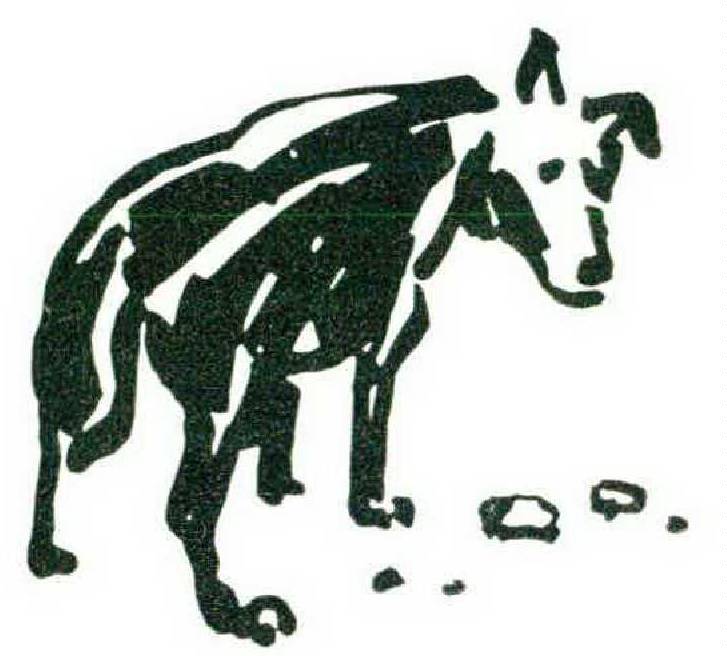
From the horizon, God blew on our hills. We could feel his breath whistling over the old stones of the houses. It didn’t change anything much, except that a dog, driven by the wind, entered the town. A black, shining dog, come from God knows where, which had dangling ears, and which, as soon as it saw Rock, attached itself to him. Rock threw stones at it, and the dog followed after him, bleeding. We had to laugh at Rock, running away, with that old bastard dog at his heels.
For three days, Rock continued to run, and the dog to follow him. He would try to hide himself in pits, but the dog would smell him and stop. More red than black the dog had become, from the blood caused by the stones that Rock hurled at it, and it always had the strength to keep following joyously, It was a sight, that battle in those hills; we would run to see it as soon as we had a free minute. And if sometimes the dog lost the scent, we would show it the way so that it could find Rock. Dog with dog, we would say.
Finally Rock stopped and waited for it. His shoes were full of mud, his pants wrinkled, and his hair mussed up. It was the first time wc saw him that way. The muscles on his face twitched, and it seemed certain he was about to kill the dog, which was approaching him slowly, with its chin low, but its pupils turned upward so that you could see the sky reflected in them.
The wind ruffled the dog’s fur and the boy’s hair; it was beating down on them. The dog cowered, and Rock bent over it, taking its neck between his strong hands, which were laced with twisted veins.
We watched from a distance, waiting for him to kill it. At that moment we felt the desire for him to kill it, and we didn’t know the reason. We could see the dog’s throat trembling under Rock’s hands, and its white pupils fixed on him. Squeeze, Rock, we felt like shouting.
And he did squeeze, but only a little. The dog whined and Rock’s hands suddenly relaxed, and his grip changed to a light caress. Happy, the dog barked, wagging its maimed tail. We laughed at Rock, who hadn’t been able to kill it, nor would he ever be able to do so. It meant that a feeling had entered into his spirit, and now he could say good-bye to his liberty.
Rock got up shyly, and started to walk again on the cracked clay road, with his dog, wagging its tail in victory, close behind. The wind had suddenly died down.
For about a week or so nothing seemed to have changed. Rock wandered around the hills with the dog instead of alone, and he even began to train it to catch chickens, but the dog was slow and it took a lot before he was able to get so much as a chick. And yet Rock, more and more, when he thought that nobody was looking, would kneel down and put his hands around its neck. It was a real love, and word of it soon got around the countryside and the outlying farms.
Since the dog didn’t have a name, we called it Rock, like its master. Get black Rock! wc would say. First chance I get, I’ll run him through with a pitchfork! Bui lie was always too fast for us, so we waited for Rock’s love to get stronger before we’d uo to the city hall to tell the agents that Rock had a dog and didn’t pay taxes.
The agents looked for the boy about the countryside while he ran, but finally they caught up with him, and they wanted to take his dog. Rock couldn’t fight them because they were authorities, and they had guns. To satisfy them he had to take off his jacket and give it to them. It was almost new, and the agents said in return, we will pay the tax out of our own pockets.
Rock was left in his shirt sleeves, and it was just in those days that the cold was becoming more intense, and you could actually taste the snow in the air. The dog played tricks at his side, ridiculous, black, and mangy, while the boy, without his coat, seemed thinner and weaker. Who would have said that we would be laughing at Rock?
And when we laugh at something, wc arc no longer afraid. The farmers didn’t offer him bread and ham anymore. From a distance, they would see him coming, because of the dog which barked, and they would go out with pitchforks then, to defend the chickens, and the women too.
Kill the dog, Rock, kill it!
And the winter sky descended on our hills. Between the sky and the hills there didn’t seem to be any room for men. It was a miracle that there was still space for Rock and his dog. But it was hard struggling along the slippery roads; we knew they were starving and we knew that, from one minute to the next, the gray sky would crush them down, the two of them.
Every time the dog barked, Rock coughed. His cough had a gentle note, like an answer. From that, if from nothing else, it was understood that now he would never be able to kill the dog. 1 hen. we boys decided among ourselves — we thought it was out of cruelty, but actually, we wanted to help him — and the word got around that Rock’s dog was mad. It didn’t take much for the farmers to get on its track with pitchforks, and the people from the town, too, with guns. They had been waiting so long for the chance to get back at Rock, and this was it; men you can’t kill, but dogs you can. What difference does it make that in winter it’s the men who go mad more often than the dogs?
They found Rock-dog trembling in a pit, waiting for Rock-boy, who must have been nearby searching for something to eat for both of them. With his fur standing on end, he barked. His eyes were white, said the farmers, he was really mad. Into the pit, it was all a thrusting of shining pitchforks.
We boys thought, Rock is free again, now he will show us. But instead, Rock, when he looked into the pit, started to cry, not to shout. He cried stretched out on the earth, and the wind puffed out his shirt, like a sail.
Stretched out on the earth was Rock, and in him there was more pain than hate, more suffering than freedom, more pain than life. The clog was inside of him, biting him, and by this time, neither he nor anybody else would have been able to kill it.
We should kill our dogs right away, guys.