Where I Stand
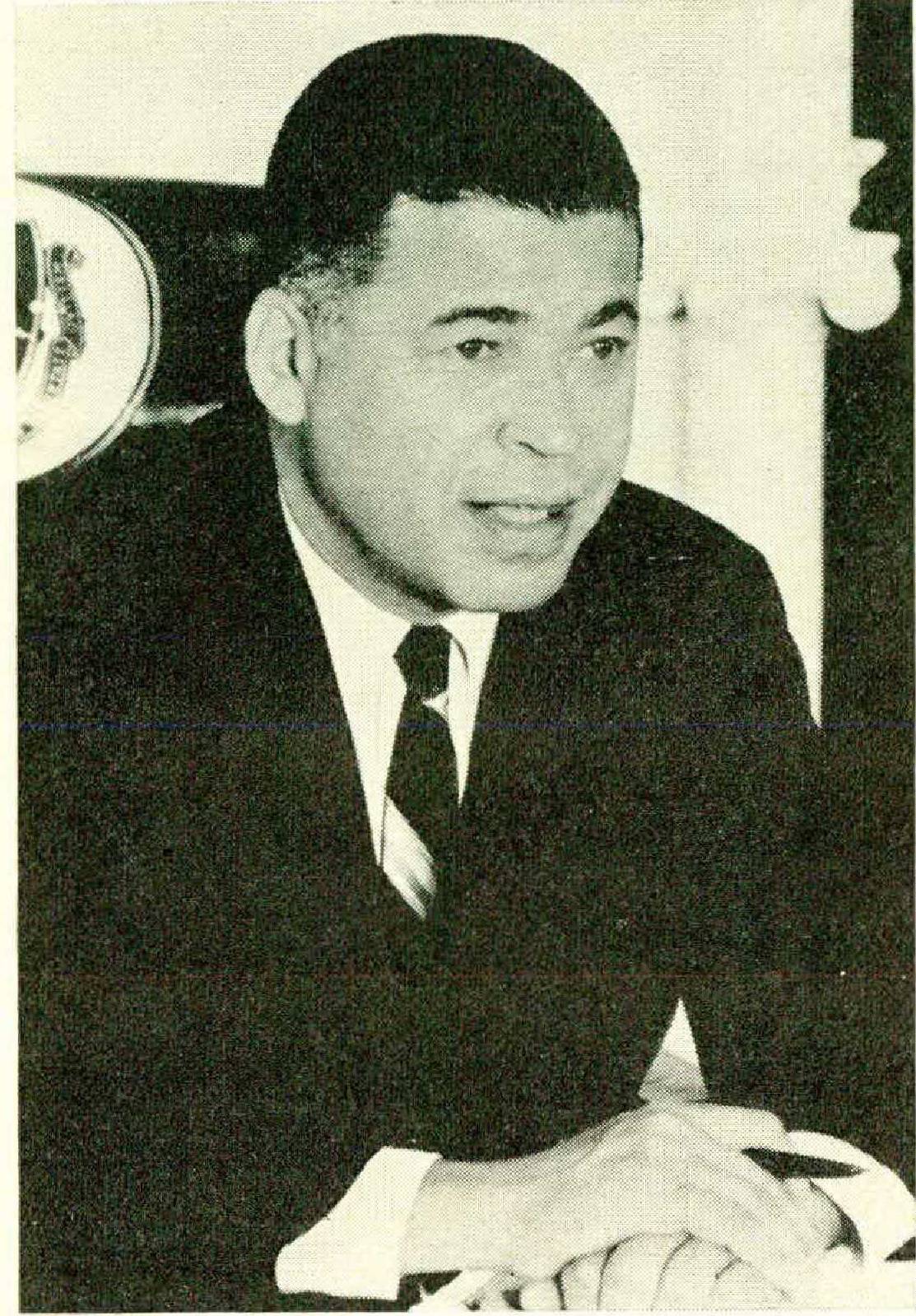
As Attorney General of Massachusetts, Mr. Brooke, forty-six, fills the highest elective post held by a Negro in the United States. If he wins the Senate seat being vacated by Leverett Saltonstall, he will be the first Negro senator since Reconstruction days. A Republican who now must declare himself on major national and foreign policy issues, he takes his stand in THE CHALLENGE OF CHANGE. to be published soon by Little, Brown. In this article Mr. Brooke gives his proposals for solving some of the most pressing of America’s problems at home.
by Edward Brooke
IF THERE is a central theme running through America’s domestic problems today, it might be described as the startling unevenness in the quality of our national life. I shall not argue whether that quality is outrageously low compared with other Western nations, as our detractors suggest, or supremely high, as many superpatriots insist. The point is simply that many aspects of our national life beg for improvement. Poverty blights the surface of America, in major areas of our material, spiritual, educational, and aesthetic environment. We cannot measure our success as a society by comparing ourselves with poorer nations. The only fair comparison measures our own achievements against our own potentialities and capabilities. And who can claim that we are remotely close to fulfilling our potential for sustained excellence in our daily lives?
By “startling unevenness in the quality of our national life” I mean the very sharp contrasts that exist, often side by side, in the lives of almost all of us. Many of the homes are lavish beyond compare, yet the facilities for public relaxation in our cities can only be called primitive. We have incredible appliances for cleaning our offices, yet inexcusably dirty streets. Private cars are magnificently shaped and equipped, but public transportation systems seem to be operated to test passengers’ capacity to endure discomfort. Immense sums are spent to air-condition homes, offices, and public buildings, but insignificant amounts are allocated to eliminate the dangerous pollution in our atmosphere. Stores are stocked with a dazzling assortment of goods and products, but schools are understaffed and underequipped. Comforts of all sorts are enjoyed by the majority of Americans, but despair, anger, crime, as well as physical decay are growing in our spreading slums. Billions of dollars are spent for neon signs advertising every conceivable product, but we “cannot afford” to plant trees and flowers in downtown business sections. The city dweller can purchase almost all of the world’s most desirable goods, but he cannot purchase security as he strolls through the park after dark. In short, many Americans are being deprived of beauty, comfort, security, and a sense of well-being because we are failing to solve problems which it is in our power to solve.
Take a ride to the country, and you will see similarly startling contrasts. Enormously expensive and efficient highways are flanked by billboards, junkyards, and other forms of cancerous blight. More and more of the roads leading from our cities are being transformed into breeding grounds for suburban slums. More and more of the country’s unparalleled natural beauty is being ravished by thoughtless exploitation. The number of pleasure boats has multiplied astronomically, but clean water in which to enjoy boating, fishing, and bathing is rapidly disappearing. More and more people have the means to enjoy more and longer vacations, but unspoiled countrysides and beaches are less and less available to most Americans. We have developed superb ingenuity for solving technological problems and creating technical marvels, yet tolerate vast areas of tawdriness and ugliness which debase our culture. We seem to be giving to ourselves with one hand and taking away with the other. We have not lacked the resources or skill to correct this imbalance. We have lacked the determination and the leadership to do it.
But there is something even more disappointing in American life than the uneven development of our physical resources. Our misuse of human resources is far worse. We are the most productive and prosperous nation on earth, yet we tolerate mass ignorance, poverty, and unemployment among our people. Some forty million of our people have not been able to cash in on the American Dream. In the midst of our plenty and progress, we have despair, disillusionment, and defeatism among people who are shackled by generations of acquired disadvantages. It is in terms of human lives that the contrasts in American life are most startling.
OF THE roughly fifty million American families, over a fifth have total family incomes of less than three thousand dollars a year, less than sixty dollars a week. Five and a half million American families — containing over seventeen million people, almost half of them children — survive on incomes of less than two thousand dollars a year, less than forty dollars a week. Of America’s “single-person” families, five million — roughly 45 percent — have total incomes of less than fifteen hundred dollars a year, and 30 percent exist on less than one thousand dollars a year, less than twenty dollars a week!
Poverty in America does not mean starvation. It does not mean utter destitution, hunger, or homelessness as it does for hundreds of millions of the poor of Asia, Africa, and Latin America. But it does mean substandard medical care, substandard education, and substandard cultural influences, all of which doom the children of the poor to remain poor unless blessed by extraordinary ability or great good fortune. It means a shorter life plagued by more frequent physical and mental disease; a smaller body and a less developed mind. And it means passing aimless days on street corners and the porches of rural shacks. It means stagnation.
The forty to fifty million Americans who are living in a twentieth-century subculture are the rejects of our otherwise magnificently affluent society, people who never had the skills to “climb aboard,” or who were not allowed to climb aboard, while American society raced forward. Or they are people whose skills were rendered obsolete by the advance. All of them find it increasingly difficult to catch up. They are the dishwashers, the harvest workers, the sharecroppers, the odd-jobmen, the coal miners, the elevator operators, the displaced conveyor-line operators, the errand boys, the nonunionized store clerks, the skilled workers displaced by automation — and always, the masses of untrained, unequipped, and incompetent, who lack that minimum of economic value to break into the vibrant world of business and organized labor, and who must exist, hand to mouth, on woefully inadequate wages or one form or another of dole.
A conservative estimate places the number of children condemned to almost certain poverty, and to rear their children in even greater relative poverty, at twelve million! Something is drastically wrong when any American child is born with such great odds against living a moderately successful and happy life.
There are exceptions, of course, which are widely publicized for the purpose of suggesting that the slum need not stunt a young person’s growth, but on the contrary, should stimulate it. But these exceptions are in fact very rare. When shining examples are cited as proof that the poor can rise from the slums, I remember the reaction of Senator Robert F. Wagner of New York when he was used as such an example. “That is the most God-awful bunk,” Senator Wagner replied. “I came through it, yes. That was luck, luck, luck. Think of the others.”
Social scientists disagree about the statistics of poverty. Some say there are thirty-five million “poor” Americans; others put the figure at fifty million. Some feel a family income of three thousand dollars a year constitutes poverty; others put that figure at twenty-five hundred dollars. Some place widows whose sole source of support is a monthly Social Security check for sixty-five dollars — roughly, the median Social Security benefit for widows — in the category of the poor; others place them in a different category. Some say America’s poor number a fifth of our population; others place the figure at a third.
One can debate the accuracy and interpretation of these figures, and one can argue about the precise point at which a person or a family can be said to be living in poverty. But such arguments are irrelevant. The essential fact is that for a large number of our people, life is a grim, degrading ordeal of bad food, bad health, ignorance, and wretchedness. And this in a nation rich beyond belief!
Until recently, it was assumed that as the productivity and wealth of America increased, poverty would shrink and eventually disappear. But that has not happened. The poverty of Americans in the “mainstream” of society has disappeared, but the poverty of the outcasts has solidified into semipermanence. Not only have those outside the mainstream become relatively poorer compared with the rest of the nation; more important, the chances for the poor to enter the mainstream have become fewer. The gap between those who have employable skills or suitable education and those who are unskilled, uneducated, unemployed — and unemployable — grows greater in direct proportion to the economic and cultural development of American society. The barriers that prevent immigration from poor America to rich America are ever more difficult to scale. The poor become poorer in a thousand ways, the most tragic of them in the opportunity, and the ambition, to make it.
This is one of the gravest problems of contemporary America, a problem which, if unsolved, will establish a permanently underprivileged and hostile class of a fourth of all Americans.
POVERTY has been a plague on mankind since the beginning of history. Most of the world’s people have been abysmally poor— too poor to secure enough food for themselves and their families. And most of the world’s people are still abysmally poor. Why, then, has American poverty become a critical political issue?
I think it has become a critical political issue for the reason that always makes issues politically critical: the time for its solution has arrived. The economic means to eliminate poverty are at our disposal. Only an all-out, unqualified, massive attack on the conditions which doom many Americans born in disadvantaged circumstances to live out their lives and rear their children in the same circumstances can promise a lasting solution. I say “massive” despite the notoriety attached to that word when used in connection with government, because the problems are massive, and they require massive efforts to solve them. They require a massive investment in human resources to raise the skills of disadvantaged Americans to the level of the majority, just as any backward sector of any economy requires massive investment in mechanical equipment to raise its technology to the level of world standards. The investment that prosperous parents ordinarily make to educate themselves and their children — and which poor families, racially oppressed families, and families living in urban slums simply cannot make — must somehow be compensated for.
But giving aid and comfort without developing skills and talents promises only more of the same. We must concentrate our efforts on the individual needs of individual families living in disadvantaged circumstances. We must, in other words, help disadvantaged Americans help themselves.
To help people help themselves, we must in the first place remove the obstacles in our national life which tend to keep the poor and racially oppressed and slum dwellers where they are. In other words, we must seek out the flaws in the system which tend to perpetuate poverty, segregation, and slums. We must tear down the barriers in our social, political, and economic institutions that help keep Americans disadvantaged.
Increasing the minimum wage, for example, would bring some immediate benefits. According to Herman Miller, an expert on poverty statistics in the Bureau of the Census, “about fifty percent of [the poor] are in families headed by a fulltime worker whose wages are simply too low to support a family.” But a higher minimum wage is often less important than extending the existing minimum to cover workers unprotected by minimum wage legislation. For example, hospital workers, unskilled restaurant help, and unskilled retail workers who earn fifty dollars or less a week are, if they are raising a family, almost certainly doomed to poverty even if they are working full time. It is a paradox that many of the families who most need the protection of minimum wage laws are excluded from them. Skilled industrial workers and others whose wages are far above the minimum are protected, but many working in jobs paying much less than the minimum are not.
The same applies to unemployment insurance. It is estimated that as many as two out of five workers in the American labor force are not covered by the federal-state unemployment insurance system. It is often argued that unemployment insurance should be increased. Perhaps that is necessary in many states. But far more important is the expansion of the system to include those workers who will most likely suffer chronic or seasonal unemployment — to include those who most need protection, but are now excluded from it.
Recent statistics indicate that a fifth of the total of America’s poor are aged. In their case, a simple addition to their income, even a small addition in percentage terms, would go far toward alleviating distress. Relief payments too must be increased where relief is needed. For in most states the level of relief is appallingly low; it is the difference between the applicant’s resources (plus the resources of his legally responsible relatives) and a minimum standard set by the state. But these minimum standards are often themselves below the poverty level. (New York’s relatively liberal welfare grants, for example, average 25 percent below the estimated poverty level.) They do not allow the families involved to make the investment in education and training for themselves and their children necessary to break free from poverty.
The simplest kind of reform in terms of government intervention in the economy would be a revision of tax laws to ease the burden in lower income brackets. Another of the paradoxes in our economic life is that families living below the poverty line pay part—albeit a small part — of their income for taxes even though this expenditure often, in the long run, costs the government more than it takes in. Even the small sum that these families must pay in taxes represents a severe strain on the family’s ability to provide itself with the essentials of food, clothing, and medical care. As a result, government, at one level or another, must fill the gap, and often a greater gap than would have existed were the tax payment abated. Not enough milk and meat in the diet means sickness and unemployment; not enough money for shoes means children do not go to school. In the end, the government pays more to correct these defects than it collects in taxes from the people who suffer them. Economically as well as morally, therefore, it makes sense to give more generous tax benefits to poor families and especially to the aged and widows.
A reverse, or negative, income tax ought to be seriously considered as a means of raising income of the disadvantaged to an established minimum level. This idea was once considered revolutionary. But now, based on the fact that the potential exemptions of many poor families exceed their incomes, it appears more and more logical. In other words, the father of a family of six who earns $3000 a year and has exemptions totaling $3600 for that year, thus incurring no tax liability, would receive $600 from the federal government, which is the amount of his total exemptions over and above his total income. The $600 would be paid by a federal appropriation or from “found money” — money collected by the Internal Revenue in interest and penalties for late payment of income taxes. If this sounds like outlandish charity, it ought to be remembered that such a family often costs the local, state, and federal government far more than six hundred dollars in a year in terms of welfare services. Such a direct payment might in fact be simpler, more effective, and more economical. We grant special tax exemptions to many individuals and businesses in special circumstances, such as the depletion allowance given to the petroleum industry as an incentive to find more oil. Why not use our tax laws to combat poverty — as a form of assistance to the oppressed to help themselves.
ALL of these measures and others to correct institutional flaws in our system can be valuable. But they cannot be valuable without planning, particularly long-range planning. The most successful American businesses use planning together with experimentation of new techniques in a remarkably effective way. The government must learn to imitate business in this respect. Study and planning for the specific needs of specific individuals who are segregated racially, economically, and culturally are not an excuse to avoid action. Study and planning are an absolute prerequisite for any kind of intelligent action.
The Democrats have struck out in every possible direction without the elementary planning which is the required first step for any kind of successful program, governmental or nongovernmental. We are now witnessing under a Democratic Administration a proliferation of agencies and a potpourri of anti-poverty programs which were thrown together slapdash and bear no resemblance to a coordinated, controlled, step-by-step series of actions that would constitute an authentic war on poverty. In fact, present programs, far from being coordinated, appear to be operated in competition with one another, as if the real war were between federal, state, and local agencies instead of against poverty. Each agency — and there are literally dozens of them — seems determined to “grab a piece” of a poor family and hang on to it, struggling to enhance its own power and prestige by proving its approach is best. As with so many programs sponsored by the Democratic Party, the emphasis has been on protecting the institutions and their prerogatives, rather than on the individuals whom the institutions are created to serve.
We have embarked on a war which America cannot afford to lose, yet embarked on it ill prepared, ill equipped, and ill led. The cause is simply too important to allow its implementation to be left in incompetent hands. We need organization, skillful and humane administration, modern accounting techniques, and above all, we need plans. We need blueprints drawn by experts, by people appointed on the basis of professional expertise, not political patronage.
The ability to help oneself is dependent primarily upon a variety of sources. But surely the principal source is education. Only education can break the heritage of disadvantage and defeatism now handed down from generation to generation. Only education can equip the underprivileged to make their own way in a free-enterprise system.
We have been clinging to a traditionally designed educational system. As an example, the nine-month school period and the three-month vacation period are a heritage from our agricultural past, which does not characterize our country at the present time. The children who were excused from school in the summer months to work on the farm do not work on the farm anymore. And the great majority of them are unable to find jobs.
The educational facilities of the nation are poorest precisely where they should be best. Two out of three of America’s unemployed workers lack a high school education. In Harlem, 80 percent of sixth-grade students are below sixth-grade norms; almost all high school students in Harlem are below standard norms — eleven out of twenty are unable to graduate. It has been estimated that 50 percent to 75 percent of slum children are failing to get a minimal high school education in our public school system. In Cook County, Illinois, 85 percent of those receiving welfare aid did not graduate from high school, and the national figure may be as high as 90 percent. In terms of preparing disadvantaged children to make use of American opportunity, our educational resources are sadly underdeveloped.
Nothing can reverse this trend except a vast educational program that will give the disadvantaged a fighting chance to catch up. Since their domestic environment is inferior to that of “normal” Americans, their schools must be made not equal, but better, than the average schools. Since they are discouraged from competing for the Good Life almost from the moment of birth, they must be encouraged by educators to work not as hard, but harder. Since they have been subjected to poorer cultural influences throughout their childhood, they must be given exposure to cultural influences which are not equal, but richer.
Only by investing more in education in the next few generations can we avoid spending far more for doles in perpetuity. Massive improvement in our educational system will be the cheapest approach in the long run, and we cannot expect private funds and foundations to do the job alone.
Measured in terms of the needs, President Johnson’s poverty program is pitifully inadequate and misdirected. At best, it is a rearguard action in a losing cause. To make ours a winning cause, the people trapped in slums must be provided with grammar and high school education, vocational education, and adult education far beyond anything yet proposed by either political party.
In addition, a national educational training corps Staffed by thousands of professional teachers — paid substantial premiums to work in slum areas, just as soldiers are paid premiums for combat duty — must be established with the specific goal of eliminating the educational gap. Such a corps could serve during a period of transition while we rethink and retool our total approach to education. In short, we must declare war on educational deficiency, and we must wage it with the same energy, efficiency, and willingness to spend money with which the cold war is waged. No single campaign or series of campaigns will be satisfactory. We must commit ourselves to a protracted war in which victory will mean the growth and development of young people, with roughly the same talents, qualifications, and ambitions, regardless of where they happen to live or the color of their skin. Nothing less than this promises success. Obviously, investment and dedication are required on a scale never before approached in American public education.
No OFFENSIVE against poverty, racial oppression, slums, and the myriad of other problems can succeed without increasing expenditures. But let me make one thing absolutely clear. We are not going to lose money or weaken America’s economic system by helping in the solution of these problems. No group will suffer — not the middle class, nor the upper class, nor the working class. On the contrary, the chronically poor will get richer, but so will everyone else. Every American will benefit economically as well as morally.
An all-out effort to help the disadvantaged to join the mainstream of American life would be one ol the wisest and most profitable investments in our national history. An investment to bring these people into the mainstream — as buyers and suppliers of every kind of goods and services — will pay enormous rewards. It will add at least thirty billion dollars each year to the gross national product — and more, as the skills, and with these the buying power, of the now disadvantaged increase. And this, of course, speaks only of the financial rewards. The real return must be measured in terms of human lives.
The money for the federal programs would come from increased spending by the federal government. Increased spending increases the gross national product. Increased national income would come from increased productivity. Tax revenues out of the increased national income would pay for the debt. This would mean an increase in taxes but more of an increase in income. The debt would be an internal debt which the people owed to each other. The people pay the taxes, but they also receive the interest on the debt.
This is not a simple or painless way to finance our proposed programs. I believe there are no simple or painless ways. It will require a large expenditure of government funds; it will mean new efforts in the public sector of our economy. I think there is no other way to reach our goals.
Consider the alternatives. Unless substantial gains — or at least realistic hope for substantial gains— are achieved soon, America will continue to be plagued by demonstrations, bitterness, violence, or the fear of them. We will continue to spend huge monthly sums for welfare payments, relief payments, and other measures which, by nature, solve nothing but can supply merely a minimum of temporary and expensive relief. Are we willing to keep sending our children to schools whose standards are lowered by children reared in material and cultural poverty, or to keep paying large tuition fees at private schools to escape that necessity? Are we willing to keep enduring the disastrous side effects of poverty and discrimination — crime, illegitimacy, and wasted human and economic potential — in our cities? (No one has calculated the total costs of these side effects in dollars, but surely it is many times greater annually than the total cost for a massive ten-year program of re-education. It costs the taxpayers of New York, for example, $7000 to rear a single child on relief to the age of seventeen.)
Are we willing to keep paying for the poor and the racially disadvantaged in a hundred ways, to keep living side by side with ugliness, ignorance, cynicism, and resentment? These things will not disappear by themselves; on the contrary, left alone, or treated haphazardly as they have been treated, they can only intensify. We will have to pay more and more relief for unwed mothers living in the slums; we will have to pay greater and greater sums to battle, less and less effectively, urban crime. We are deeply disturbed by these aspects of American life, but we cannot wish them away. Our national life will continue to be disturbed until we commit ourselves to eliminating them in the only realistic way possible, by eliminating the conditions that cause them.
THE Republican Party has traditionally felt that the principal function of government is helping people to help themselves. Now it has the opportunity to discharge that function on a scale unprecedented in American history. We have traditionally believed in investing funds wisely rather than spending profusely for projects which offer no promise of return. Now we have an opportunity for investment in the future of the country which not ordy will give a dollar’s value for a dollar spent but also will produce enormous profits. We have traditionally argued that the Democrats have temporized and faltered, rushing from one expedient welfare measure to the next because they do not fully understand the nature of America’s problems. Now the opportunity is ours to demonstrate an understanding of the real issues confronting the nation and to offer lasting solutions rather than everlasting subsidies.
We have traditionally believed that individual initiative made America great, and that governmental programs which sabotage initiative are in the long run self-perpetuating or self-defeating. We have recognized that America has thrived on differences and that the American melting pot was never intended to produce a bland gruel-like American who thinks like his neighbor, looks like his neighbor, and talks and acts like his neighbor; that it was never intended to blur the complexity, the diversity, or the wonder of difference among Americans. And we have led the fight against the repression of individuality. Now we have an opportunity to protect individualism by encouraging individual effort on the part of tens of millions of Americans.
The Democrats are known as great theorizers and great idealists, but they seldom follow through in any measure relative to their basic idealism. Already the present Democratic Administration has begun to hedge on its concept of the Great Society. President Johnson has encountered considerable difficulty in finding competent, hard-nosed managers for his programs. No matter what the Administration’s speeches and press releases say, the President has already begun to retreat from his commitments to domestic solutions, giving as the reason the growing burden of Vietnam. The reason is understandable, and I don’t think that anyone who believes in our commitment in Vietnam is going to object to the President’s cutting back on his Great Society to honor that commitment. But President Johnson should have recognized that as the Vietnam war began to escalate, his Great Society would never be able to get under way with any real effect so long as he was determined to employ the vast amount of resources which he has allocated to Vietnam. The assumption from all of this is that the Johnson Administration has played politics as usual, promising everything to everybody and forgetting the hard realities which face the nation.
I fully realize that in the area of foreign affairs any Administration, Republican or Democratic, will constantly have to alter certain domestic expenditures for international commitments. But what the nation needs in this crucial moment in our history is administrative strength and business tenacity which, though pursuing an intelligent foreign policy, will keep a constant vigil on domestic policies and expenditures and as a result see vital domestic programs to fruition.
A Republican Party which will not forget reality and which will draw upon its hard business training and administrative follow-through is best equipped to solve our complex national problems. It is time for the Republican Party to act. For these are times when cursing the darkness has become unacceptable to the vast majority of American people. The vast majority is waiting for us to strike the match.