The Real Cultural Article
PETER DAVISON is the director of the Atlantic Monthly Press and author of BREAKING OF THE DAY AND OTHER POEMS.
I have long been puzzled over why book reviewers increasingly turn their attention to one another rather than to the books they are supposed to be writing about. Not until recently, when I ran across a brilliant article by Sigmund Quarles (author of A Critic’s Critique), was I fully enlightened.
Quarles’s essay first appeared in the September, 1965, issue of Intimations, whose editor has kindly allowed me to quote it in full. Though (as the reader will perceive) it soon reaches far, far higher than its origins, it begins its flight as a review of The Drums and the Fire: My Second Term As President of the United States, by Henry Popham,
THE DYING BREED: Arthur Sturbridge Speaks Out
by Sigmund Quarles
The new review by Arthur Sturbridge in Nemo II for March, 1965, is by far his finest. It makes a reviewer grateful that such an intelligence should be exercising its powers in this arid generation. Sturbridge’s utterance takes as point of departure a work by Henry Popham — and, more specifically, the degeneration of standards in Popham’s latest socalled volume.
Beginning with a hard, level look at the dilemma of the writer in our time, Sturbridge turns playful. But it is the playfulness of the tiger. Under such conditions as these, he asks, is it better to have read and writ than never to have writ at all? Such a question is beyond clear decision by a reviewer (how modestly Sturbridge assumes the mantle!), but no reviewer worthy of the name can avoid grappling with the questions raised by Popham’s book.
The critic’s task weighs heavy, even on such shoulders as Arthur Sturbridge’s. Should Popham have written this book or another? Might he not have written a general study rather than a personal one? Did he have access to all the source material? Even though these questions might perhaps be answered yes, surely someone had blundered: the book should surely not have been allowed to be what it is, but should have been edited. Having said this much, Sturbridge leaves alone the question that troubles this reviewer: why should Popham’s book have been published at all?
Sturbridge next reverts to a theme that makes its majestic appearance over and over again in his work: the decline in the contemporary imagination; the impotence of this generation of writers to cope with the central human experience of rape, torture, and extermination; the speciousness of contemporary authorship, force-fed as it is by a publishing industry which grows more and more hopelessly enmeshed with the mass media. If Popham had chosen to write about the Civil War prison camp at Andersonville, Georgia, Sturbridge asks, what publisher today would have had the courage to publish his account? Obviously there is something rotten in the state of letters. We are, Sturbridge quotes, “fastened to a dying animal.”
Arthur Sturbridge believes in facing facts. The craft of criticism is dying for want of exercise, just as medicine would die without cadavers for the use of students. How can a critic deal with Popham, for instance, when for all we know he may have written the wrong book? How can a critic keep his scalpel sharp when, week after week after month, there are no new volumes worthy of his steel? It is chastening to imagine what will become of the next generation of critics without a Ulysses or an Across the River and Into the Trees to practice on. Without a constant supply of classics, Sturbridge ventures, a critic is like a squirrel who can find no nuts to sharpen his incisors on. His teeth may grow so long he cannot close his mouth.
All this has been mere preparation for Sturbridge’s threnody — a theme that all his work of the past two decades has been pointing toward. Why, he asks with astonishing boldness, why criticism at all? Has it perhaps outlived its time? Since no adequate books are being written, why should criticism hold itself ready to strike? The question has been advanced before, but never in such terms nor from such a source. Is not criticism, perhaps, a luxury in times so austere as these, as was the clavicembalo during the Thirty Years’ War? Have we in fact, Sturbridge inquires, approached the moment when books may be published without drawing any fire at all? If so, can what we loosely call the literary world survive the lack? The moose in parts of Canada died of disease when there were no longer any wolves to keep their numbers down.
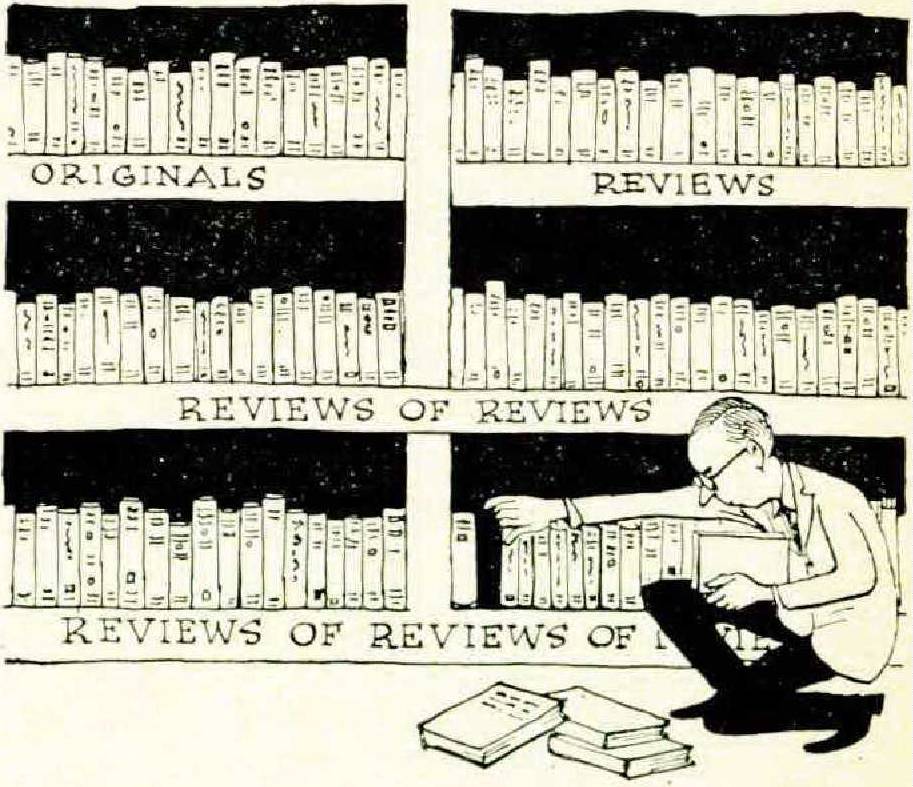
No, Sturbridge concludes, there is a way out. The critic, like all other artists, must adjust to the altered challenges of our time. He must learn what to notice and what not to notice. He must recognize the terrible truth that never again will he be able to review the first edition of Swann’s Way. Twilight is everywhere. But until the darkness falls, critics have one task left: reviewing one another’s works.