The Hero Bullet and Other Related Nonsense
A Boston University graduate, JACK BELCK is now working on his master’s degree in journalism at the University of West Virginia.
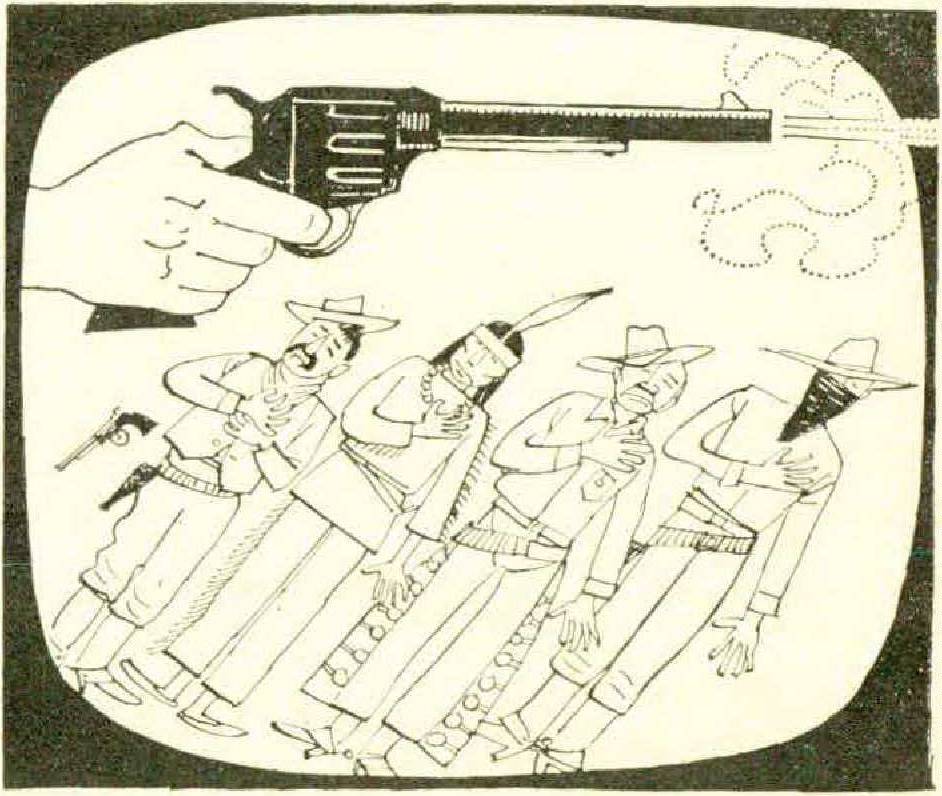
Every moviegoer and TV watcher knows about the hundred-shot sixgun used in low-grade Westerns. This firearm that, to coin a phrase, “you can load on Sunday and shoot all week” cuts manpower requirements considerably and allows a maximum amount of blood (ketchup) shed for the fewest dollars, since one Grade B cowboy armed with this device can polish off a large tribe of whooping Indians in nothing Hat.
Although historical experts and ordnance authorities now sit in film and TV studios to make sure that the right gun does the right thing in the right frame of reference, they still miss.
Not only do strange and impossible things occur with weapons in the thirty-live-millimeter commercial dreamworld, but authors continue to hand their heroes and villains pieces of artillery that make even the amateur shooter laugh. And what the actors do with these guns escapes the understanding of a man with even a basic knowledge of firearms and how they work.
In a recent 1870-style Jimmy Stewart Western, one of the villains sat atop a rocky outcropping and took aim at a distant man careening across Warner Brothers’ back lot on a buckboard pulled by two lathering horses.
The crook propped a Winchester saddle gun on his levi-clad knee, and bang: one empty buggy and one perforated rancher. The effect was very dramatic, especially since the rifle was an 1894 model, a little out of place for 1870. The range was a good 500 yards, and considering that a brand-new 1894 Winchester is doing well if it can keep its shots inside a four-inch circle at 100 yards, this was remarkable shooting, particularly when the assassin had to pot at a wagon going along (and up and down) at 20 mph.
The veteran Western watcher knows what would have happened if the villain had missed, as he would have done had the buckboard rider been the hero and not a bit player: the bullet would have ricocheted into space with a lusty sharp whine no matter what.
But as any shooter is well aware, not one bullet in a hundred ricochets to the accompaniment of a soul-stirring whang, even when shooting is going on around granite boulders and ironware. In filmland, however, the damn slugs carom noisily off (a) water, (b) sand, (c) wood, and will even oblige with a melodramatic buwaaaaaaaaaar when fired into the air.
And what would have happened had the hero been in the buckboard and had the villain on the half* mile-away rock misread the script and popped lead into him? The bullet would have gone into either his non-gun-hand shoulder or his leg, for the superaccurate bullet which whines at the drop of a trigger also refuses to penetrate the torso of a Good Guy, except perhaps in a foreign film.
Our hero-missing slug has another useful attribute — it doesn’t kill a villain who has something to say before he dies. Extras and assorted gunhands drop like the lead in them when hit, but the star rascal usually ends up with blood oozing out of his mouth, along with broken phrases that either quote philosophy in third-grade English or more or less tell the hero, bent carefully over the [gut-shot dying man, where the loot, girl, mine, map, or evidence is.
Possibly the most remarkable feature of the hero bullet is that it does a fantastic job on Indians; not only does it send the redskin flying dying into the dust, but his horse too, suggesting that the hero bullet can kill at least two objects while hitting only one. If so, it would seem more sensible to aim for the horse; it’s a bigger target, and if it is hit, the rider will get killed too. This is real economy.
We can’t help adding that the hero bullet contains some form of anesthetic, because heroes and villains alike grab their newly acquired bullet wounds, either to stop the flow of blood or to locate the hole for viewers whose eyesight isn’t too good. Anyone who’s ever been shot, however, knows that clutching at one’s gunshot wound is likely to be unpleasant, if not extremely painful.
Shooting back at someone chasing him as he rips across the prairie on his slavering nag is a reflex deeply ingrained in both hero and villain, even if a few minutes’ shooting would bankrupt the average thirty-dollara-month cowboy who is obligated to pay five cents for each bang he wastes in this exciting but useless fashion.
And the cowboy, trapped in the bunkhouse or behind the old corral, will rap oil 642 shots at anything, anywhere, but when the director signals “‘Now!”, his cartridge belt, which didn’t hold more than 25 rounds to begin with, suddenly runs dry, and our hero has to fight it out hand to hand with a villain who usually is smart enough to keep a few bullets in his gun at the very end.
Worst of all, considering how important the six-gun and thirtythirty rifle are to the lives of the characters and the plots of the stories, we cringe when we see both Good and Bad Guys shoot their weapons and then not clean them, even after dropping them in the dust, down wells, in mud puddles, and, presumably, on stable floors. Since black powder was the usual propellant before the early 1900s, and it rusts things if not washed out immediately, we suspect our film gunmen know as little about firearms as their writers, directors, and producers.