Originality and Success
they shall have music
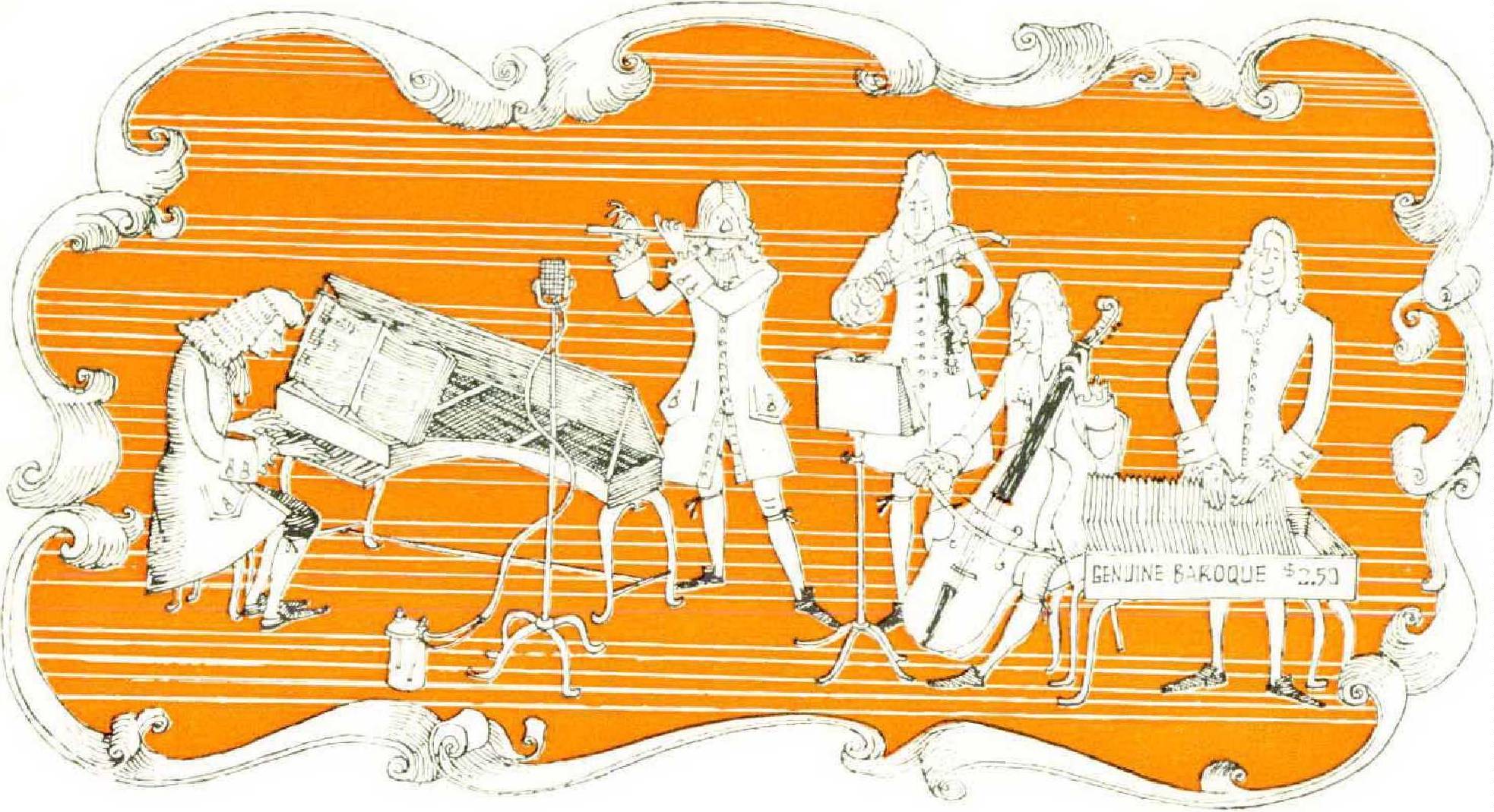
Two years ago a new label called Nonesuch, priced at $2.50 and specializing in baroque music, appeared on the racks in record shops. Such appearances are by no means rare; there are approximately five hundred labels listed in the Schwann catalogue, of which perhaps a twentieth manage to lead a durable, not to say thriving, existence.
But in its two years, Nonesuch has not only managed to establish itself securely; it has begun to cause a re-evaluation, at least in a portion of the industry, of long-established pricing and repertory practices. At the same time, it has re-created to a degree some of the excitement and adventure that characterized the early days of the LP era, and that have diminished so drastically in recent years.
Nonesuch is the brainchild of a thirty-four-year-old record executive named Jac Holzman, who founded (and still runs) Elektra Records, a firm specializing in folk song releases, which are particularly prized by college audiences. Elektra, which began operating fifteen years ago in the back room of a cigar store in Annapolis, Maryland, where Holzman was enrolled at St. John’s College, today occupies a modernistic suite of offices and sound labs in a mid town New York skyscraper. It was there that Holzman, selfassured, businesslike, and loquacious, developed his concept of a purely classical line to be called Nonesuch.
“Originally, it was a merchandising concept,” he says. “Elektra had been successful, and we wanted to diversify. I like baroque music, and I knew the difficulty of buying such records at $5.95. It’s a tough choice at that price. So the idea came to me of creating a low-price record line that would not be a cheap record line. I didn’t want a $1.98 line; $1.98 sounds like a cheap record, no matter how good it may be. The $2.50 price — the same both for monaural and stereo — was the basic idea of the series. I filled in the details later — about ten minutes later.”
To get his recordings, Holzman went to Europe and began licensing tapes from companies in England and on the Continent. “I had been collecting European catalogues for years and knew what to go after,” he says. “I didn’t want Beethoven symphonies; I knew I couldn’t compete with the other labels on warhorses. What I was after was unusual repertory or possibly unusual performances. And I found there was plenty. In fact, some had been available to established companies here, but they weren’t interested.”
Pye in London and Club Français du Disque in Paris were the producers Holzman wanted most to affiliate with; he also wound up with Critère and Cycnus in Paris, Camerata in West Germany, Tono in Zurich, and several others. Whereas he originally had to seek out the Europeans, now they are coming to him with recording projects. Nonesuch has also issued a few American products, and has plans for further recording here.
The first release of the new label, early in 1964, gave a fair cross section of its wares. Included were such items as a set of Renaissance songs by Claude le Jeune, a French sixteenth-century master hitherto unknown to the record catalogue; two cantatas by Bach; an all-Albinoni record; an anthology of works by various composers entitled The Baroque Trumpet; and a collection called Symphonies and Fanfares for the King’s Supper, consisting of music by obscure French composers originally written for the delectation of the court of Louis XIV.
Having decided to concentrate on specialized and even scholarly recordings, Holzman then took the seemingly contradictory step of dressing them up in glossy and festive garb. All jackets were laminated, a procedure previously unheard of in a low-priced line. The jacket designs were bright, colorful, and touched with humor. Liner notes were authentic and ample. And a catalogue of the entire series was thoughtfully included with each disc. “We wanted to make it fashionable for people to buy a lowpriced record,” explains Holzman.
To longtime collectors, the Nonesuch releases, which already total more than 100, have reintroduced a welcoming freshening of repertory into the catalogue. But their appeal apparently is particularly strong among collegians and other young customers, who are attracted by both the low cost and the novelty of the repertory. A new generation has come into the market since the original Age of Discovery which followed the triumph of the long-playing record around 1950. In recent years there has been a shift away from unexplored repertory performed by unknown musicians toward established works done by celebrated performers. In this sense, the activities of Nonesuch are a throwback to the pioneering and exploration of the dawn of LP.
Curiously, the process has turned up not only some fascinating music but some admirable performers as well. The city of Saarbrücken, for example, boasts an expert ensemble known as the Chamber Orchestra of the Saar, conducted by a highly capable musician named Karl Ristenpart. He has made a dozen recordings released by Nonesuch, including Bach’s Magnificat in D and Mozart’s Vesperae Solonnes de Confessore, K. 339, both with breathtakingly beautiful singing by the American soprano Teresa StichRandall. Similarly adept are the Little Orchestra of London, conducted by Leslie Jones, which specializes in early Haydn symphonies, and the Gürzenich Symphony Orchestra and Chorus of Cologne, which participated in one of the most ambitious Nonesuch projects to date, a two-record album of Beethoven’s Missa Solemnis.
Actually, in choice of repertory Nonesuch has expanded far beyond its original concept of specializing in the baroque. Naturally, it is in the thick of the current revival of the works of Georg Philipp Telemann, with six records devoted to this contemporary of J. S. Bach. But it also is the only company in the catalogue with records of music by Johannes Tinctoris and Franz Berwald. Tinctoris was a Flemish theoretician and composer whose dates are 1436 1511. A recording of his Missa Trium Vocurn (Mass for Three Voices) by a French instrumental and vocal ensemble under Roger Blanchard reveals him as a musician of bold originality, one who made especially striking use of the bass voices, much in the manner of Russian liturgical choirs today. Franz Berwald, by contrast, can be considered almost a modern; he lived from 1796 to 1868 and composed romantic symphonies that show the influences of Berlioz and Schumann and have a terse and brusque melodiousness of their own. A Nonesuch record of two Berwald symphonies (the Sérieuse in G minor and the Singulière in C major) played by the Stockholm Philharmonic under Hans Sehmidt-Isserstedt promptly appeared on classical best-selling charts in trade publications. As a result, further Berwald releases are on the way.
Most recently Nonesuch has invaded twentieth-century repertory with a spectacular recording of Stravinsky’s The Rite of Spring by Pierre Boulez and the Orchestre National de la R. T. F. At this late date, recordings of Stravinsky’s Rite are no novelty; in fact, this record comes as close as any other on the Nonesuch list to breaking Holzman’s self-imposed ban against war-horses. What makes the recording so unusual is the freshness and excitement that has been imparted to the score by Boulez, who is one of France’s most original and controversial young composers. In effect, Boulez has taken a fresh look at Le Sacre, scrubbed it clean of encrustations, and set it forth in something approaching its original newness and sharp-edged splendor.
Artistic considerations aside, what fascinates the rest of the record industry about Nonesuch is its indisputable commercial impact. Industry statistics are notoriously unreliable, but Holzman says he is selling a million records a year, and his competitors acknowledge that, whatever the precise total, he is selling a lot. In the record business, imitation is the promptest of compliments, and it took less than a year for copies of the Nonesuch line, complete even to jacket design, to appear.
But the effect has been even broader, for several larger companies are seriously considering bringing out a competitive $2.50 line. Of course, some of the established producers have long had budget lines, such as RCA Victor with its Victrola series, London with its Richmond label, and Vanguard with its Everyman line. All of these offer quality products, but almost invariably they are reissues of records that came out previously on the parent label. And they stick pretty thoroughly to standard symphonic and operatic repertory.
Holzman professes unconcern over a possible upsurge of competition, He feels that he has had a sufficient head start over any rivals, that his European affiliations are solid, and that his production and distribution system is firmly established. Holzman’s Elektra folk song line runs to about twenty releases a year (one of them is the fastest seller in the company’s history, the recent Baroque Beatles Book), but he hopes to continue bringing out no fewer than fifty new Nonesuch records annually.
“I think we’ve changed the concept of the classical price structure in the United States,” he says. “And I also think we’ve forced the large companies that have been sitting on some fine material to open up the repertory. All of us here are enthusiasts; I guess this is a kind of personal record company. When it comes to deciding what to record, you can’t feed the data to a computer and devise a formula. If we like it, or if it’s fun, we’ll do it.”
Record Reviews
Alkan: Le Festin d’Esope; Barcarolle; Quasi-Faust; Symphonie
Raymond Lewenthal, pianist; RCA Victor LSC-2815 (stereo) and LM-2815
Alkan was the name used by a nineteenth-century French pianist born Charles Henri Valentin Morhange. He was a contemporary of Chopin and Liszt and, like them, composed as well as performed. If his music is less appreciated today than theirs, it may be because it lacks the poetry of the one and the brilliance of the other. And yet it has qualities of its own, especially an inventiveness and bizarrerie that mark it as the work of an original and imaginative mind. It is music of inordinate difficulty, which also helps explain why most pianists have been content to let it lie. Raymond Lewenthal, however, regards Alkan as a challenge, and he lavishes his considerable technical prowess upon these demanding scores. Some of the eccentrically titled selections on this record represent only portions of complete works (Quasi-Faust, for example, is the second movement of a sonata). Among the intriguing pieces still left unrecorded is Le Chemin de Fer, Opus 27, believed to be the first composition descriptive of the railroad.
Bartók: Violin Concerto No. 2 Stravinsky: Violin Concerto
Joseph Silver stein, violinist, with Boston Symphony Orchestra conducted by Erich Leinsdorf; RCA Victor LSC-2852 (stereo) and LM-2852
That the life of a concertmaster need not be limited to playing occasional wisps of solo passages during symphonic concerts is demonstrated by this record, in which Joseph Silverstein, the admired first violinist of the Boston Symphony, steps forward in two difficult modern works. The terse and witty Stravinsky concerto, which demands close collaboration of soloist and orchestra, comes off with particular élan. In the Bartók concerto, Silverstein has some formidable competition in the form of recordings by Stern, Oistrakh, and Menuhin, but he conveys much of the work’s warmth and color.
Offenbach: The Tales of Hoffmann
André Cluytens conducting Paris Conservatoire Orchestra and Choeurs René Duclos, with Nicolai Gedda, tenor; Gianna d’ Angelo, Elisabeth Schwarzkopf, and Victoria de los Angeles, sopranos; Jeanmne Collard, mezzo-soprano; Ernest Blanc and Jean-Christophe Benoit, baritones; and George London and Nicolas Guiselev, basses; Angel SCL-3667 (stereo) and CL-3667: three records
A first-class recording of this marvelous opera has for so long been absent from the record catalogues that this release is almost too good to be true: a Hoffmann that captures most of the melodic splendor, dramatic thrust, and fevered imaginativeness that Offenbach poured into his one serious opera. Nicolai Gedda, as the tormented poet whose three ladyloves are really one (or is it the other way around?), has seldom sounded more eloquent or impassioned, and of the three sopranos he courts, two (Elisabeth Schwarzkopf as the courtesan Giulietta, and Victoria de los Angeles as the young girl Antonia) are just about perfect, while the third (Gianna d’Angclo as Olympia, the mechanical doll) is only somewhat less so. Among the quartet of villains, George London makes for a black-voiced, menacing Coppelius and Dr. Miracle, while Nicolas Guiselev is equally malevolent as Councillor Lindorf, with only Ernest Blanc lacking the dark smoothness of an ideal Dappertutto. But Tales off Hoffmann really isn’t a roster of names and roles; it is a masterpiece of musical sorcery.
Thomson: Four Saints in Three Acts
Beatrice RobinsonWayne and Inez Matthews, sopranos; Ruby Greene, alto; Charles Holland, tenor; Edward Matthews, baritone; Abner Dorsey, bass; and others, with chorus and orchestra Conducted by the composer; RCA Victor LM-2756 (monaural only)
Four Saints in Three Acts, with words by Gertrude Stein and music by Virgil Thomson, was completed in 1928, first produced in America in 1934, and recorded in an abridged version in 1947. This is that recording, in a triumphant reissue on LP. Even at this late date it would take a bold man to say what Four Saints is about; Mr. Thomson states that the objective was to evoke “something . . . of the childlike gaiety and mystical strength of lives devoted in common to a nonmaterialistic end.” It might be noted, though, that after thirtyseven years, Four Saints contains some of the most direct, melodic, and singable music that any American composer has written in our time. It also contains two of Miss Stein’s most famous utterances, “Pigeons on the grass alas” and “When this you see remember me,” both of which find their perfect setting in Mr. Thomson’s music. The sure vocalism and precise diction of the 1947 cast, all of whom are Negro, are as gratifying today as they were then, and a libretto is provided.
Bentley on Brecht
Songs and poems of Bertolt Brecht adapted and performed by Eric Bentley: Folkways FH-5434 (monaural)
Eric Bentley is a Columbia University professor and authority on the drama, who has a special predilection for the works of Bertolt Brecht, the German Marxist poet and playwright who died in 1956 after a number of not very happy years in America. Brecht s songs (many of them with music by Kurt Weill) have had countless interpreters through the years, but none more dedicated or determined than Mr. Bentley. On this record the Columbia professor not only is responsible for the selection and translations of the songs; he also does the singing and accompanies himself on the piano and harmonium. Among the typically Brechtian ballads are “The Hymn of the Great Baal,” “A Man’s a Man,” and “Ballad of Sexual Submissiveness.” College was never like this.
Jacques Brel
Jacques Brel, singer, with orchestra conducted by François Rauber; Reprise R-6187
Jacques Brel is a young Belgian popular singer who has so far made only one brief visit to America. On the strength of this recording, more would seem to be desirable. He is something of a male equivalent of the late Edith Piaf in his sense of drama and irony. His chief need would seem to be repertory. These songs are of his own composition, and there is a certain sameness in their symbolism, and heaviness in their effort to sound significant. However, the last two numbers, “Bruxelles” and “Madeleine,” indicate that a more joyous and less complex Brel may be lurking behind an all too grim facade. “Bruxelles” is an enchanting tribute to a city that deserves more frequent celebration in song.
Bob Dylan: Highway 61 Revisited
Boh Dylan accompanied by guitar, harmonica, organ, piano, bass, and drums; Columbia CS-9189 (stereo) and Cl-2389 Nobody blends folk rock and social fervor as expertly as Bob Dylan, and nobody adds such a sprinkling of literary and historical allusions. In this collection Dylan turns his driving beat on such numbers as “Like a Rolling Stone,” “Desolation Row,” and “ Tombstone Blues.” a sample stanza from the latter running:
Causes Galileo’s math book to gel thrown
At Delilah who’s sitting worthlessly alone
But the tears on her cheek are from laughter.
Dylan pours such conviction into his singing that his phantasmagoric world almost becomes real. And certainly his originality and inventiveness show no sign of flagging.
Edith Hamilton: Echoes of Greece
An address by Edith Hamilton on January 31, 1958, at the Institute of Contemporary Arts, Washington, D.C.; Spoken Arts SA-928 (monaural only)
Edith Hamilton was ninety years old when she delivered this talk on education, but her voice was reasonably steady and her views unshakable. This is a civilized discourse by a woman who knew much about civilizations, our own and those earlier. She reminds her hearers delicately that the Greeks believed in individuals, not in committees or the mass. She also has some wry comments to offer on what she regards as the modern cult of unintelligibility in the arts. Listening to her quiet words, it is possible to regret, with her, the decline of classical studies today, and even more, the loss of so gentle a reproving voice.
Man of La Mancha
Music by Mitch Leigh, lyrics by Jo Darion, with Richard Kiley, Irving Jacobson, Ray Middleton, Robert Rounseville, and Joan Diener; Kapp KRS4505 (stereo) and KR-4505
This musical play about Don Quixote, one of the most imaginative of the current season’s Broadway productions, makes for a fine and flavorsome original-cast album. Granted that the score is not of surpassing musical quality, it still abounds in ebullient and tuneful numbers, and its Spanish flavoring, however artificial, is not without tanginess. Moreover, the performers, headed by Richard Kiley as the Don, Irving Jacobson as Sancho Panza, and Joan Diener as Dulcinea, pour zest, wit, and eloquence into the songs. Man of La Mancha has the element most Broadway musicals lack — a character of its own — and it gives point and piquancy to this recording.
Robinson-Latouche: Ballad for Americans
Paul Robeson: Carnegie Hall Concert, Volume 2
Paul Robeson, bass, with American Peoples Chorus and Victor Symphony Orchestra conducted by Nathaniel Shilkret, and Alan Booth and Harriet Wingreen, pianists; Vanguard VSD79193 (stereo) and VRS-9193
Few records capture a past era or a lost voice more eloquently than this one. Earl Robinson and John Latouche wrote their Ballad for Americans when they were working in the WPA Federal Theater Project; Paul Robeson first sang it on a CBS broadcast in November, 1939; RCA Victor recorded it in 1940. Its ten minutes of music seemed to be the kind of patriotic, socially conscious affirmation people in those days wished to hear. Autres temps, autres chansons; the Ballad vanished years ago. Perhaps its view of history was too simplistic, or its sentiment too obvious, or its music too banal. In any case, a new generation may discover on this Vanguard reissue of that old Victor recording that the Ballad for Americans still packs a surprising punch. At the very least, they will find a graphic musical expression of the emotions of a bygone era. And in addition, there is the Robeson voice in its magnificent prime in the Ballad, and in a collection of songs and spirituals sung on the stage of Carnegie Hall in 1958.