Bonanza in Colorado Who Gets It?
An oil reserve worth as much as $300 billion lies under the earth in the West, and the fight for it is well underway in Washington between the oil companies and representatives of the public at large. A veteran member of the national news staff of the Washington POSTand author of books about the government, TAXPAYERS’ HAYRIDEand ARMS, MONEY AND POLITICS, Julius Duscha here tells how the struggle is going.
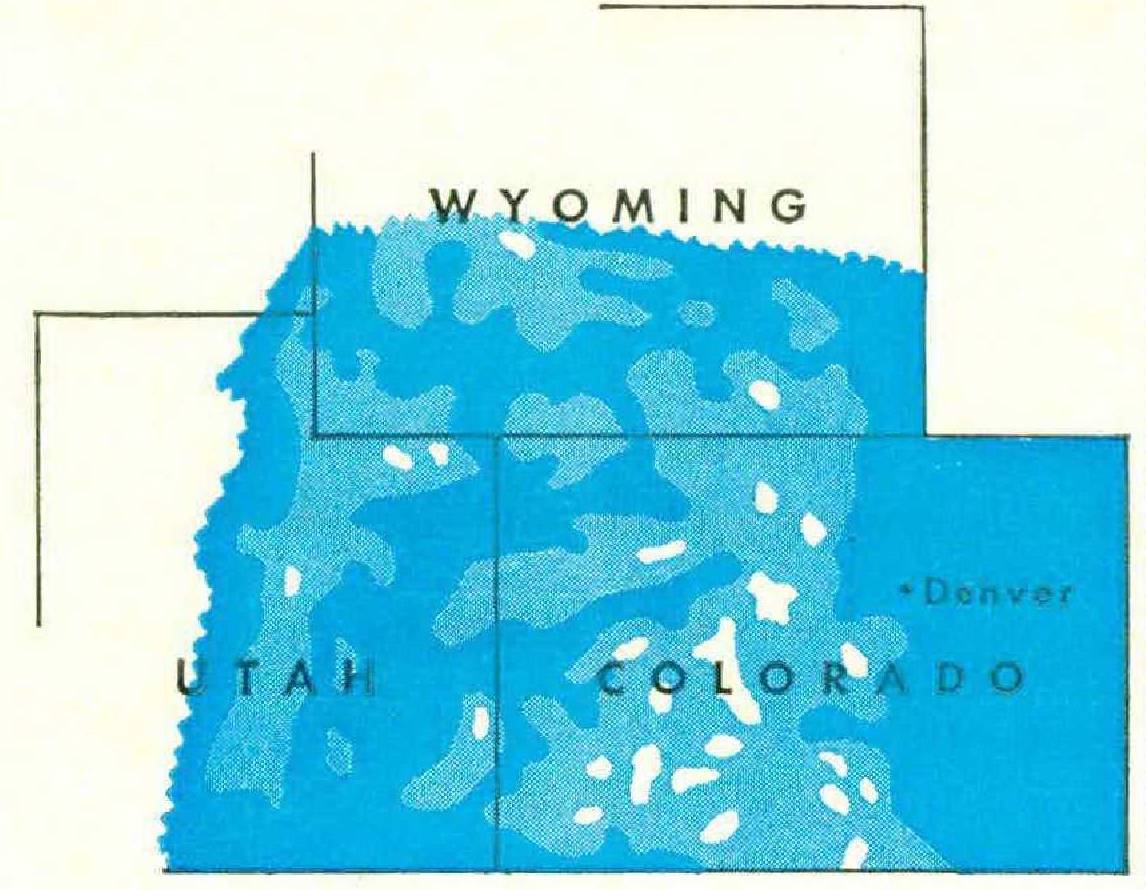
EVERY fall thousands of deer come down from the mountains of western Colorado to spend the winter foraging on some of the most valuable land in the world. Beneath the land is the largest oil reserve known to man, enough to meet America’s needs for hundreds of years. The oil is worth at least $300 billion, and it is all on public land. But if American oil companies have their way, they will get most of the benefits from this resource.
Major oil companies are putting heavy pressure on both Congress and Secretary of the Interior Stewart L. Udall to grant leases giving them control over the land and the exploitation of its oil. So far Udall has successfully resisted these pressures, but efforts will be made in Congress this year to force Udall to lease the land to the oil companies.
Big Oil wants action now before the cost of getting the oil out of the ground is known and before the precise value of the oil can be determined. And Big Oil has powerful friends in the Senate and the House who usually get the industry what it wants in Washington.
Supporting Udall’s go-slow position are conservationists and such economists as J. K. Galbraith of Harvard, who vigorously argued for continued public ownership and control of the land as a member of an Interior Department advisory board on the oil problem. Seeking immediate leasing of the land to oil companies are such powerful members of Congress as Representative Wayne N. Aspinall of Colorado, who is chairman of the House Interior Committee and whose congressional district includes the oil lands in western Colorado. A hearing on the leasing problem has already been held in the Senate, and House hearings are planned for this year.
At issue is not only control of the 300-billiondollar oil reserve centered in western Colorado and extending into southern Wyoming and eastern Utah but also the future of the extensive federal benefits now granted the oil industry. These include the legislation that saves the industry a billion dollars a year in income taxes and the federal restrictions that keep cheap foreign oil out of the United States at a cost of $2 billion a year to consumers.
The huge profits of the oil industry have been built over the years on a favorable federal tax structure, on federal controls over the importing of oil, and on state regulations carefully restricting the production of oil each month. The industry’s argument for these benefits is that domestic oil producers must be given all possible encouragement to develop new reserves because oil is a scarce and irreplaceable resource essential to the nation’s security.
The truth of the matter is that the United States and the rest of the non-Communist world already have so much oil that no one knows what to do with it. Texas, where almost half of America’s developed oil reserves are located, restricts production to little more than a quarter of the state’s capacity. Many other oil states enforce the same kind of restrictions on production, while Venezuela and the Middle East stand ready to flood the United States with cheap, and good, oil.
Every move in the oil game affects all of the players. Thus the reserves in Colorado, Wyoming, and Utah threaten to undermine the foundation for the governmental benefits enjoyed by the industry not only because there is so much oil beneath the land in question but also because it is a different kind of oil.
The oil is locked in shale, a rock formed from silt deposited by glaciers fifty million to seventyfive million years ago. Geologists confirmed the location and the extent of the shale oil deposits in the 1920s, so there is no need to compensate oil companies for exploration costs. But the deposits have taken on their great value only recently because scientists are on the threshold of the development of efficient methods for taking the oil out of the rock. In experimental plants in Colorado, oil has been removed from the rock through a still expensive mining and heating process. The cost of this process is expected to be reduced sharply as further experiments are conducted by industry and federal and state governments.
But the most spectacular and most promising breakthroughs in the shale oil fields probably will result from atomic energy. The Interior Department in cooperation with the Atomic Energy Commission is planning to conduct experiments to use controlled nuclear explosions to ignite underground fires hot enough to separate the oil from the rock without disturbing the landscape.
Once shale oil is commercially competitive with oil found in its liquid state, all of the political benefits affecting the oil industry should be re-examined. With almost limitless oil resources easily available beneath the rocky terrain of Colorado, Wyoming, and Utah, the 27.5 percent depletion allowance and the other tax favors granted the oil industry would be difficult to justify. There no longer would be any need to stimulate still more production by continuing to give these tax concessions to the oil industry.
In the industry’s view, the best way to prevent what could be a shattering reappraisal of its tax and other governmental benefits would be to tie up the shale lands with leases as quickly as possible. Then the oil companies could bring the shale fields into production in a way that would cause little disturbance to the existing price and tax structures of the industry. But if Secretary Udall and the conservationists win this struggle and are able to prevent the leasing of the shale lands until their value is known, it should be possible to re-examine the governmental benefits to the entire oil industry once the shale resources become competitive.
LIKE all the other major political and economic disputes that depend on decisions in Washington, the controversy over the shale oil lands involves a cast of strong characters in positions of power and influence. As in the case of so many other Washington controversies, the outcome of the shale oil dispute may depend more on power politics than on the public interest.
The most influential proponent of immediate leasing of the shale lands is Congressman Aspinall. As the representative of the congressional district containing the richest of the shale deposits, Aspinall has an obvious interest in a development plan that would bring more people and more money to the shale area, which is sparsely populated. And as chairman of the House Interior Committee, the stubborn, plain-talking Aspinall has always put the development of resources ahead of conservation measures.
“Natural resources were placed here to be used,” Aspinall maintains, “not to be cooped up for future generations, and anyone who says otherwise is giving you a bunch of buncombe. The oil isn’t worth a hoot to anybody as long as it is in the ground.”
Aspinall is a realistic politician who knows how to wait out an adversary. The congressman was one of the implacable opponents of the original wilderness preservation bills. He was against them because so many wilderness areas contain valuable minerals, trees, and grass sought by mining, lumbering, and grazing interests. Patiently and purposefully, Aspinall outwaited the conservationists, fleeing to Colorado one year to avoid calling a meeting of his committee to consider the wilderness bill. Finally, the conservationists gave Aspinall practically all of the concessions he sought in the wilderness bill to protect Western commercial interests. Then the legislation easily went through his Interior Committee and the House.
In dealing with the shale oil issue Aspinall again appears to be playing a waiting game. After a government advisory board issued a deeply divided report on shale oil last year, Aspinall indicated that he would quickly convene hearings on the report, but then postponed the hearings because he did not want to endure the acid tongue of economist Galbraith, one of the members of the advisory board who opposed the immediate leasing of the shale lands as advocated by Aspinall. The congressman contented himself with ominous mutterings about “the personal ideology” of some members of the advisory board. But no one in Washington who is familiar with Aspinall and his usually successful legislative tactics believes that the last word has been heard from him. And Aspinall’s last word is usually the one that counts in resource issues like shale oil.
The Senate Interior Committee did hold a shale oil hearing last year (at a time when Galbraith happened to be lecturing in Australia). Colorado’s two Republican senators, Gordon Allott and Peter H. Dominick, used the hearing to press for an early decision by Secretary Udall to allow the leasing of the shale oil lands. Allott and Dominick attacked Galbraith as a man with a “long history of antiprivate enterprise.”
The Senate hearing showed once again how the members of the Western-dominated Interior Committee stick together. Only one member of the seventeen-man committee represents a state east of the Mississippi, and he is Senator Gaylord Nelson of Wisconsin, who also happened to be the only member of the committee to question the wisdom of immediate leasing of the shale lands. The other members of the committee took the traditional Western stance for quick and easy commercial access to resources on the public lands.
Not a single representative of an oil company appeared at the Senate hearing, even though major companies are actively seeking shale oil leases. No one who is familiar with the way Washington lobbyists work was surprised, however, at the failure of oil company representatives to come forward. Big Oil learned long ago that it can best press its arguments for tax benefits and other governmental favors by helping to elect sympathetic senators and representatives and then letting them present the industry’s case. The late Speaker Sam Rayburn, for example, never allowed a man to get on the House Ways and Means Committee unless he supported the 27.5 percent oil depletion allowance. President Johnson when he was the Democratic leader of the Senate helped to see to it that senators who would be friendly to the oil interests deep in the heart of Texas were appointed to the Senate Finance Committee.
THE, oil companies have pushed their case for leasing of the shale lands with discreet visits to senators and representatives as well as to Secretary Udall. Udall, who uses as a paperweight a chunk of the dark, oil-bearing rock given to him by a government geologist, became aware of the shale controversy soon after taking office as Secretary of the Interior five years ago. It was not, however, until 1963 that he felt the problem demanded some action on his part. Across his desk one day came a request from the Shell Oil Company to lease 50,000 acres of the richest shale land. When Udall asked Interior Department officials to evaluate this request, he was astonished to learn that the shale acreage sought by Shell contained enough oil to meet the company’s requirements for 660 years.
Shell was not the only company seeking leases on the shale lands. Sinclair had asked for leases that would meet its oil requirements for the next 226 years. A somewhat modest request came from Humble, which sought only enough land to fulfill its oil requirements for 54 years. Continental asked for what amounted to a twenty-seven-year supply of oil. Other companies seeking leases included Union, Richfield, Standard of California, and Standard of Ohio.
Despite lobbying by the oil companies at the Interior Department and in Capitol Hill offices, Udall has resisted a precipitous decision. He may have remembered a story often told on Capitol Hill about his predecessor, Fred A. Seaton. When Seaton became Secretary of the Interior during the Eisenhower Administration, he suggested to members of his staff that they say no to all proposals from the oil industry. Seaton noted at a staff conference that oil had so often caused scandal to the department that the best way to avoid it in the future might be to take a wholly negative attitude toward proposals from the oil industry.
Only a few months after he took office as Secretary of the Interior, Udall himself had been acutely embarrassed by an incident involving an oil lobbyist then working for Shell. The lobbyist, a dapper well-known Washington figure named Jack Evans, wrote to his colleagues in the oil industry to tell them that Udall had asked him to enlist their support in purchasing tickets to a one-hundred-dollara-plate Democratic dinner. When the letter fell into the hands of columnist Peter Edson, who published it, Udall protested that there had been a misunderstanding between him and the lobbyist, who happened to be a personal friend of his.
Udall was not about to be burned again by an oil matter, and he discovered that there were excellent precedents for caution in dealing with the shale oil question. The shale lands were withdrawn from leasing by the late Herbert Hoover when he was President in 1930, and not a single lease has been issued since then.
“Whether the 1930 order was in furtherance of a far-seeing conservation policy, or a retreat from a vexing administrative problem is open to some question,” Undersecretary of the Interior John A. Carver, Jr., has noted in a polite reference to the aftermath of the Teapot Dome oil scandals which plagued Republican Administrations during the 1920s.
By early 1964, with pressures from oil lobbyists and Western senators and representatives increasing, Udall decided to follow a familiar Washington route out of a dilemma. He announced that he would appoint an advisory board to study the question of developing a shale oil industry and to appraise the problems involved in the leasing of the shale lands.
For a government oil committee the Oil Shale Advisory Board was unusual. The Interior Department generally seeks advice on oil matters only from industry sources. The department’s ninety-man National Petroleum Council, for instance, is made up entirely of executives from the oil industry, but four of the seven members of Udall’s shale board had no connection with the industry.
The four nonindustry members were economist Galbraith; Benjamin V. Cohen, an old New Dealer still practicing law in Washington; retired General James M. Gavin, a former Army Chief of Staff who is now chairman of the board of Arthur D. Little, Inc., the research and development company; and Joseph L. Fisher, president of the foundationfinanced research organization called Resources for the Future, whom Udall named as chairman of the advisory board.
The other three members of the board turned out to be supporters of the oil industry’s proleasing point of view. They were Milo Perkins, another old New Dealer, who is now a business consultant in Tucson, Arizona; Orlo B. Childs, president of the Colorado School of Mines; and H. Byron Mock, a Salt Lake City attorney who has represented companies seeking leases on the shale lands.
But the oil industry’s failure to place a majority of its friends on the advisory board did not stop industry supporters within the Interior Department from seeking to influence the board’s deliberations. At their first meeting the members of the advisory board were provided with thick folders containing background information on the shale problem prepared for them by Interior Department employees working under the direction of John M. Kelly, who was then Assistant Secretary of the Interior for Mineral Resources.
A politically oriented oilman who returned last summer to his home state of New Mexico, Kelly got his Interior Department job in 1961 because he had the powerful support of Senator Clinton P. Anderson, then chairman of the Senate Interior Committee and now head of the Senate Space Committee. The fifty-one-year-old Kelly is a darkhaired, bushy-browed, genial Irish geologist. Born in Chelsea, Massachusetts, he moved after college to New Mexico, where he prospered in the oil industry. Always considered a spokesman for the oil industry’s interests while he was in the Interior Department, Kelly was allowed by an understanding Senate Interior Committee to keep title to some of his oil properties after his confirmation by the Senate as an Assistant Secretary.
Another Interior Department official with a direct interest in government policies toward the leasing of the shale lands was Charles H. Stoddard, the director of the Bureau of Land Management. Although his bureau is responsible for overseeing grazing and other leasing operations on the government-owned shale lands, Stoddard was not even consulted during the early days of the advisory board’s work. Kelly, who was organizing the Interior Department’s oil shale staff work, knew that Stoddard was opposed to the immediate leasing of the lands being sought by the large oil companies.
When the time came for the Oil Shale Advisory Board to begin work on its report, the members asked the Interior Department to furnish a draft to serve as a basis for the board’s recommendations. The draft was prepared by Kelly and his aides, again without consulting Stoddard and the BLM.
The draft report, which was and still is labeled confidential, called for the removal of “obstacles to the commercial development of oil shale” and recommended that at an early date the Interior Department “announce its willingness to receive requests and proposals for production leases and that it explore with applicants their interest, capability and needs for land for commercial development.”
DESPITE all the prodding from Kelly, however, only three members of the advisory board — Perkins, Childs, and Mock — advocated in its final report the immediate leasing of shale lands to oil companies. Three other members — Fisher, Cohen, and Galbraith — said that the government should proceed cautiously before leasing any of the land. The seventh member of the board, General Gavin, had resigned early in its deliberations because of the press of other business.
This report [Galbraith wrote] is right in stressing that the oil shale deposits, underlying some 5,118,000 acres in Colorado, Utah and Wyoming, are a publicly owned resource of great magnitude. Several hundred years’ supply of petroleum at present consumption rates exist in these beds on lands owned by the people of the United States. Foresighted efforts in the past have kept these lands from those who, under the sanction of private enterprise, view public property only as an opportunity for personal profit. Having withstood thoughtfully designed raids in the past, it is important that the government show equal wisdom and restraint in the present on behalf of our resources for the future. . . .
There is no showing of urgent economic or strategic need for oil from the shale in the present or near future. The domestic petroleum industry is operating under severe government restrictions. Imports are subject to quota. These sources are almost certainly cheaper than oil from shale by prospective processes. Hence there is no pressing peacetime need for oil from shale. Given the most rapid development, the share of oil from shale in total production will be negligible for many years. Hence it will not, in the foreseeable future, be an important wartime resource replacing any important present source of petroleum. We cite this because strategic arguments are regularly advanced for oil shale development. They appear to reflect only the common effort to find a national security justification for action that individuals or groups would find in their economic interest. . . .
The major oil companies are naturally concerned with protecting their position in the event of the development of an oil shale industry by buying or controlling oil shale acreage. However, with one or two exceptions they seemed not now inclined to incur substantial development costs to produce shale oil. Certainly for companies with alternative sources of petroleum the economic attraction of oil shale is not high. The incentive to control oil-bearing acreage is thus, for the time being, much greater than the incentive to produce from it. This incentive, however, is very strong and strongly indicated by present efforts to obtain acreage in the area.
While members of Congress from the Western states and lobbyists for the major oil companies continue to press for the leasing of the shale lands as if they were just another public resource to be controlled for private gain, Secretary Udall and a few other officials in Washington have recognized the unique position in which the government finds itself. Seldom in the history of the United States has the government had the opportunity to guide the development of a natural resource in the way it can direct the growth of a shale oil industry. The closest parallel is probably with the early days of atomic energy.
It seems plain now that if the public interest is to be served, Udall — and President Johnson — must first make certain that no legislation is pushed through Congress forcing the government to lease its shale lands before their true value is known and before the cost of taking the oil out of the rock is determined. But Udall and Johnson also must convince Congress that shale oil offers a special opportunity to develop an extremely valuable resource in the best interests of the people to whom it belongs.
The government does not, however, necessarily have to develop the shale lands itself. What is necessary is that the government protect the public interest in this great resource, once private development of these federal resources is permitted. A quasi-public corporation similar to COMSAT, which is operating the nation’s commercial communications satellites, a Tennessee Valley Authority, or an agency modeled on the Atomic Energy Commission could be used to develop the shale fields. Studies should be undertaken to determine what kind of development corporation and plan could best serve the nation after it becomes clear that shale oil is needed to augment or replace liquid petroleum reserves.
In the meantime, the government should help to support research of the kind that is now being conducted by the Oil Shale Corporation in western Colorado and by a group of eight oil companies at the recently reactivated shale oil experimental plant at Rifle, Colorado. Fifteen percent of the shale land is not owned by the federal government and is available to oil companies that want to carry on research. Large tracts of land are not needed for experimental work, and if it is necessary, the government can lease small sections of its shale lands to facilitate research.
But, above all, a Great Society must encompass bold planning for the development of natural resources as well as human resources.