Berg, Bernstein, Britten, Bacli, and the Beatles
they shall have music
BY HERBERT KUPFERBERG
Edgard Varèse, the adventurous composer who died last October at the age of seventy-nine, once remarked that there was no such thing as a musical avant-garde. “The composer is never ahead of his time,”he said. “It is the audience which is behind.”
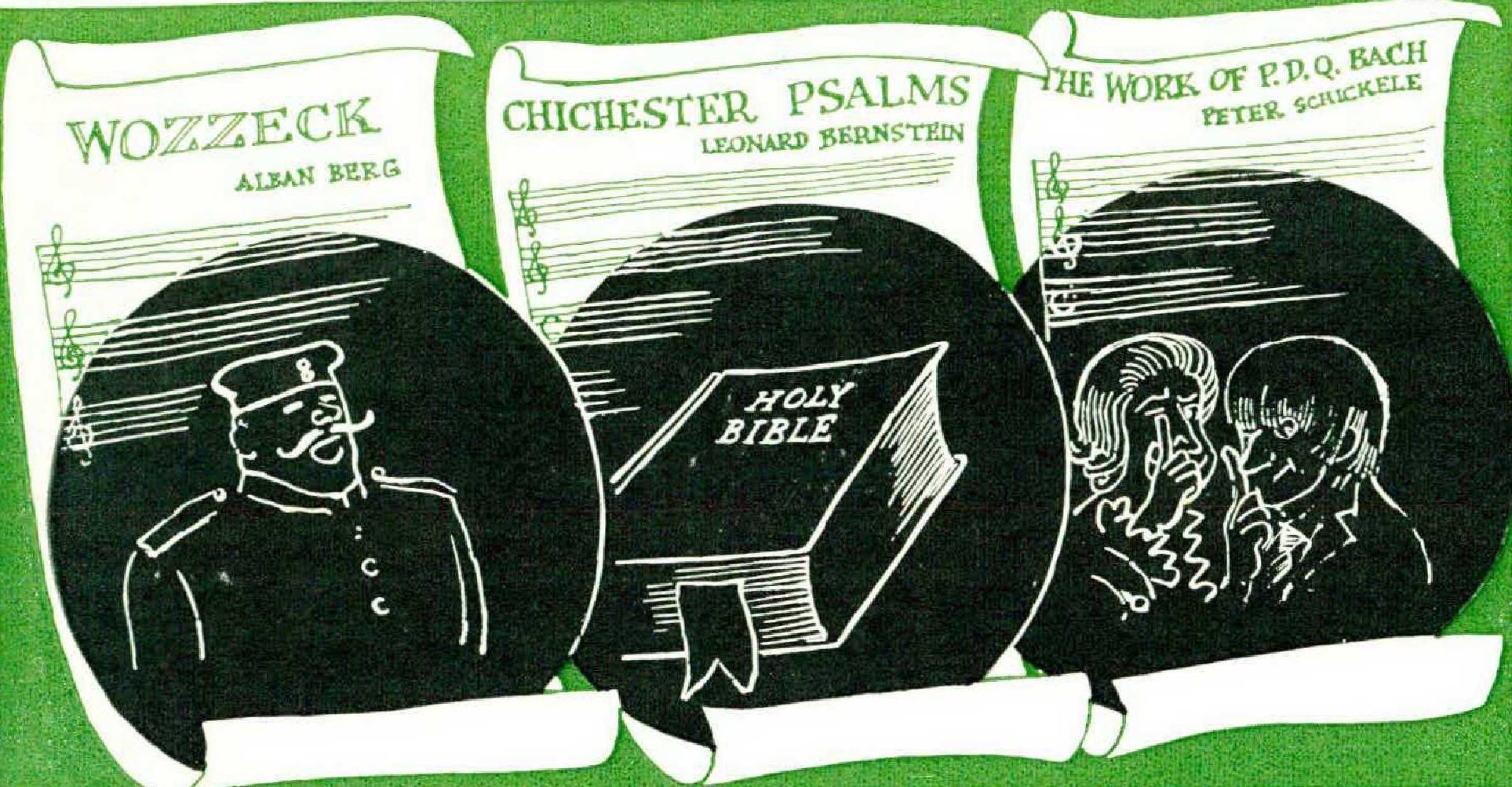
A case in point might be that of Alban Berg and his opera Wozzeck. That Berg’s Wozzeck is a masterpiece of modern opera is a tenet held almost universally among musicians. But it took twenty years after its premiere in 1925 to establish itself firmly on the world’s operatic stages, and even today more productions of it are born of artistic conscience than of commercial optimism. Its brief history at the Metropolitan Opera is instructive: it had to wait thirtyfour years for its first production there in 1959; since then it has had fleeting revivals in 1961 and 1965, but cannot yet be considered part of the permanent repertory.
Similarly, Wozzeck has been a late bloomer on records. Only one complete recording of it has been previously made, and that, by the late Dimitri Mitropoulos and the New York Philharmonic, has long been outdated in sound. Now Deutsche Grammophon has produced a brilliant new one, which sets forth Berg’s masterpiece in all its garish strangeness (DGG-138991/92, stereo; 18991/92, monaural: two records).
Wozzeck’s modernity is more than a matter of music alone. The drama upon which it is based seems startlingly contemporaneous, although it was written nearly 150 years ago by Georg Büchner, the German poet and playwright who lived a feverishly short life and died in 1837. In the character of Wozzeck, Büchner invented one of the first antiheroes in literature, a lumpish soldier whose fate it is to be ridiculed, demeaned, and finally, crushed by the world around him. The symbolism of Wozzeck must have seemed particularly apt in the Berlin of 1925, and it has not altogether lost its point in our own day.
Berg’s musical setting, like the play itself, is stark, somber, and intense. His acerbities and atonalities led to an uproar in the 1920s; but Berg moved within recognizable musical forms, and his use of the famous Sprechgesang, a vocal recitative halfway between speech and song, was ideally suited to express both the bewilderment of Wozzeck and the madness of his tormentors.
DGG’s new recording of Wozzeck sets forth this compelling opera with all its harshness, but with a leavening of humanity. It is particularly successful in its creation of the weird, hallucinatory characters who drive Wozzeck first to murder and then to suicide. The Captain, who symbolizes corrupt authority, the Doctor, who represents unfeeling science, the Drum Major, who embodies brutish sexuality, all stand forth with the vividness of figures in a nightmare. In many instances effects are achieved with a sharpness that is often lost in a stage production, as in the snoring of a barracksful of soldiers, or the strident playing of a beer garden band. And the grim conclusion of Wozzeck, with a child gaily riding his hobbyhorse off to view his murdered mother’s body, chirping “hop, hop!” as he goes, comes through with emotional intensity as well as dramatic irony.
Wozzeck is conducted by Karl Böhm, one of the foremost authorities on the score (he also directed the Metropolitan Opera performances). Dietrich Fischer-Dieskau is Wozzeck; Evelyn Lear is his faithless girlfriend, Marie; Fritz Wunderlich his army pal, Andres; Gerhard Stolze the Captain; Karl Christian Kohn the Doctor; and Helmut Melchert the Drum Major. The chorus and orchestra are from the German Opera of Berlin, which has long had Wozzeck in its repertory. The German text is included, along with translations into English and French, and the explanatory material is unusually ample. The avant-garde may have accepted Wozzeck a long time ago; but this is a recording which gives the derrière-garde a chance to catch up.
Leonard Bernstein’s newest venture into choral writing, Chichester Psalms, was commissioned last summer for a music festival in the Cathedral of Chichester, Suffolk, England. Bernstein wrote an eighteen-minutelong work, sung in Hebrew, based upon the full texts of two Psalms (the Twenty-third and the 131st) and portions of four others. He has recorded it with the New York Philharmonic and the Camerata Singers. With it is coupled his 1946 ballet score Facsimile (Columbia MS-6792, stereo; ML-6192, monaural).
The Chichester Psalms is the work of a skilled and urbane composer who is a master of orchestral writing, not to mention orchestral conducting. But it also is the work of a composer who has written successfully for the Broadway musical theater. It is a little startling to hear the Psalms treated as if they were part of West Side Story; the tunes are different, but the same sense of easy melodiousness is there. In the setting of the Twenty-third Psalm Bernstein does find music that touches the spirit of the words: a lovely, folksong-like melody, with just a tinge of the blues, over a liquid, floating accompaniment. It is sung by a boy soprano and lingers hauntingly in the mind. Had the rest of the Chichester Psalms been equally artless and untheatrical this might have been a memorable work indeed.
Benjamin Britten’s Cantata Misericordium is, by contrast, a subdued and subtle composition. It was written in 1963 to commemorate the centenary of the International Red Cross, and has now been recorded by Peter Pears, tenor, Dietrich Fischer-Dieskau, baritone, and the London Symphony Orchestra and Chorus, Britten himself conducting. On the reverse is Britten’s Sinfonia da Requiem, written in 1940 (London OS-25937, stereo; 5937, monaural).
Appropriately to its occasion, the Cantata Misericordium is a dramatization of the parable of the Good Samaritan. A baritone and tenor, singing in Latin, enact the story of a traveler on the road from Jerusalem to Jericho who is set upon by robbers and given succor by a lowly Samaritan after several more substantial citizens have hurried by, ignoring his plight. The chorus sets the mood with the opening words, “Bead misericordes” (“Blessed are the merciful”), describes the action, and draws the moral. Sometimes the chorus and solo voices reinforce one another; at other times they overlap; at still others they go their separate ways. But the texture and mood remain at once musically consistent and dramatically apt.
The Cantata Misericordium runs only about a minute longer than the Chichester Psalms, but seems far more substantial in content and richer in meaning. In fact, it is astonishing how much Britten has packed into this succinct but exquisitely wrought work, and how deeply he has touched it with compassion and beauty.
Musical wit being so rare a commodity, it is a pleasure to welcome P. D. Q. Bach to the record catalogue. P. D. Q. Bach, hitherto unknown to history, is the personal discovery of a musician named Peter Schickele, who has given several concerts devoted to his life and works. One of these, at Town Hall, New York, last April, was recorded on the spot, enabling the world at large to make the acquaintance of P. D. Q., who was, as Mr. Schickele points out in the solemn lecture that accompanies the music, the last and also the oddest of the twenty-odd sons of J. S. Bach.
Mr. Schickele’s spoof is not limited to his spoken commentary. It is also carried out in his musical program, especially two numbers by P. D. Q. Bach, the Concerto for Horn and Hardart (S. 27), and the cantata Iphigenia in Brooklyn (S. 53162), both of which are performed with aplomb by a chamber orchestra led by Jorge Mester, with Ralph Froelich, French horn, Leonid Hambro, harpsichord, and John Ferrante, countertenor (Vanguard VSD-79195, stereo; VRS-9195, monaural). Musical satire of this sort can easily become crude and witless, but Mr. Schickele evades the pitfalls magnificently. His “hardart” is an actual instrument contrived for the occasion, a collection of gongs, bells, buzzers, and whistles that blend in neatly with the score he has devised. But it is the music of the “concerto” itself that provides much of the hilarity, being a concatenation of offbeat rhythms, incorrect keys, aimlessly reiterated tunes, and sour notes, somewhat in the manner of Mozart’s Musical Joke Sextet.
Iphigenia in Brooklyn is even funnier, if slightly more obvious. Both the musical and literary elements of the cantata style are parodied with a flourish, with harpsichordist Hambro playing never-ending cadences, and countertenor Ferrante plowing his way through a madcap vocal part. The climax comes in a recitative, “Oh ye gods, who knows what it is to be running? Only he who is running knows,” which leads directly into an aria made up of the repeated words “running knows.” As if to demonstrate his versatility, Mr. Schickele’s program also includes a quodlibet of his own composition, consisting entirely of themes stolen from other composers. It starts with the first measure of Mozart’s Haffner Symphony, which leads, incredibly but somehow logically, into the Soldiers’ Chorus from Faust, then on to “Tea for Two” and possibilities even more remote. It’s all very clever and competent, and easily passes the prime test of wit, musical or otherwise — it makes you laugh.
Much the same can be said for another record, which bears the startling title The Baroque Beatles Book and consists of music performed by the Baroque Ensemble of the Merseyside Kammermusikgesellschaft, Joshua Rifkin, conductor (Elektra EKS-7306, stereo; EKL-306, monaural). It is Mr. Rifkin who is responsible for these works; what he has done is to take various melodics made famous by the Beatles, rewrite them in a baroque style, and perform them with a first-rate orchestra, along with Harold Brienes, tenor, and the Canby Singers. Thus one hears such tunes as “I Want To Hold Your Hand” given fugal treatment in a piece called The Royale Beatleworks Musicke, and “Help!” turned into an aria from the Cantata for the Third Saturday after Shea Stadium.
In a way, this record is almost a victim of its own subtlety and adroitness, for the Beatles’ melodies have been so neatly arranged and disguised by Mr. Rifkin that at times one is conscious of listening only to some rather good, if unfamiliar, music in the style of Bach. For the fullest appreciation of the delights of this collection, one must have a thorough knowledge of such Beatles songs as “Ticket to Ride,” “Hold Me Tight,” and “I’ll Cry Instead.” Perhaps this is the best reason that has yet been adduced for a closer study of their repertoire.
Record Reviews
Choral Songs of the Romantic Era
Camerata Vocale of Bremen directed by Klaus Blum, and University of Leipzig Chorus directed by Friedrich Rabenschlag; Nonesuch H-71081 (stereo) and H-1081 Once upon a time family groups used to gather around the piano to sing songs like these by Mendelssohn, Schumann, Brahms, and Karl Loewe — most of them celebrating the wonders of nature or the bittersweet pangs of love. It is a style of do-it-yourself entertainment that seems highly unlikely to make a comeback, but these performances furnish a comfortably homelike atmosphere. The German words and English translations are printed on the jacket, providing the opportunity for a little sing-along experimentation, nineteenth-century style.
Stravinsky: Orpheus; Apollo
Igor Stravinsky conducting Chicago Symphony Orchestra and Columbia Symphony Orchestra; Columbia MS-6646 (stereo) and ML-6046 These two ballet scores, both on Greek themes, represent Stravinsky’s homage to antiquity. Though they differ in their instrumentation and concept, each brings color and life to its subject. Orpheus, one of Stravinsky’s most underplayed but rewarding scores, is lean and spare in its writing but broadly spacious in its effect. Through this subdued but eloquent work there float elusive strands of almost Debussyan melody. Despite the classic restraint of the music, the figures of Orpheus and Eurydice are given flesh and infused with feeling. Apollo has long been known as Apollon Musagète, but Stravinsky says he prefers the simpler title. Here the scoring is for strings alone, but these are more than adequate to provide a widely expressive range of color and emo( tion in a rather abstract ballet. Stravinsky conducts both compositions himself, making two more entries in what undoubtedly is the most comprehensive project ever undertaken by a composer recording his own works.
The Was the Year That Was
Tom Lehrer, singer and pianist: Reprise S-6179 (stereo) and 6179 Most of these sharp-edged satirical songs by Tom Lehrer stem from the lately departed That was the Week That Was television program. But their rhymes, their catchy rhythms, and most of all, their deadly aim still give the songs pertinence and immediacy. Few current national and international enthusiasms escape Lehrer gibes: he takes on National Brotherhood Week, the Ecumenical Council, the Multilateral Force, and Wernher von Braun. (“Once the rockets go up, who cares where they come down? That’s not my department, says Wernher von Braun.”) One of the most heartfelt and hilarious of the songs deals with the intricacies of the New Math, which may be no surprise since Lehrer has been a Harvard and MIT mathematician on the side. He also is no mean musician, accompanying himself with a bouncy piano that never misses a beat.