Art and Anti-Art
A Viennese who found sanctuary in England before the Second World War, E. H. Gombrich established his international reputation as director of the Warburg Institute of the University of London. His article is based on a slightly longer chapter which he has just prepared for the eleventh revised edition of his book THE STORY OF ART, published by the Phaidon Press.
E. H. GOMBRICH
CAN one write or teach the history of art “up to the present day” as one can write or teach the history of aviation? Many critics and teachers hope and believe that one can, but I am less sure. True, one can record and discuss the latest fashions, the figures who happen to have caught the limelight at the time of writing. But only a prophet could tell whether these artists will really make history, and on the whole, critics have proved poor prophets. Imagine an open-minded and eager critic in 1890 trying to bring the history of art up to date. With the best will in the world he could not have known that the three figures who were making history at that time were Van Gogh, Cézanne, and Gauguin; the first a crazy middle-aged Dutchman working away in southern France, the second a retiring gentleman of independent means, who had long ceased to send his paintings to exhibitions, and the third a stockbroker who had become a painter late in life and was soon off to the South Seas. The question is not so much whether our critic could have appreciated the works of these men as whether he could have known of them at all.
Similarly, I confess that when I wrote about surrealism in my book The Story of Art (1948), I was not aware of the fact that an elderly German refugee, whose work would prove of greater influence in the subsequent years, was then still living in England in the Lake District. I am referring to Kurt Schwitters (1887-1948), whom I regarded as one of the amiable eccentrics of the early 1920s. Schwitters used discarded bus tickets, newspaper cuttings, rags, and other odds and ends, and glued them together to form quite tasteful and amusing bouquets. In his refusal to use conventional paint and conventional canvas his attitude was connected with an extremist movement that had started in Zurich during the First World War — Dadaism. It was an offspring of that primitivism that had earlier led Gauguin to reject the tainted civilization of Paris for the dream of savage innocence. He once wrote a letter in which he said that he had to go back beyond the horses of the Parthenon to the rocking horse of his childhood; and the childish syllables da-da can stand for such a toy. It was certainly the wish of these artists to become as little children and to cock a snook at the solemnity and pomposity of Art with a capital A.
It is not difficult to understand these sentiments, but it has always seemed to me a little incongruous to record, analyze, and teach such gestures of “anti-art” with the very solemnity, not to say pomposity, they had set out to ridicule and abolish. Be that as it may, the appeal of “anti-art” was irresistible to many young art students, and critics now gravely talk about “neo-Dada.” Clearly, however, it is not the label that matters but the wit and talent that may go into these assemblages of discarded objects.
We speak of art always when anything is done so superlatively well that we all but forget to ask what the work is supposed to be, for sheer admiration of the way it is done. If by painting we mean simply the application of paint to canvas, you can have connoisseurs who admire the way this is done to the exclusion of everything else. Even in the past an artist’s handling of paint, the energy of his brushstrokes, or the subtlety of his touch has been prized, but generally in the larger context of the effect thus achieved.
In China in particular the sheer mastery of brushwork was much discussed and appreciated. It was the ambition of Chinese masters to acquire such a facility in the handling of brush and ink that they could write down their vision while their inspiration was still fresh, much as the poet jots down his verse. Indeed, for the Chinese writing and painting have much in common. We speak of the Chinese art of calligraphy, but really it is not the formal beauty of the characters that the Chinese admire so much as that feeling of mastery and inspiration that must inform every stroke.
In France this concentration on the mark or blot left by the brush was called tachisme, from tache (“blot”). In the United States Jackson Pollock (1912—1956) began experimenting with novel ways of applying paint in the 1940s. Pollock had been interested in surrealism, but he gradually discarded the weird images that had haunted his paintings for exercises in abstract art. Becoming impatient of conventional methods, he put his canvas on the floor and dripped, poured, or threw his paint to form surprising configurations. He probably remembered stories of Chinese painters who had used such unorthodox methods and also the practice of American Indians who made pictures in the sand for magic purposes. The resulting tangle of lines satisfies two opposing standards of twentieth-century art: the longing for childlike simplicity and Spontaneity that: evokes the memory of childish scrawls at the time of life before children even start to form images, and, at the opposite end, the sophisticated interest in the problems of “pure painting.” Pollock has thus been hailed as one of the initiators of a new style known as action painting or abstract expressionism.
Not all these painters use Pollock’s extreme methods, but all of them believe in the need to surrender to spontaneous impulse. Like Chinese calligraphy these paintings must be done rapidly. They should not be premeditated but rather resemble a spontaneous outburst. There is little doubt that in advocating this approach, artists and critics were in fact influenced not only by Chinese art but altogether by Far Eastern mysticism, particularly in the form that has become fashionable in the West under the name of Zen Buddhism. In this respect, too, the new movement continued an earlier tradition of twentieth-century art. Both Kandinsky and Mondrian were mystics who wanted to break through the veil of appearances to the realm of mystical essence; and in a similar quest the surrealists courted “divine madness.” It is part of the doctrine of Zen (though not its most important part) that no one who has not been shocked out of his rational expectations and assumptions can become enlightened.
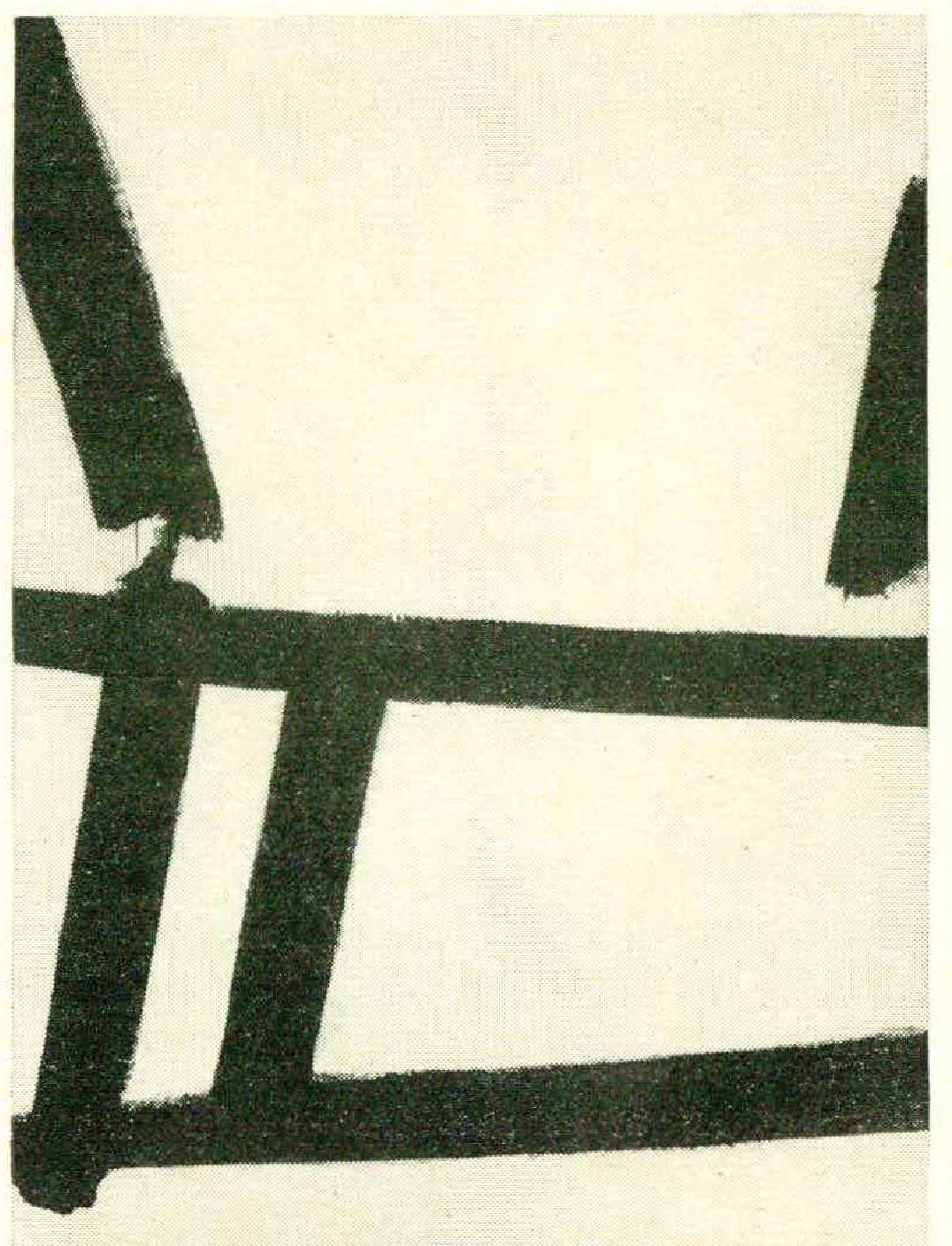
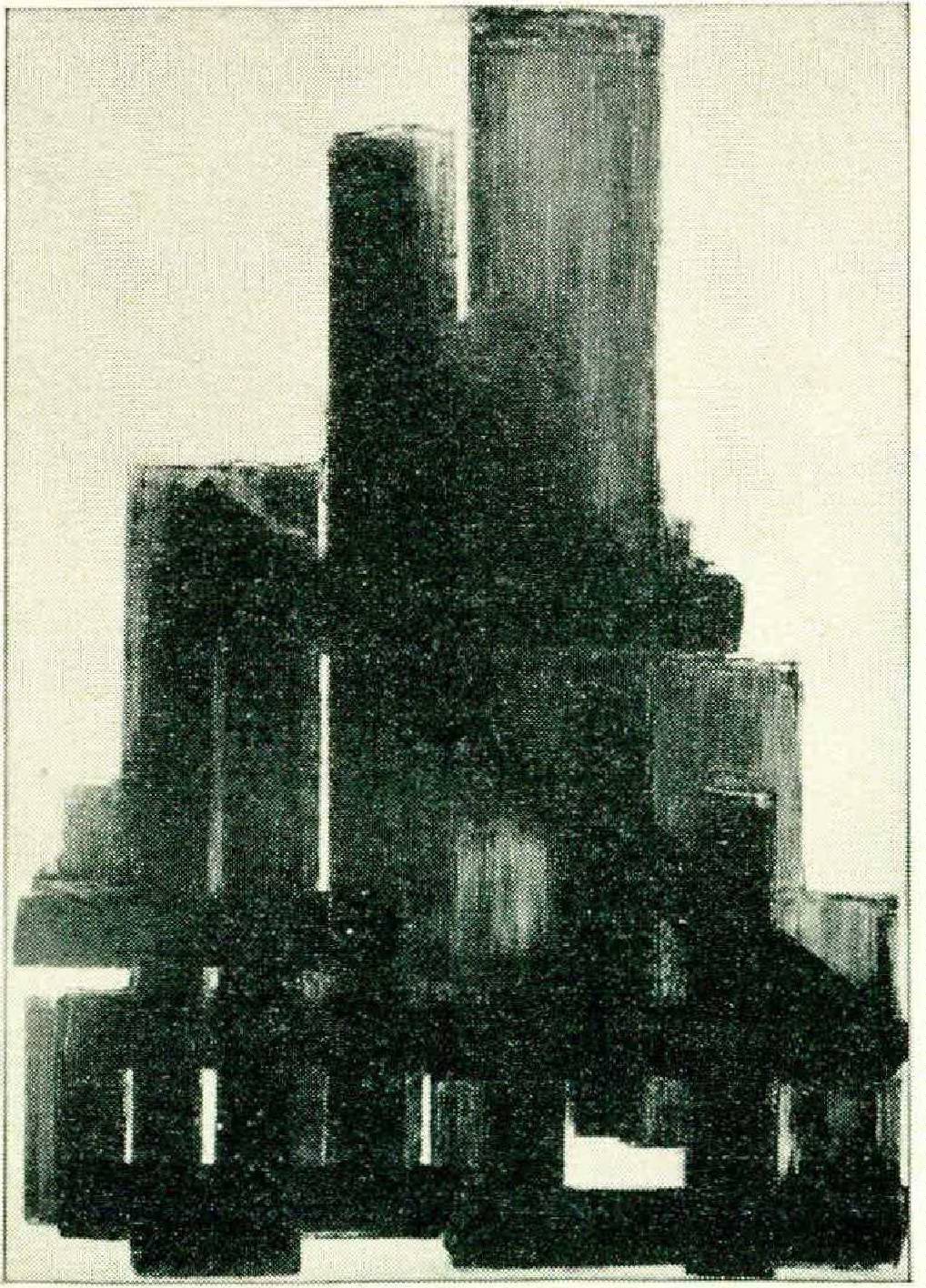
One need not necessarily accept an artist’s theories to appreciate his work. If one has the patience and the interest to look at many paintings of this kind, one will certainly come to like some better than others and gradually appreciate the problems these artists are after. It is hard to demonstrate this within the confines of a short article, but it would seem that even to compare a painting by the American artist Franz Kline (1910—1962) with one by the French tachiste Pierre Soulages (born 1919) is not uninstructive. It is characteristic that Kline called his painting White Shapes. He obviously wants us to pay attention not only to his lines but also to the canvas which they somehow transform. For simple as are his strokes, they do result in some impression of a spatial arrangement, as if the lower half were receding toward the center. To me, though, the painting by Soul ages looks more interesting. The gradation of his energetic brushstrokes also results in the impression of three dimensions, but at the same time, the quality of the paint looks more pleasant to me — though these differences hardly come through in illustration. It may even be that this resistance to photographic reproduction is precisely what attracts some of these artists. They may want to feel that their work really remains unique, the products of their hands, in a world in which so much is machinemade and standardized. They like to go in for canvases of enormous size where it is the scale alone that makes an impact, and this scale, too, loses its point in an illustration. Most of all, however, they are fascinated by what they call texture, the feel of a substance, its smoothness or roughness, its transparency or density. Some have therefore discarded ordinary paint for other media, such as mud, sawdust, or sand.
Here is one of the reasons for the revival of interest in paste-ups of Schwitters and the other Dadaists. The coarseness of sacking, the polish of plastics, the grain of rusty iron can all be exploited in novel ways. These products stand somewhere between painting and sculpture. Thus the Hungarian Zoltán Kemeny (1907-1965), who lived in Switzerland, composed his abstracts with metal. In making us aware of the variety and surprise that our urban surroundings offer to our sense of sight and touch, works of this kind may claim to do for us what landscape painting did for the connoisseurs of the eighteenth century by preparing them for the discovery of the “picturesque” beauties of nature in the raw.
I trust no reader will think, however, that these few examples exhaust the possibilities and the range of variations likely to be encountered in any exhibition of contemporary art. There are artists, for instance, who have become particularly interested in the optical effects of shapes and colors, the way they can be made to interact on the canvas to produce an unexpected dazzle or flicker. Most of all, however, it would be misleading to present the contemporary scene as if it were entirely dominated by experiments with paint, texture, or shapes alone. It is true that to command respect among the younger generation an artist has to master these media in an interesting and personal way. But some of the painters who have attracted most attention in the post-war period have from time to time returned from their exploration of abstract art to the making of images. 1 am thinking in particular of the Russian émigré Nicolas de Staël (1914— 1955), whose simple yet subtle brushstrokes often compose themselves into convincing evocations of landscapes which miraculously give us a sense of light and of distance without making us forget the quality of the paint.
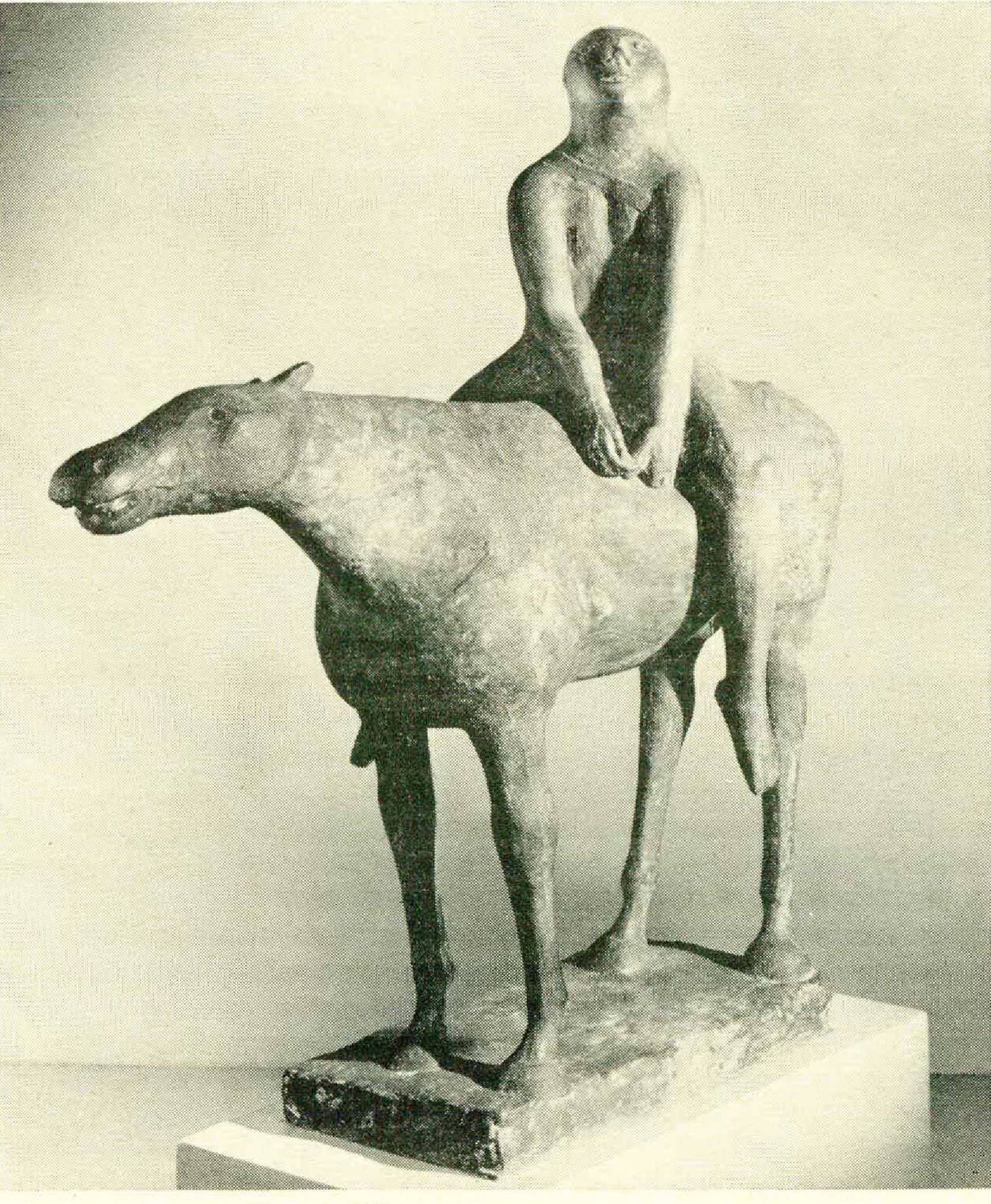
Other artists of this post-war period have been engrossed by one image which haunted and obsessed their mind. The Italian sculptor Marino Marini has become famous for his many variations on a motif that impressed itself on his mind during the war — the sight of stocky Italian peasants fleeing from their villages on farm horses during air raids. It is the contrast between these anxious creatures and the traditional image of the heroic horseman that lends a special pathos to these works.
Even these few examples may help to explain why it is harder than ever today to write a history of art up to the present. If there is anything that marks the twentieth century it is the freedom to experiment with all kinds of ideas and media. The seminal movements of expressionism, cubism, and primitivism did not neatly follow each other in time but rather presented three possibilities, which often interacted and crossed in the artist’s mind. Maybe it is partly an optical illusion, caused by the greater distance, that makes us believe that earlier centuries knew a more orderly succession of styles. However, even Gothic and Renaissance did not follow each other as soldiers on parade, and there must have been moments when nobody knew which of the two was in the lead. Yet it is precisely this which the impatient reader wants to be told by the contemporary historian or critic. He wants to learn about the latest ism.
Only yesterday the latest ism was supposed to be pop art. The ideas behind this movement are not hard to understand. The unhappy cleavage between what is called applied, or commercial, art, which surrounds us in daily life, and the pure art of exhibitions and galleries, which many of us find so hard to understand, has presented a challenge to art students, for whom it has become a matter of course that one must always side with whatever is despised by people of “taste.” Other forms of antiart by now had become a matter for highbrows. They shared with the hated idea of Art its exclusiveness and its mystical pretensions.
Why was that not so in music? There was a kind of new music that had conquered the masses and engaged their interest to the extent of hysterical devotion. This is pop music. Could we not have pop art as well, and could it not be achieved by simply using the images familiar to everyone from comic strips or advertising? Perhaps a prophet could predict whether a master will arise who will turn such unpromising material into art. I do not pretend to know. Anyway, today “op art,” so called for its exploration of those optical effects I have mentioned above, is claimed to be in the lead.
UP TO the Second World War, most writers about art still took it for granted that it was the duty of the critic and the historian to justify all experiments in the face of hostile criticism. Though this attitude has survived to the present day, the situation has in fact completely and radically changed in the last twenty years or so. No revolution in art has been more successful than that which started before the First World War. Those of us who knew some of the first champions of these movements and recall their courage, and also their bitterness, can hardly trust our eyes when we see exhibitions of onetime rebels arranged with official backing and beleaguered by eager and earnest crowds of people anxious to learn and absorb the new idioms.
If anybody needs a champion today it is the artist who shuns rebellious gestures. I am convinced that it is this dramatic transformation rather than any particular new movement that represents the most important event in the history of art during the last twenty years.
Observers from very different quarters have recently begun to comment on this unexpected turn of events. Here is Professor Quentin Bell writing on “The Fine Arts” in a book entitled The Crisis in the Humanities (edited by J. H. Plumb) in 1964:
In 1914, when he was referred to indiscriminately as “cubist,” “futurist,” or “modernist,” the postimpressionist artist was regarded as a crank or a charlatan. The painters and sculptors whom the public knew and admired were bitterly opposed to radical innovations. The money, the influence, and the patronage were all on their side.
Today, it is almost true to say that the situation is reversed. Public Bodies such as the Arts Council and the British Council and Broadcasting House, Big Business, the Press, the Churches, the Cinema, and the advertisers are all on the side of what, to use a misnomer, is called nonconformist art . . . the public can take anything, or at least there is a very large and influential section of it that can do so . . . there is no form of pictorial eccentricity which can provoke or even astonish the critics.
And here is the influential champion of contemporary American painting, Harold Rosenberg, who coined the term “action painting,”commenting on the scene on the other side of the Atlantic. In an article in the New Yorker in April, 1963 (reprinted in his book The Anxious Object), he reflected on the difference between the reaction of the public to the first exhibition of avant-garde art in New York in 1913 — the Armory Show — and that of a new kind of public which he describes as the “Vanguard Audience”:
The Vanguard Audience is open to anything. Its eager representatives — curators, museum directors, art educators, dealers — rush to organize exhibitions and provide explanatory labels before the paint has dried on the canvas or the plastic has hardened. Cooperating critics comb the studios like big-league scouts, prepared to spot the art of the future and to lake lead in establishing reputations. Art historians stand ready with cameras and notebooks to make sure every novel detail is safe for the record. The tradition of the new has reduced all other traditions to triviality.
Mr. Rosenberg may surely be right when he implies that we art historians contributed to this change in the situation. Indeed, I think any author who now writes a history of art, and particularly of contemporary art, has the duty to draw attention to this unintended effect of his activities, the misleading impression which such a panorama may give that all that matters in art is change and novelty. It is the interest in change that has accelerated change to its giddy pace. Of course it would not be fair to lay all the undesirable consequences — as well as the desirable ones — at the door of art history. In a certain sense the new interest in the history of art is in itself a consequence of a great many factors which have changed the position of art and artists in our society. I should like to discuss some of them.
The first is no doubt connected with everybody’s experience of technical progress. It has made us see human history in terms of successive periods leading upward to our own age and beyond into the future. We know of the Stone Age and the Iron Age, we know of the Feudal Age and the Industrial Revolution. Our view of this process may have ceased to be optimistic. We may be aware of losses as well as of gains in these successive transformations, which now promise (or threaten) to take us into the Space Age. But ever since the nineteenth century the conviction has taken root that this march of the ages is irresistible. It is felt that art no less than economics or literature is swept along by this irreversible process. Indeed, art is regarded as the main “expression of the age.”
Here in particular the development of art history has its share in spreading this belief. A Greek temple, a Roman theater, a Gothic cathedral, and a modern skyscraper are said to express a different mentality and symbolize a different type of society. There is some truth in this claim if it is simply taken to mean that the Greeks could not have built Rockefeller Center and might not have wanted to build Notre Dame. But too often it is implied that the condition of their age, or what is called its spirit, was bound to blossom forth in the Parthenon, that the Feudal Age could not help creating cathedrals, and that we are destined to build skyscrapers. On this view, which, by the way, I doubt, it is of course both futile and foolish not to accept the art of our age. It thus becomes sufficient for any style or experiment to be proclaimed “contemporary” for the critic to feel the obligation to understand and promote it.
It is through this philosophy of change that critics have lost the courage to criticize and have become chroniclers of events instead. They have justified this change of attitude by pointing to the notorious failures of earlier critics to recognize and accept the rise of new styles. It was in particular the hostile reception first accorded to the Impressionists, who later rose to such fame and commanded such high prices, that led to this loss of nerve. The myth has sprung up that all great artists were always rejected and derided in their time, and so the public has made the laudable effort no longer to reject or deride anything. The idea that artists represent the vanguard of the future, and that it is we and not they who will look funny if we fail to appreciate them, has taken hold at least of a large minority.
A second element that contributed to this situation is also connected with the development of science and technology. Everybody knows that the ideas of modern science often look extremely abstruse and unintelligible but that they still prove their worth. The most striking example, of which most people are by now aware, is of course Einstein’s theory of relativity, which appeared to contradict all commonsense notions about time and space, but led to the equation of mass and energy that resulted in the atom bomb. Both artists and critics were and are immensely impressed by the power and prestige of science and derive from it not only a healthy belief in experiments but also a less healthy faith in anything that looks abstruse. But alas, science differs from art because the scientist can sort out the abstruse from the absurd by rational methods. The artist or critic has no such clear-cut tests. And yet he feels that it is no longer possible to ask for time to consider whether a new experiment makes sense or not. If he does, he may fall behind. This might not have mattered all that much to critics of the past, but today the conviction is almost universal in industry and in politics that those who stick to obsolete beliefs and who refuse to change will go to the wall. To appear progressive you must also advertise your sympathy with the latest artistic fashions — the more revolutionary the better.
The third element in the present situation may seem at first blush to contradict what has gone before. For art not only wants to keep step with science and technology, it also wants to provide an escape from these monsters. It is for this reason that artists have come to shun what is rational and mechanical and that so many of them embrace some mystical faith that stresses the value of spontaneity and individuality. It is indeed easy to understand how people may feel threatened by mechanization and automation, by the overorganization and standardization of life, and by the dull conformism that ensues. Art seems the only haven where capriciousness and personal quirks are still permitted and even treasured.
Since the nineteenth century many an artist has claimed that he fought the good fight against stuffy conventionalism by baiting the bourgeois. Alas, the bourgeois has meanwhile found out that it is quite fun to be baited. Do we not all feel some kind of pleasure in the spectacle of people who refuse to grow up and still find a niche in the contemporary world? And is it not an added asset if we can advertise our lack of prejudice by refusing to be shocked or bemused? And so the world of technical efficiency and that of art have reached a modus vivendi. The artist can withdraw into his private world and concern himself with the mysteries of his craft and with the dreams of his childhood, provided, at least, he lives up to the public’s notion of what art is about.
These notions are very much colored by certain psychological assumptions about art and artists. There is the idea of self-expression that goes back to the Romantic era; also the profound impression made by the discoveries of Freud, which were taken to imply a more immediate connection between art and mental distress than Freud himself would have accepted. Combined with the increasing belief that art is the expression of the age, these convictions could lead to the conclusion that the artist has not only the right but the duty to abandon all self-control. If the resulting outbursts are not pretty to contemplate, this is because our age is not pretty either. What matters is to face these stark realities that help us to diagnose our predicament. The opposite idea, that art alone might give us a glimpse of perfection in this very imperfect world, is generally dismissed as “escapism.” The interests aroused by psychology have certainly driven both the artists and their public to explore regions of the human mind which were formerly considered repellent or taboo. The desire to escape the stigma of escapism has prevented many from averting their eyes from spectacles which former generations would have avoided.
ART differs from other forms of creation in being less dependent on intermediaries. Books must be printed and published, plays and compositions must be performed; and this need of an apparatus applies a certain brake to extreme experiment. Painting has therefore proved of all the arts the most responsive to radical innovations. You don’t have to use a brush if you prefer to pour your paint, and if you are a neo-Dadaist, you can also send some piece of rubbish to an exhibition and dare the organizers to reject it. Whatever they do, you may have your fun. It is true that ultimately the artist also needs an intermediary, the dealer who shows and promotes his works. Needless to say, this remains a problem; but all the influences discussed so far are likely to work on the dealer even more than they work on the critic or the artist. If anyone, it is he who must keep his eye on the barometer of change, watch trends, and look out for rising talents. If he backs the right horse, not only can he make a fortune, but his clients will remain grateful to him. Conservative critics of the last generation used to grumble that “this modern art” was all a dealers’ racket. But dealers have always wanted to make profit. They are not the masters but the servants of the market. There may have been moments when a correct guess gave an individual dealer the power and prestige for a time to make or break reputations, but dealers do not cause the winds of change any more than windmills cause the wind.
We must not forget that there are large parts of the world where artists are forbidden to explore alternatives. The theories of Marxism as they are interpreted in Russia regard all the experimentation of twentieth-century art as a mere symptom of the decay of capitalist society. The symptom of a healthy Communist society is an art that celebrates the joys of productive work by painting cheerful tractor drivers or sturdy miners. Naturally this attempt to control the arts from above has made us all aware of the real blessings we owe to our freedom. It has also, unfortunately, drawn the arts into the political arena and turned them into a weapon in the cold war. Official sponsorship of extremist rebels in the Western camp might not have been so eager had it not been for the opportunity to drive home this very real contrast between a free society and a dictatorship.
There is indeed a lesson to be drawn from the contrast between the drab uniformity of totalitarian countries and the gay variety of a free society. Everybody who watches the contemporary scene with sympathy and understanding must acknowledge that even the eagerness of the public for novelty and its responsiveness to the whims of fashion add zest to our lives. It has stimulated inventiveness and an adventurous gaiety in art and design for which the older generation may well envy the young. We may sometimes be tempted to dismiss the latest success in abstract painting as “pleasant curtain material,” but we should not forget how exhilarating the rich and varied curtain materials have become in the last fifteen years through the stimulus of these abstract experiments. The new tolerance, the readiness of critics and manufacturers to give new ideas and new color combinations a chance, has certainly enriched our surroundings, and even the rapid turnover of fashions contributes to the fun. It is in this spirit, I believe, that many young people look at what they feel to be the art of their own time without worrying overmuch about the mystical obscurities contained in the preface to the exhibition catalogue. This is as it should be. Provided the enjoyment is genuine, we can be glad if some ballast is being discarded.
The danger in these surrenders to fashion, on the other hand, need hardly be emphasized. It lies in the threat to that very freedom we enjoy. Not from the police, to be sure, and that is something to be grateful for; but from the pressures of conformism, the fear of falling behind, the fear of being considered square or whatever the next equivalent label may be. Only recently a newspaper told its readers to take note of a current one-man show if they wanted to “stay in the art race.” There is no such race, but if there were, one would do well to remember the fable of the tortoise and the hare.
It is more than ever necessary to remember to what an extent art differs from science and technology. It is true that the history of art can sometimes trace the steps in the solution of certain artistic problems, but in art we cannot speak of “progress” as such, because every gain in one respect is likely to be offset by a loss in another. This is as true of the present as it was of the past. It stands to reason, for instance, that the welcome gain in tolerance will also result in a loss of standards and that the search for new thrills must also endanger that patience that made art lovers of the past woo the acknowledged masterpieces till they yielded something of their secret. Granted that this respect for the past had its drawbacks where it led to a neglect of living artists; we have no guarantee that our new responsiveness will not lead us to neglect a real genius among us who forges ahead regardless of fashion and publicity. Moreover, the absorption in the present could easily cut us off from our heritage if we came to regard the art of the past as the mere foil against which the new conquests acquire meaning.
Paradoxically, both museums and books on art history may increase this danger, for by grouping totem poles. Greek statues, cathedral windows, Rembrandts, and Jackson Pollocks together we too easily give the impression that all this is Art with a capital A, though dating from different periods. The history of art only begins to make sense when we see why it is not; and why painters and sculptors responded to different situations, institutions, and beliefs in very different ways. It is for this reason that I have concentrated here on the situation, institutions, and beliefs to which artists today are likely to respond. As for the future — who can tell?