Animals Running Free Two Weeks in the Serengeti
Novelist and short-story writer, Martha Gellhorn was in residence for nearly two years in East Africa, in the course of which this appealing article was written.
by Martha Gellhorn
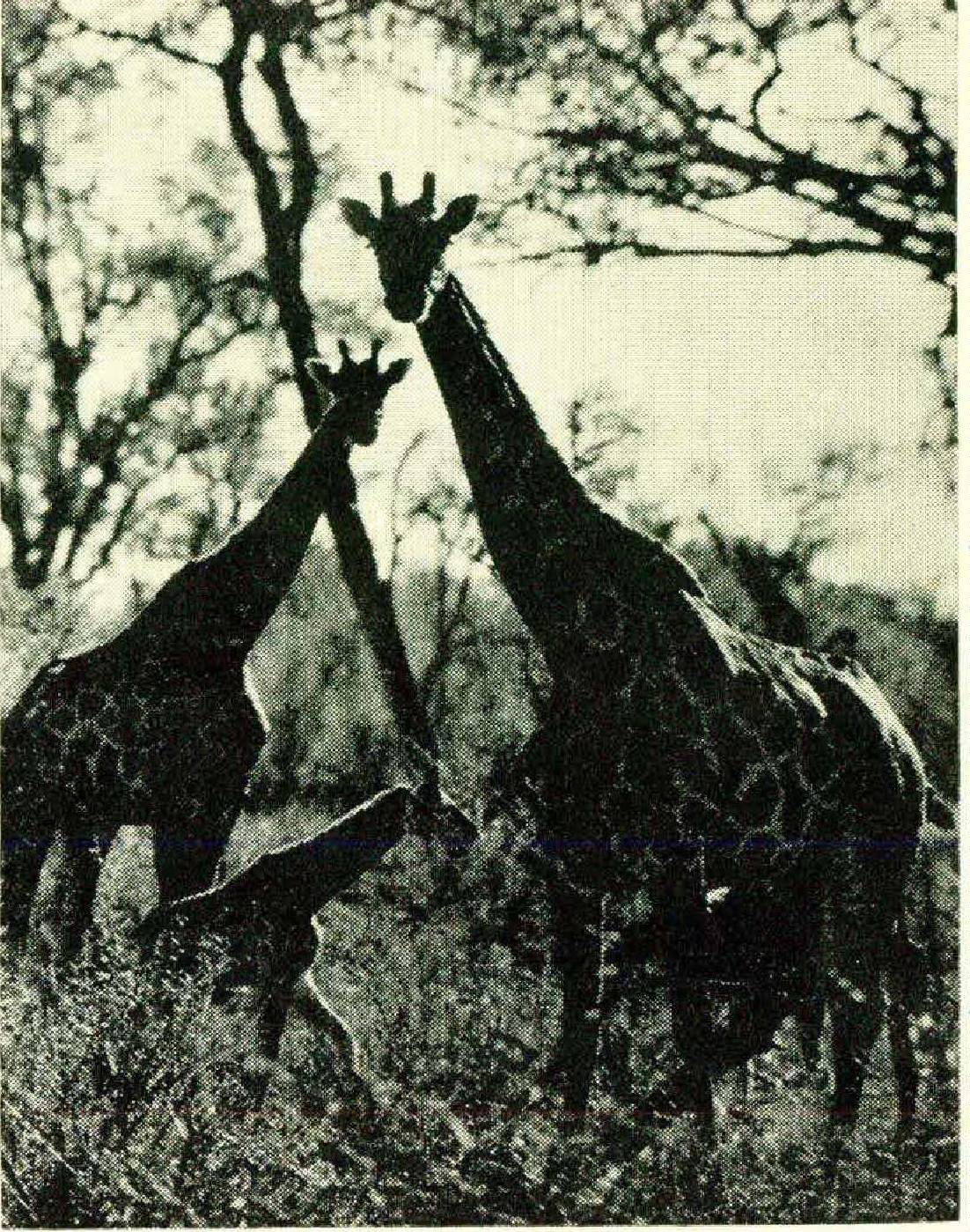
ON THE winding, ravishing, unfeasible road down from the Ngorongoro Crater, joy sets in. Below a loop of curve, a Masai stands on one leg like a stork, dressed in large earrings, a sepia toga, a spear, supervising his bony humped cattle. Otherwise there is no one, no house, no vehicle, no gasoline station, no helping hand should the car conk out. If you have the world to yourself, as far as you can see, you begin to feel you’ve discovered the whole wonderful place. The views make the heart beat with excitement, but the road requires attention, being red murram soil, treacherous when turned into glue by rain, just as treacherous when deep in dust. Zebras roam, more like the Swedish toy trade than authentic African wildlife. Near the wooden arch that announces the Serengeti National Park, giraffes are daintily occupied in nibbling the tops of acacia trees. Let those who will, rear lion cubs; I’d plump for a baby giraffe, not more than seven feet tall. Inquisitive and nervy, the giraffes pose with their leaning-tower necks at unlikely angles and scrutinize you through tremendous eyelashes, don’t like what they see, and amble or bound away in motion like no other creature. They never seem real; unicorns would be as probable.
Having passed the Serengeti gate, one is nowhere. Blue mountains rim the silent world. The plain, a mile-high plateau, stretches around with nothing on it. By now one feels, correctly, antsize, though a glad ant. Then suddenly a giant bustard, resembling a hut on feet, runs across the short tawny grass; ostriches exhibit pink feminine thighs: Thomson’s gazelles graze and twitch their metronome stumps of tail. The Serengeti people are proud of this road; of the four roads leading from the wilderness outside into the wilderness of the park, this one alone is all-weather and can be used in the rains. Joy turns into slight panic; the ruts are so deep that a small car, like mine, has to ride on the rims of the road, which are loosely piled with knife-sharp rocks. Calculations start: is there enough gas, could I actually change a tire — undo those rusty screws tightened by brawny men — how can everything take so long to get to?
This was my first solitary travel in Africa; before, I had taken an African driver, as linguist, not daring to launch forth with no knowledge of Swahili. The foreigners who live here say Swahili is a pushover language, but it is unrelated to any of the Western tongues and must be memorized by brute force. After two months with a rudimentary do-it-yourself Swahili grammar book, I believed I knew enough to ask for directions, or whatever else seemed necessary, and set out from the Indian Ocean coast for the Serengeti.
It is a journey of only 450 miles and took me the better part of three days; hereabouts journeys are not measured in distance but in time. Perhaps two dozen cars, buses, trucks passed in these days, and a few lone Africans on bicycles and a few lone Africans walking under the straight sun, but whenever I stopped by the road for lunch an African would appear from the ground and say pleasantly, “Jambo, Mama,” and ask the basic questions: where have you come from, where are you going, how many children have you? In Tanzania, Africans are cosier than in Kenya: in Kenya “Memsaab,” in Tanzania “Mama.” The scenery got more and more beautiful; the coast is like a video wide-screen dream of South Sea islands, but upcountry is superb mountains and great gold and green plains pimpled with dry volcanoes, and the biggest sky there is goes up forever.
THE Serengeti, though the most famous of the East African game parks, suffers economically and gains in delight because it is so hard to reach. One can come on the twice-weekly plane from Nairobi, a milk train of the air, a tedious journey that takes as long as from London to New York; or briefly on the Nairobi Sunday air excursions; or, if rich, by chartered small plane. One can come in a minibus on a conducted tour, or in a convoy of Land Rovers on private safari; but tourists are usually pressed for hours and likely to visit the more accessible parks. The result is that the Serengeti is a pleasure dome the size of Connecticut, with practically no one in it. This enormous territory is administered by 17 Europeans with the help of 120 Africans; since almost 3 million people live in Connecticut without stepping on each other’s toes, you get some idea of how alone you can be in the Serengeti. Except for the innumerable birds and the animals. In the whole world, there are not so many animals living together the way they did when animals began, at home on magnificent land that has never been cultivated or inhabited since the beginning of time.
The humans live at Seronera, as do a lot of lions; the lions made it their favorite base in historical limbo, and relinquish the area unwillingly. At first sight, Seronera appeals only because it is safety and a chance to wash, eat, sleep. The scattered buildings are rough and ready: round huts with thatched roofs, an anachronistic architect-designed stone bar, tents, unpainted gray cement-block houses with green corrugated tin roofs, prefabricated yellow houses with bamboo roofs, narrow white barracks, water tanks on top of noble boulders, bathhouses, a new tiny museum like the church of some recent Christian sect, a gasoline pump, a workshop, offices, African staff quarters. There is no plan, no harmony. It looks the way most human habitation looks in Africa, where gracious living has scarcely penetrated.
There are handsome lodges in some of the East African parks, and one is better served in them, but they seem fishy; Africa is not stylish and Africa is no hotelier’s ideal. Seronera, for all its faults (every prospect pleases, and only man is vile), is genuine. This impression of a settlement in the wilderness, whose object is not elegance but survival, is enhanced by beat-up dusty Land Rovers and trucks and people dressed in whatever faded careless clothing suits them. Nothing and no one even faintly relate to glamorous movie versions of life in the African bush.
The Serengeti keeps in touch with the outside world twice a day for half an hour, by shortwave radio to the Parks Headquarters in Arusha. A truck rumbles in twice a week, bearing food, supplies, and mail from Arusha 206 miles away, a hard day’s drive in dry weather, the nearest shopping center. The regular plane brings perishable goods such as butter. During the long rains the Screngeti is closed, as visitors either cannot get there or, if they somehow manage, they cannot move on the quagmire of park tracks. At all times, the residents are a tiny world, marooned in space.
They might be riven by feuds or around the bend with eccentricities, and they are not. They’re an international community — British, German, Dutch, South African — courteous, considerate, and keeping a tolerant emotional distance from each other. Status-seeking, the acquisitive itch, jealousy would be comic neuroses in this setting; and they don’t go in for social life. Driving after dark is forbidden to visitors and not much fancied by residents: the roads are even worse if you can’t see them properly, and animals are mesmerized by headlights and tempted to leap into the path of the car. Besides, there is no point in sharing the ever-present brussels sprouts and topi steak. Their paths have crossed enough during the day’s work. Occasionally they visit around for a drink, but mostly they stay at home after sundown. They are all readers; you have to be to live anywhere in Africa outside the cities. The generators for electricity stop humming early; a day in a Land Rover just about equals a day in the saddle.
They loaned me the Taj, short for Taj Mahal, the tatty one-room house used by the director of the parks when he visits the Serengeti. It is a modest eyesore, with cretonne curtains strung on wire, bleak cement floor, lumpy beds, furniture from a defunct government office. This dwelling soon felt like my very own dear little nest, with a tinge of supermarket due to my supply of canned food lined on bookshelves. Simba, meaning lion, and a joke name for the ancient scrawny grumpy African who is the Taj cook-houseboy, lukewarmed corned beef, soup, and other delicacies for meals. A thermos of ice, sent every afternoon from the chief Park Warden’s fridge, made l’heure bleue a daily ration of bliss. With a cold whiskey and soda, and wearing sweaters, I sat on the porch and watched the sky change and listened to silence broken by hyena snarls and their siren wailing, jackal barking, offstage lion roars, the tramp of unseen hooves, and my transistor gramophone playing Brahms and Chopin.
THERE is no routine in the Serengeti; nature sees to that. Rain is the worst upsetter, but unpredictable animal life, including the human animal, also gums the works. Daily problems have a splendid range. For instance: five Peace Corps kids, covered in mud and cheerful, showed up at the Warden’s office to report that a truckload of African schoolgirls and various tourists had been stuck all night in the black cotton soil on the Ndabaka Gate road, owing to the early rains. The Roads Warden, who was supposed to go north to check on a half-finished bridge, instead went west with a rescue squad. The Peace Corps kids were having a glorious time. Formerly students of Spanish literature, history and political science, business, they were now an itinerant surveying team and had been camped on that 90-mile Ndabaka road taking levels for culverts. Before dawn, they managed to pull their own truck out of the mud and drove back to Seronera alongside a troop of sixteen lions going the same way.
Then a delegation of fuming African chiefs arrived to be indignant with the chief Park Warden, a born and delightful diplomat. The chiefs claimed that one of their number had been falsely accused of obstructing Park Rangers in their work of marking park boundaries, and arrested: was that justice? They were placated, but Rangers, scattered and out of radio touch, had to be rounded up in a hurry and sent 250 miles to Maswa to testify in court, because the Maswa police were in a jurisdictional fury over poachers caught in their territory and taken elsewhere for trial.
Word came in that the building of a Ranger post on the northern side of the park and the construction of a water tank at the southern gate had been halted because the workers were constantly driven off by swarms of enraged bees. The medical orderly was outdone because most of the African staff thought anti-malaria pills were a nuisance and chucked them into the bush around their houses. The incidence of malaria was rising. He wanted a weekly military lineup, with people obliged to swallow medicine in ranks. The assistant Park Warden flies the Serengeti’s Super-Cub on aerial reconnaissance of poachers, Masai trespassers, squatters, grass fires, and game dispersal, though his principal task is to command the Ranger force in its unending war against poachers. He was absent on leave, and the wildebeest migration had now passed the protection of the park limits to the northwest, poachers were preying on them, and it was essential for someone to organize an antipoaching patrol at once.
ALL residents of the Serengeti treat the chanciness of their physical environment as we treat the chanciness of traffic, yet take no silly risks from ignorance. As for the chanciness of the man-made environment outside, news of that filters in on radio broadcasts if you have a radio and can hear through the static, or in stale newspapers and magazines. People elsewhere in East Africa follow reports of political changes south of the Sahara with alternations of hopefulness and alarm, depending on rumors and how they feel that day. In the Serengeti, disasters — from the Congo to Rhodesia, with a dash of cold-war panic about Chinese Communists thrown in — do not affect daily life; the residents are too far away from the man-made world and too busy coping with the natural world. The Serengeti expatriates are even spared the expatriate anxieties about dispossession of property or deportation or sporadic local flareups. Their jobs will be taken over by Africans when Africans are ready for the work, and that’s that. It’s a big help to peace of mind to feel that you are not only earning your living in a way you enjoy, but performing a valuable service for the future. The Serengeti becomes a Cause to all who know it.
The administration of the Serengeti is employed to defend the land and the animals and cherish the tourists, but there is a separate new establishment, the scientists. This is the Serengeti Research Project, which has its eye on eternity. The science of wildlife ecology is so recent that it is nearer to art than to science; techniques have to be invented, imagination and intuition are more useful than microscopes; for after all, the subject is alive but cannot talk. Since right now it is essential to know what this fabulous horde of animals needs to survive, and someday it may become necessary to interfere with them — manage them — in order to preserve species, to preserve the habitat, five young scientists roam the 5000 square miles of the Serengeti, studying various wild creatures. The Africans call the scientists by the name of the animal they pursue: thus, Mr. Lion, Mr. Hyena, Mr. Wildebeest, Mr. Zebra, all, naturally, in Swahili. The very pretty English wife of the young Dutch scientist is Mrs. Hyena. The German veterinary who studies diseases of game is probably known as Mr. Sickness, Bwana Ugonjwa.
The scientists spend most of their time in the bush with their subjects. Mr. Zebra, a German, was camped somewhere on the 9-mile-wide floor of the Ngorongoro Crater, where the walls of the crater rising for 2000 feet imprison the game in a vast pen. He was tracing 120 zebra he had already marked, to observe the social structure of the herds, their population growth, their feeding habits and family life. Mr. Wildebeest, an Englishman, was mainly flying 75 feet above whistling thorn trees at 50 miles an hour in the Super-Cub, mapping the position of the wildebeest migration. By aerial count, he has 330,000 of these bearded, top-heavy creatures to study. Twice yearly they migrate from one side of the park to the other, in a stream 35 miles long, raising a great dust cloud and looking like a weird army in retreat. Mr. Wildebeest has to discover the reasons and needs of this mysterious mass movement, and the relation of population to habitat.
Mr. Lion, also German, goes off alone for three or four nights of full moon and lives silently inside his Land Rover, having instructed his houseboy to notify all hands if he doesn’t reappear by a certain date. He broadcasts a recorded lion’s roar over a loudspeaker, and the lions gather around his car “biting the tires”; he says they are playing. When asked if he was not frightened, he said “less frightened.” By day, he had been watching a pack of wild dogs, fierce democratic predators who have no specific leader but operate like a relay race, and return from the hunt to disgorge food for those who stayed behind, guarding the young.
Mr. Hyena, a towheaded Dutch Ph.D. from Oxford, took me along while he collected hyena droppings, which are chalk-white, dry, and odorless, the only bearable feature of a hyena in my opinion. He will then examine the hairs in these droppings, under a microscope, to find out which animals hyenas eat most. We chased a jackal in the Land Rover until it released its victim, a mangled hyrax; he needs samples of the hair of all prey. We picnicked on a kopje, one of the beautiful Dali-esque boulder formations that rise from the Serengeti plain. Before we settled down with our sandwiches, he walked briskly around clapping hands, to warn off lions and snakes in the surrounding rocks. Red mongooses fled in all directions. He owns a stuffed hyena, a thoroughly repellent object, which he will station near herds of plains game in order to watch the reactions of the harmless gazelles to the enemy who runs them to death and eats them to the last bone.
Mr. Sickness has a laboratory like a large dollhouse, stuffed with small jars holding intestinal worms. When we were driving to his other laboratory camp, on the northwest edge of the park, he spotted a mass of vultures, and leaped from the Land Rover to find the body of a giraffe, dead of old age. He immediately got to work, muttering happily about his luck, and how unusual it was to find a dead giraffe, and cut off bits of lesioned skin from the legs. A colleague in Beirut had diagnosed these lesions as made by worms, not wounds; but he needed more samples to decide which worm and why. One of Mr. Sickness’ chores is the meat massacre; every so often he and a Warden go out beyond the park limits and shoot a number of topi and wildebeest as essential food for the community. Everyone loathes this job, but Mr. Sickness takes a different scientific attitude: this is how he collects all those instructive parasites. He is studying the transmission of disease from game to domestic stock, and the suitability of game meat for human consumption, and the difficult problem of how to crop game — kill it, when overpopulation sets in — as protein for protein-hungry Africans.
The Serengeti Research Project is financed entirely by contributions from outside, by UNESCO and FAO and West German foundations and government funds, by English and Dutch scientific groups. The work is of major importance and hopefully will be made so permanent that no political changes will ever destroy its continuity. The Serengeti offers a unique kind of natural laboratory; what can be learned here is applicable throughout Africa, and scientists would never again find such an untouched area, and such a lavish variety of fauna.
NO ONE imagines that poaching can be entirely stopped. Africans crave the taste of wild meat, and, as an old Africa hand observed, “a poacher is the former owner,” so poachers do not feel like thieves but like men done out of their ancestral rights. The Serengeti anti-poaching force, the Rangers and their boss, the assistant Park Warden, bear animosity only toward those poachers who have introduced a Big Business note. When hundreds of wire snares are used, and the animals are eaten alive by hyenas and vultures while they choke in the snares, a certain amount of hatred galvanizes the anti-poaching force. Also there are motorized poachers, who cruise around in trucks, with guns; and they too are regarded as swine. But the average local African, who kills with a poisoned arrow, for food and fun and a bit of extra cash, does not inflame anyone. On the other hand, law and order must be maintained, and if the poachers were not hounded, they would poach everything in sight, and do incalculable damage. Poachers were controlled by an exhilarating game of cops and robbers; controlling them, limiting their activity, is the most that can be hoped for.
For three days, I tagged along on an anti-poaching patrol with the chief Park Warden, pinch-hitting in this job, eight Park Rangers, and three game department Rangers (attached troops). We set out in one Land Rover and one truck, soon left the park boundaries and jolted on a dust track, being stung by tsetse flies. Tsetse flourishes all over East Africa; it thrives on game but does not harm wild animals; it is lethal to domesticated cattle; we assume here that it has had no chance to become a carrier of sleeping sickness. It administers a jab like a hot needle. Presently we were off any sort of track, weaving through trees, fording streams, crashing over bush and stones, and the heart lifted and sang. This country is broken by hills, and muddy streams fringed with fever trees, and islands of thicket, palm, wild fig, wild almond, sausage trees matted together by vines and orchids; there are wide glades bright with white and pink wild flowers. Since the animals are hunted here, they are frightened, and ran from our noise in streaming friezes against the sky. Herds of giraffes cantered very fast, at once graceful and absurd with their uncoordinated gait and waving necks, and topi and eland and leaping impala and wildebeest and buffalo and even tribes of mongoose ran like mad with them. Not being a poet or a scientist, I have no suitable language for these animals. I can only say that to see them racing over their own land is to see freedom in tangible form; and the sight is intoxicating.
OUR party was under the operational command of the head Ranger, Sergeant Major Kimani, who had retired from the British Army with a pension and the Military Medal after service in Somaliland and Burma during the war, in Malaya and India, and finally in Kenya fighting the Mau Mau. He looks more like a Frenchman than an African, with a sharp, witty, amused face, an intellectual’s stoop, and grizzled curls; and he has the irresistible charm of a man who is brilliant at his job and loves it. The Rangers were younger, tall, stalwart, gay; one wore a safety pin jauntily in his pierced ear, one had wound his long hanging hollowed earlobes around the tops of his ears for comfort, some had tribal tattoos on their cheeks, private touches added to the Ranger’s uniform of green shorts and bush jackets.
This was the first time I had been with Africans on their own terrain, doing what came naturally to them, and they were impressive. They knew this roadless landscape as one could know the rigidly numbered streets of New York; they could spot animals as if they had telescopes for eyes. When the sky looked blank, they sighted vultures at great distances, proof of a dead beast, possibly killed by poachers; and the strong noisy vehicles lurched across country, guided by circling birds of prey.
The truck, with Sergeant Major Kimani hanging from the side, led the way. We tore through whistling thorn bushes, and the thorns burst past the open slots of the windshield and in the windows; and with them the silver galls of this tree which are homes for ants. So now we had thorns in the flesh and biting ants down shirt fronts; it was very jolly. Suddenly, Sergeant Major Kimani waved his arm, and we stopped in silence and leaped from our transport. We deployed and plunged into a thicket, shouting — what for? to frighten off animals, to tell the putative poachers that they might as well give up the ghost? Using our hands to open a path, we thrust through scratching bushes and tripping vines, past a curled python, and caught poachers.
They were two skinny old men, armed with bows and poisoned arrows, wearing rags, bead necklaces, charm amulets, and aggrieved expressions. They had a snug camp of thatch huts hidden in a clearing, and zebra meat. The oldest said they had not killed the zebra; a lion did. Everyone roared with laughter, including the elderly poachers. The poachers’ possessions — gourds, skins, herb medicines, bows and arrows — were collected, as evidence to be used against them in court. Strips of zebra meat, drying on racks, were confiscated. That night the Rangers and the poachers would gorge together on a luscious zebra barbecue.
The Rangers showed me a cylindrical leather quiver full of poisoned arrows, but no one would touch these even with the tips of fingers. The poison looks like dried black glue, and is made from the native acocanthera tree, available to anyone who has the patience to boil the bark and roots. The Rangers say that an animal, hit with such an arrow, takes ten to fifteen minutes to die; a man gets dizzy, stumbles around, and collapses; but a man wounded in the chest gives one cough and falls down dead. Occasionally a poacher aims poisoned arrows at the Rangers, and is immediately shot at, with their Greener rifles or anti-riot guns, in legitimate self-defense.
We burned the empty huts of the old gentlemen poachers; poachers’ camps are razed whenever found. They flame like haystacks, and everyone, even the poachers, took instinctive hilarious pleasure from the roaring towering fire. The poachers were handcuffed with light chain contraptions, bundled into the truck, and the chase was on again.
Kimani had us clambering over hills; he and the Warden and the Rangers moved like mountain goats. The grass was chest-high, and buried underneath it were large loose granite rocks, very rough going and model snake country. The Guide to African Snakes promises you from twelve to twenty minutes of agony before dying of a mamba bite. (“It would be a crowded hour,” said the chief Park Warden.) Terrified by the snake guide, I had bought an anti-snake-bite kit, and this was now back at our camp. Obsessed by snakes, I failed to fret over a buffalo crashing out of the brush and away down the hill. However, the solitary buffalo, too old and sullen to live in the herd, and rhino are the hazards of this work which the Rangers take most seriously.
The rhino has earned his savage temper, being hunted nearly to extinction for his horns. The citizens of China and India cling to the immemorial illusion that rhino horn is an aphrodisiac. As a result, the dangerous two-thousand-pound beast is dangerously hunted and killed with a poisoned arrow by an intrepid African, who gets as little as $2.80 on the rhino-horn black market. Rhino are becoming so scarce that during the floods a few years ago they were airlifted (no idea how) to safety.
After the sweating climb, and all the terrors of the imagination, one pants to the top of the hills: and there is Africa. It is easy to understand about Cortes’ men silent upon a peak in Darien. One is swept by exultation, seeing land, like the sea, plains and hills and more hills and more plains, stretching out to the circle of the horizon; land which must have looked the same to the first of our species, well over a million years ago.
The next day, by a river, the Rangers and the Warden went running into the attack, laughing aloud; police operations are not usually so lighthearted. They had spotted the quarry before jumping from the cars. They caught three hefty young Africans who were winded by the chase and announced in loud voices that the Rangers were washenzi (“uncivilized”). Their complaints were heard in sympathetic silence, after which the young men settled down in the truck, one of them took cigarettes and a nickel-plated lighter from his ragged shorts, and they chatted amicably with the Rangers, all addressing each other as “bwana” in the polite African manner. The poachers will get six months in clink, which does not worry them. Time is not a tragic matter in Africa, and clink is all right, free food and shelter and agreeable pals, other poachers. Their wives will wait for them, for financial reasons if no other. Their wives have been wooed and their fathers-in-law won with many cows, bride money, and if husbands are deserted, fathers-in-law have to refund those cows.
Poaching fulfills all sorts of African purposes. In the neighboring Sukuma tribe, a bride wraps the tails of wildebeest around her legs, thus bringing good fortune to her new husband, who will, if she is so adorned, possess many cows in future years. The selling price, per tail, is $2.80 — 20 shillings; and explains why dead wildebeest are found along the boundaries of the park with nothing removed except their tails. Lions are poached for their skins; a lion skin makes a handsome coat for ceremonial occasions and nets the poacher $30.00, a lot of cash. Melted lion fat is considered sovereign medicine for getting strength, and sells for $7.00 a beer-bottleful, which is also good money. Witch doctors will pay well for two bones behind the lion’s ears, and for the fluid that gushes from the stomach through the mouth before the lion dies. (Witch doctors are also partial to leopard skins and give from $42.00 to $56.00 per hide.) And pride is a reward; an African, who hunts on bare feet, armed with a spear or bow and arrow, is justly hailed as quite a man when he comes home carrying a lion skin over his shoulder.
Above all, poaching is a butcher’s career. The African tribes around the Serengeti are not poor and own large herds of cattle, but do not eat their cattle any more than we squander our savings. What they like to feast on is zebra and wildebeest, and they can pay for their luxuries. The motorized poachers take orders in the villages, collect money in advance, and massacre from trucks: $12.60 for a zebra carcass, $11.20 for a wildebeest, $8.40 for a topi. The poachers we caught were little retail fellows; they sell a piece of sun-cured meat, as long as their forearms, for about 42 cents. Their tribes have hunted in the dry season since tribes existed, and they love this life. They have a whale of a time in their thatched camps, stuffing themselves with meat, smoking bhang (marijuana) in the evenings around the fire, and earning illegal money with which to buy more of the coveted cows.
On the highest hill, in this place which is without place names, stands a monument to Western civilization in the form of a German fort. The building is straight Beau Geste and dates from the time when the Germans were overlords of Tanganyika, before and during the First World War. We climbed the hill and found on one square corner tower the scars of shrapnel and lower down the nicking of small arms fire. An old African had told the Warden that long ago he saw the strong young Wazungu (“Englishmen”) running up this hill and being killed, as easily as birds. He could not believe it; he had never imagined that white foreigners were vulnerable like other people. The only visible occupant of the fort now is a deadly five-foot-long puff adder, thicker than my arm, slithering around the dry cistern which once stored rainwater for the German soldiers.
At the end of the afternoon, after the hot exhausting exciting day, it was lovely to come back to camp, two small tents pitched under trees by the Grumeti River, and the evening bath. The English must have invented this goofy tub, a little square of green canvas, propped off the ground by four sticks, in which one crouches in a fetal position. Muddy bath water from the Grumeti was laced with Dettol, an odorous disinfectant, to protect one’s scratched body against bilharzia. Clean and in the alternate set of fresh clothing, we read before dinner by the light of a lamp, hung on a forked pole, and drank welcome whiskey with water that had been kept cool in damp canvas-covered canteens. A red half-moon floated above the acacia trees. It was the height of luxury. The nights were not entirely restful because two prides of lions set up a close antiphonal roaring, near the river; jackals made a yelping racket; and rain hit against the tent roof like buckshot.
The chief Park Warden had to return to his administrative duties; Kimani and the Rangers would carry on until they had collected a truckful of pri oners. The manacled poachers, our haul, were smoking and chatting in the shade at the Rangers’ camp, with one man to guard them. The heftiest young poacher said pleasantly to the Warden, “We have no anger against you; it is just our bad luck.” I wanted to know whether he would be out hunting next season. He laughed and said, “No. Not after we have seen the rough edge of it. If there is room, I want to be a Ranger.”
THE Tanzania government has shown real wisdom in setting aside great tracts of virgin land for future game parks; and they allot, in percentages, more government revenue than we do to the upkeep of their existing parks. It is not enough for the parks but plenty to anger the citizenry if they believe that game parks are a white man’s foible, while they clamor for hospitals, schools, roads, and other twentieth-century blessings.
The director of the Tanzania National Parks, a large quiet-spoken Englishman, is a tireless man with a mission: to preserve the parks, notably the Serengeti now. Now is the vital word. In a calmer future (we trust a calmer future), foreign tourism will increase; and an African middle class will evolve, financially and emotionally able to enjoy and pay for its heritage. Most Africans have never seen wild animals; those who have fear them as dangers to life or detest them as dangers to crops. The Parks’ education officers are busy convincing Africans that they own something of surpassing value which no other people can ever buy or build. The director is busy forming a structure of parks and administration and research that will last, the while seeking maintenance contributions from outside Africa.
African schoolchildren are invited to visit the parks; they are given free shelter in hostels, a guide, and gasoline for the journey; they bring their own food and bedding and their chaperone-teachers. They leave after two days, devoted conservationists, crazy about park life and wild animals. A Parks Land Rover tours the villages and shows films of African wildlife, while the people gather around a tree where the movie screen hangs and revel in this outdoor entertainment and are charmed by a new aspect of animals, as photogenic and interesting and their communal property, a source of pride. There are posters and radio talks and school competitions for essays in which patriotism and conservation merge. It is a wide, wise, and well-done scheme, and it will work in time.
In the long run, the Serengeti will have to pay its way by a combination of tourism and the sale of meat from game-cropping. But for the moment, tourism does not shine as a specially bright light of hope, because African politics are turbulent and tentative, which daunts tourists, and African travel is far too costly. Game-cropping is easy to talk about, but no one really knows as yet how to work it efficiently. And it takes a lot of civilization, or overcivilization, before people come to realize the value in itself of unspoiled nature; Africans cannot be expected to share our feelings; they’d rather have skyscrapers. The great usefulness of the Serengeti as a research station is beyond average African comprehension and beyond nearly everybody’s; this is a new field of exploration, whose meanings in understanding wildlife and our own relation to it are guessed at by imaginative scientists.
So here is the Serengeti, an irreplaceable art museum of creation, and a few hundred people throughout the world care deeply about its preservation, and prove their concern in money and work. If they succeed, Tanzania and all the rest of us benefit; if they fail, we all lose. And, of course, there is no second chance.