Le High-Life in Guadeloupe
pleasures and ploccs
BY JAMES EGAN
Guadeloupe, after having dozed through the jet-borne Caribbean boom of recent years, has now awakened to the value of the tourist dollar, and has built some of the fanciest resort facilities in the West Indies. These are planted in a setting of prodigal mountain scenery, rain forests, white beaches, and opalescent waters — the whole wrapped in an ambience peculiarly French.
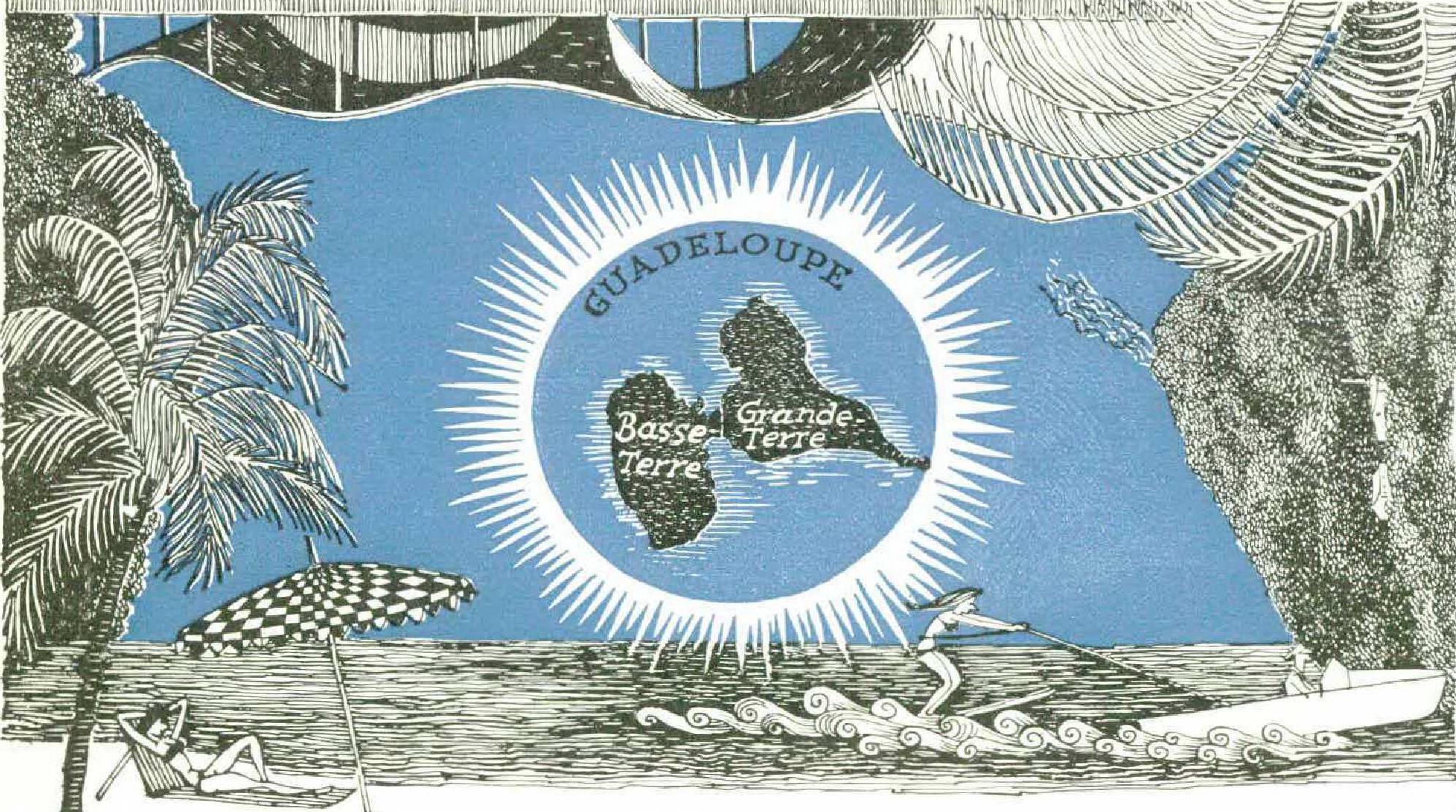
Guadeloupe has been French since 1635, with a few brief spells of British rule in the late eighteenth and early nineteenth centuries. Lying midway in the Antilles chain between the Virgin Islands and Trinidad, the island, shaped like a butterfly’s wings, is actually two islands joined by a narrow strip of land. The western wing is called Basse-Terre, an old seafaring term for the land below the wind; the eastern wing is called Grande-Terre. The names have nothing to do with topography; Basse-Terre is rugged and rears up through tropical jungles to a still-active 4800-foot volcano, La Soufrière; Grande-Terre rolls gently in sugarcane and savanna.
The politics of the island are confusing, like all French politics. In municipal elections held while I was there, I counted more than a dozen local parties; my favorite was one in the town Petit-Bourg, called Union pour la Rénovation de Petit-Bourg. It won handily against the Entente Démocratique. As one transplanted Frenchman told me, “Here we vote more for the personality than for the party. We have whites, blacks, mulattoes, and East Indians, and although we have our differences, they are not profound.”
It was a soft tropic evening in winter when my wife and I landed at the big jet airport near Pointe-àPitre, Guadeloupe’s bustling commercial capital, less than five hours flying time from New York. A fortyfive-minute ride over an excellent route nationale brought us to the Fort Royal Hotel on the northwest coast of Basse-Terre. The long, low, modern hotel, standing out on a bluff between two curved beaches, blazes with lights at night. Inside, a staircase made for grand entrances sweeps down from the lobby to the dining room; an orchestra plays nightly for dancing; a bilingual M.C., who doubles as coiffeur, runs horse racing games. Before and after dinner, the shiny bar is well filled.
Rooms in the Fort Royal’s main building are glass-walled and slickly furnished in palisander pieces from France. For the guest with Robinson Crusoe tastes, there are conical cottages at the remote end of the west beach. Each is a single circular room with bath; but air conditioning, a nearby free-form swimming pool, and a big American breakfast tray keep the guest from feeling like a castaway. Moreover, the daily buffet lunch, served by the pool under a loggia draped with bougainvillaea, runs to cold salmon mayonnaise, heaping platters of fowl and cold meats, enormous French sausages, popeyed shrimp in their shells, spears of palm heart, cold braised celery, a wicked lineup of patisseries, and bowls of tropical fruits. Fortunately, one can work it all off on the hotel tennis court, water skiing, or piloting a Sailfish. A nine-hole golf course is scheduled to open this coming season. Rates at the Fort Royal in season for a double room and bath are $27 to $29 a person, Modified American Plan; out of season, $16 to $18; service and taxes included.
In the Fort Royal’s boutique I fell into conversation with the shop’s owner, a lively bright-eyed woman from Southeast Asia. She had been a couturiere, she told me, for the elegant ladies of Guadeloupe, and she supplied a somewhat foreshortened view of the island’s social structure, seen from the top. “This is not a poor island,” she said. “There are many rich families here, very rich. They are the békés, the white planters. They own the sugar and rum factories, and now they have the representation for foreign industries here — the agencies for Peugeot, Mercedes. There is always much entertaining. The women go to five or six cocktail parties a week, and they must have a different dress for each. It must also be different from all the other dresses at the party, so of course they have it made to order.” She sighed. “But now it is so difficult to get seamstresses that I must also sell readyto-wear from Nice and Cannes.”
The next day we looked in on the holdings of a béké family at Deshaies, a fishing village near the Fort Royal. “Rocailles de Guy Blandin,” the entrance sign said; the rock gardens proved to be an entire mountaintop, where M. Blandin, a former banana planter, grows acres of anthurium for export to France. The flat, waxy, heart-shaped flower, actually a leaf, with a protruding tongue is usually red or pink, but M. Blandin has developed hundreds of other varieties.
“Regard this giant.” he said, pointing to a scarlet and green monster a foot across: others were pure white, peach, even brown. M. Blandin is a passionate horticulturist in a climate that encourages his passion. He grows more than sixty varieties of hibiscus; his red foxtails are ten times the size of those in our temperate gardens. A stocky man in his fifties, with a square Breton face and piercing blue eyes, M. Blandin spoke rapid-fire French, curiously accented. I asked him what part of France he came from. “My family has been in Guadeloupe two hundred years,” he replied. “We are Creole.” Had he been to the States? “Oh, yes, in passing to visit my son at the university in Montreal. He has a degree from Cambridge, and now he does graduate work in finance. He likes business and money and all that.”
“Will he come back here to Guadeloupe?” I asked.
“My son doesn’t like flowers. He wants to be a banker.” M. Blandin smiled. “But he is still young. Perhaps he will change his mind.”
Another day we made an excursion around the perimeter of BasseTerre with a French photographer, Francis Sanglerat, and his pleasantly tinted Guadeloupean model, Claudie. M. Sanglerat, a lean scar-faced man who looks like an amiable Humphrey Bogart, had lived in Guadeloupe for some fifteen years. Yet he is a true Parisian, born in Montmartre, “le coeur de Paris” he said. Claudie had lived on the island all her eighteen years; only her photogenic face, on Sanglerat’s postcards, travels around the world.
We headed down the precipitous west coast, where heavily wooded mountains run to the sea, and palmfringed beaches rim the coves. Guadeloupe is legitimately billed as the Emerald Isle of the French West Indies. Along its roads grow a profusion of banana and breadfruit trees, mango and papaya trees, tall hedges called sang-dragon. Claudie gathered stalks of wild sugarcane, peeled them, and chewed them up at the rate of a yard an hour.
In every little town stand the symbols of authority: the gendarmerie, the green bronze statue of La République, and the church. Adjoining the church is usually a cemetery, as elaborate as those one sees in the French Pyrenees, with the same ornate family tombs decorated with intricately beaded wire wreaths and improbable artificial flowers. The tombs are above ground; one is vaguely Chinese with a pagoda roof, another is Persian; but perhaps the most astonishing are resort-modern, hygienically tiled in black and white, like bathrooms, with glass-brick windows and wrought-iron gates. Inside one of these we saw a painted plaster statue, presumably of the head of the family. The figure, with arms outstretched, wore a neat black suit and striped shirt and tie, all lovingly painted on. The eyes were blue and bulging, the hair blond. “Famille Egerton,” the plaque said. Were they descendants of some British sailor who landed here a hundred and fifty years ago?
Lunch on the road in Guadeloupe is likely to be an adventure in French provincial cooking. We stopped at a modest hotel and restaurant called the Rocroi, much like those in the south of France. We ate outdoors on a terrace overlooking the sea, flanked by a small zoo occupied by a raccoon — said to be the only wild animal in Guadeloupe besides the mongoose — and a noisy collection of doves and parakeets. The proprietor was from the Midi, and the fare was richly Provencal: spiced-up hors d’oeuvres and black blood sausage; l’aïoli — mayonnaise heavily laced with garlic and served with cold boiled vegetables; thin lamb chops; salad; cheeses, including an oddity called Caprice de Dieu: and homemade sherbet. M. Sanglerat put away most of a carafe of red wine. Claud ie managed with a Dubonnet, red wine, and a Pepsi Cola. She did well by the sherbet too, a great island favorite. “On Sunday afternoons at four o’clock,” said our escort, “all the ladies take three or four glasses of sherbet made with the vanilla or coconut of the island. Then they groan and say, ‘I will lose my line!’ ”
A few miles beyond the Rocroi we came to the city of Basse-Terre, Guadeloupe’s political capital, small and somnolent. We drove up through the flowering suburb of Saint-Claude, where the French prefect lives in an elegant old wooden house, then followed a narrow switchback that ascends to the volcano, La Soufrière. As we climbed, we plunged into a rain forest. The mountains of Basse-Terre intercept the moisture-laden trade winds, which dump enough rain on the island to feed some eighty rivers. The dripping forest is laced with parasitic vines and tropical ferns; mahogany trees up to six feet in diameter lie uprooted by past hurricanes.
“The temperature here drops one degree centigrade each hundred meters one mounts,” said M. Sanglerat. Claudie shivered in her thin dress and chewed up several more inches of sugarcane. Still some distance from the summit, the road ended. A smell of sulfur filled the air. A chill fog closed in. Did we want to mount farther on foot? Two damp, bedraggled French youths in shorts stumbled down a lava path, their feet black with cinders. They had climbed to the edge of the bubbling crater, they said, and the wind was très fort; it had blown them over en route. The weather changes hourly on La Soufrière; this wasn’t the moment for the ascent. We drove back down through the rain forest to the sun, pausing on the way to eat framboises de La Soufrière — big red watery raspberries — and once to chop out of the jungle undergrowth a flaming orange and yellow bird-of-paradise flower which rose on a six-foot stalk.
The last stop on our Basse-Terre expedition was at Trois Rivières, to examine some pre-Columbian Carib rock inscriptions half hidden along the banks of a pretty little stream. The inscriptions are badly worn, but small boys stand ready, for a fee, to dash a bucket of water on the rocks to bring out the scratches. In Guadeloupe the marks of the past are almost everywhere obscured; the tropics rapidly swallow up crumbling forts and ruins. Now an ambitious tourist office is beginning restoration, and the old Fort Fleur d’Epée, for one, has recently been turned into an attractive museum. It celebrates — naturally — French victories which drove out the British.
On Grande-Terre, the low-lying pastoral half of Guadeloupe, future archaeologists will have their work cut out for them when they come upon La Caravelle, the island’s other luxury hotel. It is a swooping white concrete structure that looks like a world’s fair pavilion. The bidets suggest a French hotel, to be sure, but what are twin washbasins doing in French bathrooms? The molded fiber-glass beach chairs with a Paris nameplate are obviously designed to enthrone a race of goddesses. And they do: bikinied airline hostesses. The tribal rites here — eating and drinking, swimming and water sports — trace directly to the French Riviera.
La Caravelle is ten miles from Pointe-à-Pitre on a mile-long stretch of white sand shaded by coconut palms and sea grape. A small dock juts into a reef-rimmed bay, where a constant stream of skilled water skiers perform. About a third of the guests are American. As one New York doctor remarked, “The thing I like about this place is that it is frankly French, There isn’t even a drugstore in the hotel.”
Lunch at La Caravelle is served at a poolside bar, and we usually settled for les sandwiches francais, ten-inch lengths of French bread filled with ham, chicken, or roast beef. But dinner takes off in full-blown metropolitan French style with, for example, potage Saint-Germain, langouste armoricaine, a cutlet Pojharsky, petits pois with tiny white onions and bits of pork; then runs through the inevitable salad, cheeses, pastry, and fruit. The wine list is long, and a bottle of
Pouilly-Fuissé 1959 costs the same as in France. La Caravelle’s rates in season for a double room and bath with terrace facing the sea are $23 to $26 a person, Modified American Plan; out of season, SI7 to SI9; service and taxes included.
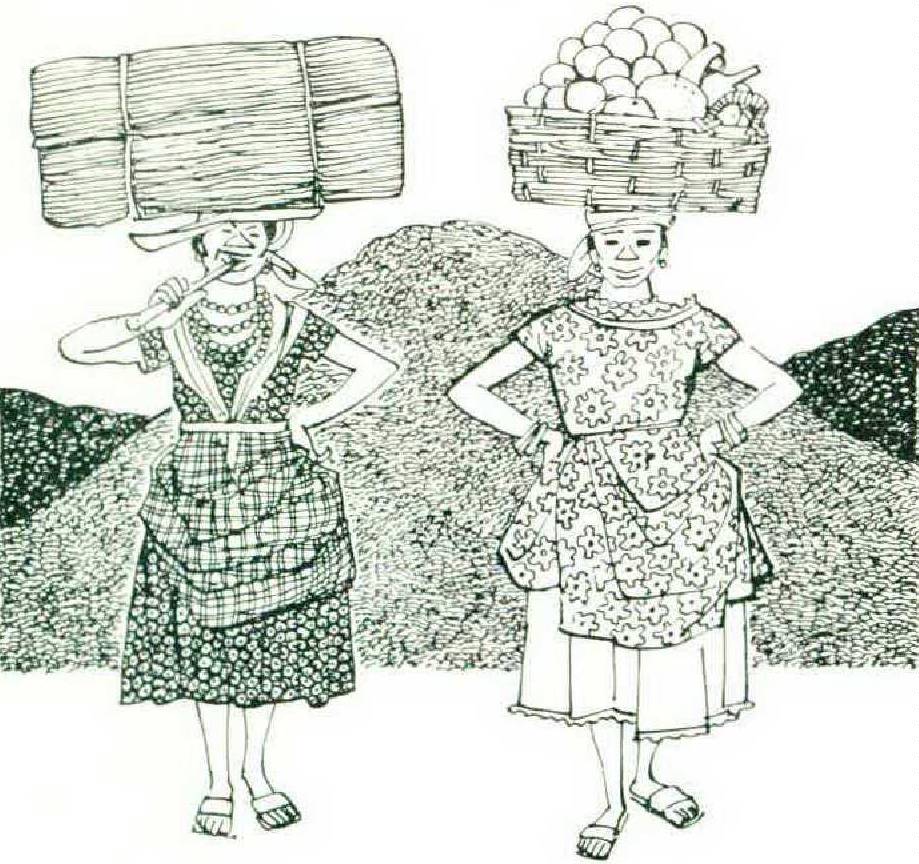
On a Sunday morning we taxied from La Caravelle to the neighboring town of Sainte-Anne, not much more than a single street of unpainted houses, with fishing boats drawn up at one end of the beach and an openair market at the other. But everybody was dressed up for Sunday Mass. The little girls came in sparkling white or pink dresses and Straw bonnets, the boys in crisp white shirts and shorts. A few of the older women wore the traditional costume of Guadeloupe: a flowered, full-length dress hitched up to show the petticoats, and a madras-kerchief headdress tied up in points. The Mass was sung in French; the sermon was a plea for strict observance of Lent; and through it all, babies toddled up and down the aisles in happy confusion.
La Caravelle itself celebrated Sunday with two serious devotions: a stupendous buffet lunch attended by most of social Guadeloupe, followed by a three-hour fashion show run by the Maison Vogue, a smart Pointe-à-Pitre shop. The dozen young mannequins were amateurs, ranging from rosy blond to café an lait, all fresh and lovely. They performed creditably, if a bit nervously. It was a cozy family affair, and each girl had her claque, who applauded as the announcer brought her on. When the show was over, the stars came out to join their families and friends for kisses and congratulations, lemonades and Cokes.
When we explored Grande-Terre one day with our French photographer friend, he volunteered to show us the sugar mill of one M. Beuzelin, “a formidable character,” he said. We drove through bottomlands of sugarcane, past Hindu settlements flying tattered temple pennants, and presently entered a gate marked Néron. “The proprietor has named his place after the Roman emperor,” explained M. Sanglerat. “He considers himself a spiritual descendant of Nero and rules his establishment accordingly. He is also an admirer of Maréchal Pétain, as you will see.”
In a clearing before a battered wooden mill, sweating workers unloaded sugarcane from oxcarts to trucks. The mill machinery appeared long unused, yet an odor of fermented cane hung over the place. Blazoned across the facade of the mill in red letters a foot high was the Pétainist motto: “Dieu— Travail — Famille — Patrie.” A local artist had crudely daubed on the office wall a lifesize figure of a French soldier shouldering a rifle and standing at salute. Above the figure was a street sign: Place du Maréchal Pétain. But the proprietor himself was nowhere about.
“This gentleman has certain fixed ideas, you understand,” said M. Sanglerat. “He used to detest De Gaulle, naturally, but lately he says he is not so bad. When I asked him why, he said, ‘Because now De Gaulle follows the policies of Pétain.’ So when De Gaulle visited here last year, the proprietor sent him a case of his own rum. Each bottle carried a special tricolor label — De l’Empereur de Rhum an Président de la République.”
We were sorry to miss M. Beuzelin, but perhaps he would have refused to receive enemy aliens, in any case.
Among Guadeloupe’s colorful characters is Mario Petraluzzi, amateur historian, antiquarian, expert on Creole cuisine, and owner of the Grand Corsaire de la Pergola, a restaurant with guest cottages at Gosier, five miles from Pointe-à-Pitre. We lunched at La Pergola, high above a beach and the Bay of Guadeloupe, in an atmosphere of privateering days. The restaurant lounge is hung with cutlasses, old charts, oil portraits of corsair captains. Ancient cannons stand in embrasures about the building, and overhead flies a skull-and-crossbones flag. Yet there is no note of professionalism in the decor; it is disarmingly haphazard, and the effect is both honest and naïve.
“I have been here since twentyeight years,” said M. Petraluzzi, a salty, animated man of about sixty. “I do not want a grand hotel. I prefer a small place, and I am always full. Some guests I like better than others. You know who are the best guests in the world? Those from Boston and Philadelphia.” He produced a bronze medal on a red ribbon. “I give this to my faithful who come here for three years.” It was inscribed from the corsair captain of the frigate La Pergola, signed “Cap Mario”; and it named the recipient a resounding “Chevalier Compagnon de l’Ordre des Corsaires de La Guadeloupe.”
Mario himself owns a similar medal of solid gold. He hung it on his chest and strutted about, a corsair reincarnate. Mario confided that he is sometimes at odds with the administration, but his Creole cuisine has a firm following. He served us a fine omelette aux crabes (it takes at least ten land crabs to produce the spicy brown filling); a court-bouillon de poisson à la Créole (red snapper in a sauce of lemon flavored mysteriously with “herbs of the country”); and coupe Mariette (a dessert named after Mario — fresh tropical fruits covered with vanilla sherbet and syrup of guava). “Imagine,” said Mario when we left, “La Pergola is not among the hotels in the illustrated tourist folder.” He addressed nameless enemies: “Crétins, idiots, imbéciles, tellement bêtes!”
Although the city of Pointe-àPitre itself gives an unfair impression of Guadeloupe, for it is a scaly port, it is a goal for bargain-hungry tourists from the cruise ships. French perfumes and liquors are the best buys, at less-than-Paris prices. Shops carry French ready-to-wear; the Maison Vogue probably offers the largest stock — more than four thousand dresses, they say, at about half the price of imports in New York. In the Prisunic, a variety store, there are French table linens, French tinned delicacies, and postcards featuring Jean-Paul Belmondo and Charles Aznavour. With a little searching, one can also find a newspaper in English: the European edition of the Herald Tribune, flown in from Paris.
But it is outside the port and its shops — on the beaches, in the mountains, in the verdant cane fields — that one discovers the beauty of Guadeloupe, the beauty that moved Nobel laureate Saint-John Perse to write of his birthplace: “I dreamed the other night of islands greener than the imagining.” One afternoon, we sat with M. Sanglerat and Claudie in a little bamboocovered bar far out on the island, by a deserted beach. A gentle breeze stirred the tamarind trees. Hummingbirds danced about the trumpet vines. Claudie had just come back from wading in the blue-green sea. “You have a paradise here,” my wife observed. Claudie shook her head. “I would like someday to go to Tahiti,” she said dreamily. “I would wear a pareu and tuck a flower behind my ear and swim in the lagoons. I would like that.”