God and the Tower and the Boy
A playwright and critic now in his early thirties, Jeremy Kingston was born in London and was a clerk at a firm making marmalade, at a firm making asbestos cement, and in a factory making shavers. Now he devotes his time to the writing of plays and stories.
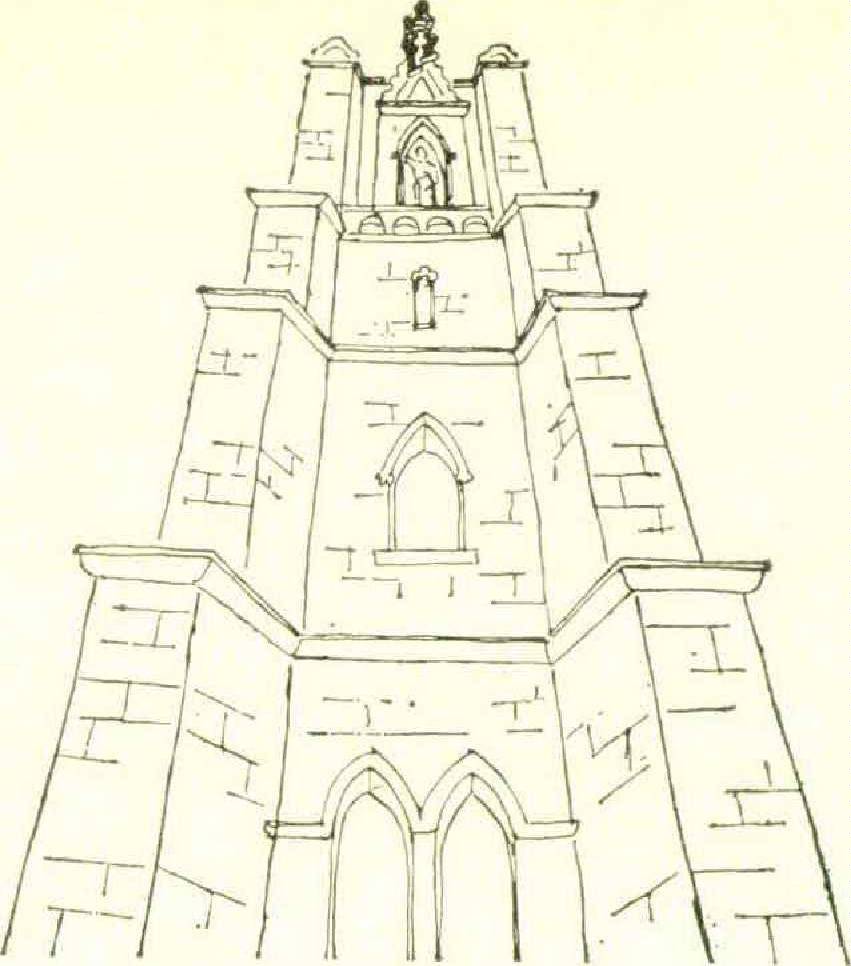
A Story by JEREMY KINGSTON
THIS is your crew?” Father Bodley said to Father Palgrave. They were standing outside the chapel door watching the boys hurry in for Benediction.
Father Palgrave gently pressed the palms of his hands together.
“Stop that!” Father Bodley said to a boy who had rubbed a foot against the edge of the grass verge. “Keep to the path, boy!” The boy, who was about eight years old, glanced timidly at the Father and hurried into the chapel.
“I have hopes for O’Meara,” said Father Palgrave. “He seems to have a natural piety.”
Father Bodley listened to the scuffling of the preparatory school boys out of sight on the terrace below. They were fighting, he supposed, and treading on the grass. As they climbed the steps to the chapel lawn and came into view of the two Fathers, they smoothed back their ruffled hair and began to walk dutifully two by two. Little evidence of natural piety there.
“Yes,” said Father Palgrave. “With careful guidance, I think we can make a priest of him. And God willing,” he added.
A small stone fell from somewhere on the tower above them and bounced off the bald oval on Father Bodley’s head. He looked up immediately. Surely no boy — ! Surely none would dare — ! He stepped into the porch to make certain the door to the tower steps was locked, and then returned to Father Palgrave, rubbing the top of his head.
“And your boys?” Father Palgrave asked. “Early days, I know.”
“Stop that!” said Father Bodley. A small boy with a smut on his cheek quickly swerved off the grass and hurried past. “Natural hooligans,” Father Bodley said. “But give me time.”
The last of the boys climbed the steps from the terrace. Father Palgrave clapped his hands. “Come along!” Father Bodley called. He held his arm up in front of his face and looked across his wristwatch at the now scampering laggards. He swiped at the last one as he passed by, and then preceded Father Palgrave into the porch. He tried the handle of the tower door again, but it was still fast. Father Palgrave overtook him at the inner door and stood waiting by the painting of the Last Judgment while Father Bodley closed the door and straightened the purple curtains. Father Bodley gave another gentle rub to the top of his head and accompanied Father Palgrave up the aisle. Father Mavrodacci entered the chapel at the north door, and Benediction began.
The corridors and classrooms and playing fields of Oakhill College and St. Ignatius Loyola Preparatory School for Boys were quiet for half an hour. Blades of grass on the grass verges straightened themselves. Dust settled on the wooden seats and desk lids. The blue-black ink on the nibs of the pens dried swiftly, the film across the slit thinning and at last parting with a faint pop. Another small stone dropped from the tower and bounced harmlessly on the gravel path.
When the final praise had been uttered and repeated and the closing prayers intoned, the boys stood up, filed pew by pew into the aisles, and left the chapel for their classrooms. Father Bodley stood with Father Palgrave again at the outer door and watched them jumping down the steps and out of sight.
AT ONE end of the arched colonnade in the preparatory school, three eight-year-old boys were discussing miracles. In a niche of the stone column beside them stood a statue of St. Francis Xavier, and beneath it a conical green metal vase containing some marigolds and a double daisy. On the brick wall across the colonnade hung a painting of St. Ignatius Loyola Wounded at the Siege of Pampeluna. The conical vase below this was empty of flowers.
The first boy, whose elder brother was a monk and one of whose aunts was a nun, said, “God saved the choirboy who fell off the chapel tower, because his surplice held him up and he floated down.”
The second boy sniffed critically and pulled one of the marigolds out of St. Francis’ vase. Father Oblake, passing by at that moment with a bunch of white lilies, stared at him.
“What are you doing, boy?”
The boy hastily put the marigold back in the vase. “I’m sorry, Father,” he said.
“What did you think you were doing?”
The boy lowered his eyes. The other two boys turned their heads away. Father Oblake stared at them, stared at the green vase below St. Francis and then at the empty vase below St. Ignatius at the Siege of Pampeluna. He took the double daisy from St. Francis’ vase, walked across the colonnade and put it into St. Ignatius’ vase, looked around at the boys (motionless beside St. Francis), transferred the lilies to his other hand, and went on his way.
“It’s true, Francis,” said the third boy. His name was Stopforth. “That’s what happened.”
“What happened, then?” said Francis.
The boy whose aunt was a nun said, “He’d climbed to the top of the tower and fell over. But God saved him by making the wind blow his surplice out, and he came down like that, like a parachute.”
Francis said firmly, “I don’t believe it.”
“What do you mean, you don’t believe it? Don’t you believe in God?”
“When did this happen? What was the choirboy’s name? Who saw it?”
“Hey — listen,” the first boy called to two other boys walking in the colonnade. “Francis says he doesn’t believe in God!”
Francis raised his voice. “I said —”
“What’s that? What’s that?” Father Bodley had come striding down upon them. “Little boy, come here! You”—he regarded the others — “why aren’t you at the playing fields?” The boys scattered. Father Bodley looked at Francis.
“What I said, Father, was I didn’t believe God saved the choirboy when he fell off —”
“You know it’s a sin not to believe in God?”
“Yes, I know, Father.”
“You know it’s a mortal sin? You know what a mortal sin is? Did our own St. Francis Xavier deny God? Did St. Francis of Assisi? Did St. Francis de Sales? Better men than you.”
“Father —”
Father Bodley’s cheek twitched. “Go to the chapel,” he said, “recite two decades of the Holy Rosary calling to mind the Prayer and Agony of our Blessed Savior in the Garden and the Scourging of our Blessed Lord at the Pillar.”
“Father.”
The boy turned and walked away along the arched colonnade. Father Bodley watched him, realized he was walking in the wrong direction, and strode after him. As soon as the boy was at arm’s length, Father Bodley stretched out his right arm and placed his fingers and thumb on the boy s head. He took hold of the scalp and hair and firmly directed the boy through a half revolution until he was facing the opposite way.
“I have to go to the playing fields, Father,” said the boy.
“Now,” said Father Bodley, “we are going to the chapel.” And he accompanied the boy back along the colonnade, across a corridor, down four steps to the hall, and out to the main drive of the preparatory school. Still with his hand firmly on the boy’s head, Father Bodley turned a sharp right, pushed the boy away from his side, again to a full arm’s length, and walked with him along the first terrace.
The boy said, “What I mean is, Father, did God actually send a puff of wind just to save the choirboy from killing himself?”
“What’s that?” said Father Bodley.
“I mean, was he a saint? Were you there when it happened, Father?”
The boy moved his head suddenly and looked up at the tower they were passing. Father Bodley straightened the boy’s head, but he looked up at the tower himself. He thought: When what happened?
“Because it must be two hundred feet high, and it would be a miracle, wouldn’t it, like at Lourdes or Fatima or the loaves and fishes.”
“A hundred and forty feet,” said Father Bodley, conditioned to correcting error. Why was the boy talking of saints and miracles? And what had choirboys to do with it? And the tower? Father Bodley became uneasy. Had he acted hastily?
“Do you doubt God?” he asked.
“No, of course not, Father,” said the boy.
I have acted hastily, thought Father Bodley. There is no need for me to keep my hand on his head. I am not a blind peddler to be led by an urchin! He took advantage of the steepness of the last flight of steps to remove his hand; and to still those doubts concerning his wisdom in rebuking the boy, he said,
“Trust in God, child, and in me.”
The boy noted the change in address from “boy” to “child,” but since he did not know Father Bodley was concerning himself with his own doubts and not with this matter of the choirboy, he felt the reply was unsatisfactory. Fie did not ask another question.
IN THE chapel the boy Francis obediently recited the twenty Hail Marys. It took him just over three minutes, but he knew he could not appear at the playing fields for at least another quarter of an hour or he would be criticized for gabbling his duty. He stared at the statue of the Assumption of the Blessed Virgin beside which Father Bodley had left him, and read the writing on the placard below it.
transgressions of thy servants;
that we, who by our own deeds are
unable to please thee, may be
saved by the intercession of the
Mother of thy Son our Lord.
Father Oblake, walking down the central aisle with a vase of dying lilies, glanced at the boy as if he had seen him before somewhere and passed on out of the chapel.
Francis stood up from his pew and walked to the next statue, which was of Christ. Christ was shown wearing a long crimson cloak and holding between the forefinger and thumb of his right hand a cushiony stuffed heart made of scarlet velvet. Next to the statue of Christ stood a statue of St. Francis Xavier Preaching in Japan, and it was probably while the boy was walking toward this statue that the thought which had been seeking expression for some time finally emerged into consciousness. It had perhaps been in his mind ever since he stood beside the other statue of St. Francis in the arched colonnade. The only obstructions to the manifestation of this thought in the form of action were, Where could he find a choirboy’s surplice? and How could he get up the tower?
The dying lilies that had been on the altar at Benediction had now been replaced by fresh ones. Father Oblake had carried all the old ones away and would presumably not return to the chapel for some time. Francis walked across the chapel (genuflecting dutifully at the center aisle) and knocked at the north door in case Father Mavrodacci was still on the other side of it. Nobody answered his knock, so Francis opened the door and went into the room.
He was surprised to find it so bare of furniture. Only a wooden bureau, a table, and a line of deep cupboards. A crucifix hung above the door, a bowl of holy water was screwed to one side of it, and a number of keys hung from a wooden board. The label of the first key he looked at was marked Tower Door, and the second cupboard he opened contained the small cassocks and surplices of the altar boys.
Francis wondered if it was sinful to wear a cassock and surplice if one was not going to serve at the altar. Before putting the garments on he made a sign of the cross as an indication that his intentions were honorable. Having straightened the folds of the lace under his arms, he made a second sign of the cross, walked back into the chapel, looked around for Father Oblake, genuflected, and made his way to the porch. The door to the tower unlocked easily, and after making yet another sign of the cross, he began the climb up the spiral staircase to the top.
FATHER PALGRAVE was showing the boys in His class how broad beans could be seen to sprout root and stem in a jam jar filled with blotting paper and damp sand. As he set the jam jar back in its place on the windowsill, he happened to look up at the chapel tower and saw a figure standing by one of the pepper-pot turrets at the top. Assuming the figure to be that of a workman, he turned back to his class and proceeded to show them how, no matter which way around the bean was placed in the jam jar or in the earth, the root always grew down and the stem always grew up. The class noted the fact with interest, and Father Palgrave took the jam jars back to the windowsill. Glancing up at the tower again, he was this time astonished to see that the figure at the top was obviously wearing the surplice of an altar boy and appeared — Father Palgrave’s eyes widened — to be dancing. There could be no doubt of it; the figure was jumping up and down and holding his cassock out like a skirt.
Father Palgrave turned from the window, told his boys to draw a broad bean, warned them to be quiet while he was away, and left the room. He looked out of the round window halfway down the stairs in time to see the boy — it was a boy, he supposed — push his head and shoulders through one of the circular embrasures of the parapet and peer down at the wall of carved stone falling perpendicularly below him.
Father Palgrave was a cautious, naturally gentle man; crises agitated him, and he tended to vomit afterward. Sweat broke out on his hands as he ran down the rest of the stairs and into the drive, but his principal emotion at this moment was anger. As he drew near to the chapel he decided to conceal from the boy the fact that he had been observed. He slowed his pace to that of a walk. But he was anxious to see if the boy was still at the dangerous edge of the tower, so he took out his handkerchief and held it in front of his face. In the course of Hurrying it around his nose, he glanced quickly upward. The boy could just be seen, peering down at him from beside one of the pepper pots. Father Palgrave put his handkerchief away, climbed the last flight of steps, and saw Father Oblake walking ahead of him to the chapel door.
Father Oblake carried a flat basket filled with marigolds.
“Someone is on top of the tower,” said Father Palgrave, “An altar boy.”
“An altar boy,” Father Oblake echoed feebly.
“He is dancing,” said Father Palgrave, “and he is pushing his head through the stone circles.”
He pushed Father Oblake away and stepped toward the door to the tower. As he did so, the boy whose elder brother was a monk and one of whose aunts was a nun entered through the outer door. Both Fathers started at his sudden appearance, and Father Palgrave hesitated with his foot on the first step.
“Good afternoon, Father,” the boy said to Father Oblake. “Good afternoon, Father,” to Father Palgrave.
The two Fathers looked at him, at each other, and back again to the boy as he walked toward them.
“Father Bodley,” said the boy, “sent a boy to the chapel to recite two decades of the Holy Rosary and sent me to find him. Have you seen him, Father?” He had looked from one to the other of them while speaking, but he addressed his question to Father Oblake.
“What is your name?” asked Father Oblake.
“Donovan, Father,” said the boy. “My brother is Brother Donovan.”
Father Palgrave interrupted impatiently. “Find out how that boy got hold of his cassock. And see if anything else is missing. Candles. I don’t know.”
Father Oblake’s mouth opened. Fearful thoughts of a sacrilege being committed at that moment on the top of the tower assailed his mind. Now he recognized the boy in front of him as having been one of the group standing in the arched colonnade. With that he remembered that the boy he had seen in the chapel — and who was presumably now on the tower — was the one who had pulled out the marigold from the vase below the statue of St. Francis. “Not that!” he cried, his fears for a sacrilege reinforced. He hurried into the chapel and made for the north door.
“What is this boy’s name?” Father Palgrave asked.
“Has he climbed the tower, Father?”
“I asked for his name,” snapped Father Palgrave .
“Morfey, Father. Francis Morfey.”
“Thank you, Donovan,” said Father Palgrave, and turned again to the tower steps.
“Father — if he’s gone up to the top, he might be going to jump off. Father.”
“What?” said Father Palgrave. He came down the steps again. “Why might he?”
“He might be,” Donovan said.
Father Palgrave stared at him. “Go and tell Father Bodley,” he said, and was gone, climbing the steps of the tower two at a time.
Donovan left the porch and walked backward from it looking up at the narrow yellow cliff face of the tower. Sure enough, Francis Morfey was there at the top, wearing a cassock and surplice, crouched now on the outer side of the parapet. His right hand clutched the edge of a stone circle, and his left arm was pressed against the pepper-pot turret at the corner.
“Francis!” Donovan called. “Francis!”
Francis looked down.
“Father Bodley says you’re to—” Donovan stopped. He had intended to say “come down at once!” but found he could not utter the words. If Francis jumped and God did not work a miracle, he, Donovan, would be blamed for sure. Stopforth would say the three of them had talked about the matter in the colonnade, and Father Bodley would say — Donovan did not dare to think what Father Bodley would say. He turned and ran down the steps and ran all the way to the playing fields.
Father Oblake came out of the chapel and looked up at the tower. When he saw the boy crouched on one of the ledges at the top, he gasped in horror. He stationed himself directly beneath the boy, as if to catch him in his arms should he fall.
“Help!” he cried. “Help! Help!”
FATHER PALGRAVE was now climbing the last spiral staircase that would bring him out to the tower roof. His intention was to surprise the boy by his sudden appearance and grab hold of him before he tried to climb onto the parapet. He did not know that Francis had already climbed over it and was staring thoughtfully at the distant ground. “Surprise,” Father Palgrave muttered. “Surprise is of the essence.” And he held his handkerchief once again to his face to muffle the sound of his panting breath.
He climbed the last turn of the spiral and paused by the small door to recover a little of his composure. He then jumped up the last two steps, flung himself through the door (in the southeast pepper pot), and found himself alone on the roof. After a moment of astonishment he looked over the south edge of the parapet, then over the east edge, turned, and saw the boy at the other side of the west parapet, looking at him through a stone circle.
Francis had not yet jumped because he was waiting for a gust of wind. If God intended to work a miracle through him, he wanted God to have the material to hand. He was prepared to stay where he was for the time being, but when he heard Father Palgrave fling himself onto the roof, he knew that he was not prepared to be dragged back over the parapet and taken downstairs. After he had floated to the ground the Fathers might or might not punish him. If he were taken beforehand, punishment would be inevitable.
He started to climb down the carvings below the parapet.
Afterward, Father Palgrave declared himself unwilling to discuss the emotions that had filled him on seeing the boy’s head suddenly disappear from view. His intention had been to seize the boy harshly and speak to him with all the anger he could command. Disobedience, theft, possibly sacrilege, trespassing, egotism, and pride were offenses that immediately came to his mind as he pounded up the stairs. Not to mention scaring the wits out of his superiors. But when the boy’s head sank in front of his eyes, fear bordering upon nausea possessed him.
“My child!” he cried, “child!” and ran to where Francis had been.
Francis cautiously felt his way downward and sideways across two ledges and found himself at the edge of the tower below the pepper pot. He presumed that the side of the tower around the corner was much the same as the side he was clinging to, and since his spread-eagle position against the stone was impossible to maintain, he began to climb farther down.
Father Palgrave watched him silently and thanked God that the chapel’s often-abused architect (dead these fifty years) had cluttered his work with so much fussy detail.
Francis climbed down the carved bosses below the pepper pot as down the broken stumps of the lower branches of a fir tree. At last he found himself perched on a narrow saddle-shaped piece of stone, with his face pressed against the corner of the tower and the short spike of the saddle pressing against his buttocks. Realizing it would be difficult to jump from such a position, he brought his legs up to the saddle again, shuffled around, and sat down once more, facing the other way. The spike was now at his front, and he gripped it firmly as if it were a saddle’s pommel. He stared at the view.
Father Palgrave licked his dry lips and leaned over the parapet.
“What are you doing?” he said.
Francis looked up. “I have to jump off, Father, because God wants to work a miracle through me and make me float down to the ground.”
“Not at all,” said Father Palgrave. “Come up here at once.”
“I don’t think I can,” said Francis.
“Come back at once,” Father Palgrave repeated.
“I don’t think it’s possible, Father,” said Francis.
“You climbed down; you can climb up. Climb up.”
“I don’t think I can,” said Francis.
Father Palgrave looked down at the boy eight feet below him and wondered indeed if it was possible. “I will give you a hand,” he said. He crouched down on the roof and pushed his right arm through the nearest stone circle. But now he could not see how close he was to the boy, so he withdrew his arm and stood up again.
“Your hand was a long way away,” said Francis when Father Palgrave looked over the parapet.
Father Palgrave tried a second time. He lay down flat on the roof at right angles to the parapet and pushed both arms through the stone circle as far as they would go. Finding he could not now bend either arm downward unless he stood on his head, he withdrew his left arm and was able then to bend his right arm down at the elbow.
“I still can’t touch you,” said Francis.
Father Palgrave stood up and brushed the dust from his soutane. He wondered what to do next. To his left at the bottom of the hill were the first houses and shops of the town. Farther away, the three tall chimneys of the factory stood outlined against the distant hills and sky. Somewhere in that area there would be fire engines with extension ladders, ordinary ladders, decorators’ cradles. In the school itself there might be some rope. A sound he had been hearing for some time on the periphery of consciousness identified itself as being Father Oblake’s intermittent but frequent cries for help. Father Palgrave looked down over the parapet and saw that considerable activity was taking place below. Half a dozen boys had gathered at the foot of the tower and were staring up. Others were hurrying to the college buildings, and many more were arriving from the preparatory school. Bounding up the final flight of steps to the chapel came a soutaned figure immediately recognizable as Father Bodley. Behind him came a mob of small boys, many of them in football shorts and boots.
Father Bodley arrived at the foot of the tower and said to Father Oblake, “Is that Father Palgrave?”
Father Oblake nodded. Droplets of sweat were collecting beside his eyes and trickling down his checks.
Father Bodley bent his neck back. “Father Palgrave!” he called.
Father Palgrave leaned farther over the parapet. “Yes?” he said.
“Can you reach him?” called Father Bodley.
“No,” said Father Palgrave.
“Father,” said Francis.
“Yes?” said Father Palgrave.
“I don’t think God wanted it to be a public miracle.”
“How do you know?”
The boy thought. “I don’t know,” he said at last. “But He didn’t say anything about doing it in front of a lot of people.”
Father Palgrave considered how best to reply to this. “What did He say?” he asked.
“He just said I was to come up here and jump off, and He would send a puff of wind to float me to the ground.”
“Father Palgrave?” called Father Bodley from below.
“What is it?” called Father Palgrave.
“What are you doing?”
“Because,” said Francis after more thought, “if He does want it to be a public miracle, perhaps I should wait till there are more people watching.”
“That is a good idea,” said Father Palgrave firmly. “Yes. Wait there. Stay where you are.”
“How will I know when He wants me to jump?”
Sweat broke out once more upon Father Palgrave’s hands.
At the foot of the tower Father Bodley had sent some boys to find a blanket, others to find the Father Rector if he had not yet been found; and he was asking for rope.
“Is there one in the potting sheds?” he asked Father Oblake.
“I don’t know!” said Father Oblake. A dazed look had come into his eyes. “Perhaps. There might be. I don’t know! Perhaps.”
Father Bodley sent half a dozen boys to the potting sheds. “If there’s no rope there,” he said, “we shall have to cut one down from the gymnasium.”
Small pieces of stone and grit were falling down the tower from where Francis was sitting.
“I don’t like the look of that,” said Father Bodley.
Francis, though he did not know it, was sitting on top of the pointed canopy of a six-foot statue of Our Lady Queen of Heaven. A statue stood beneath each of the corner pepper pots of the tower in a deep niche. Francis’ feet were resting on the crown above her head,
“Those carvings aren’t meant for that,” Father Oblake complained. “For the weight of a starling, perhaps, for a starling’s nest, but for —”
Father Bodley cut him short. “I am going up to Father Palgrave.” He addressed the boys nearby. “Does anyone know why he’s up there?”
“He’s trying to speak to Morfey,” said Donovan.
“Oh! Oh! Why Morfey is up there!” said Father Bodley crossly. “Obviously I know why Father Palgrave is there.”
“He might have been going to jump off,” said Stopforth. “To see if God would save him.”
Father Bodley stared at Stopforth.
“Merciful Heaven!” said Father Oblake.
Donovan stared intently at the ground.
More pellets of stone fell down the tower.
THE Father Rector sat in his room rereading the life of St. Jerome, a man whose erudition and occasional wit always delighted him. After the dream in which he had cried out, “Lord, if ever I touch profane books again, 1 shall have denied thee!” St. Jerome, that classical scholar, avoided reading them for many years. Twenty-five years later, however, not only was he reading them but teaching them and having others copied at a high price. When reproached by Rufinus, St. Jerome retorted that if we arc to go by dreams, he had had plenty. “I have assuaged my thirst with the ocean, but on waking I have still been thirsty.” The Father Rector chuckled to himself and said “Come in!” to a knock at the door.
“Please, Father Rector,” said a boy in football shorts, “Francis Morfey has climbed up the chapel tower and Father Bodley says please will you come.”
“Cannot Father Bodley bring him down by himself?” inquired the Father Rector.
“Please, Father Rector, he’s climbed over the top of the tower, and he’s sitting on one of the statues.”
For the instant of a second the Father Rector pictured Father Bodley clinging to the wall of the tower like a black fly. Then the picture was replaced by one of a small boy crouched against the carvings and whimpering for help.
“Very well,” he said. “I am coming.”
Father Bodley had by this time joined Father Palgrave at the top of the tower and was in conversation with Francis.
“I said my two decades of the Holy Rosary, Father, and I was about to say an extra prayer in front of the statue of St. Francis Xavier when God spoke to me and said —”
“What makes you think it was the voice of God?” asked Father Bodley.
“I was in the chapel, Father! The Devil wouldn’t be able to speak to me in the chapel!”
“The Devil speaks to us all the time, child. Now come back up here.”
“He can’t,” said Father Palgrave.
“Can’t you?” asked Father Bodley.
“No,” said Francis.
Father Bodley said to Father Palgrave, “I have sent some boys for a blanket. When they arrive the danger will be over.”
“Will they know how to hold it?”
“Father Oblake will show them.”
“Do you think?”
Father Bodley drummed his fingers on the edge of the parapet.
“Father?” Francis said. Father Bodley and Father Palgrave leaned over the edge of the parapet.
“Yes?” they said.
“Father, how do you know it was the voice of the Devil that spoke to me?”
“Because that is how the Devil works,” said Father Bodley. “Would God, who loves you like a father, tell you to come up here and kill yourself by jumping over?”
“But He was going to save me, Father. That’s why He told me to put on this cassock, so He could open it out like a parachute, and I would float down under His special care.”
“That’s exactly what the Devil would tell you. That’s his style of approach exactly.”
“But if it was the voice of God, Father — and I had just said two decades of the Holy Rosary, so I was in a state of grace — I would be disobeying Him if I didn’t jump off. Wouldn’t I, Father?”
Father Bodley gritted his teeth. “Francis,” he said. “Now listen carefully—”
Father Palgrave said, “You’re not going to instruct him in apologetics when he might fall to his death any second!”
“When else should I do it?” retorted Father Bodley.
Francis said, “What shall I do, Father, if this stone I’m sitting on breaks?”
“What?” said the Fathers.
“Because it is breaking.”
“Pray,” said Father Bodley. “We will all pray. Pray,” he said to Father Palgrave.
“I’m praying, Father,” said Francis.
“We are all praying,” said Father Bodley.
A few moments later Francis said, “It seems to have stopped breaking.”
“God has heard our prayers,” said Father Palgrave. Father Bodley glared at him irritably.
“God told me to move myself a certain way, and when I did the stone stopped cracking.”
Father Bodley knew where this line of reasoning would end. He leaned over the parapet and called out in a loud voice, “Stand clear down there!” The audience below retreated from the foot of the tower at once, even Father Oblake. Father Bodley saw that a blanket was being brought from the college; and could that be the Father Rector hurrying behind?
Francis spoke again. “I think God must have saved me from slipping off because he wants me to jump. Don’t you think, Father?”
Father Bodley did not reply. He was silently urging the boys with the blanket to hurry.
“They’re bringing a blanket!” Francis said suddenly. “They don’t trust God! Father, why aren’t they trusting in God?”
“We all trust in God,” said Father Bodley.
“But if they bring a blanket, God might not want to work the miracle because everyone won’t be trusting in Him!”
“Say something,” said Father Bodley to Father Palgrave.
“What shall I say?” said Father Palgrave.
Before he could think of anything, Francis said, “God has just told me that when I float down, the wind will carry me some distance away, and so the blanket won’t be under me when I touch down.”
“Is that possible?” Father Palgrave asked Father Bodley.
“How can I tell!” said Father Bodley. “I have no idea at all!”
THE Father Rector had now arrived at the chapel. He considered the scene at the top of the tower, ordered the small boys holding out the blanket to be replaced by eight stalwart monitors from the college, and went into the porch with the head monitor to climb the tower.
While they were climbing, a piece of the canopy on which Francis was sitting broke under its unaccustomed weight and plunged down. It fell smack into the center of the blanket and bounced several times. The boys cheered.
Halfway up the tower the Father Rector was pausing for breath. He was sixty-two and had never climbed the tower before. “What are they cheering?” he asked. “Because if he has come down, we need not go up.”
The head monitor squinted through a narrow window, “They’re still looking up at the top,” he said.
“Then we shall have to go on,” said the Father Rector, and did so.
Francis was finding his position athwart the much reduced saddle difficult to maintain. “But I can’t jump yet, Father, because I must wait for God to tell me when.”
“I will tell you when,” said Father Bodley. Now that the blanket had arrived he wanted the whole business over as quickly as possible. “Ready? Get steady. Jump!”
Francis didn’t jump. “There’s no wind,” he said.
“God will provide,” said Father Palgrave, adding, “there is a little breeze up here.” The strain was beginning to tell on him.
“I do wish they’d take the blanket away,” said Francis. “It’s working against my perfect trust.”
The situation had arrived at this point when the Father Rector, panting quite a lot, and the head monitor, panting rather less, arrived at the roof of the tower. The Father Rector looked over the parapet, and the boys below, impressed by his speed, cheered. The noise was suppressed by Father Oblake and Father Mavrodacci.
“Well, Francis,” said the Father Rector, “I am glad you are still here. I would not have liked to climb all this way to no purpose.”
Francis wobbled awkwardly on his saddle as he looked up at him. “I didn’t want all this attention, Father Rector,” he said. He explained what he was doing.
“But why are you still up here?” asked the Father Rector. “Why aren’t you now on the ground again? I mean, what delays you?”
Francis explained that since the blanket had been spread below to catch him, God had stopped speaking. “I don’t know whether to wait for Him to speak again, Father Rector, or not.”
“He does not always speak to us in a voice at once recognizable as His.”
“Father Bodley made me wonder if it was the Devil who spoke to me. But I don’t see how that could be because it was in the chapel I first heard him.”
“The Devil, alas, can speak to us even there,” said the Father Rector. “Though whether it was he who spoke to you in this case” —he smiled at Father Bodley and then looked down to Francis again— “neither Father Bodley nor I would be able to say with certainty.”
“Then why has He stopped speaking to me, Father Rector? I thought He would tell me when to jump.”
The Father Rector looked meditatively at the boy. “Possibly He no longer needs to speak to you about this matter. He speaks to us in His wisdom from His own time. But we have to obey Him in our time.”
Francis stared at the boys gathered around the blanket below. He looked at the buildings of his school to the left, the playing fields, the town spreading from the foot of the hill. Above him, Father Bodley, the Father Rector, Father Palgrave, and the head monitor leaned on the parapet, watching.
“He expresses Himself to us in all manner of ways,” the Father Rector continued. “All the time. He urges us to do one thing and not another. He helps us to do one thing and not another. But our deeds are our own to perform.”
“Then I could jump in my own time,” said Francis. “When I want to.”
“Why, yes, my son.”
Francis thought for a moment. “I will jump when I have counted to three,” he said. He counted, to himself, to three and jumped.
One of the senior boys had calculated that the fall, at thirty-two feet per second per second, should take rather less than two and a half seconds. The fall by his stopwatch took fractionally longer, and he attributed this to the resistance offered by the boy’s cassock and surplice. Francis fell into the center of the blanket. He was pounced upon by Father Oblake and carried into the porch to await the Father Rector. The rest of the school crowded by the chapel door.
The four at the top of the tower watched his descent attentively.
“Like a stone,” said the Father Rector, “I am relieved to see. He will blame the presence of the blanket for that,” he said to Father Bodley, “and reproach us.”
“He ought to thank us he’s alive!” Father Bodley burst out.
“Well, yes. And we must be thankful there was no strong wind. If he had floated —He raised his eyebrows and lowered them again. “Reproach we can bear, I think, but a happening that looks like a miracle—!”
Father Palgrave was vomiting in the northwest corner.
“When Father Palgrave is ready, we can begin the descent, perhaps.”