Exercise in Slow Motion
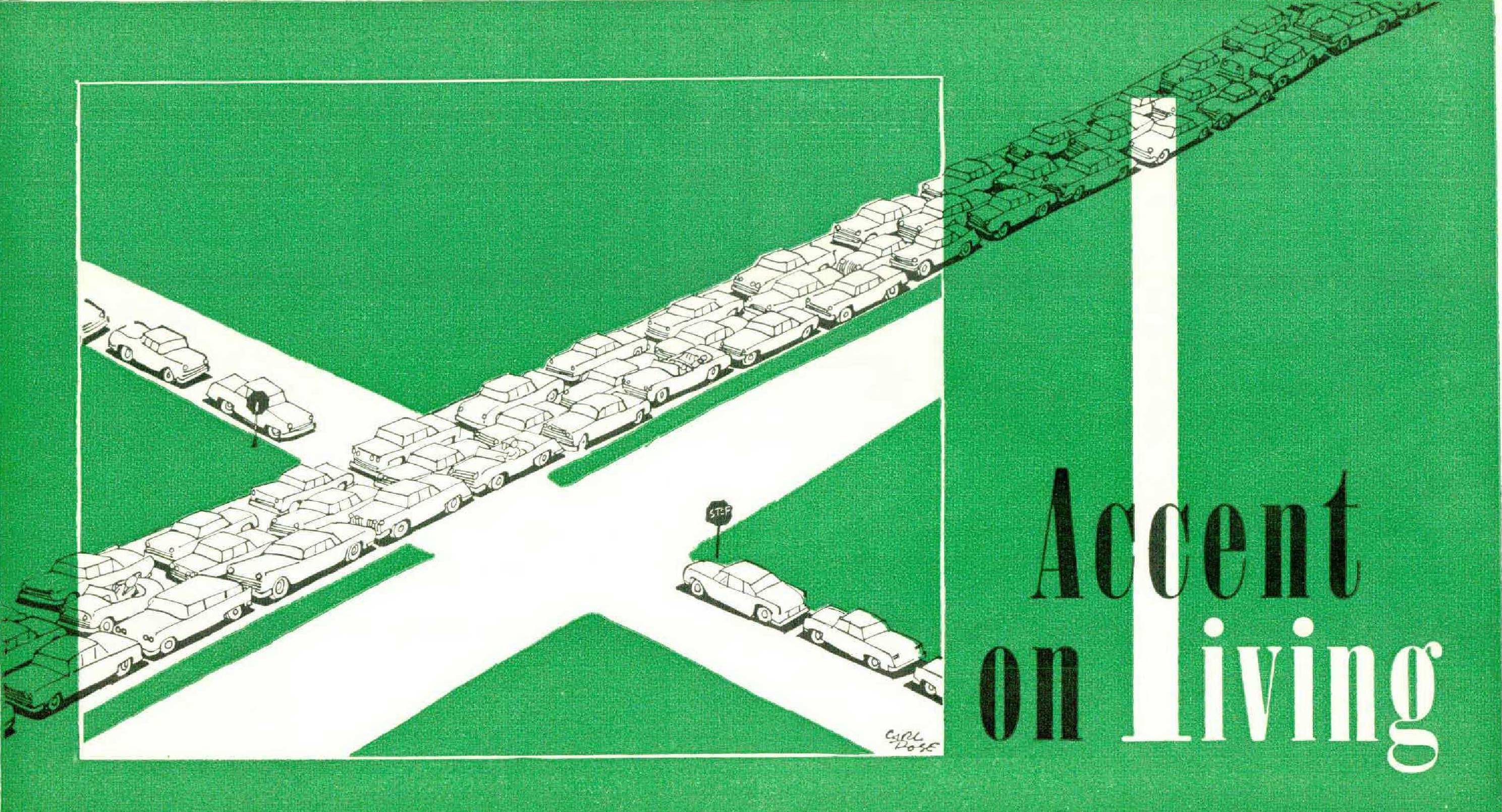
Big roads beget big traffic. Big traffic begets big jams. How far can a traffic jam reach?
As one who has been able to avoid weekend driving on big roads (either by staying home or traveling on little roads), I realize my data may be incomplete, but I had good local opinion, on a Sunday afternoon, to support the belief that the jam we were looking at was some seventyfive miles long. It could have been longer, for it extended on the NewYork-bound side of the big road as far as one could see in both directions, and the point from which we surveyed it was seventy-five miles from Manhattan. We were fiftyseven miles from the Tappan Zee Bridge, whose tollbooths, our host said, were causing the jam, but he felt that the remaining distance to the city was probably equally congested. Even a fifty-seven-mile jam, especially on a road that boasts it offers “no services for motorists,” can be a bit tedious, and it was inevitable that the traffic would be increased by tributary roads on its way to Tappan Zee.
Our first encounter with the jam came when our host tried to intersect it a few miles beyond Middletown. The outbound side of the road was all but unused, but the lanes leading to the city were packed with slowly moving cars, none of which was willing to risk its precious five mph while letting an outsider cross through.
Our host is a resourceful man. “Let me show you how this can be done,” he said. He turned his car around, branched off on a small road, and came back to the big road once again at a point three or four miles farther away from Tappan Zee. “They won’t let anyone through,” he explained, “but they’ll let me join the parade.” This proved to be so. With polite gestures from both parties, a car slowed sufficiently to let us into the right lane, and by similarly polite exchanges, we eased into the extreme left lane and turned painlessly into the road we had vainly sought to reach only a few minutes earlier.
It was about two hours later when we crossed the big jam again on our way back to Middletown. This time we took still another small byway which eased us to the other side of the jam via an overpass. Since there was no traffic at all on the small road, we stopped on the overpass and got out to survey the jam.
The pace had slowed, and the cars, still filling the big road, were barely moving. Seen from above, they showed a remarkable uniformity in keeping exactly the same distance behind the car ahead — between three and four feet, I judged — with all the precision of a military exercise. No horn sounded, and the slight downgrade at this point made exhaust and engine noise unnecessary, so that the hush that hung over the whole scene, out in this rural countryside, was somehow more shocking than a cacophony would have been. Here were the holiday-makers on their way home; how long they would be spending on the big road with “no services” was anybody’s guess.
I have never seen one of those ribbonlike migrations of ants in the jungle, but the image came to mind as we watched the endless lines of creeping cars, all bent on the same objective, silent, intense, and slow. It was plain that these people — two to a car, for the most part — had rejected altogether any use of public transportation; yet one doubted the continuing feasibility of the private vehicle when so many individualists set out at the same time for the same destination.
A recent hot-day venture — a Saturday morning — on Boston’s Southeast Expressway became a wild series of sprints and slowdowns and stops. A single bad tire could throw the whole exodus into a turmoil: vapor locks, lane-changers, the overloaded station wagons with no rear visibility, and a heavy admixture of luckless travelers from distant parts who had been led to believe that they would be making better time on the big roads. A single traffic circle at the Bourne Bridge over the Cape Cod Canal causes eight-mile jams on a busy day. A Boston Globe headline is revelatory: “Xway Load Twice Official Estimate for ‘70.”
The tranquillity of the back roads, the small, twisting, rolling, and often poorly surfaced old-style routes between Boston and Cape Cod, is hardly believable, yet there they are, sparsely traveled, while the fireworks are going off on the big highways. There are still farms and farmhouses, market gardens, flowers, trees, and human beings to be seen along the roads, and every so often even a little town, complete with meetinghouse, shops, and perfectly real “services for motorists.”