Closing the Game Gap
C. MICHAEL CURTIS is a member of the ATLANTIC’S editorial staff and an occasional contributor to these pages.
A man in Arizona has decided that Americans should be playing a new game called Victory Over Communism. It is described by its creator, a Phoenix businessman, as “America’s first anti-Communist game for children and adults,” and is intended as the all-purpose birthday, Christmas, or graduation gift.
Victory Over Communism is played on a smallish cardboard rectangle bearing a map of the world —with twenty-five “slave” countries etched in red — and a timetable demonstrating that the world will be wholly Communistic by 1973, “the date set by most authorities on the subject of Communism, that the Communists will complete their goal of World Communism, if they are not stopped.”
The players roll dice and, accordingly, grapple with a set of questions designed to test their knowledge of the history and method of the international Communist conspiracy (for example: “Are Communists more interested in adults or children?”; “Are we as a nation and as individuals really in trouble because of the Communist conspiracy and internal infiltration of Communists in our country?”; “What president campaigned that he would ‘clean up the mess in Washington,’ but after elected actually made the job of uncovering security risks almost impossible?”). For the benefit of doubting Thomases, each question and answer is documented, with a page reference to John A. Stormer’s definitive work None Dare Call It Treason.
Correct answers enable each player to free one of the slave countries, and the object of the game is to free all twenty-five slave countries before the 1973 deadline is reached.
There is, clearly, much to be said for a board game that can help save this country from Communist infiltration, but one may ask if America should have only one “antiCommunist game for children and adults.”What have the other game manufacturers been up to, and how subtly have our children, for many generations, been betrayed by the callous indifference of playground instructors in every corner of this country?
No great imagination should be required to transform heretofore wasted playtime into a useful exercise in democratic indoctrination. Among the many possibilities are the following:
Monopoly: The first thing about Monopoly that ought to be changed is its name, which is unfortunately suggestive of an antiquated economic phenomenon now known only to public utilities. A better and more ideologically correct name would be Free Enterprise at Work. The place-names, venerable old Ventnor Avenue, Boardwalk, and the like, would be changed to the names of Communist satellites or underdeveloped nations. Initial stops at those countries would give the dice roller the opportunity to invest wisely in said country’s economic future, and the traditional houses and hotels could be replaced by simulated tin mines and sugar plantations. Anyone landing on another player’s property would have the opportunity to foment a palace revolution, or at least smuggle machine guns to disaffected trade unionists. As a penalty, a player could be misled by CIA intelligence reports, forced to return a shipment of Soviet cod, or represented at a conference of African nations by Senator Ellender of Louisiana.
Hide and Seek: One player is “it” — that is, acting chairman of a congressional subcommittee investigating un-American affairs. His chore will be to unearth Communist influences no matter how ingeniously they are hidden. His playmates, representing various aspects of American cultural, political, and social life, will hide as best they can. The player who is “it” will shut his eyes, then count aloud, one by one, the number of card-carrying Communists currently employed by the U.S. State Department (the number tends to vary from region to region). When the count is completed, the “seeker" will loudly announce “here I come, guilty or not,” and will commence his search. Each playmate as he is found will announce that he is an FBI informer and will outline the extent of Communist infiltration into his sector of national life. The game will not be up until every playmate is found.
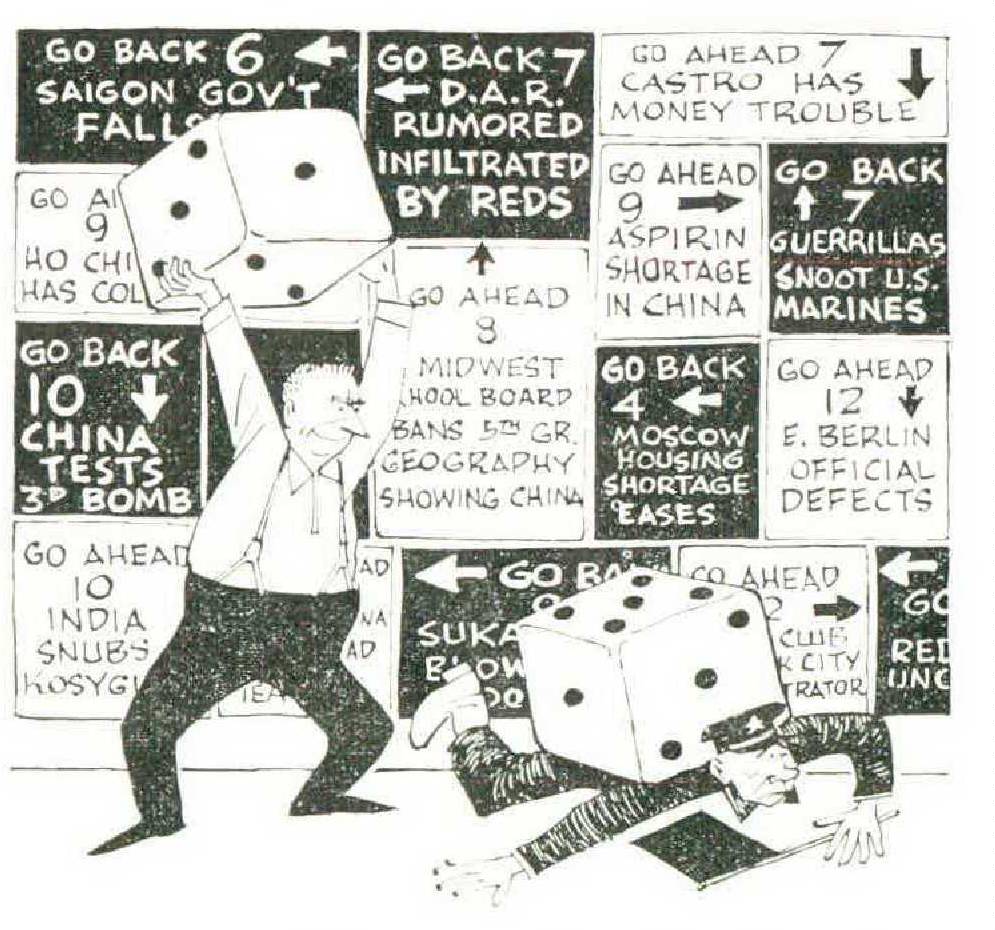
I Spy: The player who is “it” will announce that he is looking closely into Communist subversion of some American institution: high school libraries, university economics courses, church discussion groups, UNICEF, or what have you. At the announcement “I spy,” the remaining players will attempt to guess in what textbooks, novels, or other written material the discovery of Communist influence has been made. With each guess, whether in error or not, the book or publication nominated will be symbolically banned from subsequent distribution, on the grounds that the mere taint of suspicion is intolerable where the minds of our youth are concerned.
As each book is banned, the player rises higher in the antiCommunist hierarchy, from local school board member to sheriff to FBI agent and ultimately to partnership with Billy Hargis. When all books, save the John Birch Society Blue Book, have been removed from library shelves, the game is over.
Scavenger Hunt: With a slight shift in emphasis, Scavenger Hunt offers unusual opportunities in anti-Communism. The “leader,” who makes out assignments, forgoes the normal procedure of asking each player to return laden with odd objects. Instead, he supplies each player with specially prepared cards, reading “Don’t Buy Communist Hams,” “This Book Written by a Woollyheaded Left-wing Intellectual,” “Impeach Earl Warren.” “In Your Heart You Know It’s Only Halloween,” and so forth. The players are to place these cards where they will be most damaging to the Communist cause. The player whose cards arouse the most heated indignation from the pinko press is declared the winner and is invited to ghostwrite a newspaper column for Barry Goldwater.
The possibilities are limitless, and there is little apparent reason why patriotic Americans should stop short of shaping all social and recreational activities, from birth to grave, into occasions for ideological indoctrination. In this regard, the Russians and Chinese have shown themselves far more imaginative than Americans, creating what some political strategists have called “game gap,” It would surely be a pity if U.S. accomplishments in outer space, industrial technology, and political organization should fail because the Communists beat us to the Farcheesi board.