The Power and the Glory
ALAN COREN is assistant editor of PUNCH. This is his first appearance in the ATLANTIC.
Mr. Denis Healey, the Minister of Defense, promised today that Britain would not lose her world lead in the development of vertical-takeoff aircraft. — BBC NEWS
The other morning I was standing by the gas stove, ears tensed for the first fine, careless cackle of the percolator. watching the new day creep feebly up the sky with that curious, droopy grayness that characterizes February in London. The days, at this bleak time, never quite make it, never quite manage to look like anything but a dispirited pause between one night and the next. Buses loomed out of the dankness, shouldering the veils of drizzle aside rather in the manner of Akim Tamiroff pushing his way through the hanging beads of some Casablancan clip joint, and disappeared back into the sniveling gloom. Not, all things considered, a morning designed to render the waking heart delirious at the prospect of unknown delights to come; but one, nevertheless, sadly appropriate to the island over which it had chosen to break.
We live on the second floor (a rough translation into basic American would make it the third floor, give or take the odd vowel change), which puts us on an exact level with the upper decks of London buses. Since our flat fronts the road, this means that at any given breakfast brew-up, people pass slowly by, in groups of thirty, and watch me with emotionless eyes as I strive to keep the front of my pajamas closed; while I, in turn, stare back at them with the cool superiority of a man who in happier days might have been out chopping his way through Sikhs and Boers with terse Victorian purpose. These moments are about the only chance I have to show that breeding still counts, now that the Empire turns out to be something on which the sun never rises.
On this particular morning as we stood there, all thirty-one of us, I noticed for the first time a strange, unsettling sadness in the sixty alien eyes. They seemed to be looking to me for hope, for some mute sign that life was more than a tale told by an idiot; but before I could come up with a glance of comfort, a smile of faith, the bus moved on, and wobbling slightly, they vanished into the gloom. I was deeply moved. The look was a look I had seen before, over the past few months, on faces passing in the street, in eyes across a public bar, in the brave, unflinching gaze of friends and cops and grocers; it was a look which said, with all the terrible expressiveness of silence, “What is to become of us?”
I turned again to the percolator, which by this time seemed to be sobbing in sympathy with the general mood, and as I did so, I caught the wheeze of the bedroom radio plucking weakly at the ether; my wife was awake, and avid for news. In these post-lapsarian days since the Tories shuffled brokenly into the sunset, England has been gripped by a feverish need for information unmatched since VE Day. Each dawn, red eyes pop open all over the queendom, tiny, terrified stars in the overwhelming grayness, and wait for the eight o’clock news. In the preliminary silence, one seems to hear the creak of the economy and the occasional subterranean groan of the widening trade gap, like some glacier running between Land’s End and John o’Groats House and threatening to swallow us all. Then comes the Greenwich time signal, followed by a BBC voice intoning in old, noble accents the latest catalogue of horrors: the crash of stocks, the leaps of bank rate as it fights its way upstream, the rifts between and within political parties, the news that Britain has been bounced out of one more of the rooms in the fickle seraglio that is Europe today, stories of industrial dispute and international embarrassment, of crop failure and metal fatigue — the list seems endless. And after it all, at ten minutes past eight, we drag ourselves from our beds with all too evident third-rate power, and crawl away to work with the aforementioned look in our hundred million eyes.
To return to specifics —I sloshed the coffee into a brace of Coronation mugs, and, my upper lip a ridge of steel, padded into the bedroom to shore up my wife’s wilting spirits with a lew well-chosen words about the unconquerable will and study of revenge and similar snippets culled from our immortal heritage. She lay palely between the sheets, like one whose life has been frittered away on overattention to camellias, listening to the newscaster reel off reports of motions of censure on the government, the wasting sickness of our gold reserves, the current protest march of aircraft workers, the latest lurch in the cost-of-living index, and other gobbets calculated to stick in the most optimistic craw. As the minutes flashed by, loaded to the gunwales with disaster, our commingled gloom deepened to a rich ebony, and I was on the point of hurling the radio through the window, in the hope, perhaps, of felling a passing Volkswagen (a distinct statistical possibility), when the announcer paused suddenly, caught his breath, and said, “Mr. Denis Healey, the Minister of Defense, promised today that Britain would not lose her world lead in the development. of vertical-takeoff aircraft.”
There might have been more news after that, but we didn’t hear it. My wife sat bolt upright in bed, the color hurtling through her cheeks, her eyes uncannily bright, and clutched at my arm with that reserve of energy normally associated with drowning men in the presence of a sudden boathook.
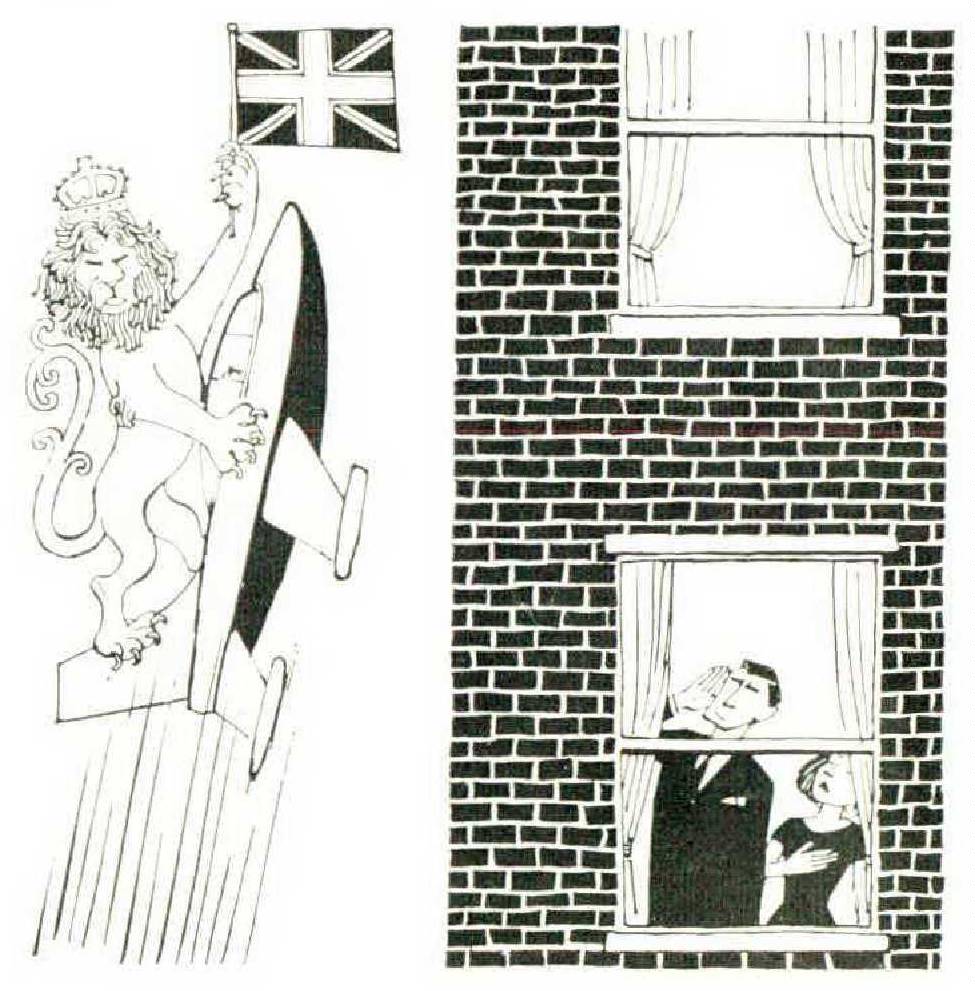
“Can it be true?” she whispered.
I bit my lip. I clenched my teeth, I counted to three. “It has to be true,” I said.
“A world lead? Of our very own?”
“And we have it already!”
“Pray God we can hold on to it!” she muttered. We looked at each other with new hope. Horizons began to open belore us, albeit vertically.
“I think —” I said, very slowly, “I think it’s all going to be all right after all. I think we’re going to come through.”
We drank our coffee in one draft, flung the cups over our shoulders, and offered a brief prayer for those in peril on the drawing board. We had seen, at last, the thin end of the wedge, and it was a good wedge. Without a weapon of one’s own, you see, without an original working weapon, it’s impossible to hope for greatness. All very well to moan about defense expenditure and the lack of funds for schools, hospitals, pensions, roads, universities, and all the rest of that pointless paraphernalia. All very well to brag about your Shakespear es and your Dantes and your Racines and your Lila Wheeler Wilcoxes. But when the chips are down, the chap from Smith and Wesson is the one we turn to. Weapons are the only true curators of our culture, and what in recent months has sapped the vitality of the island race has been the increasing doubt about whether our independent deterrent was worth the sack it came in. While other nations proliferated their Polarises or lobbed their IGBMs willy-nilly between Novaya Zcmlya and the pole, we in Britain gradually came to feel that the idea ol having our own personal overkill was but an idle dream. We know that, called upon to swap punches with an unnamed foreign power, we’d be hard put to it to raise one megadeath among the lot of us. In all probability, the first day’s hostilities would turn us into mere froth and flotsam; we should go down in history as no more than a patch of choppy water off the Irish coast. But not now. Now that we possessed a weapon in the development of which we led the world, to what glorious heights might we not rise?
“They ought to ring the church bells,” said my wife, mopping her tears with a sheet corner.
“By heavens!” I cried, smiting the mattress till the springs sang. “ The old lion lives to roar again. Let Russia tremble! Let China quail!”
My wife looked at the ceiling with passionate calm.
And gentlemen in Oshkosh, now a-bed,
Shall think themselves accurs’d they were not here,
And hold their manhoods cheap. . . .
She lit a cigarette with a trembling flame. “I say, my love, do you suppose it’s too late to get the Empire back? Or at least some of the nicer bits?”
“Never!” I shouted. “We are just entering the period familiarly known as the nick of time, and from here on in the going cannot be anything but good. Before the year is out, vertical-takeoff aircraft will be dropping like archangels all over the uncivilized world. Natives will run from the bush crying, ‘What is that great shining bird that drops from the skies like Ukkra, God of Sleet?’ and we shall answer, ‘It is a British vertical-takeoff aircraft, you heathen bastards, sent from the Great White Queen across the oceans, and you have ten seconds flat in which to start the groveling routine.”
She clasped her hands ecstatically. “Oh, think of it! There is trouble in the straits . . . the natives are running riot through the rubber . . . mud has been thrown at the flag.”
“ Ten thousand miles away a tall figure in muttonchop whiskers hails a cab in Downing Street and clops rapidly —”
“Glops?”
“All right, roars; roars rapidly through the night to Buckingham Palace . . . the Imperial Presence . . . the curt nods . . . the rasp of quill on parchment.”
“Britain has decided to send a vertical-takeoff aircraft!”
“Ah !”
“Ah !”
I strode to the window, hands clasped behind me, and looked into the coruscating future. Behind me the radio muttered on, half heard. I he bulletin was over, and a political commentator was expanding on the news, the way political commentators will.
“Britain should not be alarmed that the projected cooperation with the United States, and possibly Germany, in the development and construction of vertical-takeoff machines"— somewhere inside me, a tiny, inexplicable fist gathered a handful of intestine and squeezed — “will in any way detract from the imprtance of British research.”
“What?” whispered my wife, and the terrible question dropped like lead shot through my misgivings. I silenced her.
“... our own world lead will now become merged with the lead of the Western alliance, It is to be insisted that a world lead shared is in no way a world lead lost . . .”
The radio clicked off. I turned, pity and panic wrestling in my bosom, to see her knuckles whitening on the edge of the blanket.
“We’ve made—we’ve made another noble gesture, haven’t we?” she muttered.
Slowly I nodded. But the light, though waning fast, had not altogether passed from my eyes. “All is not utterly lost, my love,” I said. “One truth remains. When it comes to noble gestures, Britain still — ”
“Leads the world?” she murmured .
“That’s right,” I said.