William Golding
A British novelist who began his career as a teacher, William Golding participated in heavy action as a naval officer in World War II, and then returned to teaching until the success of LORD OF THE FLIES in this country brought him freedom to write full time. The reasons for his immense popularity among undergraduate readers are here scrutinized by Kenneth Rexroth, poet, painter, and critic.
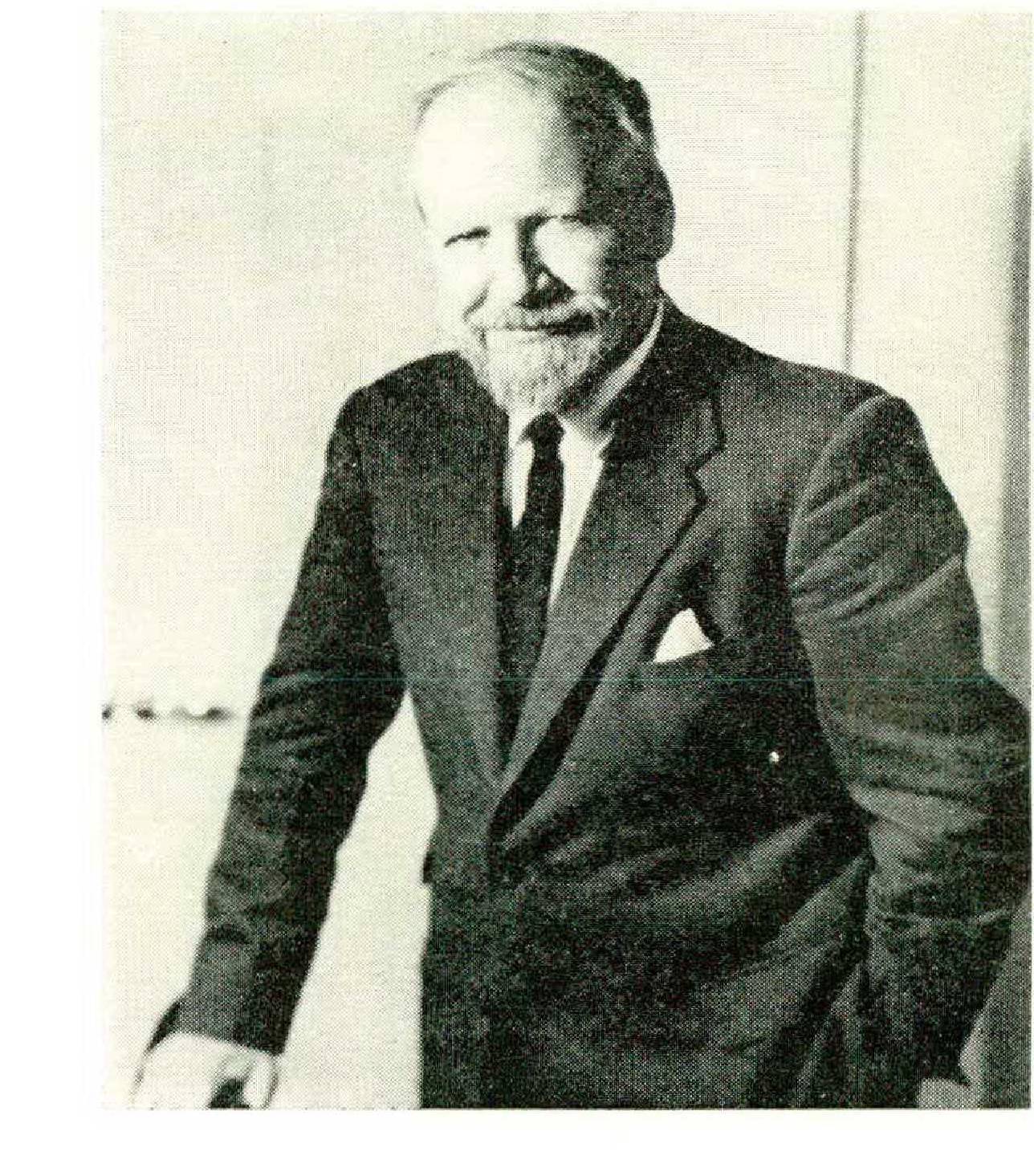
by KENNETH REXROTH
ABOUT the last writer in the world it would ever occur to me to read is William Golding, so before I start this little essay I want to make it very clear indeed precisely where I stand. Many years ago my friend Dwight Macdonald wrote a book about Henry Wallace, and everybody said, “Poor Dwight, he takes it all so seriously; it just goes to show that he’s jealous — he wishes he were Henry Wallace.” Later he wrote a devastating essay on James Gould Cozzens, and everybody said Dwight wished he were James Gould Cozzens. He wrote another about the Hundred Best Books more devastating still. His friends couldn’t make a mock of him by accusing him of wanting to be everybody from Gilgamesh to Marcel Proust. So they just said he wished he were Mortimer Adler. It didn’t seem to occur to anybody that editors paid him money for doing these jobs.
I haven’t any desire at all to be William Golding, much as I would enjoy spending my declining years pacing the lawns of Salisbury Cathedral Close while reading my Sarum breviary or seeking a glimpse of the protonotary curlew in the copses while the most gracious spire in Europe regarded me across the water meadows. It would be nice, but I wouldn’t want to write novels to do it.
When I was asked to do a comprehensive piece on all the books of William Golding for the Atlantic, a spontaneous yes popped out of me before I realized what I was getting into. After all, Gertrude Stein spent most of her life trying to get into the Atlantic, and they didn’t take her until she was older than I am now. Besides, there’s the pay to be considered. So it’s just prestige and money that prompted me to write this essay. I do not inhabit a universe of discourse in which the turbulence of controversy about William Golding is likely to arise.
Like Salinger, Golding is one of those authors schoolteachers say all the young read. It’s easy to see how this works out. They say to their classes as they assign Catcher in the Rye or Lord of the Flies, “You have to read this book. All young people think it’s terrific. It expresses the Alienation of Modern Youth.” So they did with my daughter. “How do you like Catcher in the Rye?” “Not much,” she said. Later, “How do you like Lord of the Flies?” “I can’t read it.” Maybe she was just raised right.
Who does read William Golding, and why? Since taking on this job I have asked around pretty extensively. I think his reputation is based on the strong physical response and moral identification he arouses in that class which worries all our social analysts: the great horde of the newly arrived of the new professions, the affluent parvenus of cybernetics, the upwardly mobile. He expresses their rootlessness, their complete lack of connection with either social or literary tradition, their amoralism — what used to be called social Darwinism — their always haunting sense of being unfree, perhaps their most distinguishing characteristic and itself the primary expression of their lack of that unfashionable theological virtue, hope, their lack of all sense of style. This is the definition of a parvenu.
Every time society passes through a critical point in its technological evolution, such people become a problem. The traffic management of taste breaks down, and the permanent issues of life and literature become conifused and obscured. Right now, of course, with the population explosion and automation both happening at once, Neanderthals with slide rules are all over the place. William Golding not only writes about them in scarcely veiled allegory; he writes for them. His message is not unlike that of Jack London — a now forgotten (except in Russia and the nations of rising expectations) American author who spoke for the Nietzschean parvenus of the boom times before the world depression of 1912—1914. Golding’s prose is almost as bad. In some ways it is worse, because it lacks specificity. In London there is a degree of sensual immediacy and passionate rhetoric unknown to Golding. The homo homini lupus conclusion is there in italics, Q.E.D., at the bottom of every page, but in the older writer, it seems to be based upon facts of a rather adventurous experience. In Golding, experience is replaced by a kind of truculent rhetoric. The lack of concrete sensual apperceptions, the lack of interesting events in the lives of the twenty-thousand-a-year technical and professional intelligentsia in the garden suburbs and the highrise condominiums, lies at the root of their nausea, their inescapable boredom and contempt of life and of each other, their truculent rhetoric.
The reason, of course, is that they are uneducated. Education is the imparting of a life style, whether it be that of a German socialist tooland die-maker, the proverbial sturdy English yeoman, a Chinese mandarin, or the former inhabitants of Brattle Street. Each has his special spiritual etiquette which can always be relied upon to cope and which comes to him through a social umbilicus. If the navel string is snapped before gestation begins, such endowments obviously cannot be transmitted. In a special sense of the word, it is taste with which we cope. If we cope, we are heroes, even when we go under, as eventually we all do.
There are no tragedies in lives without style. William Golding’s thesis is that there is no such thing as style, and that the pretense of it always ends in a shambles. I think he intends his novels to be terrible warnings. Behind them I suspect he agrees with me, but alas, he himself lacks the style necessary to an Old Testament prophet. He leaves me unmoved, but to his audience he oversells his case. They agree with characters in the novels, but not with any implicit lesson to be drawn from their behavior, because they find themselves therein, just as the gray flannel junior executive who has never known anything but taedium vitae finds his own fantasy’s shadow in the picaresque adventures of the dope and switchblade school.
Each novel is the story of the impossibility of coping, not of failure. Agamemnon failed. Prometheus on his rock coped. A deaf and blind man run over by a driverless car which has broken away on a hillside has not failed. Since life is not in fact like this, Golding’s novels are rigged. All thesis novels are rigged. In the great ones the drama escapes from the cage of the rigging or is acted out on it as on a skeleton stage set. Golding’s thesis requires more rigging than most, and it must by definition be escape-proof and collapsing.
SUCH self-destroying machines are perfectly conceivable, but they must be made of carefully tooled gears and pinions and put together with great style. I do not believe they are that, but it is arguable that the first great books of this métier are Céline’s Journey to the End of Night and Death on the Installment Plan. There is a world of difference in style and skill between Céline and Golding. Céline is full of unforgettable minute particulars of time, person, place, and thing. Golding is uniformly disoriented and ambiguous for time, person, place, and thing.
Lord of the Flies is simply a carelessly documented book. Its opposite number, The Swiss Family Robinson, is ridiculously impossible, with flora, fauna, and geology from the ends of the earth all dumped on one tiny island, but we forgive the improbability because the boa constrictor really seems to eat the mule, and if polar bears had eaten breadfruit, we would have believed it. Lord of the Flies functions in a minimal ecology, but even so, and indefinite as it is, it is wrong. It’s the wrong rock for such an island, and the wrong vegetation. The boys never come alive as real boys. They are merely the projected annoyances of a disgruntled English schoolmaster. At the end of the book, we are not convinced of the obliterative effects of original sin; we just feel that Mr. Golding should get a better job. Certainly this is not a picture of the juvenile delinquency that has swept over the world from Jakarta to Reykjavík. Hell’s Angels, hooligans, Mods and Rockers, tricheurs — these people are after more reality, not less, and their explosions result from frustrations coming from outside, deliberately inhibiting their quest for a wider reality. They do not come from within what sociological cant calls their peer groups.
If Lord of the Flies is an unsuccessful attempt to deny The Swiss Family Robinson, Pincher Martin is an even less successful denial of Robinson Crusoe. Since Pincher Martin is all a hallucination, it eludes comparison with Defoe’s flawless orchestration of specificities. That’s just the point. If reality had been allowed to intrude, the thesis would have fallen to the ground. I do not accept Jean-Paul Sartre’s philosophy, but he had sense enough to know that a one-man No Exit is, as it were, a denial of terms. Besides, Golding’s book is annoying. I object to having to read 185 pages of a wornout gimmick.
Free Fall should be the best of Golding’s novels. The people are more vividly drawn than in the other books, and their motives are more complex. There are dramatic rather than melodramatic tensions. The thesis again is Golding’s obsession, original sin, but in this case the story is of the struggle to transcend it. Yet again it is all hallucinatory. Furthermore, since the characters do not seem at first to be presented purely as vehicles of the thesis, it is possible to judge them as people. So judging, it is apparent that there’s something nasty about all Golding’s people; not evil, just nasty. One of the things wrong with them is a kind of special muzziness that he is able to give to all his characterizations — or unable not to give. They are uncleanly seen. If you are going to undertake this journey, you should not forget that the clarity of Dante’s vision is never impeached by the confusions of either the damned or the undamned.
The Inheritors shares with the other novels their imprecision of documentation. Modern paleontology does not support Golding’s picture of Neanderthal man or of his relation to Cro-Magnon man. To judge by his remarkable brainpan capacity, he may well have been smarter than us. Certainly he was in many ways more specialized, and so, I suppose, what we used to call “further evolved.” We know nothing about the relations between Cro-Magnon and Neanderthal man. There is no evidence that the second race exterminated the first. More likely, Neanderthal man was overevolved, overspecialized for the peculiar conditions of the late Pleistocene, and died of disease and with hundreds of other Pleistocene species. The cave bear was not exterminated by the grizzly, nor the ground sloth by the bison. Nor do we know enough about Cro-Magnon man to justify Golding’s picture of him. I know the sources of Golding’s characterization. It is very moving when the Sorcerer of the cave of Les Trois Fréres suddenly makes his appearance, but the evidence does not in fact warrant such deductions. I know that it has become fashionable to write books called “ The Religion of the Caveman,” but they are all as imaginative as any fiction.
Of course, there’s nothing wrong with invention, extrapolation, or anachronism in a novel about Neanderthals, if it can be made convincing. The Neanderthals don’t have to have been really like that — nobody ever really lived who was like the characters of Henry James either. It’s the end in view and the means employed that count. I think that the end is false and the means are imprecise.
The Neanderthals were not a race of Adams and Eves with red wool, nor the Cro-Magnons moral monsters, the issue of the sons of God who mated with the children of men. It’s not just that Golding projects the present into the past. Wells, London and many others have done that, writing of the same subject. It’s that he projects into the birth of humanity a compound of personal problems which are essentially trivial.
The Spire is the most exasperating of all these books. Here the anachronism is breathtaking. This is not the Middle Ages, and it is certainly not Salisbury Cathedral. It is William Golding. “ The Bad Rover Boys on a Desert Island,” “ The Bad Rover Boys at the End of the Ice Age” acquire a sequel — “ The Bad Rover Boys in the Age of Faith Build a Cathedral.” Again, Mr. Golding judges human beings, past or present, far or near, the way a British schoolmaster who doesn’t like teaching in a provincial town regards his charges. This is a symbolic tale of the upwardly mobile with a vengeance. The thesis is that they are snotty-nosed little boys. Maybe they are; they seem to enjoy being told they are.
What depressed me most was that Mr. Golding doesn’t even like that pretty church, perhaps because it is so perfect an expression of style. He should not only get another job; he should move. Maybe he has. He’s sold enough books to live on the Riviera, where it’s stylish.