The California Sound

California has long been credited with a number of important contributions to the American way of life —the outdoor-barbecue fetish, for example — but its role as a cultural innovator has been underestimated. As evidence, one need only turn to that contemporary phenomenon known as the California Sound.
Contrary to popular impression, the California Sound does not refer to the noise produced by automobiles colliding on smog-bound Los Angeles freeways; nor to the snap, crackle, and pop of “liberal” books being roasted on an open fire by the John Birch Society.
The California Sound, it can be reliably reported, is a school of rock ‘n’ roll music that, though typically Californian in form and content, has achieved a bizarre popularity among the puberty set across the nation. It has, indeed, become the principal rival to the most popular strain of rock ‘n’ roll, the Negro ethnic rhythm-and-blues music. In so doing, it has earned actually millions of dollars for a small group of California youths who have managed to compensate in enterprise what they lack in musicianship.
The California Sound first came to national attention with the advent of surfing music — a curious fad that spawned singing groups bearing such names as the Beach Boys and the Fantastic Baggys (baggys are the loose-fitting trunks worn by the surfing cult). Though the process of riding a surfboard over the breakers would seem to be, at best, a matter of purely coastal interest, surfing music quickly spread to the hinterland, and even the farm boys were soon singing the praises of the Malibu surf.
Since the rise of surfing music a couple of years ago, the California Sound has undergone several metamorphoses. First there was the “sidewalk surfing” phase that grew out of the popularity of the skateboard. The “sidewalk surfing” music apparently assuaged the yearnings of the city youths who had to settle for pavement rather than ocean beneath their boards.
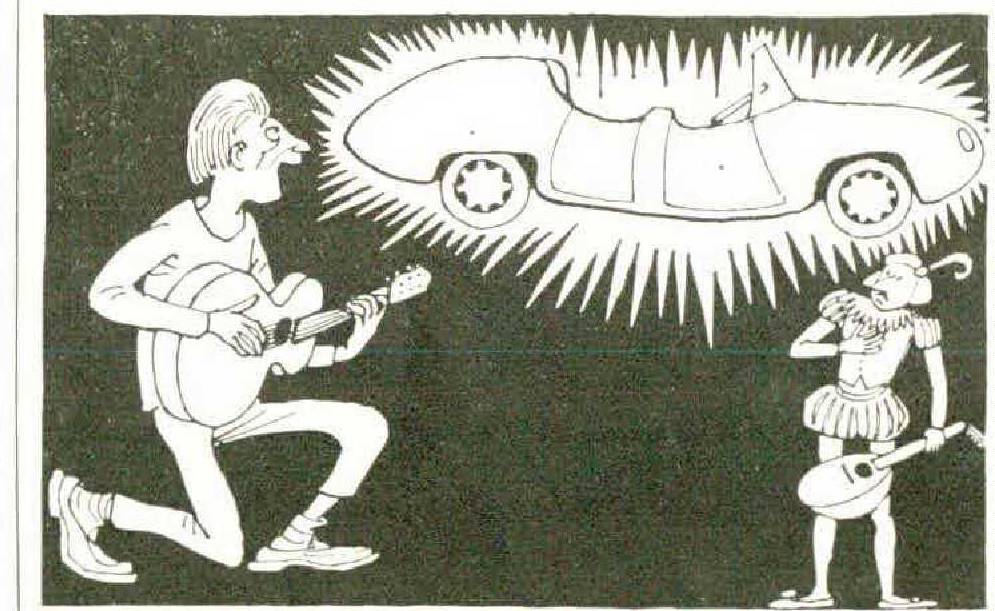
Next came the “carburetor love song” phase, in which the rock ‘n’ roll troubadours expressed their undying devotion to their automobiles. Couched in hot-rod argot, replete with background drag-race noises, these numbers were all but unintelligible to anyone who didn’t know, among other things, that “deuces" meant carburetors and “409” meant Chevrolet.
Out of these intimations of automania developed an even stranger phase: rock ‘n’ roll tunes that related grisly tales of teen-age automobile accidents. The lyrics of these numbers offered morbid descriptions of bodies strewn across the road and limbs protruding out of windshields — all this while the Beatle beat kept hammering in the background.
Through all these changes, the exponents of the California Sound have continued to expand their following. Some enthusiasts, in unguarded moments, have even proclaimed that the California Sound, alone among the various schools of rock ‘n’ roll music, most nearly resembles authentic folk music, since its songs reflect the way of life of a region.
There is a kernel of truth to this contention. California living revolves around the automobile and the beach, and these are the subjects immortalized in the songs. The barely audible lyrics of the surfing songs reflect the surf addict’s Spartan devotion to his board, a devotion that leaves little room for dalliance. Hence, in a number titled “Tell ‘Em I’m Surfing,” the lyrics tell how a cute little girl in the neighborhood who invites a boy to a poolside tryst gets put down for trying to distract her boyfriend from the rigors of the surf.
Similarly in the carburetor love songs, the car, not the girl, usually wins. In “Move Out Little Mustang,” a boy with a Mustang (the Ford, not the horse) is crowded off the road by a pretty girl in a Thunderbird, so the boy does the chivalrous thing: he tries to crowd her off the road.
Most of the California-style rock ‘n’ roll songs are composed by boys in their teens or early twenties, and they sound it. Each of the boys has his own specialty and is revered for his specialized know-how. For example, a twenty-four-year-old Los Angeles disc jockey, named Roger Christian, specializes in automobile songs; his reputation apparently derives more from his ability to find words to rhyme with “carburetor” than from any lyrical gift.
In the surfing (both seaside and sidewalk) specialty, two strapping young Californians named Jan Berry and Dean Torrence (“Jan and Dean” to their followers) have established a certain hegemony, their recordings selling in the tens of millions. In some of their tunes, Jan and Dean have sought to escape from the sullen self-consciousness of adolescent music by attempting to introduce a note of humor. Their albums are studded with tunes about little old ladies who have a penchant for drag racing. Hence “The Little Old Lady From Pasadena” is depicted as a granny with a heavy foot on the accelerator, and “meaner” too (to rhyme with Pasadena).
Jan and Dean, blond, white, Anglo-Saxon, and middle class, are eminently representative of California’s rock “n" roll singers and set a vivid contrast to the ghetto-bound youths who dominate Eastern rock
’n’ roll music. To the Easterners, rock ‘n’ roll is a way of life. Not to Jan and Dean. Between recording sessions and sojourns to the beach, Jan continues his studies at the California College of Medicine while Dean studies fine arts at the University of Southern California. As Jan puts it, “We intend to be around earning a good living long after this surfing stuff has been forgotten.”
Noting that the throbbing beat of rock ‘n’ roll provides a vital sexual release for its adolescent audience, Jan believes that the next big trend in rock ‘n’ roll will be to relieve the sexual tensions of the pre-adolescent set. One tune called “Baby ‘Talk,” involving a romance between a five year old and a three year old, already has sold in the millions.
Clearly, this pre-pubic music could open up whole new areas of subject matter for the rock ‘n’ roll troubadours. There could be tunes about tricycle drag races, bathtub surfing, and even plaintive ballads about diaper rash.
The California Sound, it is clear, still has a lot of ground to cover.