Zermatt
pleasures and places
For years I resisted the call. There was something too obvious about that great Tom Thumb of a mountain mocking one across the virgin snow, the chocolate-box view with the little clockwork funicular which beckons from the walls of travel offices all over the world. It was too much like a Swiss Taj Mahal. But my friends kept going, winter after winter; and finally one of them said, “It’s got to be seen to be believed. The first morning when I pulled back my hotel-room curtain, there it was, all rose and gold, rising up against a sky as pure and blue as Fra Angelico’s. It was so unbelievable that I took it for a trompe-l’oeil fresco painted on the wall by a tasteless management. I yanked the curtain back over it — but no, it was the real thing. And those sleighs —”
“Sleighs?” I said.
“Why, yes, there’s no road up to Zermatt, so in the village everyone travels by sleigh.”
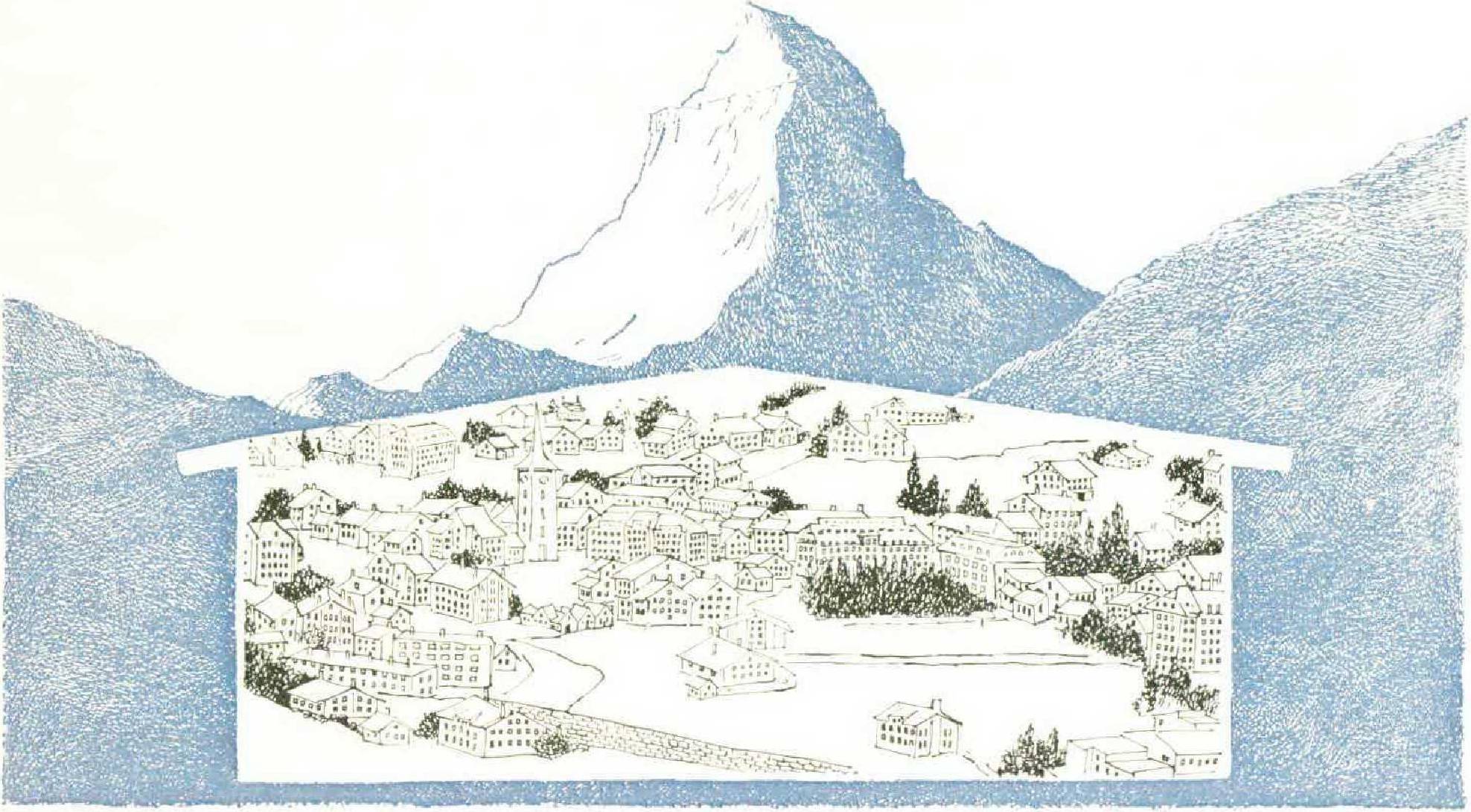
That did it. I took the next train, and have been going back ever since. And each time the electric train from Brig rounds the last mountain bend on its one-and-a-half-hour ascent from the valley, I feel the same wintry thrill. The faithful gauntcheeked porter will be there, waiting expectantly by his sled, and out beyond the platform, by the cigarette and chocolate stall, the well-blanketed horses hitched to the fur-lined sleighs will be pawing the snow and exhaling clouds of steam as in a Currier & Ives print. This is Zermatt the timeless, insulated from the mechanized march of history by twenty kilometers of roadless defile and a dead-end valley at the foot of the majestic Matterhorn.
For here the giant forces of geology have, so far, successfully stood off the juggernaut of industrial progress. The little village of Zermatt (the name comes from the old German zu der Matte — “to the meadow”) lies at an altitude of some 5000 feet, and from here to the top of the Théodule Pass, which leads over into Italy, there is another steep rise of 5500 feet. But for these 5500 feet and the presence of the Théodule Glacier, which even in summer is full of crevasses presenting risks for inexperienced hikers, the valley of the Visp would have become another Brenner Pass, linking the Gothic north with the Latin south, and Zermatt would long since have been transformed into a noisy transit point on a major international thoroughfare. Instead, the valley has been locked from time immemorial by a formidable gate of ice and rock.
and the little village of 1800 souls which nestles beneath it thus remains, with Wengen, the only Alpine resort in Switzerland which cannot be reached by car.
One has only to walk up the main street on any winter evening to appreciate just what this means. The air is of a virgin purity; the snow, though it tends to melt under the noonday sun, is still snow, and not the filthy slush it becomes in KitzbÜhel or Davos after it has been churned to a brown soup by a ceaseless stream of Volkswagens and fumespewing buses. The old church bell tolling the Angelus for evensong rings out loud and clear, with no competition from motor horns or klaxons, and if the pedestrian must occasionally give way, it is to the lively jingle of harness bells. Two bay horses pulling the sky-blue sleigh of the Zermatterhof plunge by with their cargo of new arrivals, bundled beneath their furs like deck sitters on an ocean liner. Or one may see the proud red chariot of the Hotel Mont Cervin, piloted with insolent dash by a ruddy-cheeked young coachman with the gold letters MC emblazoned on his visored cap.
In the spring, the sleighs give way to open carriages, pulled by the same horses over the village’s dirt and stone streets. Those who have had occasion to compare the two seasons will readily agree that Zermatt in summer is even more beautiful than in winter. The snow-powdered mountains to the south shed their white ermine capes for cloaks of a gaunter hue: the slate gray of the soaring rocks is transmuted from afar into a deep misty blue, which is heated to a purple rose in the fire of the rising and setting sun. Lower down, beneath the glaciers, the slopes burst into a quilted patchwork of brilliant green, spangled with a galaxy of sprouting blossoms which run a dazzling spectrum, from the mustard yellow of the rock orpine to the red of the mountain lily, the purple of the Alpine columbine, the white of the one-flowered wintergreen, and the pale carmine flush of the wild Alpine rose.
This schematic inventory would be incomplete without mention of the noblest flower of them all — named, for this very reason, edelweiss (noble white). It prides itself on being the highest growing of all Alpine flora, and it maintains an Olympian remoteness which has the force of an aristocratic instinct. It is the most inaccessible of Alpine flowers, choosing with deliberate mountaineer orneriness to grow in tufts perched far out on a precipitous overhang or in three thimblefuls of earth caught in the cleft of a dizzying crevasse. The Swiss are justly proud of its rugged individuality, so akin to their own, which is why they chose it long ago to be their national flower. It can be plucked by an enterprising climber, but to uproot it is a criminal offense, punishable by law. This is one of the first things the summer hiker learns from his guide. He is also told to beware of the edelweiss’ elusive lure: for many are the inexperienced aliens who in reaching for the rare white bloom have lost their foothold and plunged headlong to their death.
But let us, after this brief botanical detour, resume our walk on the terra firma of the valley floor. I Here on the right, basking in the hot midday sunshine, is one of the landmarks of the village, another of the many chalet-hotels lining this picturesque main street — the Hotel Walliserhof, recognizable by its dark timbering and gay red shutters. The only Zermatt hotel which managed to stay open right through the last war, it now boasts sixty beds in lieu of the twenty before the war, and under the management of its owner, Theodor Welschen, its corridors, staircases, and little writing rooms have been charmingly decorated with iron cheese-making pots, delicate watercolors and figurines of the Madonna, an eighteenth-century clock, and even an impressive baroque chandelier from Brig.
Here the young rendezvous in the evening to drink gluhwein and Williamine, a distilled pear cordial which can hold its own with the best Framboise; if energetic, they can twist and throb to the beat of a perspiring band. Next door, in the pinepaneled taproom, the village elders and Scotsmen in tartan caps cluster around the wooden bar exchanging speculative gossip about the coming curling contests.
A little farther up the main street on the left, beyond the gabled shops advertising canary-yellow slacks and thick reindeer sweaters from Norway, is the squat Mont Cervin, Zermatt’s most fashionable hotel and also one of its oldest, since it dates from 1867. Its gradual growth and enlargement, along with much of present-day Zermatt’s, were the work of Alexander Seiler, a kind of local Conrad Hilton.
Until Seiler turned up on the scene, travelers venturing up the thirty-five-mile valley of the Visp as far as Zermatt were traditionally put up by the parish priest. But in 1838 the cantonal government of the Valais (that part of southern Switzerland which borders Italy between the Lake of Geneva and the Tessin) forbade priests to act as innkeepers. Mountain climbing was then in its infancy, the vertigo of dizzying precipices and breathtaking vistas having been made fashionable by the Romantics, and what Zermatt clearly needed was a well-run hostelry for visiting British lords and others of a pioneering mettle. Alexander Seiler, who had started out as a soap manufacturer in Sion (the capital of the Valais), down in the valley, was consequently lured up to Zermatt by his brother Joseph, who happened to be the curate. The two brothers bought out the local doctor, who had tried to run an inn, and in 1855 Seiler opened the first of the five hotels which were eventually to be his. He renamed it the Monte Rosa, in honor of that year’s victorious ascent of the second highest of the Alps.
The Monte Rosa Hotel has subsisted to this day next door to the parish priest’s chalet, easily identifiable from the painted fresco of the Madonna and the curved pulpit balcony adorning its facade. The Monte Rosa itself has preserved the same humble scale, with low-ceilinged rooms and a flutter of Victorian lace. A few of the old wardrobes remain in the earlier part of the hotel, along with a quaint old stove made of giltstein (a porous light-gray stone noted for its heatretaining properties) which once warmed the entire establishment. The stove is still on view in a fragrant pine-paneled drawing room on the second floor whose walls are covered with photographs and pictures of the Matterhorn and its first conqueror, Edward Whymper, who climbed it in 1865. An engraving, done by Whymper himself, shows the “Members of the Alpine Club in front of the Monte Rosa Hotel in 1864”— bearded men in round hats, cravats, and waistcoats, whose rugged tunics must have constituted as formidable an impediment to their exertions as did the stiff uniforms worn by their contemporaries at Vicksburg and Chattanooga.
Whymper’s memory, consecrated at the Monte Rosa in a facade medallion and a basement restaurant christened the “Whymper Stube,” has also been preserved at the Zermatt Museum, now housed directly behind the hotel. Here has been assembled an impressive array of ice picks, boots, ropes, letters, faded daguerreotypes, and photographs commemorating the first ascents of the towering peaks encircling Zermatt, down to 1962’s first winter conquest of the Matterhorn’s northern face by Von Allmen and Etter.
The proximity of the Matterhorn imbues the village with a spirit all its own. In other Alpine resorts the ski instructors may take a variety of jobs for the summer, but here most of the ninety teachers in the ski school work as mountain guides from June to September.
In talking to these hardy mountaineers, one encounters the same rugged tranquillity but also the same restless urge and distant look in the eye which one finds in old sea captains. “If I could, I would start again tomorrow,” Alex Perren likes to say, carefully bending his metallic leg as he sits down by the bar of his new hotel. His leg had to be amputated several years ago after he had dangled at the end of a rope for half a day over a rocky cliff of the Ober-Gabelhorn.
How much this indomitable Alpine spirit will continue to sway Zermatt it is impossible to say. For the dominant forces in evidence now tend to work in a contrary direction. The emphasis is increasingly on facility, and all the surrounding mountainsides up to 3000 meters have been covered with a network of funiculars, T bars, chair lifts, and cable cars to exploit nature’s generous expanse of treeless snow, on which one can ski well into April (considered by some the best skiing month). It is now a rarity to see a skier using skins, even to climb to the top of the Théodule Pass; one can make the journey in three quarters of an hour comfortably hitched to a snowcat piloted by a bearded character with the appropriately international name of Rico MÜttenzer. It is then an easy run down to the Italian resort of Cervinia, from which one can return to the Swiss border by cable car.
The climbing of the Matterhorn itself has almost become an enterprise of mass production, and in July and August there are days when as many as twenty or thirty guides and a hundred amateurs make the climb along a well-roped and stakedout course.
To be sure, Zermatt has managed to preserve many of its quaint old chalets and forage huts, which in other resorts like Verviers and crans have all but disappeared. But these picturesque relics of the past, some of which go back to the sixteenth century, are now being engulfed by a torrent of new construction, which is turning the village into a thriving town — it already boasts nearly seventy hotels. In the process the old village spirit is waning, and with it that fierce clannishness which was once the mark of the Zermatters. There are some 310 BÜrger — descendants of the original families inhabiting the commune, who enjoy common grazing and forestry rights on the surrounding hillsides and a share in the profits reaped by five hotels, the Gornergrat funicular, and the Schwarzee cable car. But the 160 non-BÜrger now living in Zermatt are in many cases richer and politically more influential.
In 1870, when Alexander Seiler asked to be made a BÜrger so that he could bring his own livestock up into the valley and provide for his hotels, his request was denied, and the resultant wrangle went all the way to the cantonal authorities in Sion. In 1889 six Landjäger from the cantonal constabulary had to be sent up to Zermatt with loaded rifles to seize the town hall and cow the stubborn BÜrger into submission. This kind of incident is almost inconceivable today, if only because the once jealously guarded grazing and forestry rights have lost most of their value; the five thousand strangers who now crowd into Zermatt during the peak tourist months (February, March, July, August) have to be supplied with meat, milk, butter, and cheese from the valley.
A get-rich-quick spirit is, however, clearly infecting the community and gnawing away at the old rustic virtues. Real estate speculation is on the rise, and even more serious, a good eighty Zermatters own cars, which they are forced to garage in villages farther down the valley since the existing road from Visp only goes as far as St. Niklaus, some twenty kilometers distant. With these new possessions has come an inevitable demand for the prolongation of the Visp road all the way to Zermatt.
The issue first came to a head in December of 1959, when an assembly of male Zermatters — the women here, as in most Swiss cantons, are still disfranchised — was asked to vote funds for the building of a road. The advocates claimed that the construction of the highway would bring in more tourists and thus more money to the community. The opponents, led by Constant Cachin, who heads the eleven-man committee formed to spur Zermatt’s touristic development, argued the opposite.
“I told them,” says Cachin, a balding rosy-cheeked man whose bluff exuberance is abetted by the legal training he got at Fribourg, “that if a road was put through, Zermatt would be flooded, but not with automobiles, with buses! Yes, huge sight-seeing buses! The people Who would make money out of the road would not be the people of Zermatt but the bus companies. Just think— five hundred huge buses a day crawling up that narrow valley and disgorging fifty to a hundred passengers each into Zermatt’s main street, with every person being told that he’ll have just twenty minutes in which to grab a hamburger at the nearest sandwich counter, buy a souvenir, and take a quick snapshot of the Matterhorn before being herded back on the bus for the three-hour return trip to Visp. Zermatt would become a huge bus terminal, and all our oldest and best customers, those who have been coming here for years for a couple of weeks of peace and quiet, would pack their bags and leave. At night the hotels would be empty.”
Whether Cachin’s eloquence had anything to do with it is a moot point, but 182 Zermatters then had the robust sense to vote the road project down by a slim majority of three votes. Even in remote Zermatt, relatively sheltered from the winds of change, this was too good to be true. And sure enough, a few months ago when the issue came up again, the road was voted through by a decisive majority of 60 percent, over the vigorous protests of the village’s wisest citizens, who have never believed in the merits of sacrificing sense for speed.
One of these is Bernard Biner, a powerful white-haired man who for twenty years headed the local guides’ association. I found him sitting in front of his little Bahnhof Hotel, near the station, where he and his sister take in skiers and climbers for as little as ten Swiss francs a day, allowing them to cook their own meals in the basement. He was staring through a pair of binoculars at the Matterhorn, which was partly veiled by clouds.
“The road?” he said, lowering his glasses to gaze at me out of his penetrating, still blue eyes. “Yes, there’s no stopping it, but thank heaven I won’t be around to see it. Because it’s going to take them a good ten years to cover the twenty kilometers between here and St. Niklaus, with tunnels having to be dug a good part of the way and the commune asked to dig into its pocket for each new kilometer built. It will be interesting to see what happens when they have to start paying higher taxes; all they’ve got their minds on now is the prospect of being able to drive up here by car.” He mentioned the names of several prominent Zermatters who now owned Bentleys and Mercedes down the valley. “You must remember, the peasants here aren’t more intelligent than anywhere else. They want to have cars too, like the rest. I say God bless them! Let them go down to Milan in their Alfa Romeos if they want to and get themselves killed in accidents. But the people I’m sorry for are the old clients, from London, Paris, New York, who have been coming here for years and who won’t do so any longer once that road is built.”
He took another long squint at the Matterhorn.
“Damned liars,” he finally announced in his perfect English. “I can’t find a trace of them. They’ve almost certainly taken refuge in the Solvay hut.”
“Who?” I asked.
“Those young boys up there on the mountain. I don’t care what anyone says: they’re good climbers. One of them, Toni Hiebeler, often stays with me here, and he wouldn’t risk going on in this uncertain weather. But just try to explain that to the people in the village. They’ve got their telescopes out, and every couple of hours they startle the world with the news that the climbers have progressed fifty more meters and are now only three hundred from the top. When all they can see is cloud.”
Several days later, after a snowstorm had closed in on the Matterhorn and the climbers had been given up for dead, they trudged calmly back to town with the information that they had spent the last forty-eight hours sleeping off their exhaustion in the Solvay hut. They’d made no attempt on the summit at all. The local boys with the lynx eyes were suddenly nowhere to be found, but it was too late. The following day the Swiss magazine Blick tore into the Zermatt guides for having kept the world agog for two days with a cock-and-bull story of local fabrication. The infuriated guides retaliated by assembling in the little town square in front of the church and making a bonfire of all the Blick copies they could lay their hands on. Then they marched down to the house where Hiebeler, Blick’s local correspondent, was staying and stuck up a notice: “If you want to save your skin, buy a return ticket immediately.”
Things were beginning to crackle, and any moment I expected to see a platoon of Landjäger get off the train and unlimber their rifles. I went back to see Biner and found him sitting quietly on the ramshackle sofa in his simple living room office. He was impressively calm, with that massive serenity which comes from having tested one’s strength more than two hundred times against the icy walls of the Matterhorn.
“Well, what did I tell you?” he greeted me, with a wry smile.
I congratulated him and asked what the rumpus was all about.
“Nothing, except that our youngguides have discovered that the safest way of climbing the Matterhorn is through a telescope. You risk a still neck instead of a broken one. That’s what they mean by progress.” He raised his bushy eyebrows and lightly tapped his index finger against his sun-bronzed temple. “Publicity . . . politics. . . progress. Call it what you will. It’s all the same you understand.”
I did. Only too well.