That Earthy Man
One of England’s most distinguished editors, now on the staff of THE SUNDAY TELEGRAPH, HUGH MASSINGHAM is the son of H. W. Massingham,himself a great editor and an intimate friend of the young Churchill. Mr Massingham here recalls the days when Sir Winston was a frequent visitor in his home and when, to the Tory world,he was considered a radical.
HUGH MASSINGHAM
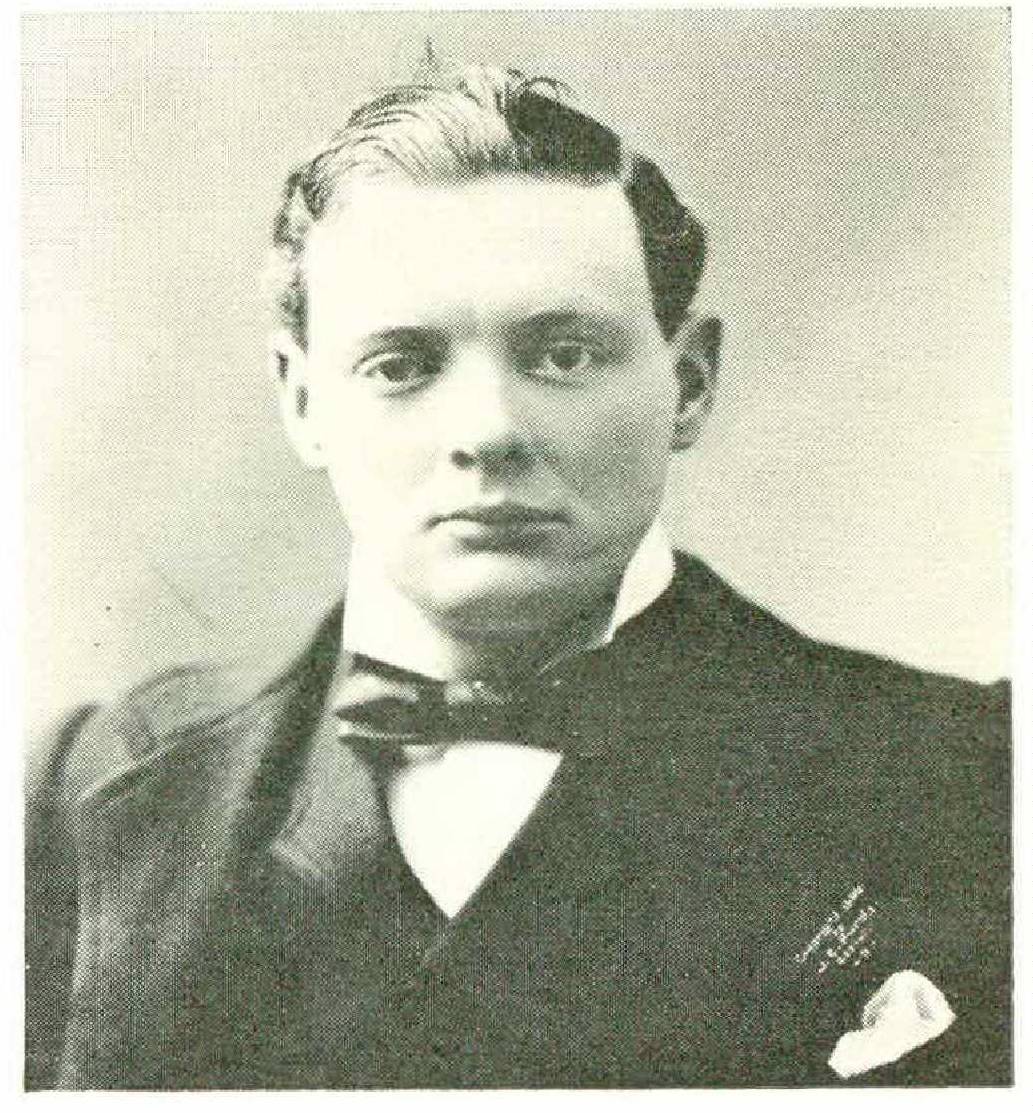
Now that he is dead, many people will remember him only in one of his more implacable moods. The jaw will be jutting out, the face creased in a ferocious frown, and one foot will be pushed forward as if he were about to launch himself upon his enemies.
It is not a misleading interpretation, even though it may be rather an obvious one. There were times when Churchill was ruthless: a man cannot be a successful leader of a nation in war by learning to turn the other cheek. But this was only one side of his character. There were many Churchills; so many, in fact, that if they could have been gathered together, they would have filled a fair-sized stadium.
One of his extraordinary gifts was that although he moved among the famous and the splendid, he managed to project such a clear image of himself that even the dullest felt that Winston was a friend. Politics, perhaps, is nearer to the theater than to any other art, and the inspired politician has always been able to put himself across by certain simple tricks of speech, and even of dress. Nobody understood this better than Churchill. There were the extravagant hats, the improbable pictures of him industriously laying bricks. He deliberately mispronounced words—jestapo, he said, though he (and everybody else) knew that the right word was gestapo, with a hard g and a long a. Even the drink and cigar often seemed two of his stage properties. No one has ever seen Winston smoke a cigar to the end, and time and again he would take only a sip from his sprightly whiskey and soda. Both, at least in later life, were merely symbols of his virility.
He was helped in his conjurer’s deceptions by having a larger bump of humor and mischief than any of his contemporaries. A politician cannot create a sympathetic image of himself unless he can occasionally come down from his pedestal, and he cannot get off his pedestal unless he sees through his own pretensions and is able to appreciate the absurdity that makes him the brother of all human beings. Hitler never made a joke about himself or about anybody else: Winston crackled with them all day long. There was his dig at the austere and severe Sir Stafford Cripps when Winston was addressing the troops in the desert during the war. “Here we are,” he said, “marooned in all these miles of sand — not a blade of grass or a drop of water or a flower — how Cripps would have loved it.”
Then there was the moment when a Mr. Alfred Bossom was addressing the House. “Who’s this chap?” he asked in a penetrating growl.
“Bossom, sir.”
The great man thought about this. “Bossom,” he reflected. “Odd name, isn’t it? Neither one thing nor the other.”
He could even joke about his own death. When the War Office decided that the British Army must be reorganized and various units amalgamated, it was suddenly realized that Winston’s old regiment was among those that were to be axed. What a row there was going to be! Faced by this appalling prospect, the generals persuaded Montgomery to break the sad news. Monty dwelt on the need for economy, the inevitability of change.
There was an ominous pause. “What about the Army’s horses?” Winston asked.
Some of the horses would undoubtedly remain.
“What about the bands?”
At this point, it is reported, Monty momentarily forgot the delicacy of his mission. “You know, Winston,” he said, “you really are an extraordinary chap. I come to tell you about your old regiment, and you ask me about the horses and the bands.”
The great man lowered his cigar. “Want to make sure I get a good funeral,” he said.
No one enjoyed Churchill’s humor more than Churchill, and, indeed, it used to be one of the pleasures of my life to watch him preparing to make a joke at a public meeting. One always knew it was coming. His own laughter began somewhere in the region of his feet. Then a leg would twitch; the bubble of mirth was slowly rising through the body. The stomach would swell; a shoulder, heave. By this time the audience would also be convulsed, although it had no idea what the joke was going to be. Meanwhile, the bubble had ascended a little further and had reached the face; the lips were as mobile and expressive as a baby’s. The rich, stumbling voice would become even more hesitant. And finally there would be the explosion, the triumphant sentence of ridicule.
IT IS this human side, the earthy man hidden under the robes and the glitter of fame, that haunts me at this moment, because, in a curious way, Churchill flitted in and out of my life ever since I can remember. He and my father were once friends. My father, H. W. Massingham — H.W.M., even to his children — was not only one of the great English editors of recent times; he was also a radical, and it was because he saw Churchill as among the radical hopes of his time that the two men became intimates.
People do not remember this phase in Churchill’s lite. Today he is seen both as one of the architects of victory in the last war and as leader of the Conservative Party. They forget that there was a phase in his career when the rich and privileged fancied they could hear the fearful creaking of the tumbrels every time he spoke. Listen to him on the Tories in the days when he was a friend of my father’s. “We know perfectly well,” he said, “what to expect — a party of great vested interests, banded together in a formidable federation: corruption at home, aggression abroad to cover it up. . . . Sentiment by the bucketful, patriotism by the imperial pint; the open hand at the public exchequer, the open door at the public house; dear food for the millions, cheap labor for the millionaire.”
Because of these opinions, Winston became one of my father’s many political loves. In a sense, it might be said that H.W.M. was among his early sponsors. In 1909, when Churchill was thirty-five, he brought out a book of speeches called Liberalism and the Social Problem, and my father wrote the introduction to it. Much of the writing and most of the ideas now seem a little musty and far away, but the tribute my father paid to the young Liberal politician is still fresh and alive. “A word,” he concluded, “as to the literary quality of these addresses, widely varied as they are in subject. The summit of a man’s powers — his full capacity of reason, comparison, expression — is not merely reached at so early a point in his career as that which Mr. Churchill has attained. But in directness and clearness of thought, in the power to build up a political theory, and present it as an impressive and convincing argument, in the force of rhetoric and the power of sympathy, readers of these addresses will find few examples of modern English speechmaking to compare with them. They revive the almost forgotten art of oratory, and they connect it with ideas born of our age, and springing from its conscience and its practical needs, and, above all, essential to its happiness.”
The strange fellowship between these two — my father was wiry, puritanical, and withdrawn, while Churchill, even then, was rosy, expansive, and pleasure loving — inevitably came to an end, but while it lasted, the great man stamped in and out of our house. Indeed, it is one of my many regrets that I never kept a diary while I was a child. In my saner moments I see that I would not have contributed even as much as a comma to the saga of Winston’s life. A child is more interested in sport than in the history of his times. In those faraway days, Churchill to me was not a man: he was a cigar, a cloud of smoke.
But, although I have no notes to jog my memory, I can, as I concentrate, as I look back, see one scene that appears to me deeply significant. My father was holding one of his pompous luncheon parties, and, for some reason, I was allowed to attend. Winston was two places away from me, and on the other side of the table, opposite a bowl of red roses, sat a bearded gentleman called Bernard Shaw or some such name. He seemed to me an extraordinarily vain and foolish person, and I have never been able to rid myself of that early prejudice.
My father at this time had remarried, and my stepmother, though a person of many virtues, could not be described as particularly intelligent. It happened at this lunch I am describing that there was one of those inexplicable silences that can occur even when the company is both distinguished and witty. As the conversation faded, my stepmother’s clear and bell-like voice rose in what seemed at the time to be a deafening roar. “Mr. Churchill,” she said in her most earnest manner, “it is not the world that is wrong: it is the people who are in it.” I have no idea if she was aware of the enormity of this remark, because I was transfixed by the ferocity of my father’s glare. If looks could have killed —
It was then that Winston intervened. “My dear Mrs. Massingham,” he said, “the same thought has often occurred to me. It is not the world — how right you are! How perfectly right! No, it is the people, as you say, the people in it. That is what is wrong.” All this was said with great conviction and apparent sincerity, and it was then that Churchill ceased to be, for me, a cigar or a cloud of smoke: he became a man. Child as I was, I realized that there could be few men who had both the wit and the sympathy to try to rescue my stepmother from her predicament.
MY FATHER quarreled with Winston during World War I. Sooner or later he quarreled with everybody, and for the most admirable of reasons. In a sense, H.W.M. was the saint who strays into the warm and corrupting world of politics, and he therefore demanded of his heroes an impossibly high standard of virtue. When he felt that he had been betrayed — and, of course, he was invariably betrayed — his love not only turned to hate; he had a power of invective and irony that was the equal of Swift’s. H.W.M. did as much as anybody to end Lloyd George’s career — “Mr. George,” he mockingly called him. When Lloyd George pushed Asquith out of the nest in World War I and became Prime Minister, my father began one of his articles with this quotation: “Had Zimri peace who slew his master?” It must have been an attack of this kind that provoked Winston into writing a letter breaking off relations.
Although I was, naturally, on my father’s side, there was a revealing scene that even then raised a doubt in my mind. It was during one of the terrible massacres of World War I, and my father had just come back from Downing Street. He described to us how, while he was waiting, Lloyd George came out of the Cabinet room, jauntily smoking a cigar. Winston followed him. He was not jaunty. He was not smoking. Moved beyond measure by the fearful roll call of the dead, he was unashamedly crying. It has always seemed to me that if my father had understood this little scene, the two might still have remained friends.
Years afterward, Winston came into my life again. I was then with J. L. Garvin, and Garvin, like my father, was one of the great editors of modern times. Garvin and Winston were two halves of a whole. Both were bons vivants. Both loved wine, and I can see them now as I write, gently swilling generous helpings of brandy around and around their balloon glasses. They were also great conversationalists, and I can remember a heavy night in summer when these two sat talking. They set off on the Volga and then progressed, perfectly logically, to a discussion on the merits of Macbeth. There may seem little connection between the Volga and Macbeth, and yet at the time it caused me no surprise. The Volga led to an analysis of the Russian people, and the Russian people led to Tolstoy, and Tolstoy reminded them of Goethe, and Goethe of Stendhal, and Stendhal of the English novel, and the English novel of poetry, and poetry of Shakespeare.
And there is something else that has stayed in my mind. Any serious writer knows the agony of composition: every sentence is altered a hundred times. He forgets that the great politician does exactly the same. During this conversation with Garvin, Winston threw off various jokes, wicked criticisms of public figures, and generalizations about life and letters. What was to fascinate me during the next six months was how all his best remarks on that evening cropped up in his speeches. In the meantime, they had been polished, sometimes almost beyond recognition. What had been crude had become subtle, and what had been boisterous and thoughtless had become dignified.
There are other memories. There were the meanspirited years in the thirties when Winston seemed out of office forever and I used to go and talk to him about the rising power of Nazi Germany. (Frivolous people, in those days called Winston “windy” because he insisted that Hitler was a menace both to Britain and the whole civilized world.) Most clearly of all, I remember the day when he made his first public speech after his stroke in 1953. It seemed as though he would never come, and there was a rumor that he had had a relapse and had been taken ill on his way to the hall. When at last he did appear, he came onto the platform from the wings, walking very slowly, and it seemed to me that as he moved, he was searching for something — a table, the back of a chair — to support him in his extremity.
Even when the photographers had stopped stalking him with their flashbulbs and cameras and he began to speak, the suspense was hardly less agonizing. There were certain words that he could not quite pronounce, certain passages when he seemed about to lose the drift, and every now and then I was filled with the sickening certainty that he would pitch forward on his face among the banked flowers at his feet. That he not only recovered from his illness but was able to remain as Prime Minister still seems to me almost a miracle.
There are a thousand and one memories of Winston in his later years, but as soon as we try to go back to his beginnings, the picture gets more and more cloudy and blurred. Winston, of course, drew a portrait of himself in My Early Life, the best book he ever wrote, in my opinion. But there is also a novel called Savrola, which nobody seems to have read.
Savrola is an absurd book. Winston was no novelist, and in a way that is why Savrola is so interesting: the hero is Winston at the age of twenty-six. He may pretend that he is describing a mythical country, he can call himself Savrola, but in fact he is telling us what he felt and thought and hoped for as a young man. There is even a sense in which Savrola is much more revealing than My Early Life. In an autobiography, a man naturally tends to present us with a flattering portrait: in Savrola we catch Winston in an off moment when he thinks he is talking about somebody else but is in fact talking about himself.
In the first place, the novel reveals many details that we can find nowhere else. For instance, we can discover what books Winston read as a young man. “The walls,” he says,describing Winston-Savrola’s room, “were covered with shelves, filled with wellused volumes. . . . It was a various library: the philosophy of Schopenhauer divided Kant from Hegel, who jostled the Memoirs of St. Simon and the latest French novel; Rasselas and La Curée lay side by side; eight substantial volumes of Gibbon’s famous history were not perhaps inappropriately prolonged by a fine edition of the Decameron. . . . A volume of Macaulay’s Essays lay on the writing-table itself; it was open, and that sublime passage whereby the genius of one man has immortalised the genius of another was marked in pencil. And history, while for the warning of vehement, high and daring natures, she notes his many errors, will yet deliberately pronounce that among the eminent men whose bones lie near his, scarcely one has left a more stainless, and none a more splendid name.”
Savrola shows, too, that even at that age Winston knew all about the intoxication of public speaking. “His composure had merely been assumed; crowds stirred his blood, and when he rose he could wear his mask no longer.” He also knew the fearful toll that a speech makes on a man’s vitality. “Then he sat down, drank some water, and pressed his hands to his head. The strain had been terrific. He was convulsed by his own emotions; every pulse in his body was throbbing. . . .”
We find out, too, about his attitude toward life, the part a man can expect to play. “To what purpose then,” his beloved asks, “are all our efforts?” To which Winston-Savrola replies, “God knows, but I can imagine that the drama would not be an uninteresting one to watch.” The play, then, may or may not have a purpose, but the mere fact of appearing in it is its own reward. And yet he has intimations of the invisible forces. He may slightly mock at the idea of a Being who “exists to approve our victories, to cheer our struggles, and to light our way,” but at the same time he argues that “there is no faith in disbelief, whatever the poets have said.”
That view was to become stronger as he grew older. When he met his Chiefs of Staff during the war to celebrate a victory, he sometimes astonished one and all by reminding them of the mysterious ways of God and the endless mercy of Providence. While Winston always enormously enjoyed the role he was playing, he seldom forgot that he was acting before an unseen as well as a seen audience. It is one of the stranger facts about a very strange personality.
Savrola is the story of a brave, handsome, eloquent, and brilliant man who roused the masses in Laurania against a dictator called Molara. There is a sense in which the novel was peculiarly prophetic. Forget the melodrama of the plot. Ignore the execrable prose. Substitute the name of Hitler for Molara, and the novel suddenly becomes alive. And this is not only because Winston-Savrola, in his finest hour, eventually fought and defeated Hitler-Molara; the real fascination of the book lies elsewhere. What it tells us is that, despite the disappointment, despite the dog-eared days when he was almost forgotten, Winston had a wonderfully happy life. Everything he dreamed about his future in Savrola came true. He wanted to fall deeply in love, and he did. He wanted to be a man of action, and he was. He hoped for great power, and it was given to him.
Even in his death, he has not been cheated. Winston-Savrola marked his epitaph all those years ago: “among the eminent men whose bones lie near his, scarcely one has left a more stainless, and none a more splendid name.”