Look What I Brought Back From Ancient Egypt
HANNAH LEES, wife of a Philadelphia physician, says she writes about “whatever amuses, interests, or enrages” her. Her article “Negro Neighbors" appeared in the January, 1956, ATLANTIC.
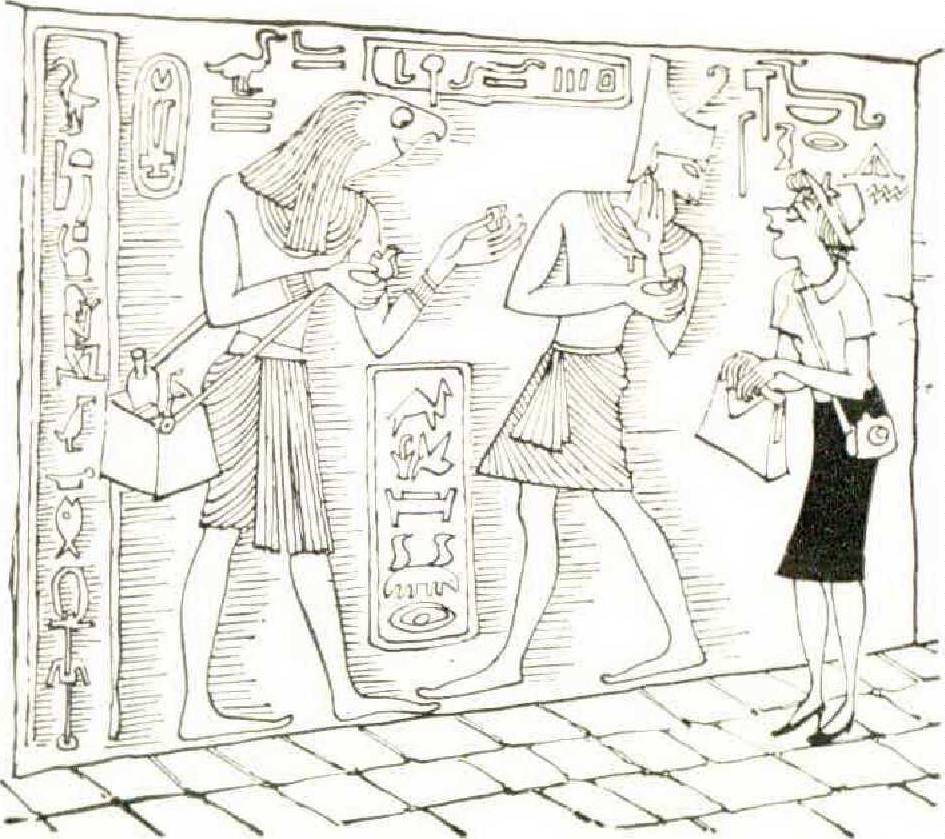
However you feel about Egypt today, there is no denying that it had a pretty magnificent past, and I’ve just come home with some marvelous little fragments of it — I think. Even the best preserved of those threeand four-thousand-year-old tombs and funerary temples, you see, have a lot missing, and they were originally jammed full of stuff, for the ancient Egyptians had to take all their worldly goods into the next world with them, literally including the kitchen stove. The archaeologists have collected all the best and put them in museums, but there must have been a lot they missed or didn’t bother with. The natives have been going over the ground for centuries, too, of course, but even they couldn’t gather up everything.
This fairly rudimentary kind of thinking has bred a special class of tourist, second only to the shutterbugs. While the shutterbugs are scanning the ruins with their light meters, the souvenir hunters, masquerading as amateur archaeologists, are scanning the rubble — which is everywhere — for something, anything, that might be a relic of the past. It is quite a sport.
“That bit of green — look, it’s a mummy bead; only a piece of one but obviously old.”
“Here’s a fragment of pot, and just see that yellow and green design.”
“Probably left by the last archaeologist’s cook.”
“Maybe, but maybe not. I’ve seen that design in museums, and look how black and weathered the clay is. It could go way back.”
“Oh, look, here’s a cartouche on this fragment of limestone.”
“No, dear, that’s just erosion.”
“What makes you think so? See the hawk beak — Osiris obviously — like those inside the tomb. It’s the same limestone. Even the colors are similar. I’m going to ask our archaeologist.”
“Have you seen the little head Mrs. Fortune picked up at the last temple? Her husband found the feet—alabaster they looked like. They plan to mount them when they get home.”
“She has a good eye, but I was told she bought it; and you haven’t seen the wonderful little bit of carved carnelian I found — a marvelous patina. They used a lot of carnelian you know.”
If some of us can pick up souvenirs of our own, it stands to reason that the little boys who live right next door could find still better ones, really good bits of original fresco or fragments of statues. Why not? The tombs were tilled with little statues, The pharaohs and nobles altruistically took all their servitors with them in effigy instead of killing them. Everything is supposed to be turned over to the state, of course. But the state museums already have so much. Little boys are notoriously unprincipled, and so are tourists, at least the kind of tourist I happen to be. If someone offers to sell me a genuine old fragment, will I buy it? You bet I will, and I’ll smuggle it out in my girdle and be one up on Mr. Nasser, whose face I am getting pretty tired of looking at on all available wall space.
I have read the guidebook warnings that every ruin is swarming with natives selling fakes, that the Egyptians are so clever at making copies of mummy beads, coins, old heads, and fragments of relief, even the Egyptologists cannot always tell the difference. Already I’m familiar with the obvious ones: the gleaming alabaster heads of Nefertiti, the granite (or plastic) heads of Rameses, the cheap mummy beads, the antiqued oil lamps. But not everything is like that, and if you’re a good judge of human nature and have a natural eye, who is to say you might not get onto something worthwhile: something real? They are terribly alluring, some of the relics, and so are the little boys who flash them at you from the voluminous folds of their galabias, those loud, full nightshirts that 90 percent of the Egyptian men and boys still wear, the other 10 percent having taken to striped cotton American pajamas.
“Lady.” The eyes sparkle, the teeth gleam white, the hand appears beside the bus window, and there is a jagged piece of limestone, like a thousand pieces lying among the rubble, but on it is a carving of the regal head of Queen Hatshepsut. The colors, rose, gray, gray-blue, are soft and faded with age. Only centuries, millennia, could have given that look surely. The irregular edges of the stone are rubbed smooth by time.
“How much?” My mouth is watering. “It isn’t old, of course.”
“Old, lady. I And near here. Five hundred piasters.”
“Too much.” You have to bargain. I know. “Why should I think it’s old?”
“I find it, lady, and this. Look.” Another piece flashes before my eyes, a young male head this time, Rameses or maybe Tutankhamen, in soft brown and rust and ocher. I want them. I want them both. Of course they may be fakes, but maybe not, and if I can get them cheap — “A hundred. Two hundred for both.”
He shakes his head vigorously, still smiling. “Five hundred both.”
“Too much. Two fifty both.”
“No, not enough.” I have them in my hands, fondling them, examining the patina.
“Quick, lady.” There is sudden fear in his voice. He is gesturing to me to hide them, peering ahead jerking his chin for me to look. And there, coming, is a jeepful of khakiclad soldiers. Suddenly I am as afraid as he is. My hand drops to my lap and burrows under my big handbag. I sit there, trembling, until the jeep has passed.
“Quick, lady, they be back. Three hundred both. Quick.”
“Two fifty both?” The pieces are still in my lap.
“Two fifty, take them lady, but hurry, hurry.” Money changes hands. My bus starts up. We are off before the soldiers reappear, and there I am with my genuine pieces of an ancient tomb.
“Look how lovely,” I say, to convert my scornful husband. “Even if they’re fakes I wasn’t cheated much. And how do you know they aren’t old? Look at the faded color. Look at those worn places, the blackening. You know, I’ll bet they really are, or why was he so afraid of the police?”
“They’re in on it, of course. They get a cut of all he takes this way.”
“Nope, never. There was real fear in the boy’s voice. I could tell.”
All this happens in the Valley of the Queens at Luxor. Two or three days later, several miles up the Nile at Aswan, I am idling through some souvenir shops and I come upon some pieces of frescoed stone with relief heads in color — a little like mine except the color is not so good. These don’t look to me either old or real.
“Reproductions?” I ask knowingly.
“Reproductions, lady. At Luxor they sell these for antiques, but I would not try to fool you.”
Back in my room I get mine out. They have an unmistakable look of age. Entirely different, really, from those reproductions I saw in the shop. But how did they ever carve them, how did they carve any of those huge reliefs, huge figures, back all those centuries past when they had no knives? Our archaeologist tells us they used flint knives, but what a job, what incredible patience. I am haunted by the miracle of ancient creativity.
Next day, at the tomb of Tutmosis III at Amada, I am sitting around waiting my turn to go down inside. A lot of limestone rubble is lying around, and idly I pick up a rather flat piece. My fingernail can scratch it. It is quite soft. Kicking the sand with my toes, I turn up a different kind of flat stone, with a sharp fluted edge. Flint? That’s what they used to use. How did they go about it? Would it work?
Sitting there in the hot sun I begin idly to scratch the soft limestone with the flint. It cuts easily. Could I make a relief? My hand tries to trace the rough profile of a pharaoh with the ubiquitous beaky nose and jutting tuft of beard. One of the caretakers sees me and comes to look.
“Ah, lady, making antique?”