Two-Way Radio for Everyman
CARL DREHER was one of the early wireless amateurs in the United States, one of the earty holders of a commercial operator’s license, a pioneer in broadcasting and sound films, and is a Fellow of the lnstitute of Electrical and Electronics Engineers, the successor society to the American Institute of Electrical Engineers and the Institute of Radio Engineers.
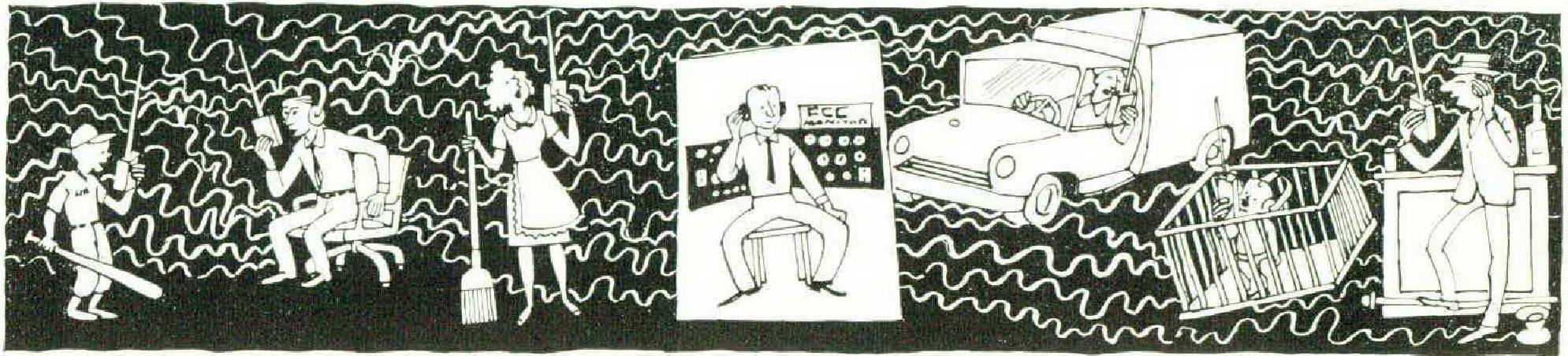
In 1957 the Federal Communications Commission opened up a skimpy slice of wavelengths for what it projected as “Citizens Radio Service,” now known as Citizens Band, or CB. In so doing, the FCC also opened a Pandora’s box for itself. The citizens, however, loved it. There are now well over 700,000 licensed CB users, and their numbers are being augmented at the rate of 10,000 a month. Though not on the scale of the great radio boom of the twenties, or the even more spectacular television boom of the forties, CB represents a respectable repetition of these extensions of the communication arts. Strangely, it has gone practically unnoticed in the magazines, in contrast to amateur, or ham, radio, which economically and socially CB has already eclipsed.
CB has both legitimate and illegitimate functions. Summarized by the FCC, the legitimate function is “to further the efficient conduct of a business or household.” Illicit, but widely practiced, is the conversion of CB into a hobby like amateur radio, but free from the necessity of acquiring a modicum of technical knowledge and proficiency in telegraphy and proving it by passing an examination. CB entails no such ordeal; by act of Congress any citizen over eighteen is entitled to a license. For short-range or walkietalkie operation, he doesn’t even need that.
If you have a shortwave receiver which takes in the 11-meter band, you can explore CB without risking a penny. Just tune sharply in the 26.965—27.225 megacycle band. Though you won’t hear nearly as much as you would with a CB transceiver (transmitter plus receiver) and you won’t be able to talk, you will get a pretty wide sample of America at work and at play. Practically every business can save time and lost motion by communication between a base station and one or more mobile units. Lumberyards, appliance services, fuel oil distribution, building, medicine (physicians) are examples. Even writers — if I feel like going fishing instead of waiting for a possibly important telephone call, my secretary will let me know from the house when the operator is ready with my party. It may not mean much to me, but for a more conventional businessman it can add up to hundreds or thousands of dollars a year in more efficient routing of vehicles and personnel.
You will also get an earful of the gab which the FCC is trying to suppress. The temptation is great because, while CB is mostly a shortrange or local service, at any time the signals can start bouncing off the ionosphere and you hear stations a thousand miles away. So if you are equipped to send as well as to receive, you may start a conversation with a stranger. The danger is that an FCC monitoring station, which also may be thousands of miles away, may record the violation and slap a citation on you. A second citation, and you lose your license. The FCC seems to be more tolerant of short-range conversations.
Without transgressing, you can listen in on all kinds of private conversation. The age spectrum ranges from small children — some freewheeling CBers put their kids on the air — to very, very senior citizens. Male voices outnumber female voices by about two to one. Most of the business base stations are operated by secretaries, in addition to their normal duties. Almost without exception, their circuit discipline is excellent.
Despite moments when I recall Pascal’s dictum that “men are necessarily so foolish that not to be a fool is merely a varied freak of folly,” I find CB not only fascinating, but worth the money. For very short distance work, the investment can be as low as $24 for two walkietalkies. The range will be about a quarter mile. Each set weighs and looks like a transistor radio, which in fact it is, except that it sends as well as receives.
If you want a pair of more powerful sets for your home and your car for your boat), the cost will be $140 minimum. This may provide up to twenty miles for the car, although ten is more likely; the boat is pretty sure to do better. If you insist on the best, you can pay as much as $1000 for the two transceivers, but what you get won’t be ten times better than the $100 equipment.
If you don’t need CB in your business and are not interested in DX (distance), you may still want it for local news and drama. Through various channels, CB gets stuff from the police and fire departments, civil defense, and so on.
CB makes for peace in the family. Whenever my wife goes marketing,
I remember what I wanted her to get as soon as her car has disappeared down the road. This way, when she parks at the supermarket she can give me a shout, as CB parlance has it, and a brief but soothing conversation takes place.
Commuters follow the same routine in reverse. Mr. Q, returning from the city, announces his arrival at the railroad station, where he is directed by Mrs. Q to chauffeur their son from a playmate’s house (in the opposite direction, naturally) because Mrs. Q is tired. She doesn’t sound tired, she sounds high. Still, CB is furthering the efficient conduct of the Q household, even its very existence.
On the serious side, CB is not being exploited as it should be. The FCC, perhaps the most harassed of all the federal agencies, regards it as a problem and seems to wish, sometimes, that it had never started the damn thing. But CB presents opportunities too. In boating, the Coast Guard monitors a safety frequency (not in the CB band, although the suggestion has been made) for distress calls. There is nothing like this for the motorist, who can be distressed too, and in totality a lot more than boatmen. Like anyone who has logged half a million miles on the road, I have found myself stuck once in a while. On an expressway this isn’t too bad; but have you ever walked a mile at 1 A.M. in an outer suburb to awaken an irate citizen with a request that he telephone the state police to summon a garage mechanic? With the temperature at five below?
There are many such situations, including accidents involving personal injury which, at night on secondary roads, may go unreported for hours. If this were a problem in astronautics, it would be solved tomorrow, for fear the Russians would solve it first. Yet all it would require is that one of the twentythree CB channels should be reserved as a motor distress frequency. Over a major portion of the country, the state police have an operator on continuous watch for dispatching. Most of the time he could also monitor the civilian distress frequency. Over the big holiday weekends, when the National Safety Council predicts still another record-breaking toll of death and injury, wouldn’t it make sense to put on another operator, even if it increased the state budget .00001 percent? This is one of several ways in which CB could pay for itself many times over, and provide jobs besides.