"Drop Thy Pipe ..."
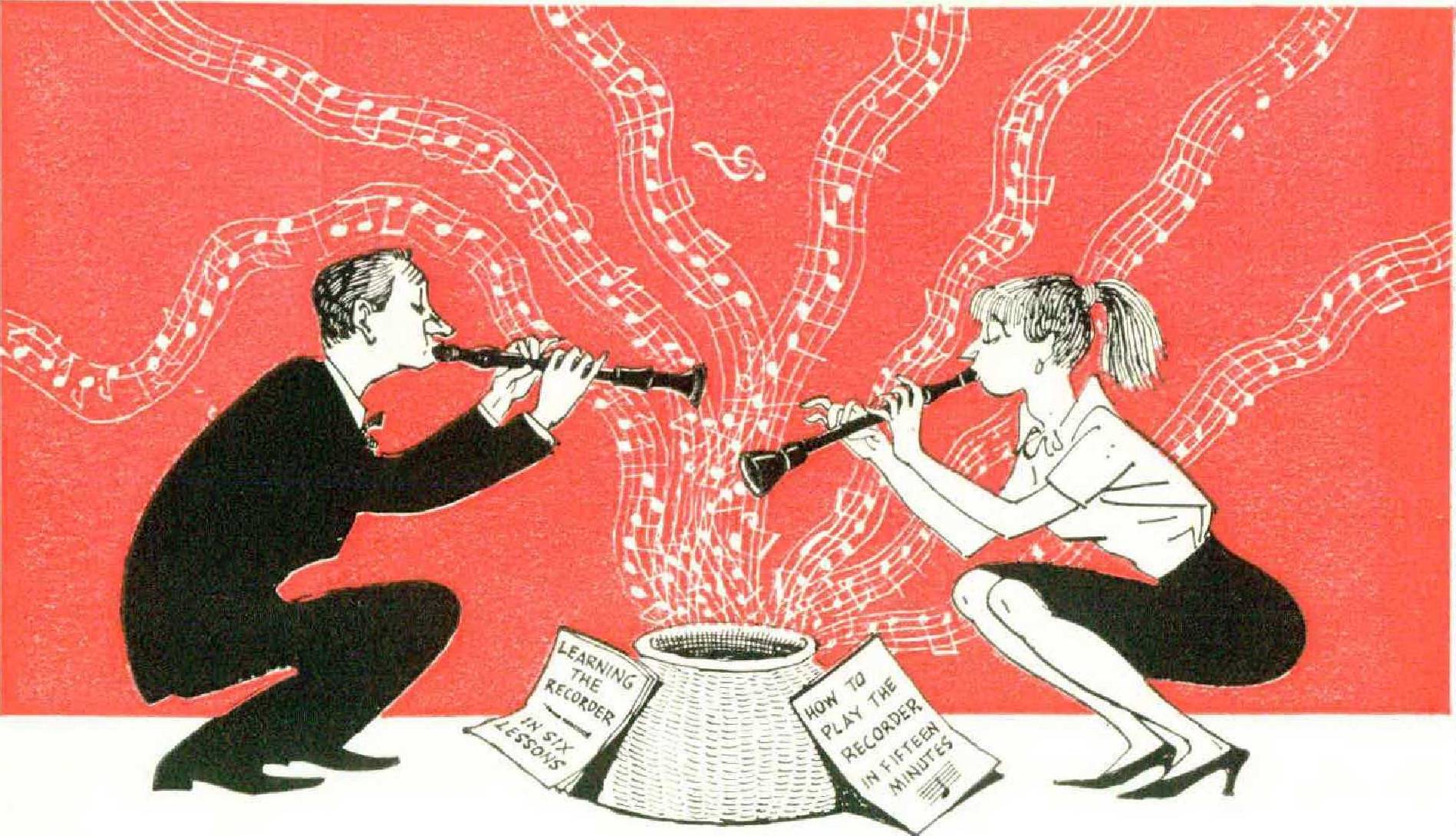
It is high time that the truth about the recorder was faced. I hate to be a balloon-buster, but someone at last has to be honest about this musical pip-squeak, whose importance is bloated out of all proportion at the present time. Since no one else has the courage, therefore, I shall risk excommunication from the recorder societies (there are such, and they are legion) of North America and Europe and hereby declare that the recorder-playing movement is composed of self-deceiving con men (and especially women) and that the pipe itself is a musical fraud.
I don’t make this confession lightly or easily, I have played — or played on—the recorder for something over fifteen years, a time which surely makes me, if not an authority, at least an initiate. But in the last two or three years I have become first worried and now horrified by die spectacle of a mass recorderplaying movement that takes itself and its pipes ever more seriously.
What triggered this attack was a statement by the leader of a Canadian recorder society, who declared that he would not rest happy until he had arranged a concert by a thousand recorder players in his city’s civic auditorium. When even two pipes have difficulty in achieving a common intonation, he wanted to have one thousand of them!
It is hard to believe that the man was serious. After fifteen years of associating with recorder players and proselytizers, however, one is faced with the fact that he was serious. Recorder players are serious. What I take to be good, clean, social fun is something of a religion to the others. They are serious about their music and about their instrument, and they spread the gospel according to Dolmetsch with the fervor of a nineteenth-century missionary society.
But what they preach is apocryphal; a religion based on falsehoods. Number one falsehood is that the recorder is easy to play, so easy that any child can pick up the pipe and toot out a melody. This simple untruth has been knocking about at least since that afternoon of July 26, 1602, when “The Revenge of Harnlett, Prince Denmarke as yt was latelie Acted by the Lord Chamberlyne his servantes” was entered in the Stationers’ Register by James Roberts. “It is as easy as lying.” said Shakespeare through Hamlet. “Govern these vantages with your fingers and thumbs, give it breath with your mouth, and it will discourse most eloquent music.” Will, it is not as easy as lying, and unless one makes a considerable effort and spends a great deal more time in practice than most recorder players are willing to spend, the pipe will discourse highly ineloquent music.
The recorder is not easy to play, and it cannot be “picked up” quickly — a term one often encounters. One can blow into it and produce some kind of note without great difficulty, true. But one can also blow into an oboe or draw a bow across the strings of a violin and produce a note. The difficulty lies in producing the proper note and the proper tone. With its extreme sensitivity to breath pressure and its clumsy and complex system of cross-fingering, the recorder is surely one of the most difficult of wind instruments to play well.
If it is not easy to play the recorder. it is harder still to listen to it. Indeed, listening to the recorder demands such patience and forbearance on the part of an audience that one is tempted to question whether the recorder is a serious musical instrument at all.
For a time the recorder was taken reasonably seriously by composers, at least to the extent that they wrote music especially for it. But what recorder enthusiasts either forget, do not know, or conceal is that there is an extremely small amount of music composed expressly for the recorder, and that what there is was composed almost wholly in the hundred-year period 1650 to 1750. The pipe is historically outdistanced by the trumpet. the oboe, the flute, the trombone, even the organ, for according to Mr. Edgar Hunt in his recent book about it, the recorder cannot be traced historically much earlier than the fifteenth century. It was used by minstrels for court music and at fairs, but the idea of a performance by a consort of recorders is more probably a modern concept than a legitimate historical one. Certainly there was little music designed especially for the recorder before the middle of the seventeenth century. As far as the Elizabethan period in England is concerned — and we know howr common the recorder, the lute, and “Greensleeves” are for atmosphere in modern productions of Shakespeare — the best that Mr. Hunt can do is the following:
We search in vain for any specific items [in Elizabethan England] for the recorders, and in our disappointment realize that if we make our own arrangements of other instrumental music, we are probably doing exactly what Elizabethan recorder players did.
Even the references to the recorder in Pepys’s diary, which are often cited as evidence of the popularity of the instrument in the second half of the seventeenth century, tend rather to suggest that it was not widely used, at least not in 1659, when the diary entries were made. Had the recorder been in common use. Pepys would hardly have described it as the novelty that he obviously found it.
The number of composers oi any standing who wrote music intended for performance on the recorder is very small, and their names crop up with predictable frequency in recorder circles: Purcell, Handel, J. S. Bach, and Telemann. Purcell, certainly, used the English flute and used it as well as any composer used any instrument. In his writings alone can the recorder perhaps best be accepted as a musical instrument, genuinely irreplaceable by the transverse or orchestral flute. But Purcell also had an unfortunate tendency to write for the male alto voice, and we know how that falls on the modern ear.
Handel and Bach wrote considerably less music for recorder than publishers of recorder music would have us believe, and most of what Handel composed appears to have been written for performance on either the transverse flute or the recorder, as the player wished. As far as Bach is concerned, 1 defy anyone to tell me that he wrote those works that are supposed to be for recorders with the pipe in mind and not the tongue in cheek. Herr Johann Sebastian was having a good laugh at all Blockfloteneers when he indicated the use of recorders (or their German equivalents) in the second and fourth Brandenburgs — as any honest player who has taken a running jump at either of them will admit.
The same thing is true of Telemann’s writing for the recorder — his pieces are incredibly difficult to master, and they have the added burden, like most of his music, of being almost unbearably dull to listen to; the current Telemann revival, unfortunately, has been insufficiently delayed. Pepusch, Sammartini, Paisible, Loeillet, Fux, and other little-known composers dabbled in music for the recorder, but even by the time that Bach’s sons were writing, the recorder had ceased to be taken seriously; neither J. C. nor K. P. E. Bach wrote for the Blockflote. as far as is known, nor did any later composer until the revival of the pipe in the present century.
There is. of course, a valid reason for this neglect: the recorder is an instrument that should be played and not heard. It can be fun (although it is not necessarily so) to sit down with a group of friends to tootle for an evening, playing music that in Elizabethan England would have been sung but that now, with the decline in the ability to read music for vocal purposes, has become unapproachable except through some more mechanical means than singing. But it is not fun. as an auditor, to have to sit through such an evening. I he best ensembles in the world Krainish the Trapp family, Dolmetsch’s group—cannot provide a really interesting concert because the recorder simply does not have what it takes to be a performing instrument. Its tone color is pure to the point ol virginity, and its dynamic range is almost nonexistent. After twenty minutes the most accomplished group begins to sound like nothing so much as an overly discreet, genteel, and undernourished steam calliope.
And yet the recorder, scarcely a musical instrument at all. difficult to play, is currently the fastest-selling musical item other than phonograph recordings in the world. According to Carl Dolmetsch, “the manufacture. export, and distribution ol recorders lias become one of the major musical-instrument industries of the day. They are produced by the hundred thousand yearly and find their way into every corner ol the globe.” Why the tremendous popularity? Two reasons, f think.
In tlie first place, the recorder’s brief period ol use by serious composers happens to be the one that is currently receiving a great deal ol attention from critics, musicologists, small recording companies, and the upper-monaural classes — the Purcell-Bach-Handel age is “in,” and with it an exaggerated interest in the historical instruments of the period. Purists insist not only on the ur-text but on the ur-instruments as well, and so we have been subjected to a whole range of aural-hardship survival courses, involving the return, for example, of the viol family, an outrage surpassing even that of the recorder. A consort of viols, wailing in vibratoless agony, always brings to my mind the picture of a fat lady in galoshes wading through a slough of hot marshmallows. There has been, too, an increased, if relatively inaudible, use of the harpsichord and the even more inaudible clavichord, which has to be believed to be heard. Oi the others — the serpent, the cittern, the shawm, the Handelian oboe - the less said the better. Fortunately, most of the instruments arc relatively expensive and. thus, relatively inaccessible.
Most, but not all. And herein lies the second and probably the main reason for the popularity ol the recorder: it is cheap. You can buy a soprano recorder for as little as a second-rate kazoo, and the most expensive recorders rarely cost over a hundred dollars, a small price compared to that of oboes, flutes, sousaphones, and other legitimate instruments.
In the very cheapness of the recorder. however, lies my hope for the early death of the recorder movement. I say this not just because the low-priced pipes inevitably are badly made and hopelessly out of tune, but also because the low prices have brought the recorder within the reach of virtually anybody, especially the anybody who feels he wants to or, worse, ought to “make music”: first, the arty-crafty types, who in my youth were wont to dip pencils in assorted vats of colored wax and to affix long silk tassels to the technicolored and vaguely phallic results; then, those amateur and misguided musicologists who insist upon the ur-perlormance of music and who proceed to “ur’ the recorder into every historical period possible; and the do-it-yoursell fanatics. who in their extreme form (usually feminine) even make their recorders, complete with intonation difficulties that would stagger a classical Chinese flute player; and. finally, the guilt-assuagers, those who have been lining the walls of their apartments with LPs, who now find an inexpensive and reportedly easv way of relieving the guilt complex of the spectator sportsman.
Of these forces is the recorder movement, in all its horrid fury, zeal, and plain noise, composed. For here in the recorder, for a mere $3.95, give or take, is the means whereby the arty-crafty, the musical primitivist, the guilt-ridden auditor — all of them — can make music.
But, alas, music is just what they cannot, or certainly do not, make.