The Power of James R. Hoffa
A member of the editorial board of the New York TIMES,who has been consulted in many an arbitration, A. H. RASKIN is keenly aware of the problems which the threats of automation and unemployment have imposed on the unions and on management. This is the fourth in his series of articles on the nations biggest labor unions. His next will deal with the longshore and maritime unions.
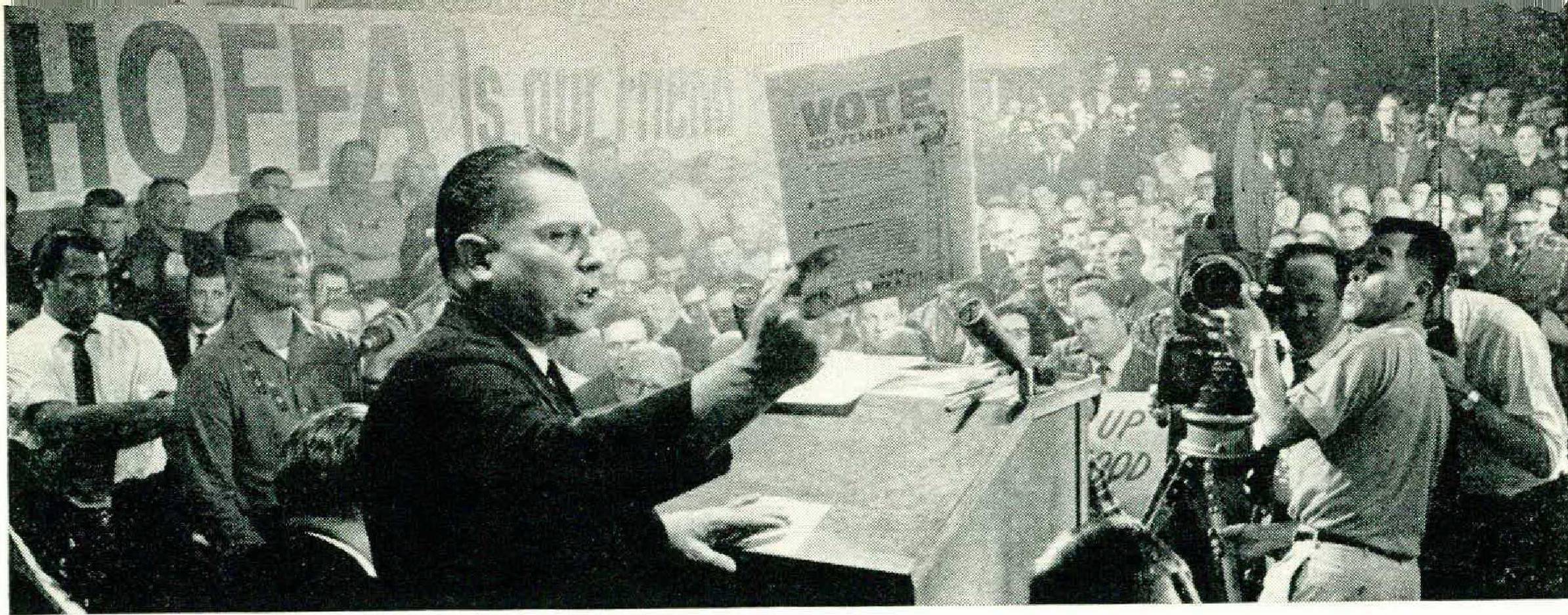
THE International Brotherhood of Teamsters, the nation’s biggest, strongest, and most investigated union, is a monument to the sweet uses of adversity, a testimonial to the proposition that nothing succeeds like bad publicity. For nearly seven years all the awesome powers of the federal government, reinforced by every instrument of mass communication, have been focused on the destruction of the union’s iron-fisted president, James R. Hoffa. Yet both Hoffa and the Teamsters have prospered, while the AFL-CIO, which cast them out as a disgrace to organized labor, is sunk in bureaucratic torpor.
True, this inverted morality play is not over, and the implacable resolve of Attorney General Kennedy to “get Hoffa” creates a better-than-even chance that the cocky Teamster chief will eventually wind up in jail — an ambition to which Mr. Kennedy’s brother, the President, dedicated himself in the 1960 campaign. But, whatever the position of the players when the final curtain comes down, the factors that have enabled the union led by Hoffa to grow bigger and vastly more powerful in the face of the most sustained, most widespread public hostility ever concentrated on a single labor organization provide an insight into the power structure of our economic society that is as disturbing as it is illuminating.
The 20,432 pages of testimony about labor-management malpractices gathered by the McClellan Committee in its three years of televised hearings contribute only foggily to this insight, even though they, and the criminal proceedings against Hoffa they engendered, represent the start and finish of most evaluations of the Teamsters as a social force.
The important thing about the Teamsters is not Holla’s web of underworld associations or his contempt for conventional standards of union ethics, but the extent to which his code is accepted uncomplainingly, even enthusiastically, by the members of his union and the great bulk of the employers in his industry, to say nothing of many leaders of the federation, which has labeled him a pariah. Of parallel importance — and more menacing still in their economic implications — are the strategic command that the union’s 1,500,000 members give Hoffa over the country’s distribution lifeline and the influence he is thus in a position to exert over most other unions and industries.
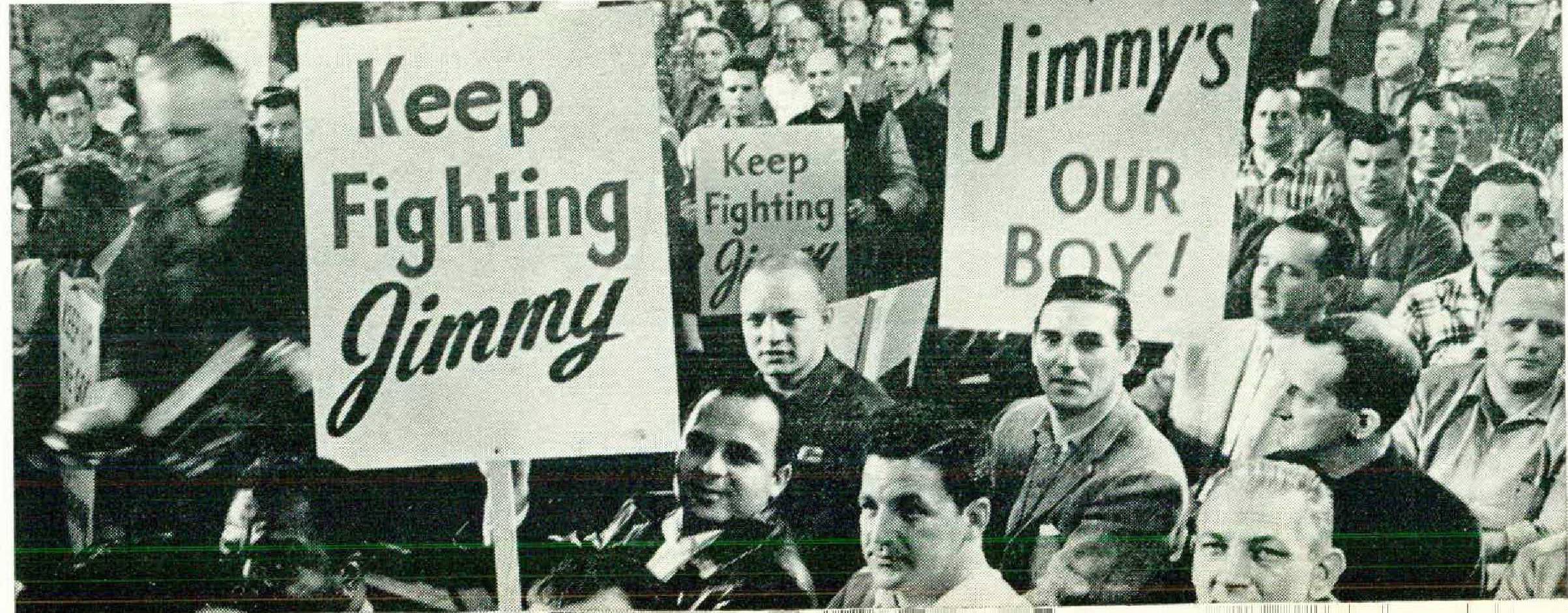
This year Hoffa confidently looks forward to putting the capstone on an edifice he has been building, brick by brick, for nearly a quarter century — the achievement of the first nationwide trucking contract. This, as his enemies never tire of pointing out, would put him in a position to stop a million local and long-distance trucks with a single strike order. But Hoffa ridicules such fears. His success in using divide-and-conquer tactics to play the selfish interests of one group of truck owners against those of another has left him sublimely sure that he can always get what he wants without paralyzing the nation.
There is nothing vainglorious about this belief, nor does it represent the zenith of Hoffa’s ambitions. On the contrary, the projected national trucking agreement is merely the underpinning for a far more pretentious structure of interrelated industry-wide union contracts — all of which would expire at the same time — through which the Teamsters could extend their economic leverage into the domain of unions in every field dependent on trucking.
Since there is nothing, from baby’s milk to rockets for Project Apollo, that does not move at some stage by truck, the range of potential alliances is as broad as the economy. No farm, factory, store, or warehouse would be untouched. In a period when automation is circumscribing the size of most other unions and the effectiveness of their strike weapon, many are likely to find singularly appealing the opportunity to have their bargaining objectives underwritten by the Teamsters’ undiminished economic muscle. The price of partnership in sacrifice of autonomy may be high, but not too high for unionists who feel disarmed by the inadequacy of their defenses against the job-killing impact of changing technology.
The dream of such a labor superfederation, with the Teamsters as its sparkplug, is Hoffa’s dream, but the power on which it is based is the Teamsters’ power, and it would not evaporate if the restless, ruthless Hoffa were swept out of the driver’s seat and into a federal penitentiary. The idea and the machinery to implement it would remain as Hoffa’s legacy, a testament to a brain as cunning and resourceful as that of any builder of our gigantic corporate complexes in public utilities, railroads, or manufacturing.
TO MAKE sense out of the Humpty-Dumpty version of the Horatio Alger story that is the career of Jimmy Hoffa, it is instructive to look back thirty years into the history of both Hoffa and his union. Hoffa called his first strike when he was eighteen years old, a tough kid who had to quit school after the ninth grade. He was unloading freight cars on the platform of the Kroger grocery warehouse in Detroit. It was 1932, the depth of the Depression, and the pay was thirty-two cents an hour when there were cars to unload. “The rest of the time you just sat around, waiting for more boxcars to come in.”
Detroit was a citadel of the open shop. There was no United Auto Workers at General Motors or Ford or anywhere else. Talking union was a sure way to lose your job and be blacklisted for any other. But Hoffa did not scare easy, then or now. “I got interested in unions because we were getting kicked around. We started talking about it on the sly. We got four other people together who agreed to be leaders, and we talked it up.”
The instinct for the jugular that has always been the foundation of Hoffa’s economic strategy manifested itself in his first engagement with Kroger. He decided that timing had to be the key for a successful strike, one that would be over almost before it began. His moment came when a carload of strawberries rolled up to the warehouse. The workers folded their arms, and Hoffa notified management that the workers had formed an independent union and would not go back to work until it was recognized. The company wilted before the strawberries did. The strike was over in less than an hour, and the strawberries became Hoffa’s launching pad to the top rung of unionism.
It was a rough ascent, and long before he reached the top. Hoffa had developed a cynical conviction that nothing in our society was fair, least of all the forces of law and order. “The police would beat your brains in for even talking union,” he recalls. “The cops harassed us every day. If you went on strike, you got your head broken.”
When he took over Detroit’s two puny, debtencumbered locals of the Teamsters Union, the truck owners sent goons to smash his office furniture, to plant dynamite in his car, and to rough him up. “There was only one way to survive — fight back. And we used to slug it out on the streets. They found out we didn’t scare.”
Not all his battles were with the employers and the police. His bellicose ways did not endear him to the deadhead leaders of the international union in the Midwest; they turned a deaf ear to his appeals for organizational and strike support. Out of it all came the central guiding principle of Hoffa’s life: You get what you take. Nobody gives you anything except what you fight for.
But Hoffa never would have climbed very far in his ascent to power if he had confined his concept of fighting to the rule of club and claw. His fists were, and have remained, a prized part of his arsenal; musclemen have always been prominent in his entourage. But with this reliance on brute force has gone an extraordinary deftness in the manipulation of power. He has played employer against employer, union against union, with a sense of realpolitik equaled only by the most accomplished of world diplomats.
Characteristically, he took as mentor in evolving his anatomy of power a unionist whose ideas of the end uses of power were 180 degrees removed from his own. Farrell Dobbs, a Minneapolis Teamster leader in the turbulent years when Hoffa was slugging his way up in Detroit, was the author of the centralized bargaining strategy so successfully employed by Hoffa to consolidate power in his hands.
An exquisite irony, worthy of extended study in a graduate school of political science, is embodied in Hoffa’s emergence as the implementer and perpetuator of the Dobbs economic theories. Dobbs was a political idealist, so devoted to the precepts of proletarian revolution preached by Leon Trotsky that he quit the union at the peak of his prestige and four times made the forlorn race as presidential candidate of the Socialist Workers Party. Hoffa, whose bleak view of idealistic motivation is summed up in the observation, “everybody has his price,” has always put politicians in the forefront of the “for sale” category. His scorn for “longhairs” and “save-the-world” types is unreserved.
THE distinctive new element that Dobbs and his Trotskyite associates in Minneapolis — Vince, Miles, and Grant Dunne — introduced into Teamster tactics was the organization of long-distance truck drivers as the integrating element in bringing all trucking in the Midwest under standard union agreements. The concept of area-wide negotiations was alien to Teamster tradition in that period. The union was a relatively loose confederation of local baronies, each sovereign unto itself. Daniel Tobin, then the union’s president, was a man of substance at the White House and in the councils of the American Federation of Labor. He was closer than any other labor leader to President Franklin D. Roosevelt, and he bossed William Green, the Milquetoast head of the AFL, with shameless arrogance. But he walked softly in the presence of the men who exercised imperial rule over the big Teamster units in New York, Chicago, and other major cities.
They operated in a dog-eat-dog industry, with thousands of small employers devoting much of their energy to trying to steal business from one another. Some of the fleet owners were former rumrunners and hijackers forced to go legitimate — but not very — by the repeal of the Volstead Act. Under-the-table agreements to get an edge on labor costs were frequent. So were payoffs to everyone from union business agents to the cop on the beat. No one paid much attention to unionizing over-the-road drivers; the great bulk of long-haul freight still moved by rail, and the union hierarchy, from Tobin down, viewed the highway drivers and the fly-by-night truckers for whom they worked as riffraff unworthy of enrollment under the Teamster banner.
Not so the politically oriented Dobbs and the Dunne brothers. They had used the technique of the general strike to obtain total domination of the trucking industry in Minneapolis; they counted on the over-the-road drivers to serve as evangels of their brand of unionism through a much broader area. The initial reaction from the parent union was frosty; it sent in strong-arm squads to discourage the expansionist move of the Minneapolis local.
Whether Hoffa came as enemy or ally in the first instance is lost in the haze of history, written and rewritten. Paul Jacobs, director of the trade-union study project of the Center for the Study ol Democratic Institutions, who was a young Trotskyite on the fringes of the Dobbs-Dunne organization in the mid-thirties, recalls Hoffa as a member of a goon squad sent in by Teamster headquarters to help smash the Trotskyite hold on the local. Hoffa’s own version, as told to Ralph and Estelle James of the University of California’s Institute of Industrial Relations, is that he came as the most junior of a little band of Midwestern Teamster officials that gave the Dobbs enterprise support from the start.
In any event, Hoffa was quick to grasp the potentialities of the network Dobbs was threading together. The Minneapolis leader got a somewhat flickering green light from Tobin in 1937 to organize over-the-road drivers, and he speedily formed a central council to seek uniform wages, hours, and working conditions throughout the Middle West. Adroit use of the leverage afforded him by the weakness of the employer associations in the industry, the vulnerability of individual companies to selective strikes in their unionized terminals, and the necessity for “interlining” transcontinental shipments from one regional carrier to another brought Dobbs a whirlwind victory — at the cost of only one serious strike, in Nebraska.
By the end of 1939 he had cemented his hold on the Central States and was reaching out for new territories in the Southwest to bring under the umbrella of the standardized agreement. But victory had lost its savor for Dobbs. His mind was on the war clouds gathering over Europe. Spurning Tobin’s proffer of a post as international vice president, he resigned to devote all his energies to the Socialist Workers Party and to keeping this country out of war.
His heir, after a brief interregnum, was Jimmy Hoffa, and the Central States Drivers Council has become Hoffa’s chariot to power, the generator of the national contract through which he hopes to unify the standards of 400,000 drivers from coast to coast this year. The freewheeling adjustments he has made in the Dobbs pattern have been detailed by Professor James and his wife in two remarkable articles published last year in Industrial Relations, a University of California journal.
Hoffa gave them an access, more direct than any other outsiders have been allowed, to the inner workings of the negotiating and grievance machinery on which he relies to dominate both industry and union. They set forth their findings with the clinical detachment of medical researchers describing the spread of cancer through a body. There is none of the melodrama of the McClellan hearings, no moral preachments, no excoriation; yet the totality of their recital is even more chillingly depressing than the Senate record in the inexorableness with which it points to one overriding fact: Each limitation Congress has sought to clamp on Hoffa’s power has been negated by the dexterity with which he and his legal battery have refashioned and reinforced the instruments of his rule.
Some of his techniques for exerting an economic squeeze on balky employers have become so subterranean that even a James Bond would find it impossible to trace the secret telephone calls and manipulations through which one layer of pressure is carefully placed atop a second layer and perhaps a third or fourth until the trucker decides to capitulate. A manufacturer may find his goods subjected to “unavoidable” delays or delivered to the wrong address until he builds a bonfire under his trucking company to go along with Hoffa. But usually such subtlety is superfluous.
Hoffa’s most dependable allies in breaking the will to fight of holdout truckers are a handful of giant transcontinental haulers. Again and again they have been his stalking horses in areas where smaller operators showed signs of standing together against regional compacts. Hoffa lets the objectors know that he is prepared to sign separate agreements with their big competitors and thus put them in a position to get even bigger while the little fellows are shut down by a strike. In the affairs of the American Trucking Association, which has periodically talked about establishing a national system of strike insurance or some other mutualassistance program to guard its members against Hoffa’s brand of industrial cannibalism, it is the big companies that customarily are most active in making sure that the protective devices never get past the talking stage.
Even more startling as a prop for the Hoffa throne is a grievance structure ideally gaited to serve as a device for rewarding his friends and punishing his enemies on either the company or union side. Most unions and employers have taken both favoritism and conflict out of the grievance procedure by leaving the final decision to an arbitrator if no direct settlement is reached. But Hoffa derides arbitrators as expensive haggle-masters, more interested in avoiding offense to either side than in dispensing justice.
Under the Teamster procedure the union is free to strike if a grievance is not settled — a powerful whip over the employer. Hoffa, always a takecharge guy, sits in the joint appeals committee in what amounts to the role of chief justice and chief executioner. An uncooperative employer is likely to get hints that the union will “throw the book” at him. An obstinate business agent can be made to lose face with his rank and file by being sent back the loser in case after case. No systematic record of past decisions is kept, so it is virtually impossible for anyone to complain that the balance has been unfairly tipped against him.
BUT to concentrate on all these appurtenances of power — and a dozen others equally calculated to make him master in the Teamsters’ glass and marble palace a few hundred yards from the Capitol — is to overlook the essence of Hoffa. He is not head of the Teamsters Union because the constitution — rewritten by a committee he chaired and passed by a convention over which he presided — gives him more centralized authority than any other union chief in America. He is president of the country’s most strategic union because he has the overwhelming backing of its million and a half members.
This says something for Hoffa. And it says something for his members, exposed as they have been to seven years of charges that their leader has turned the union into a hoodlums’ paradise and has used his vast power in ways that his Senate critics called “tragic for the Teamsters Union and dangerous for the country at large.” It is, of course, fashionable to dismiss the Teamster rank and file as members of a subculture so accustomed to the notion that “everybody steals” that they are content to forgive Hoffa any trespass so long as he keeps delivering them fatter paychecks and more generous welfare benefits every year. But to one who has spoken to many hundreds of individual Teamsters at terminals and loading docks in a half-dozen major cities since 1957, the idea that they are a special breed, untypical of Americans generally, is foolish.
They give no sense of being callous or sunk in cynicism. They do not live in a world apart, as do coal miners, whose manhood is stripped away when the mine closes for good. They differ little from auto workers or steel workers in the urges and satisfactions to which they respond. Many are churchgoers, heads of families, war veterans, a few even college graduates. If they lack polish, that is hardly a surprise. As Joseph McDonald, a moonfaced, barrel-bellied driver in Hoffa’s home local in Detroit, put it, “We didn’t build our union in this tough industry in a town this size with feather pillows.”
When Ann Landers, the advice-to-the-lovelorn columnist, ran a letter from a girl who did not want to invite her fiance’s friends to their wedding because they were truck drivers, a torrent of angry replies cascaded in from truck drivers wives. The one Miss Landers chose to print came from a college graduate who cited some of the joys of being wed to a Teamster:
We have three bright children, own a comfortable home, take a three-week vacation every year (twice to Europe since ‘56) and I have a beautiful nine-stripe beaver coat with a mink collar. The girl who wrote that letter must be living in the Dark Ages. Today truck drivers make a handsome living. Many of out friends who are professional people and executives of large companies are struggling to get by, but not us. I am proud to be married to a Knight of the Road. SHE should have it so good.
The closest Hoffa ever gets to sentimentality is when he is talking about Teamsters. “Our members are different from anybody else,” he says. “The people in our union know the guys they work for wouldn’t give ‘em a cracker without the union. You can walk on any dock and blow the whistle. They’ll all go out and never ask why. They’ll figure there must be a reason.”
He says it almost reverently. It is the secret of his power, and he never forgets it. So long as the men at the wheel and on the loading dock are behind him, he can thumb his nose at his detractors and say, “Hoffa don’t need nobody. Hoffa can do this job alone.” The $75,000-a-year salary and the years of good living have not separated him from “the guys that made me.”A month away from his fifty-first birthday, he still looks like a guy ready to climb over the tail gate of a truck, and he seems most alive when he climbs into the cab of a fortyfoot rig and gabs with the driver about four-banger engines and how to hold the mark on the clock while going from fourth overdrive into fifth.
He is tireless, the embodiment of Jimmy Higgins, the legendary rank-and-filer who never stops working. When die AFL-CIO moved into Philadelphia to “bury Hoffa,” after an insurgent faction in the big Teamster local there had come close to toppling Ray Cohen, one of the gamiest of Hoffa’s lieutenants, the Teamster head took personal command of the rescue party. He spent fifteen weeks in the City of Brotherly Love, talking personally to every member of the local he could reach. By the time the National Labor Relations Board ran a second election last April, he had convinced enough of the eight thousand unionists to give the leamsters a two-to-one margin. In the process he learned a lot about Cohen’s own deficiencies, a subject on which he had exhibited a totally closed mind when Cohen invoked the Fifth Amendment ninety-seven times before the McClellan Committee or when he was subsequently cited for looting the local treasury. The end result was Cohen’s resignation in October.
But there are no signs that his departure means a general exodus of the rogues’ gallery of Teamster bigwigs whose presence in positions of influence prompted the AFL-CIO Ethical Practices Committee to recommend that the union be expelled in 1957. Since Hoffa’s name led the list of those the federation considered unacceptable, the purge could scarcely be complete enough to satisfy George Meany, in any event.
Meany, just re-elected at the age of sixty-nine to a new two-year term as the federation’s president, stands as a granitelike bar to the readmission of the Hoffa-led Teamsters. Without his opposition the demand for taking the truck union back would be irresistible. The ethical practices drive, proudest adornment of the merger compact in 1955, was tucked away in mothballs when Congress passed the Landrum-Griffin Labor Reform Act of 1959 in the delusive hope that it would cut Hoffa down to his five-foot-five-and-a-half-inch size.
Meany’s coldness toward Hoffa is as unrelenting as Bobby Kennedy’s. And Hoffa’s feeling toward both of them is no less icy. He considers the Attorney General a spoiled brat, determined to bend everyone to his will. “Something is happening in this country by the name of Bobby Kennedy,”he told a convention of Pittsburgh transportation executives last February. “Today it is me. You may be next.” Of Meany, he says, “When you’re old and decrepit on top of being stupid, you’re in trouble. Some day the man is going to come to the door and tell you you’re out of business. He’s blocking us now, but he can’t live forever.”
The same divide-and-conquer tactics Hoffa has invoked so often to split employer fronts are being applied to cause rifts in the AFL-CIO — a task that requires little outside stimulation. In a four-hour tape-recorded interview with Playboy magazine last November, Holla solemnly proclaimed his belief that when Meany died the one right man to succeed him would be Walter P. Reuther.
“I don’t always agree with what Reuther is doing or how he operates,” said Hoffa, “but I recognize the fact that he runs a successful union, that he’s a hard worker, a smart fella, he knows his business, he’s currently up to date on the problems of the country, and he’s trying to do something about them, and that’s more than I can say for most people.”
Reuther, for all the impatience he has exhibited at periodic stages to move into labor’s number one spot, has shown no eagerness to make Hoffa chairman of his fan club. The UAW head is the high priest of austerity in top union office, and it is not so long ago that Hoffa was mocking him before Hoffa’s own local for spouting socialism and oneworldism, instead of talking a language the workers understand. Hoffa, then as now, viewed unionism as a business, with the leader’s job to sell his members’ labor “at the highest buck we can get.” To Reuther this reduces unionism to the level of a cash register or a slot machine. But such ideological refinements are of no concern to Hoffa when he is in the market for a marriage of convenience.
He is as full of bounce as ever, and as audacious. He made that clear a few weeks ago when he unveiled His initial asking price in his push for a nationwide trucking pact. The fleet operators, who had expected a modest bill the first time around to soften some of the public outcry against the “arrogance” of the basic power grab Hoffa was engineering, gulped when they read the figure on the package — $600 million for a three-year agreement. Just to make the whole thing more irritating to all, Hoffa rushed to point out that the employers could not expect to foot the cost out of their own profit margins and would have to pass it on in higher freight rates. This was another way of saying the increase — more than double any that would fit within the present Administration’s guidelines for wage-price stability — would filter through the economy and wind up, with appropriate markups for every way station in the distribution network, as an extra charge on the consumer.
BUT bravado of this sort is not always a sign of confidence where Hoffa is concerned. Some of his intimates suspect that he is beginning to crack under the recognition that there will never be any respite in his war with the Attorney General. How long can he dance away from the litigation in which he has been ensnarled since he took over for Dave Beck in 1957? Court-appointed monitors sought to oust him and his chief cronies in his first year; he wound up by ousting them. The Justice Department brought him to trial for bribery and illegal wiretapping, and both times, after involved legal maneuvering, he walked out of court free.
A federal judge dismissed an indictment accusing him of mail fraud and misuse of $500,000 in union pension funds in a Florida land deal. His trial on charges of taking illegal payments from an employer through a dummy corporation set up in his wife’s maiden name wound up in a hung jury. But the end is nowhere in sight. Still awaiting decision are indictments for jury-tampering in connection with the last trial and for conspiracy to obtain $20 million in fraudulent loans from the Central States pension fund. The Internal Revenue Service has charged him and his wife with shortchanging the tax collector by $20,259 on their 1959 federal income tax, and no one knows what additional charges will come out of the special investigative units that have been scouring his records and those of the union with an intensity well in excess of any normal call of duty.
If there was any doubt that the Attorney General still feels as strongly that Hoffa is a menace as he did when he wrote his best-selling book, The Enemy Within, shortly before he took office, Senator McClellan cleared it up for a delegation of Teamster wives from Arkansas who grilled him in his office on Capitol Hill last summer. When one lady asked whether he believed Mr. Kennedy should give a detailed public accounting of the money he was spending to “get Hoffa,” the senator gave a frank reply to one part of the question.
“I know the feeling between Hoffa, maybe, and Kennedy,” McClellan declared. “That is natural. Kennedy feels that Hoffa is a crook and a criminal. He feels like he has a duty to prosecute him if he finds that the evidence warrants it. So there is nothing unusual about that.”
In Kennedy’s first thirty-three months as Attorney General, the Justice Department obtained 168 indictments and informations against Teamster officials or persons involved in deals with them. Ninety-three of these indictments resulted in convictions, eight in acquittals, and fourteen in dismissal of the charges, usually on the government’s own motion. The prospect is for more, not less, such prosecution in the months ahead, plus an intensification of moves in Congress to adopt special laws aimed at frustrating Hoffa’s drive for national bargaining by putting his union under antitrust restraint or by outlawing industry-wide strikes in the transportation field. The precedent established by the passage of the railroad compulsory arbitration law last August has already brought a warning from Hoffa to his general executive board: “We’ll have compulsory arbitration of disputes whenever the working man is winning his strike. But no one has ever seen the Government come to the rescue of a working man who was losing a strike against his employer.”
Most of his private conversation these days has a similarly gloomy twist. He sounds like a cross between Schopenhauer and Jeremiah, with overtones of the old Purple Gang that ruled Detroit’s industrial rackets when Hoffa was battling his way to union power. The country is run by a “whore’s government”; the newspapers never tell the truth about anything, least of all labor or Jimmy Hoffa; the big corporations can steal the public blind without reproof while the poor go to jail for taking a loaf of bread; unemployment condemns millions to permanent misery while a gutless labor movement confines itself to pious declarations of impotent dismay.
For the record, however, Hoffa exudes good cheer. “We’re growing and getting along fine,” he reports. The Teamsters are organizing everything from aircraft workers to salesmen of jazz records. It would take a Sears Roebuck catalogue, he boasts, to list all the fields his union is active in. It is on the ballot in one out of every four union elections that the N.L.R.B. holds anywhere in the country. And Hoffa is ready to hop a plane anytime to go anywhere to extend its organizing range. But with him goes the shadow of the court cases that often immobilize him for weeks and months at a stretch. There is a testiness in his manner, a sharpness with his aides. One irreverent organizer who responded to a series of barked orders with a mock Hitler salute and a “Hail, Caesar" had to duck a flung ashtray.
His army of lawyers, so numerous that they are dubbed the Teamster Bar Association, find themselves taking advice more often than they give it. At the 1961 convention, where the legal framework for drawing reluctant locals into a national agreement was inserted in the union constitution, Hoffa repeatedly overrode the majority view of his counselors on what he could or could not do within the boundaries of the Taft-Hartley and LandrumGriffin acts.
On one provision particularly cherished by Hoffa the lawyers were unanimous that what he wanted to say could not be upheld under the most elastic interpretation of the federal statutes. Alter hours of unavailing effort to persuade Hoffa to scrap his brainchild, one lawyer said flatly, “Jimmy, there’s no point arguing. You’re just wrong.”Hoffa’s response was instantaneous. “Dammit, dammit,”he said, “I may have faults, but being wrong ain’t one of them.” The clause went into the constitution. It is still there.
THE cult of personality is so firmly rooted in the union headquarters that it is heresy even to discuss who would take over if Hoffa finally lost in one of his jousts with the law. He might try to be an absentee landlord, with a figurehead president in nominal control while he pulled the strings from his prison cell. But the likelihood that his adversaries in the Administration would allow such phantom rule is slim, especially since there are signs already that Hoffa’s grip on his executive board is much more tenuous than his hold on the loyalties of the union rank and file.
One ranking Teamster says that Hoffa can be sure of the backing of only two of his thirteen vice presidents in a secret ballot and that secret feelers already had been extended to the Kennedy Administration to discover the terms on which the cold war between the government and the Teamsters might be called off if Hoffa were removed from the scene. But there is no prospect of a palace revolution and no lining up of power blocs in anticipation of what might happen if Hoffa should be out of the picture. While the spotlight clings to Hoffa and his gyrations on the national scene, Teamster units in many cities are prominently involved in ptojects for community betterment.
In New York, where local Teamster identification with civic affairs was once almost entirely on the basis of “what’s in it for me?” the Teamsters Joint Council, headed by John J. O’Rourke, an international vice president, has become the most articulate voice of community conscience in combating the poverty and illiteracy that entrap vast numbers of Negroes and Puerto Ricans in the country’s richest city.
In St. Louis, Harold J. Gibbons, executive vice president of the parent union and head of a warehouse local that has long been a mecca for labor delegations from foreign lands, has announced plans for a $16 million senior citizens’ project. The Gibbons local has for a long time maintained a system of community stewards to provide a link between its members and the day-to-day affairs of the neighborhoods in which they live.
In Crystal City, Texas, a dusty little farming town near the Rio Grande that calls itself the “Spinach Capital of the World,” the Teamsters provided much of the money and manpower needed to promote a successful ballot-box revolt by the community’s Mcxican-American majority last April. When it overthrew the political domination that a tiny minority of “Anglos had exerted over Crystal City throughout its history, one feminine diehard shouted, “Next they’ll be tearing down the statue of Popeye and erecting one of Jimmy Hoffa.” A Teamster business agent is now the town’s mayor, and all five members of its city council are of Mexican extraction.
These are the less known tiles in the splotchy mosaic that is the Teamsters Union. They are part of a reality that includes almost limitless economic potential in a field unrestricted by any of the usual bounds of union jurisdiction. I his is a union that cannot live to itself; it touches too many others too intimately. That is why the character and the aspirations of its leadership, good or evil, have a significance beyond that of any other American labor organization.