"As I Was Going to St. Ives"
To get off the track of American tourism in England is an easy matter: you simply join the bottlenecks of miniature traffic by which a good part of the British population is daily processed into Cornwall. Once you have joined the summer-long cortege of Morris Minors and Vauxhalls and Anglias towing caravans shaped like bread boxes, you have set yourself toward Land’s End, the bourn from which all travelers return almost immediately. You have also quietly added weight to the lava-flow of itinerants, threatening to bury the rock-hewn towns and windy moors of the province as deep as the sunken towers of Lyonnesse.
Like their counterparts in France and Italy and Spain, one by one the famous old fishing villages of Cornwall have been noisily “discovered” — by a prominent painter, perhaps, or a best-selling novelist, or a gossipcolumn celebrity, and immediately afterward by everybody else. The new middle class of the welfare state still needs the boardwalk stimulations of Blackpool and Brighton, and it looks for them in villages where until recently the main diversions were the return of the fishing fleet and the Sunday evening chapel service. The little French port of St. Tropez is the archetype; Brigitte Bardot the saint under whose careless beneficence it thrives. Mile. Bardot is seldom actually seen these days in the byways of that village, but merely by paddling offshore on a few afternoons, she manages to rack up more real cash for St. Tropez in one season than the fishing fleet could count in a decade. By the same sort of photo-magazine enshrinement, created, then exploited by the popular press, English villages that have for centuries existed wholly self-contained and barely noticed are suddenly big business. Nowadays when you recite, “As I was going to St. Ives, I met a man with seven wives.”you are merely reporting a fact previously documented in front-page detail by Fleet Street; when you talk of the Pirates of Penzance, you have in mind innkeepers, concessionaires, and the proprietors of car parks.
There are only two important things missing from the Cornish Riviera: a summer sun, and tourists with tastes expensive and raffish enough to bring a touch of la dolce vita into the earnest heart and allwool fortitude of the British tripper. The ultraviolet rays that reach the combes and grottoed beaches of the Cornwall coast bring interesting qualities of light and diffusions of color. But they are seldom strong enough to tan the skin or to warm the atmosphere to anything more summery than a Bermuda midwinter. This is naturally dismaying to people who associate the word “riviera” with mahogany facsimiles of Miss Ambra Solaire stretched side by side under groves of beach umbrellas. But the English, undaunted by gray skies and black tides of Atlantic water, pitch their bright little tents in vast mushroom colonies wherever the rugged coastline winds. “Coziness” is the word; and the same resourcefulness that allows many of them to do without central heating in the winter makes their holidays in the rough tolerable, even merry. Teakettles sing on primus stoves at all hours; hot-water bottles are slipped between dank sheets; the flannel vest, the cardigan, and the mackintosh become the brave badges of a tribe from whose tent poles the bikini never flies.
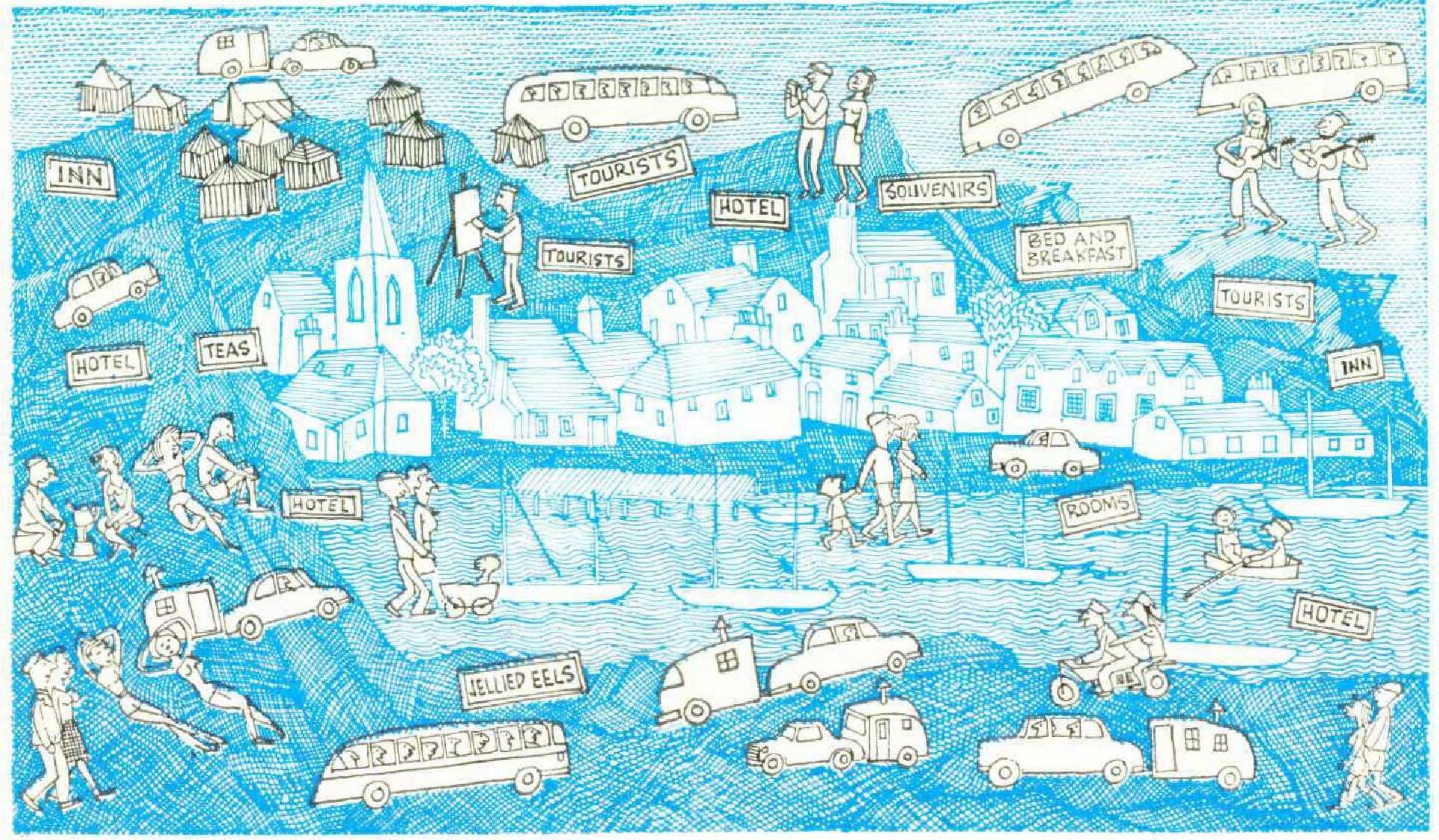
Camping on the sands or in roadside cutouts takes care of thousands of families, and farmhouses with “Bed and Breakfast” signs accommodate thousands of others. Up the scale are the newly prosperous boardinghouses — “Hot and Cold Running Water in Every Room” — and the tourist homes, renovated to look like Ligurian villas, that make solid facades along the promenades and fronts. As the grand old clientele seeks less crowded resorts, the grand old hotels alone feel the pinch.
The social and economic status of the new vacationers is reflected most strikingly in the life of gnarled hamlets that once attracted only solitary watercolorists, bird watchers, and connoisseurs of “scenic” experiences. In St. Ives, the most popular of the villages, gulls still float over seawalls and tidal flats like sediment settling in a glass, but along the front the trippers range in hordes, from stands that sell jellied eels to penny arcades to gimcrack galleries and pubs tarted up with driftwood and fishnet. In the evenings the itinerant beats, like some species of nocturnal fauna, emerge with their guitars, and the motorcyclists in outfits of leather and silver gather in little groups, slouching and glowering like Marlon Brandos. Except for the chill in the air and the absence of any bare flesh except that of sandaled feet, those gatherings might be taking place in St. Tropez or Positano or Torremolinos. The brotherhood of the beats, which contrives to be both closed and exhibitionist at once, signifies that, even though overrun with squares, the resort has arrived. But I the beards of the beats are only the fringe of the summer population. 1 hey are ignored by other young people whose interests are not satisfied simply by listening to old ballads in glassy-eyed rapport with nada. Shopgirls and typists in pairs wander toward the Palais de Danse, carefully eyed by slicked-up boys in blue serge who lounge against the harbor wall, fiercely pinching the ends of cigarettes.
The rugged houses of the fishermen — their doorsteps flush with the cobbled lanes and crooked streets — have been taken over by a wellto-do, semi-Bohemian element and given the Chelsea treatment: magenta doors, puce doors, draperies printed with geometrical designs, window boxes over which, stereophonically, come Benjamin Britten, Peter Pears, and songs from Gypsy. Arts and crafts mingle with fish and chips. The lady in the cabbage-rose print buys a lamp in the shape of a conch shell for her sitting room in Birmingham. Plastic lobsters and Toby mugs glitter beneath tinted photographs of Princess Margaret as the indomitable spirit of Bournemouth and Margate demands its kitsch and jazz. And yet, to climb any promontory just a few yards above the labyrinth of shops is to confirm a sight the sentimental imagination would keep — a toughly beautiful little port, shaped by hard living and smoothed like a stone by winds and running tides.
While the mobile masses transform the villages of Cornwall into a series of bazaars and boardwalks, an older, long-established resort life goes on quietly in the few hotels that were famous when Cornwall still lived exclusively by fishing and mining. Overlooking St. Ives, for instance. is a small castle converted to a hotel that maintains the Jane Austen gentility of a time when a holiday in Cornwall was not a trek to despoiled landmarks but a refreshing venture into the picturesque. Here twilight tennis is played on green lawns, aperitifs are served to mustachioed barristers and lavenderscented matrons in the flowering gardens, the maître d’hôtel speaks French exclusively. The guests know one another either from previous summers or by the infallible caste marks by which the scattered remnants of “good" society are held together. Newcomers encountered in the course of a Paul Jones are politely accepted to the end of the dance and no further. These members of the quality may make slumming sorties into St. Ives now and then, but its raucous amusements are not likely to detain them long. They have come with white gloves and picture hats and evening clothes to loll about for a fortnight in a hostelry as gracious as the homes they have left.
Except for a few establishments where a combination of English reserve and continental panache denotes a high standard of comfort and service, the hotels of Cornwall are apt to be disappointing to Americans. The average Briton on holiday still expects to “rough it.”to put up with small discomforts as payment for the privilege of being away from home. Americans, on the other hand, generally expect the places they go to to be a lot better than home, definitely more luxurious, if not more comfortable, and wholly without the effort that running servantless houses entails. Consequently, the big rickety, drafty, cramped hotel by the sea that seems just fine to the Englishman is apt to leave the American not only cold but frankly appalled.
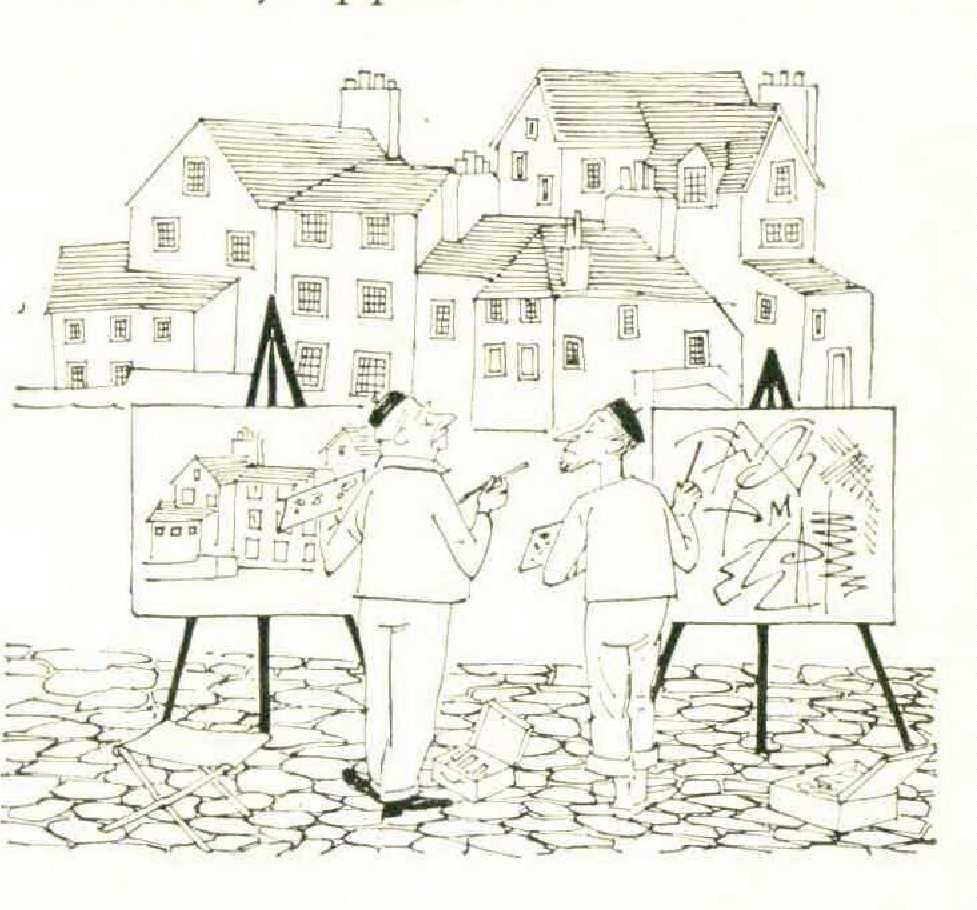
The clearest and saddest indication of what lies in store for the villages being suffocated by sudden prosperity can be read in the blight that has already overtaken Land’s End. This craggy finger of rock is by no means scenically remarkable among other similar promontories along the coast, but it is the incontrovertible last foot of solid terrain in England and the sentimental point from which the Western world begins. Like its French counterpart, Finistère, it has generated legends out of sea-wrapped mystery simply by being where it is and what it is. Here the consequences of curiosity and sentiment en masse are overwhelming: Land’s End is mainly a parking lot, a tea shack, and a seaside meadow of litter. The fallout of the age of waste lies everywhere. As buses, motorcycles, and caravans shuttle their hurried passengers in and out, pilgrimage ends not in a gift of alms and a sense of wonder, but in the dropping of a candy wrapper and the taking of a Kodachrome.
Cromlechs and rocking stones, kistvaens, dolmens, and Celtic crosses loom everywhere on the Cornish landscape, and even when they stand but a few yards away from highway traffic, maintain an impermeable remoteness. Another man-made tiling on the ancient coast, as thought-provoking as these vestiges but far more comprehensible, is the Minack Theatre at Porthcurno. This is a tiny amphitheater, set on a wall-side of rocks, where audiences face a stage whose decor includes uncapped pillars, Stone Age props, and the natural backdrop of the Atlantic Ocean. Ceaseless winds and the mumble and splash of waves below make it surely the most completely outdoor theater in the world. Yet its stage space has been arranged with such delicate attention to acoustics and visual focus that performances are clearly heard and intimately observed. A false step would send an inattentive Ophelia plummeting into the surf a hundred feet below, but such jeopardy seems in no way to subdue the passion of the players. Here on summer nights, cloaked against the rain and bundled against the wind, audiences watch university theater groups from all over the country put on stark versions of such offerings as Hamlet, St. Joan, Comas, and Electro.
Western Cornwall is largely a landscape of moors carpeted with heather, golden gorse, spiky grasses, and punctuated by the sooty fingers of abandoned kilns and mine works. Stone walls covered with moss lay a ragged geometry on gently sloping rises. Seen through a sea-heavy mist, these prospects suggest a primeval dream. This is the Cornwall you expect. The sight of Jamaica Inn, wickedly alone on a moor that glows with sinister light even at midday, delightfully confirms your romantic clichés. Unexpected are the sudden oases of salad-green foliage and the little streams that bubble through them in eddies or open out to millpond calms. From these sequestered spots, peat smoke rises over thatched roofs and swans float in slow merry-go-round circles.
The biggest resort town in Cornwall is Penzance, where a few frazzled palm trees help to maintain the overpublicized legend of the semitropics on the coast of England. Here the architecture is predominantly Victorian and in the matchless bad taste that identifies nearly all of the English channel towns, with the exception of Lyme Regis, Chichester, and a few others, all the way cast to Brighton and Dover. Penzance is crowded and more stable than the overrun coastal villages, yet tends to seem dated and passé. The twin towers of the railroad station to which the crack Cornish Riviera Limited comes steaming down from Paddington Station are both grand and desolate. People who could once afford a seafront villa have moved on. The same people can now afford a converted stone cottage and an automobile to take them to its painted door.
Traveling eastward in Cornwall is traveling back through successive phases of English social history — from the poor fishermen’s houses that now only the rich can afford to the golden arabesques of the Regency that only the rich have now deserted. The interest of the new race of excursionists has shifted to the furthest western points of England; eastward lie the genteel resorts that probably look much as they did sixty years ago. In Fowey, St. Mawes, Megavissey, and Looe, the streets are washed with sea light, the Church of England bells ring out the hours, and the pace is politely Edwardian. Clean and attractive in their antiquarian pride, these towns are nevertheless somewhat forbidding. Their moribund gentility assumes the proportions of a charade, their privacy seems almost aggressive. Their high streets and front streets attract a quota of visitors, but, unlike the hordes that swarm through the coastal villages, they do not disturb the old order of private villas and bespoke hotels whose inhabitants are perennial and unmoved to innovation.
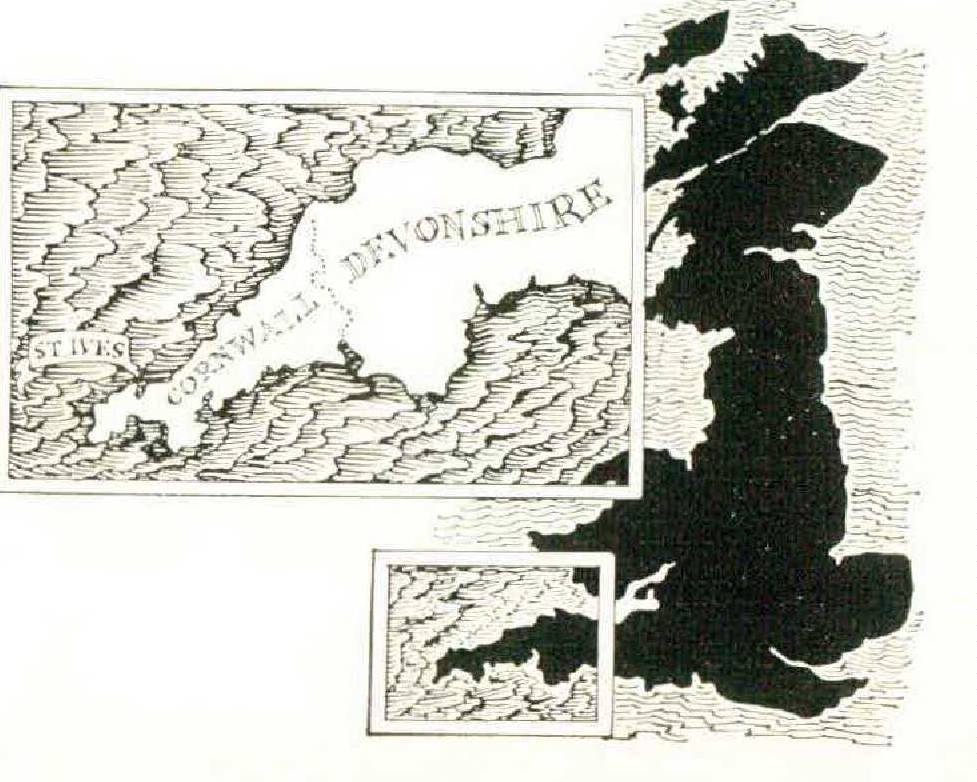
On the map, Cornwall looks like an arthritic foot stepping into the ocean. From a sociological viewpoint, it is a barren fastness stormed and invaded by a restlessly transient population for which it was in no way prepared. ibis phenomenon must be taken into first account. When one goes there, either as a tourist in a hurry to do five villages before noon, or as one who wants only to sojourn among scenes of West Country pleasure, he must be ready to put aside the irritations of traffic jams and queues and “full up” signs. To avoid desolating mistakes, he should also know in advance that his taste in determining his accommodations is a greater factor than the money he is prepared to pay for them. To stay in a new, shoddy, Italianate version of a hostelry is often more expensive than to stay in one that is old, staid, and efficient.
But anyone who can accept forewarnings and manage to survive tourist hazards will be rewarded with moments when he comes upon some of the most ancient landscapes on the civilized earth, some of the most grandly elemental conjunctions of sea and rock imaginable. If he likes to swim and sunbathe he will find that he has come to the wrong riviera. A hiker or a naturalist, a golfer or a yachtsman may find the vigorous weather perfectly suitable. Any visitor will live well if he has the patience to seek out richly simple hotels where the amenities of country life begin with good food and wine and cheerful service. All told, the visitor’s best choices in Cornwall come down to two: the Stone Age and the Edwardian Age—the one for a brute physical beauty that will make him feel paleolithic in his bones, the other for the mild comforts and social graces of an era that may in a few years be extinct.