The Sound of a Diesel
R. P. LISTER is an English free lance whose poetry and light articles appear frequently in the ATLANTIC.
The first time I heard the sound of a diesel train was about fifteen years ago in Le Puy, in Haute-Loire. This train ran on a winding track over the Monts du Velay past Fix St. Geneys and down to St. Georges d’Aurac, where it connected with the train to Paris. It ran smoothly, since it ran on flanged pneumatic tires made by the Michelin people at Clermont-Ferrand. These also had the effect of making it sway a good deal, particularly on bends, so that sensitive passengers tended to be seasick. I still have a vivid recollection of a Frenchwoman with a pale-green face leaning her head on the metal window frame and gazing out with great mournful eyes across the intervening valley of the Allier to the whaup-haunted uplands of the Margeride, like one yearning for an early death or a train with metal wheels.
For myself, I have a strong stomach and enjoyed the ride. But this diesel train had already brought me pleasure, with the then unfamiliar noise of its hooting. As it swept out past the ocher statue of St. Joseph at Espaly, it would emit a series of those strange diesel hoots, alternations of two notes separated by intervals of a fourth. It is a fine, strident noise, a little unearthly but distinctly Gallic, sounding as if a noise from the Midi had been crossed with a noise from Mars.
Not so long afterward, diesels came to some of the London lines. These diesels, to my surprise, made the same noise. Crossing over the bridge by the Royal Oak, on the way to the Harrow Road, I would hear a diesel leaving Paddington Station for the west and giving off that same succession of fourths. It took me back in mind to the little hill town in the Massif Central, full of priests and nuns and presided over by the vast cathedral, the gigantic statue of the Virgin cast from seventy bronze cannons captured at Sebastopol, and the tenth-century chapel of St. Michel, all perched high up on their respective volcanic rocks.
I was surprised that the English diesel train should make a French diesel noise, but I was not very surprised. After all, a diesel train has to make some sort of noise, and the choice of fourths by engineers on both sides of the Channel might have been a coincidence.
The next place where I heard a diesel in full cry was Edinburgh. I was strolling along Princes Street in the cool sunshine. The customary morning procession of kilted policemen, each blowing hard into his bagpipe, had just passed by. The sounds of the pibroch were dying away beyond the Scott Monument when there mingled with them a by now familiar succession of hooted fourths. It was the hourly diesel pulling out for Glasgow, along the cutting that runs betwen the Princes Street Gardens and the Castle Rock.
It was at this point that I began to suspect that, in this matter of diesel noises, something beyond coincidence was at work. It could not be that French, English, and Scottish diesel builders had all hit on the same notes purely by chance. I wondered if there were not some peculiarity about the internal arrangements of a diesel that made it imperative for it to hoot in fourths, just as some inherent characteristic of the cuckoo makes it hoot in thirds.
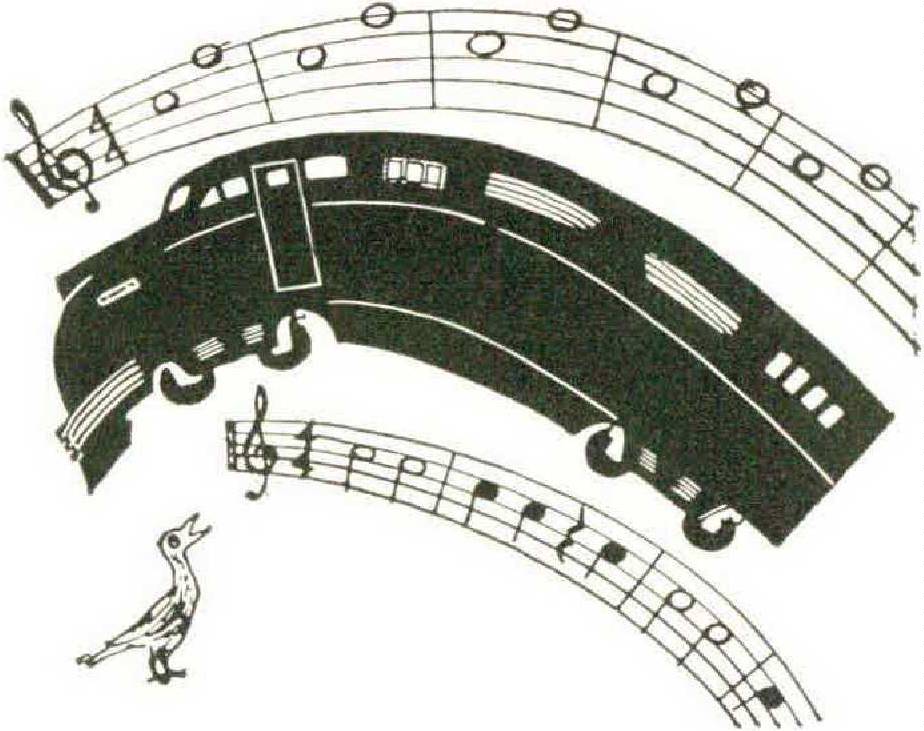
Leaning pensively on some railings near Shandwick Place, I gave some thought to this analogy between diesels and cuckoos. Cuckoos, as far as I know, make the same noise the world over. They do not, whatever naturalists may say, sing in true thirds. Sometimes they try to sing a minor third, but sing sharp. At other times they try to sing a major third, but sing flat. I have never heard a true third, major or minor, from any cuckoo, and I have heard more cuckoos than I care to count, in circumstances where I have been unable to avoid hearing them.
After considering this matter of the cuckoo, I passed on to the wood pigeon. This bird does not bother its head with intervals; it goes on singing more or less the same note, though it changes its tone of voice, so that some of the notes are almost devoid of expression, while others come out as something between a drawl and a sneer. But it is all the same note; the wood pigeon, one of the least likable of God’s creatures, is not capable of any more.
What the wood pigeon is after, when it is not stuffing its gut or persecuting its weaker brethren, is rhythm. Its song seems to have some quite subtle variations, on a casual hearing, but in fact it is exactly two bars long, in common 4/4 time, and it never varies. The first bar contains two minims; the second contains two crotchets, a crotchet rest, and then a final crotchet on the fourth beat.
The wood pigeon gives the impression, as I have said, of having a much wider range of song than this. It does so by starting its song abruptly at any point in either bar and breaking it off, likewise, at any point. It quite commonly starts with the last note of the second bar, as a lead-in to the two minims; but it may come in absolutely anywhere, even halfway through one of the notes. So the initial minim or crotchet may appear as a crotchet, a quaver, or even a demisemiquaver, but the note reverts to its true character when it comes around again.
So much for the wood pigeon and the cuckoo. All over Europe, I thought, the wood pigeon must chop off lengths of its predestined rhythm; the cuckoo must chant its out-oftune thirds, with an interpolated hiccup later in the season. So must the diesel, through some fate neither I nor it could comprehend, sing always in fourths.
How, though, were things in the New World? On arriving in New York for the first time a while ago, I listened eagerly for the song of the American diesel. It was so long before I heard it that I forget now exactly where it was. I think it was in Queens, when I was on my way to Patchogue to catch the ferry to Davis Park; but it may have been in Harrisburg, Pennsylvania, or Oklahoma City, for all I know. Wherever it was, I heard it with astonishment and delight. It made exactly the same noise as the diesel of Le Puy and all other European diesels of my acquaintance. There was something reassuring about this old familiar sound. Other sounds were new, and I was glad of it, but it was good to know that whatever else changed, the diesel remained constant to its age-old traditions.
I never heard an American cuckoo, but I heard a wood pigeon in Michigan. At least, I took it to be one. Its song was familiar, and yet not familiar; and the moment I heard it I could see what had happened to the American wood pigeon. It was the same thing that happened to Dvořák when he came to the New World, though the wood pigeon had, of course, been here longer. Dvořák’s Czech melodies were agreeably influenced by intervals derived from the plantations, and ultimately from Africa. The wood pigeon had nothing to be influenced in but his rhythm, but this was certainly affected by the same influence. The song of this Michigan bird was subtly diversified with syncopated subrhythms and slightly offbeat grace notes. As far as I could tell, these were superimposed on the same basic two-bar rhythm, which is of course syncopated itself, in the second bar. I simply had not time to confirm this by a detailed study; I had to catch a bus to Cheyenne. But I thought the whole thing a distinct improvement on the song of the European wood pigeon, though I expect the bird’s manners and morals leave just about as much to be desired.
How far, then, has the Negro influence permeated the sounds of North America, if the wood pigeon is noticeably affected and the diesel is not? I had to leave a fuller study of this fascinating question till some future time, though I hope these preliminary observations are not without interest.
As for the diesel: now that I am back in England, one of my agents, who are scattered widely all over the world, has reported to me that diesels in Spain make a different noise from other European diesels. Through one accident or another, I have never heard a Spanish diesel, and this report has stimulated my curiosity to such an extent that I intend sometime soon to pay a brief visit to Madrid, in order to verify or refute the story for myself.