The Dog Census
A political scientist and professional librarian, CHARLES A. GOODRUMdid his undergraduate work in Kansas and at Princeton and received his graduate degree from Columbia. For the past thirteen years he has been with the Legislative Reference Service of the Library of Congress, He here recalls his earliest experience as a civil servant, when dogs rather than the public were his first concern.
by Charles A. Goodrum
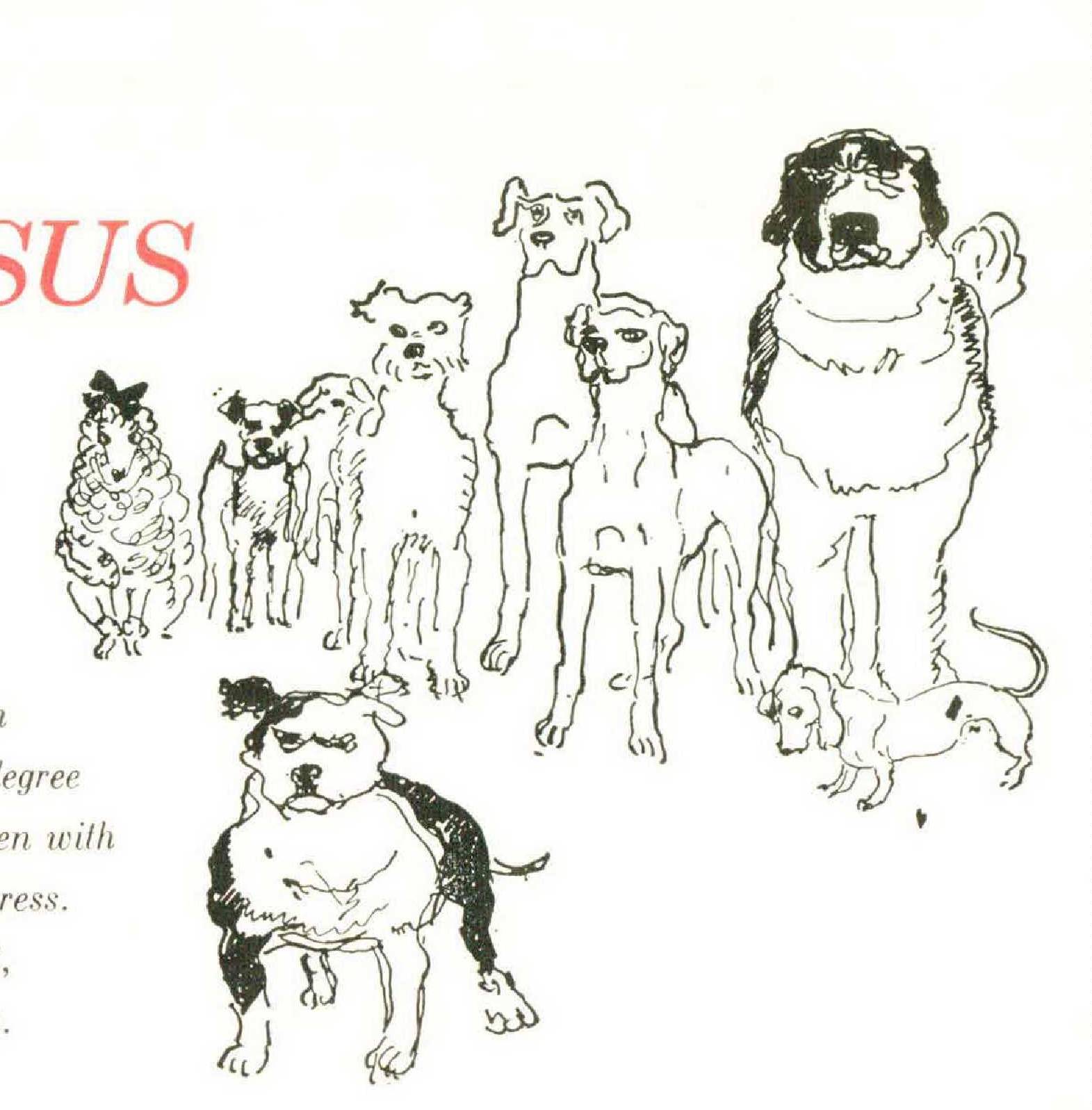
ONE of the major traumas of my formative years was a strange little episode involving a dog census. I am now a civil servant, and looking back on it, I realize that this was my first brush with both the Bureaucracy and the Public. My sympathies were with the Public all the way, but as is so often the case in these great moral issues, the money came from the government, and I needed money.
I had successfully completed my freshman year of college in Wichita, Kansas, and it was already clear that my future lay in political science. I had conveyed this idea to the proper profs, and it was therefore manifest justice that my name should be among the select few who would be offered summer jobs at city hall. Here we would see real municipal government at work.
I recall our consecration by the head of the department, who urged us to “take this opportunity to serve, to observe, to apply and see applied the principles of public administration you have studied so well through the past year.” How true, I thought (and the money will buy the fall tuition).
On the first of June we assembled at city hall in the office of the comptroller, where we were in turn divided into teams and reassigned to our specific tasks throughout the municipal departments. It was thus with some surprise that my roommate and I learned that our assignment did not fall in the civic center, but that we were to report to an unfamiliar address in the business district.
We sought out the number and found it to be a two-chair barbershop off Main Street, where we were soon joined by four other youths of eighteen or nineteen, like ourselves. The firstchair barber lined us up along the wall and proceeded with the orientation.
“Boys, you’re about to take a dog census. I’m gonna give you a bunch of slips of paper, and every time you find a dog and can get the name and address of the guy he belongs to, you’ll get ten cents. Don’t think you can kid me, see, because I’ve been running these things ever’ four years since before you was born. Ever’ one of the papers is got a number on it, and I expect to get ever’ one back, see? And don’t go making up names, hear? Now, you got two weeks to do the job in. You’ll get your money at the end, but you come in here ever’ day or so and I’ll give you some more slips and some more streets. I’ll give you slips and streets as fast as you need ‘em, but you hit ever’ house, see, and don’t think you can kid me, because — ” et cetera.
My roommate, Al Munroe, and I were to work as a team, each to take one side of a street, the streets to be assigned four at a time, running from city limit to city limit. The assault was to begin the next morning and continue for fourteen days; how far and how fast we would go were up to us.
We went back to the dorm somewhat mystified, but intrigued at the possibilities of the operation. This was in the late thirties, when most of our friends were taking summer jobs in stores at $16.50 a week or on construction projects for $20. To match their $16.50 would require 165 dogs apiece. Surely in a week we could each find 165 dogs; but how could you discover whose they were? And just how would the owners react to the official presentation prescribed by our leader? We looked to the next morning with mild concern.
FOLLOWING an early breakfast, we took a bus to the southern extremity of town, walked two blocks to the limit of our first assigned street, and started toward the other end, five miles to the north. Elm-shaded and peaceful, it looked like an early summer Saturday Evening Post cover. I took the west side, and Munroe the east. Pursuing instructions to the letter, I went up the walk of the first house, mounted the porch, and knocked at the door. The sound of a chair being pushed back was followed by the head of the house approaching in undershirt and pants. He peered through the screen door and said, “Yeah?”
I lifted the pad and pencil to present arms and declared, as instructed, “Good morning, sir. I’m from the police department, and we’re taking a dog census. Is there a dog in this household?”
“The hell you say,” he said.
“Yes, sir. What I mean is, do you have a dog here, sir?”
“You’re kidding, huh?”
“No! No, sir. You don’t have a dog, I suppose?”
“A dog census! Hah! I’ll be goddamned. A dog census. I’ll be go-to-hell. How about that? A dog census—” By this time he’d turned around and disappeared into the house, leaving me peering through the screen.
I turned around myself and walked back toward the street, where I found Munroe already waiting. “Did yours have one?” I asked.
“I don’t think so.”
“What’d they say?”
“I’m not sure. I don’t think they were up yet, and the lady was pretty short.”
We reversed our fields and looked at the next houses on our respective sides. The thing was even more complicated than we had thought, and we both were nearly as scared of finding a dog as we were of being laughed at. The real threat to the program was our little pad of paper slips, yellow ones for the householders and white receipts for the barber, carbons in between. The slips read:
CITY OF WICHITA, KANSAS
To: (name)
Of: (address)
SUMMONS
You are hereby ordered to appear in Police Court within five days to receive sentence for failure to secure dog license. Sentence shall not exceed thirty days nor fifty dollars fine. Such action may be forestalled by the payment of $2.00 (male) or $3.50 (female) each to license all dogs found in your custody. Such payment may be made at the Department of Licenses, City Hall, from 9:00 to 5:00, Monday through Saturday.
It had quickly become apparent to all of us, even back in the barbershop, that the word “census” was at best a euphemism. One of the others had asked the barber if this notice might not pique some of the citizens, and he had replied, with a strange smile, “Yep! Some of ‘em get a bit exercised all right.”
Munroe had asked, “What if they’ve already licensed the dog? Shouldn’t we ask them before we fill out the slip?”
And the barber had replied, “Nope. Ain’t hardly anybody that has, so it ain’t likely you’ll run into ‘em. If you ask ‘em if they’ve got a license, they’ll all say they have, and you’ll never have no excuse for filling out the slip and shoving it on ‘em. You only get paid on the slip, you know. If they scream and yell too loud after you give it to ‘em, you can tell ‘em that the license bureau will check ‘em all, and if they really have paid, they can forget it. You won’t hardly ever find anybody who has, so you needn’t worry — much.” Even at the time, the slight hesitation in his otherwise forthright delivery had disturbed us.
I climbed the porch of the second house. Much knocking. Nobody home. Went up to the third house. A grandmotherly-looking lady came out, and I tried the official approach. She looked puzzled, decided she had misunderstood, started to ask again, and decided against it. “No,” she said, and shut the door. I abandoned porch three for porch four.
Or, rather, stoop four. This house had the look of belonging to a carpenter or someone in the building trade, It had no porch, but had a fanshaped brick and concrete veranda and a neat, newly painted doorway. Everything about the place looked alert and well cared for. I pressed the doorbell and precipitated a peal of chimes inside. A large man of about fifty came to the door with a massive hound of some variety beside him. The beast woofed a couple of times and then looked curiously at me through the screen door.
“Good morning, sir,” I recited. “I’m from the police department, and we’re taking a dog census I see you have one there! Ha, ha, ha.” Striking the man-to-man approach.
“You betcha, son. This is George. George is just like one of the family. He’s three years old, and I’ll swear he’s still growing.”
“He’s a good one, all right!” I tried to keep it friendly and nonchalant. “Let’s see now, let me make a note of this. This is 3639 South Topeka, isn’t it? And your name, sir, is — ?”
“Alexander Strean. S-t-r-e-a-n.”
“Thank you, sir. Here’s this little slip of paper, and thank you for your courtesy.” He opened the screen door, took the paper, and began to read. His face clouded as he progressed.
“Go get him, George,” he said in a flat voice, and the dog scrambled past him and shot out the open door with a machine-gun-like roar of barks, growls, and woofs all mixed together. His ears were down and his hair up.
I backed down the steps as fast as I could go without falling over backward, and as I treadled toward where I thought the street must be, I could remember that the secret of dealing with either dogs or horses was not to let them know you were afraid. So as I staggered backward I fixed the hound with what I hoped was a stern expression and wheezed, “Now, George. Down, boy. Down. George! Stop it, boy. Down, George. Down! Down!”
At this moment I found the street, fell over the curb, and landed in a skidding arc on my back. I wrenched forward to protect myself against the expected lunge and was startled to find George, with his front feet precisely on the edge of the grass in front of the curb, laying down a barrage of noise but not moving an inch. I had just learned the first great truth on which we built the next two weeks: If You Can Make It to the Nearest Property Line, You Are in the Clear.
By this time, Munroe had rushed over to help me up, and we stood there in the street, contemplating the situation. I had just earned ten cents and aged six months. In one block we had both been laughed at and ignored. Munroe had been lied to, and I had been assaulted. We had to decide whether to abandon the whole thing or mount a formal campaign. We weighed pride, limbs, the authority of the state, and ten cents a dog into the balance and decided we would give battle. The first thing we needed was arms.
We retraced our steps to the bus line and rode back downtown to an office supply store. We entered and asked to see their selection of clipboards — the larger the better. They produced a choice that exceeded our wildest hopes. Munroe invested the equivalent of twenty dogs in a doubled aluminum job which was about the size of a snow shovel (it was intended as a wallboard for an automobile parts department), and I sunk fifteen dogs’ worth in a massive wooden model which was as thick as my thumb and weighed well over three pounds. It was capped with a huge steel clip on top and two mounting hinges on the back, which gave it a beautiful heft. We stood there in the store practicing knee-high sweeps with these, like golf pros selecting a set of woods. In the ensuing days we became marvelously skilled with these weapons. My backhand was always my best. I could sweep that board from a writing position down, across, and up the side of the head of a charging chow or schnauzer like Manolete in his prime. With little snapping terriers and bulldogs, a fast wrist action not unlike a sculling stroke over the stern of a rowboat permitted me to back to the property line with complete aplomb, leaving the dogs breathless and faintly confused as to their bearings.
Munroe maintained his dignity throughout. His metal board would drop from chest high with a single firm forehand, catching boxers and German shepherds across the skull, between the ears. A momentary opacity would cross their eyes, and you could almost hear their heads ringing. By the time they were in focus and ready to spring, Munroe would have withdrawn to the next lot, walking backward with all the assurance of the chancellor leaving the Queen.
WE SNAPPED our little pads into our new boards and headed back for South Topeka Street. From there on, we abandoned the official approach and developed our own. If the householder was a young woman, we played the rueful innocent: “Lady, you aren’t going to believe this, but the city is paying us ten cents for any dog we can find. Do you have a dog?” When she had finished laughing and admitted she did have a little specimen in the garage, we’d say, “Now, some knothead at city hall has written up the worst possible way of reminding you, but this is supposed to be a notice telling you it’s time to get a dog license. Just ignore what it says, but get downtown before too long and get everybody off your neck.” With this approach we wouldn’t get the dog sicced on us more than three times out of five.
Elderly ladies never understood what we were doing no matter how we phrased it. We finally got so we abandoned all formality, and when one would open the door we’d just say, “Good morning, ma’am, do you have a dog?” If she would say yes, we would ask her name, fill out the slip, fold it, and hand it to her closed over, saying, “Please give this to your husband when he comes home. Thank you.” It wasn’t that we were trying to deceive them, but bitter experience convinced us they never seemed able to understand, no matter how carefully we explained.
All men under fifty arrived at the door mad before they even knew what we wanted, so we snapped out our question as nastily as they had saluted us, and although we would get the dog after us five times out of five, we at least retained our pride.
In this manner we worked our way up and down the streets of Wichita. We would start off at seven thirty in the morning and keep at it till nine at night, when we would take a late bus back to the dorm, tender of knuckle and leg-weary. Inasmuch as we were backing out of about one yard in three, we not only found muscles we had never noticed; we were wearing out soles faster than heels. But we did find dogs. To this day I stand in amazement at the way they appeared everywhere in every size and shape. By the end of the first day, I had flushed out over a hundred and eighty specimens, and had netted eighteen dollars for the day. This beat grading papers or carrying roofing paper all hollow.
In the ensuing days, we increased our unit production as well. We found that if you scuffed your feet on the way to the porch, whistled loudly, and rattled the screen door ever so slightly before knocking on it, you could rouse the family dog to a fury long before the householder could swear he had never had a pet of any kind. Similarly, we found we could increase our efficiency by locating the neighborhood grouch. She would give herself away at once by snapping, “No, I don’t have a dog, and the city ought to shoot every one they find. The least people could do is to keep theirs tied up.” To this we would reply, all innocence, “Oh, is there one next door?”
This would usually elicit, “No, not them, but the next ones down have a big nasty one that’s always in my roses. Then the people in that yellow house there have two that run loose all day.” Having sold out her fellowman, she felt better, and we could head directly to pay dirt.
EVERTHING seemed to be going well for the first few days, and although Munroe inexplicably found about 15 percent more dogs on his side of the street than I did, there were plenty for all, and we progressed block after block through the city, spreading interruption and fury as we passed. We stopped washing machines, telephone calls, baths, lawn mowers, vacuum sweepers, and infant feedings. As I look back on it now, I think it is a miracle we weren’t lynched.
By the second week, however, our daily haul, which had been climbing nicely, began to decline. Not only did we find fewer dogs, but people seemed less and less astonished to be interviewed regarding a dog census. It soon became clear that the three small teams, although apparently lost in a town of 115,000, were beginning to be known. Ruth had phoned Margaret, who had warned the Pattersons, and by the time we arrived, all we got was the lady of the house looking us straight in the eye and saying, “We’ve never had a dog,” with the nine-year-old whisperingfrom the kitchen, “Hold her a little longer — he’s still here.”
By the time we made our final trip back to the barbershop, I had recorded 1650 dogs and Munroe had identified 1948. I remember to the penny the $165.00 and the $194.80 we took in. It was fifteen years and a world war later before I again made so much money for two weeks’ work.
All this came back to me a few weeks ago when I was visiting my Wichita relatives. One morning, while we were at the breakfast table, the doorbell rang. My seven-year-old rushed out to see who it was, and through the living room came an adolescent treble, “I’m from the police department, and we’re taking a dog census. Do you have a dog?”
Chris replied curtly, “No,” and shut the door.
“Hold it!” I yelled, and dashed to the front door. I called out to the departing guest, “Wait a minute, son. I once took a dog census myself, and I’d love to hear how it’s done now. What do they pay you per slip?”
The youngster was alert and courteous, and he replied cheerfully, “We get ten cents a dog, and twenty-five cents for every four chickens or one cow.”
“Great Scott!” I remonstrated. “Even twenty years ago all the chickens and cows had disappeared !”
“Yes, I know. We haven’t found a one.”
“May I see the slip?”
“Sure,” and he handed me the yellow pad. It read:
CITY OF WICHITA, KANSAS
Name:
Address:
You are hereby reminded that the fee for licensing of dogs is $2.00. If your dog has already been licensed, please ignore this notice.
I sped him on his way. Twenty-two years later, the ten cents was the same, the license fee was the same, discrimination because of sex had been eliminated, and the slip had been worked over by the public relations consultant. As a civil servant, I rejoiced. You can’t ask for more than that: no inflation for a generation, and the state has learned to keep a civil tongue in its head.