My Short, Happy Life in the Theater
MARY ROSE BRADFORD currently is living in Houston, Texas. This is her first appearance in Accent on Living.
The recent death of Jesse (“King of the Mighty Wurlitzer”) Crawford nostalgically brought back to me a phase of my life I had not given much thought to for years. While I was in college, I played the pipe organ in Indianapolis at a movievaude house I shall call the Riviera, The instrument was not a Wurlitzer, but a Sceburg-Smith unified job of four manuals, and though, like all movie organists, I tried to sound like Jesse Crawford, I didn’t, much.
The movies were second-run and six a day, the vaudeville was thirdrate and five a day, and the whole show ran a week. A relief organist and I played for the picture, and an eight-piece orchestra beat it out for the five vaudeville acts. All of the musicians belonged to an affiliate of the American Federation of Labor, the I.M.P.A., headed, during my membership, by the great bandmaster Joseph Weber.
We called the orchestra pit “the Snake Pit,” a long time before the book of that title appeared. The pit was enclosed by a rail, which topped iron bars set four or five inches apart. This balustrade, curtained by ancient rusty green rep, was really a protective measure for the personnel of the band. An enthusiastic audience was not above throwing various objects—vegetables, popcorn, Coke bottles, and so forth — toward the stage, frequently missing the musicians entirely. But I remember as if it were yesterday the time when someone up in peanut heaven threw a damp wad of chewing tobacco that landed in the bell of the tuba player’s horn. He was a German immigrant whose English was, to say the most, inadequate. On this occasion he rose to his feet, shook his fist at the gallery, and shouted, “I’m a gottam somabeech, dot’s vot I hope!”
Regardless of its length, the picture ran one hour. At that time, a couple of years before talkies came in, Hollywood sent along with each feature a score for pipe organ that was synchronized with the movie. On Sunday mornings, the projectionist ran the film through once for me and the relief organist. This was our rehearsal. Depending on the length of the film, the tempo at which we played the score was fast, slow, or in accord with the musical signs the composers and arrangers had written. (If the last, it was purely by chance.) The band also had an hour’s rehearsal with the vaudeville acts, and that was it, sink or swim. The theater opened at twelve thirty in the afternoon, and the movie went on from one to two. The orchestra and vaudeville went on from two to three. This alternation kept up until midnight, except for a two-hour period between five and seven, when the relief organist played the film score through twice.
With all those empty hours, afternoon and evening, the pit boys had to do something, so they played poker and pinochle in the musicians’ room under the stage. They often stayed through the hours from five to seven, when the relief organist was on, and they sent “the boy” out for sandwiches and coffee or bootleg beer. “The boy” was the old stage-door man, a former vaudeville aerialist who had fallen from a wire years before and was permanently crippled. Though I knew him for two years, I never heard him say anything at all except, “Ho, girl.”
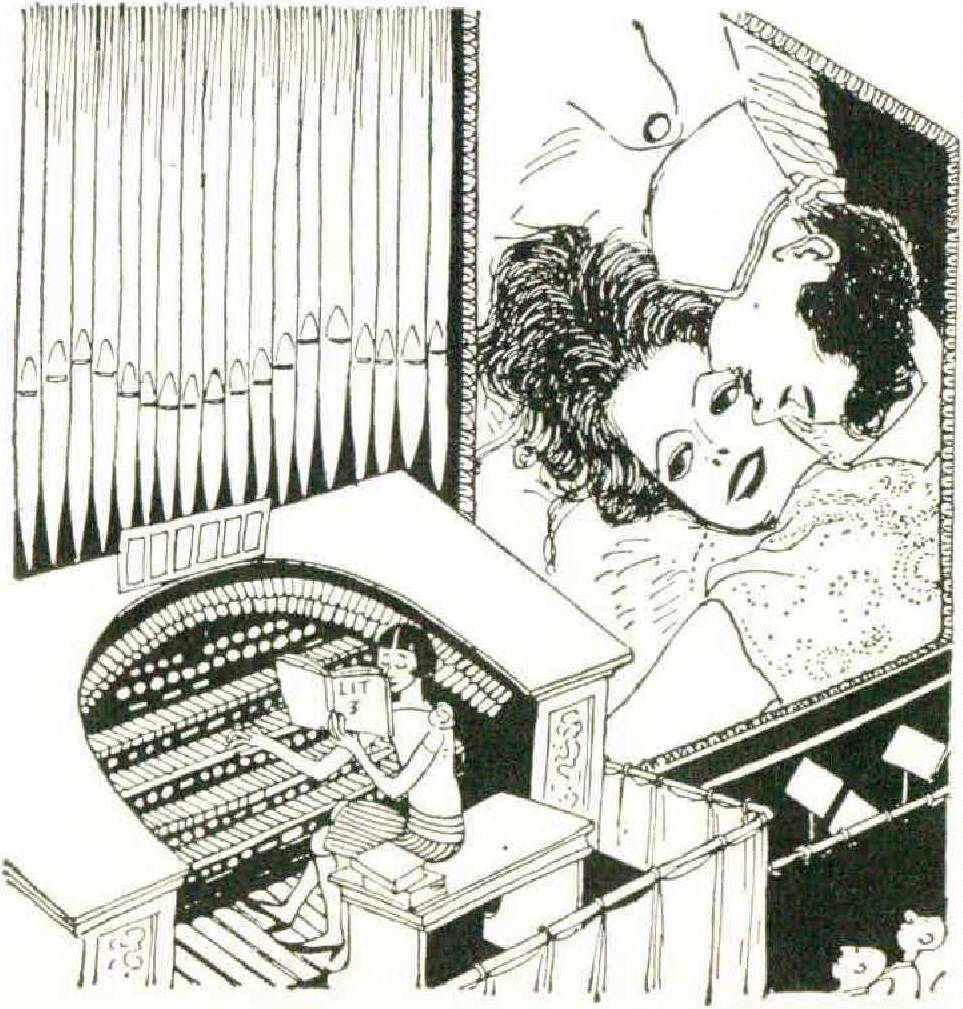
I went to school in the mornings and got down to the theater a few minutes before one in the afternoons. The pit boys called me the “Perfesser,” because I always carried books — my homework. As I said, they didn’t do any reading, but did I read. After playing the film four times the first day, I knew the score practically by heart. Then I put a book on the music rack and read, glancing now and then at the screen. The organ was set far to the left, so that Marion Davies always looked very long and thin to me, especially when she wore long pants, which she did at least once in every picture she made. Even when she was in hoopskirts she looked elongated, and John Gilbert looked more like John Carradine.
While I was still a freshman, I began to read manuscripts for a publishing house, and since the loose typewritten sheets were about the same size as those of a music manuscript, they were a lot easier to read and turn on the music rack than book pages. I got four dollars for every book report, and as I was able to read one manuscript a day, I was really holding down two jobs at once. What the I.M.P.A. and Mr. Weber would have done had they known, I have no idea. The boys in the Snake Pit knew of my deception, but they were loyal to the “Perfesser” and never told on me. During quieter passages on the screen, I often heard sounds of fights and profanity seeping up from the musicians below stage, but I didn’t tell on them, either. We seemed to be a closed corporation.
Once during my tenure at the Seeburg-Smith, I came down to the theater to find strips of adhesive tape covering the electric switch that turned on the organ. Thinking it was a practical joke, I began to tear off the tape, when a stagehand named Shorty shouted, “Hey, Perfesser, cut that out. You’re on strike!” It was news to me. No one had asked me if I was dissatisfied; no one had even suggested that I had a vote in the matter. Not knowing the etiquette and protocol of the business, I settled down with my books and manuscripts in the musicians’ room and waited it out with the poker players for three days. My next pay envelope contained six dollars extra.
At the end of my second year at the organ and in school, the publishers asked me to come into the house, at a salary somewhat below my earnings as a member of the musicians’ union. I liked books better than the pipe organ, so I took the job and said farewell to the glamorous world of the theater. As a going-away present, the boys in the band gave me a book.
Today, I wouldn’t know a spitzflöte from a lieblich gedeckt, but I still have that book. It is inscribed “To the little Professor, with love from the Snake Pit,” and was signed by the violin conductor and the seven side men. The book is A Girl of the Limberlost by Gene Stratton Porter. Now that I think of it, I never did get around to reading it.