Expense Account Luncheon
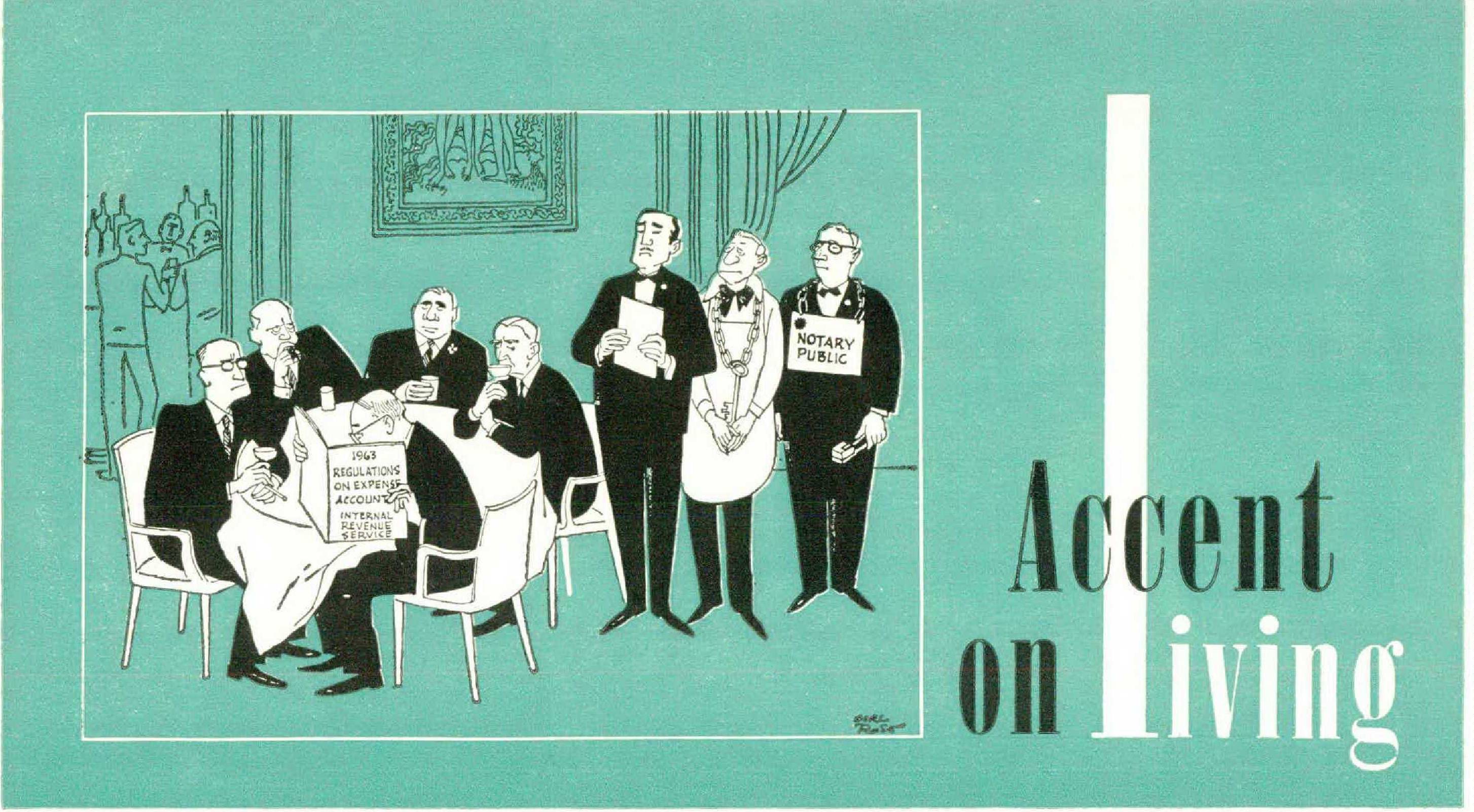
The table in the Penthouse of the Grand Dukes was laid for five. It was the choicest location, just between the bar and the Front Room and known to regular customers as die Crossroads. To sit at a Crossroads table at lunch — oddly enough, it was not a smart location after 7 P.M. — implied executive status of the hunting-lodge, yacht, stock-option level in heavy industry, although some of the home appliance crowd and one or two cosmetics magnificoes were allowed there on a dull day.
On this occasion, J. Ashley Spratt and his sales manager, of Goliath Steel, are playing host to the president and the production chief of Majestic Tack and Pushpin. They are joined, as they sit down, by a fifth man who had been waiting at the bar. Spratt introduces him. “Let me present Goliath’s auditor, George Stronk,” says Spratt. “He’s just going to see that everything is OK in terms of the new Treasury regulations on expense accounts. I understand that the drinks are part of the meal if we have them here at the table, so I’ll begin with two double fireballs on the rocks. Order up, gentlemen.”
While they wait for the drinks, Stronk, the auditor, produces a sheaf of handsomely engraved cards; each is about the size of a small bill of fare and bears the word “Affidavit” at its top. He hands two to each man at the table, gets a nod of assent from Spratt, and explains matters.
“This is simply the conventional Declaration of Attendance and Participation,” Stronk begins. He reads aloud the significant bits of the form: “Goliath, et cetera, et cetera, hereinafter referred to as the Host, et cetera. Then your names, and titles, gentlemen, hereinafter . . . the Guest, the date, name of restaurant, and so forth. . . . Luncheon — or dinner, as the case may be — was preceded and followed by business discussion for business purposes . . . further affiant sayeth not, and so on.”
Stronk pauses. The drinks arrive, and a significant nod from Spratt to the headwaiter means that another round will be along in a few minutes.
Tension grips the table as an orchestra is heard; sounding a bit muffled, it seems to be playing something from Victor Herbert. But Stronk waves a reassuring hand.
“Think nothing of it,” says Stronk.
“You’re sure?” asks Spratt. It’s not ‘entertainment’?”
“Definitely not. I made a point of getting a special ruling on it. The music is a recording, and the ‘performers,’ in the strict legal sense, are not in our presence; or perhaps I should say that we are not in theirs. But I can assure you, gentlemen, that you are all in the clear. Absolutely.”
“Good man, Stronk,” says Spratt. “Cheers.” He drains his third double fireball.
“One more point only,” says Stronk. “I suppose you all have some misgivings about Subsection B of Paragraph Three. As you see” — and the others scrutinize their engraved cards — “that is where you agree to inform Goliath of anv changes of your address.”
“Yes.” The president of Majestic Tack is speaking. “I was wondering about that. No terminal date. It really means forever.”
“Not worth a moment’s thought,” Stronk replies. “That whole Paragraph Three will have been rescinded by this time next week. The regulation is not only administratively impossible, but there are grave constitutional questions involved. Forget it.”
“You certainly have made a handsome form out of the Declaration,” says the Majestic production chief.
“That was J. A.’s idea — the engraving and all that,” says Stronk. “Just another of those details that make the trade refer to him as ‘Mr. Steel.’ ”
“No,” says Spratt modestly. “We always like to think of our customers as our guests. We tried to create a form in which the guest’s copy would be a perfectly good legal document and at the same time an attractive souvenir of an occasion that we hope will be profitable for all of us.”
“And here’s to many more of them.” The president of Majestic downs his fourth double manhattan.
Good feeling mounts throughout the meal, or rather, “the quiet business lunch,” as it is called. Spratt includes several big tips in the check as he signs it. The staff notary of the Penthouse of the Grand Dukes, his notarial seal dangling from a richly ornamented chain not unlike that of the sommelier, presents himself to each of the party in turn. “Raise your right hand, please —”
“Not a bad lunch,” remarks Majestic’s president to his production chief in the cab on their way to the airport. “I must say that Spratt strikes me as something of a fathead, but that auditor — Stronk, was it? — I’d be glad to have him on the Majestic team.”