When in Rome, Smile
W. F. MIKSCHis a free-lance writer living in Newtown, Connecticut. He was born in Bethlehem, Pennsylvania, and attended Moravian College.
Why is it that people we meet on vacation trips are so much sweeter than those back home? Everywhere we go, it’s smiles and “Por favor” and “Danke schön” until we get home again. Then it’s “Hey, watch it, Mac!”
Does travel actually breed politeness, or are we simply intimidated by strange places and faces? Does finding oneself set down amid the alien corn, with no earthly idea of how many lire there are to the dollar, make cowards of us all? Speaking for myself, yes.
Back in our local supermarket, I may seem somewhat short-tempered, but once out of the home county, I grow terribly civil. I find it no strain at all to be courteous and charming when I am wholly dependent on strangers to show me the way to a bathroom. The stray dog usually wags the friendliest tail.
I suspect that everyone else (except diplomats, who enjoy immunity) travels scared, too. At least, I notice that any bonhomie I generate on safari is more than matched by fellow tourists. They cheerfully share shipboard meals with table companions whose company — for five minutes — back in the neighborhood tavern could lead only to blows. Even traveling children become more subdued and attractive the farther they get from home. If this isn’t fright, I would like to know what you call it.
To those students of the phenomenon who attribute it wholly to the language barrier, I concede it is hard to shoulder a chip in a land where you can’t even order a ham on rye without resorting to charades. I further concede that foreign-language-course records and tourists’ conversational guidebooks, while long on “S’il vous plaîts” and “Auf Wiedersehens,” are of no help at all when it comes to translating, “Sorry, Buster, it’s my cab — I hailed it first!”
The language factor is only part of the picture; the rest is the fright which distances inspire. Put them together, as I have done in the following formula, and you have the instant measure of a tourist’s amiability:
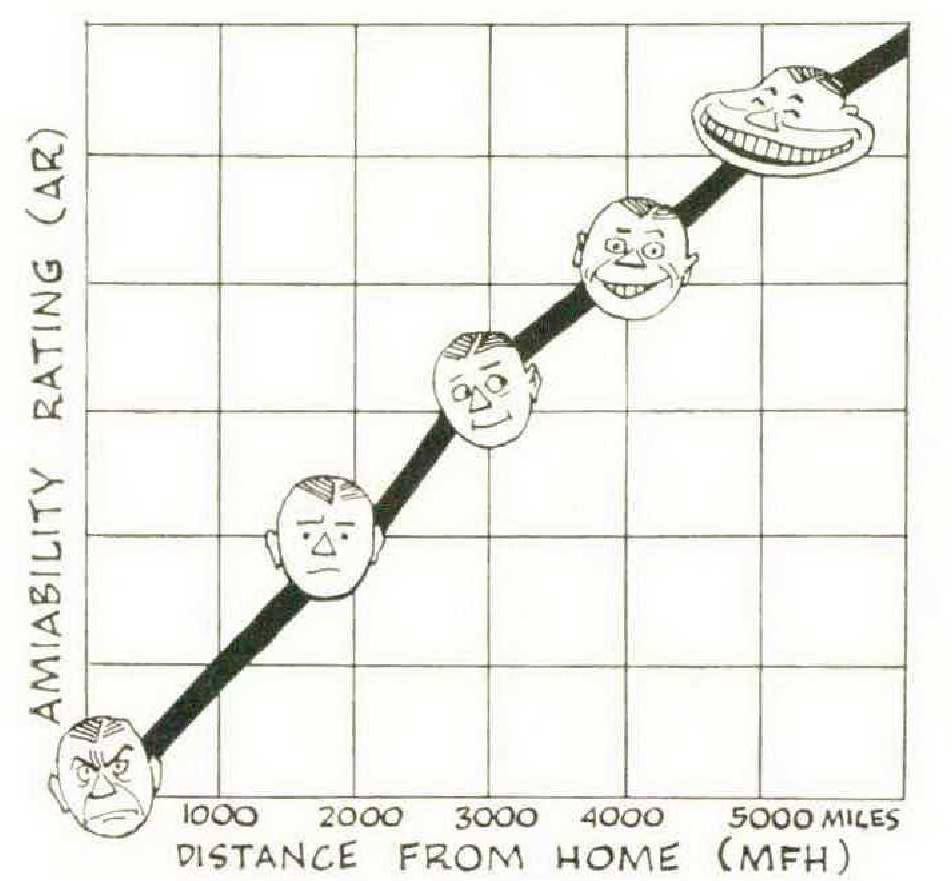

That is, MFH (Miles From Home) divided by V (Vocabulary) equals AR (Amiability Rating). Thus a tourist from Lowell, Massachusetts, visiting Paris (MFH = 3800) and knowing 19 words of French (V = 19) develops an Amiability Rating of 200. This is very good, yet not as good as if he went all the way to Tokyo (MFH = 6900) and knew only the words “Sayonara” and “Harakiri” (V = 2), for then his AR would soar to 3450. If, on the other hand, he simply drives into Boston (MFH = 23), where he knows all the native words (V = 1000 and upward) — well, his AR will sink behind decimal points, and he may very likely have trouble with the police, or at least a headwaiter.
Translating the vacationer’s Amiability Rating into terms of actual behavior can become a trifle complex, but the following should serve as a rough guide:
Under 1 AR: May appear sullen; offers little in the way of amity beyond advice on what is wrong with the way you are holding your camera.
1 to 500 AR: Will strike up fast friendships in hotel lobbies, share suntan lotion at beaches, and insist on being looked up “if you ever get out around Elkhart.”
501 to 1000 AR: Will fraternize equally with natives and fellow tourists, wave at passing gondolas, and have nothing but praise for all “colorful” local customs, right down to the village bands which start tuning up at 5 A.M. in plazas under hotel windows.
1001 to 2000 AR: Will accept goodnaturedly those scrambled eggs he can’t stomach because there apparently is no way of saying, “Sunny-side up" in Portuguese, show infinite patience in queues, and even kid with customs inspectors.
Over 2001 AR: Will tolerate any frustration short of a firing squad before calling for the American consul.
Of course, as with any theorem, my AR formula may be open to doubt. It always is possible that the real reason people on vacation are so sweet is that they don’t have to get up and go to work tomorrow.