Accent on Living
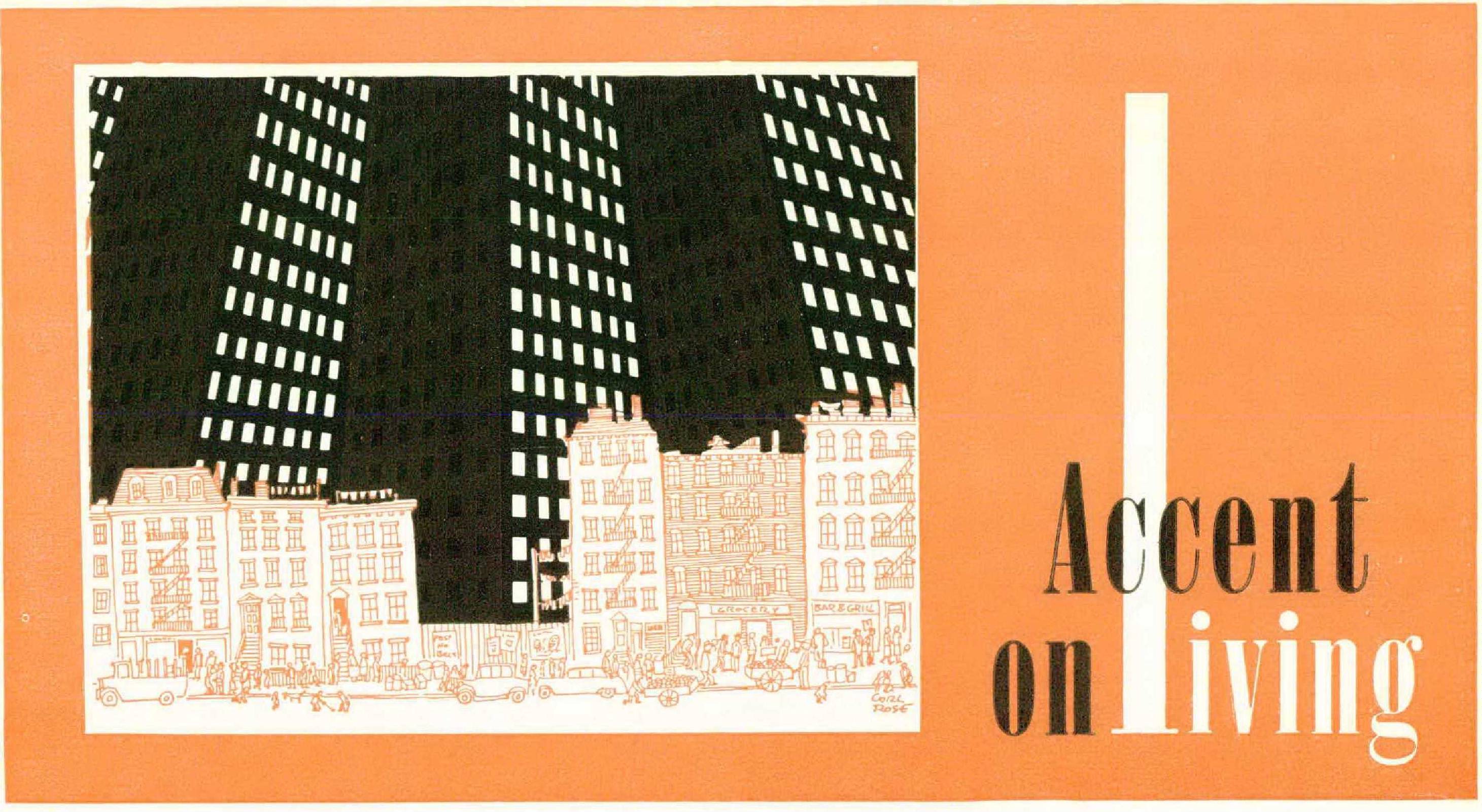
THE big cities continue to get rid of their relics, landmarks, and antiquities and to replace them with skyscrapers or multi-bathroom apartments. There are boards, authorities, commissions which are constantly on the prowl for a “blighted area,”and whatever blight they overlook, the real-estate developer will surely find. A neighborhood may look more or less unblighted and at ease. It may even look interesting. Yet the blight could be already far advanced and spreading. The residents usually think they are attached to their neighborhood. To find a substitute they can afford and enjoy may be impossible, but that is their problem, not ours. So, swing that iron ball and let the bricks fall where they may.
In New York, for instance, the City Planning Commission reported Greenwich Village as an area “appropriate for urban renewal.” The reasons for this view seemed rather spacious and vague, and one supposes that blight varies from one city to another, perhaps from one neighborhood to the next.
The late George Apley’s father was inspired to sell his home and move from Boston’s South End when he sighted his neighbor across the street one summer morning on the steps in his shirt sleeves, It was the beginning of the end, he realized, arid he was right. Blight had set in. Deducing blight from shirt sleeves in this case seems a bit unfair, for by the time John Marquand was writing Abley, that tree-shaded square in the South End had already gone to pot, and Apley’s father was betting on a cinch.
Blight can take many forms: milk bottles on the window ledge, potted plants getting their sun on the fire escape, laundry (visible), or too many pedestrians with scraggly beards. What made the Village “appropriate” for urban renewal (which, incidentally, it is not going to get)? Beards? Sneakers? Cafés?
The New York Times story blamed the Village’s blight on, among other things, an “admixture of nonresidential uses,” although one suspects that the nonresidential resources of the neighborhood are probably the principal reason why a Villager maintains a residence there. Carnegie Hall proved too tough a blighted nut for even the Rockefellers to “renew” and will continue to do business at the same old stand, even though most of the musicians who made it famous have been dead for years and years. The old Waldorf was a wonderful hotel, but not nearly so tall as the Empire State Building which took its place.
Still the great obstacles for urban renewal are the sizable groups of lowincome people, many of foreign descent who don’t know any better, who dislike high fixed charges and prefer low rents. These recalcitrants would rather sit down to an expensive and interesting meal in their substandard apartments than lay out their money on a “ranch-type” unit with monogrammed window shutters in a housing development. They are wary of long-term debt. They like to have money in hand and to spend it freely, much of it on food and drink.
The low-income slum must go. In its place, the city will be much better off with a new slum, only this one will be strictly middle-income, and a real step upward.
The only trouble with a middleincome slum is the automatic elevators: A housewife can’t step into one without wondering whether she will be jumped by some unplanned and substandard hoodlum.
CHARLES W. MORTON