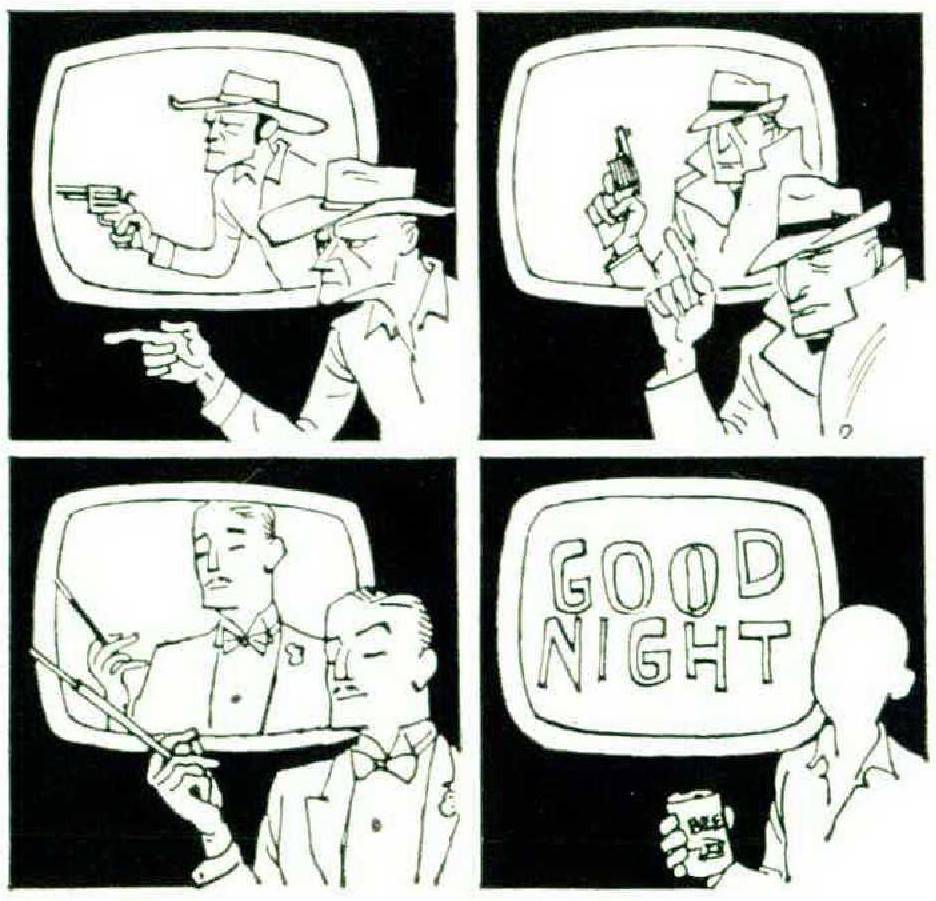
You Can't Go Home
WALTER M. GIBB is on the news staff of the Baltimore SUN and has written several light pieces for these pages.
A disturbing aspect of television is my inability to go home after the show. Perhaps inability, with its connotation of too many pretzels, is not the word; impossibility might be better, or whatever term physicists apply when the spatial relationship precludes to and fro. Because 1 am there already, and it is all too soon.
I am no quick-change artist. After two hours in a leading role I need to taper off before resuming my old walk-on with spear. A few reels suffice, and these are amply provided by the trip home. That passage from theater aisle to suburban walk offers crowd sequences, sound effects, street scenes, action, lights, and a fine supporting cast.
The movie, let us assume, is grade-A gangster. The last gun barks; there is a final wail of sirens; and all is over. From the atmosphere of unconcern round about me, I should say it is over for most of the spectators as well. They collect themselves, along with their hats and coats, and head for the lobby. I head for the lobby too, but my hat is pulled well down in front, and I keep a hand in my right coat pocket. As other underworld figures have learned before me, theater entrances abound in plain-clothes men. No point in making their job easier. On the contrary, I sometimes confound them with a touch of disarming nonchalance. Once, coming from a Chester Morris classic, I asked a policeman for a light. But my wife thought that was overdoing it. “Tomorrow,” she said, “he may recognize you in the lineup.”
Or perhaps the movie is one of war and intrigue. This demands another form of awareness. The lobby now becomes a rendezvous of enemy agents. Aided by the marquee lights and my years of experience in counterespionage. I seldom fail to spot a pair of them (I trust no harm will come of my divulging that they work in pairs), each pretending enormous disinterest in the other. The trick is to note facial contour, details of dress, and so on, without arousing suspicion, and then retain this knowledge throughout the long ride home.
Some films — the marital-problem type, for example — cry aloud for a restaurant stop on the way home. It is amazing how much unpleasantness can be smothered with onion and how large a reconciliation can be effected over a small hamburger. Now there is opportunity for such wondrously heavy lines as, “The countess was merely a phase, my dear,’” and for gestures as eloquent as the matinee-idol shrug. Waitresses and countermen have a tendency to eavesdrop here, but that simply imparts a theater-in-theround flavor.
All this, however, has to do with the trip home, the trailer which follows the feature, that half hour of do-it-yourself which cushions the return to reality and which is such fun. But with televised drama, as indicated earlier, there is no going home. Therefore, no trailer, no cushion, and, of course, no fun.
It may be that the film shown is the very same one which, when viewed in a theater some time back, had given rise to a modestly splendid follow-up performance. But what happens now? The set is turned off, the lights go on, and there am I, a hero in terry cloth, with the cat asleep on my lap. There is nothing to do except, in Ring Lardner’s homey phrase, “help mother carry out the empty bottles.” And there is no place to go save upstairs to bed, where a fellow can’t even wear his hat, let alone snap down the brim.