Let's Help the Kids With Their Ids
C. S. JENNISON, who lives in Sheffield, Vermont, is a frequent contributor of poetry and prose to the ATLANTIC and other magazines.
I have been told that psychiatry is not a subject upon which the layman should feel free to comment. I can’t go along with that. I am a layman, myself, and lately I have been exposed to a good deal of literature on Why Flora Was Frigid, or what caused the tic in Joe R.’s left cheek. My initial reaction is a yawn, but I can be more constructive than that.
Take Joe’s case. Joe was nearly forty when he began consulting his friendly, considerate psychiatrist at twenty-five dollars a throw. After months of exhaustive little tete-atetes, during which Joe ticked away like a reliable Elgin, Doctor X finally discovered the reason for the poor fellow’s affliction. Joe, in a burst of adolescent defiance against the puritanical atmosphere of his New England upbringing, had winked at a carnival girl at the age of fourteen. If he had been eighteen, or even seventeen, things would probably have worked out all right; but, as it was, Joe’s guilt complex, not to mention the tic, stayed around. Imagine. All those years.
This is fairly typical of the kind of situation presented in most of the magazines. I realize Joe had a real problem growing up: and, looking at it in one light, I guess he was lucky to be able to skip the whole sorting-out process until he was fortyish. On the other hand, I keep wishing he had kept a diary — or at least a Daily Reminder Pad — when he was a boy. That way, he could have quickly produced his early history and got rid of the tic on his third or fourth visit, thereby saving everybody a lot of time, trouble, and money.
Well, we can’t do anything about the people who are already grown up. But the toddlers of today are the neurotics of tomorrow, and I wince whenever I hear the merry laughter of children outside my window. I have yet to see one single child take a minute off from baseball or jump rope to jot down notes recording fist fights or being called Fatso. And twenty or thirty years from now, the same individuals will be jamming the doctors’ oflices, trying to remember such incidents.
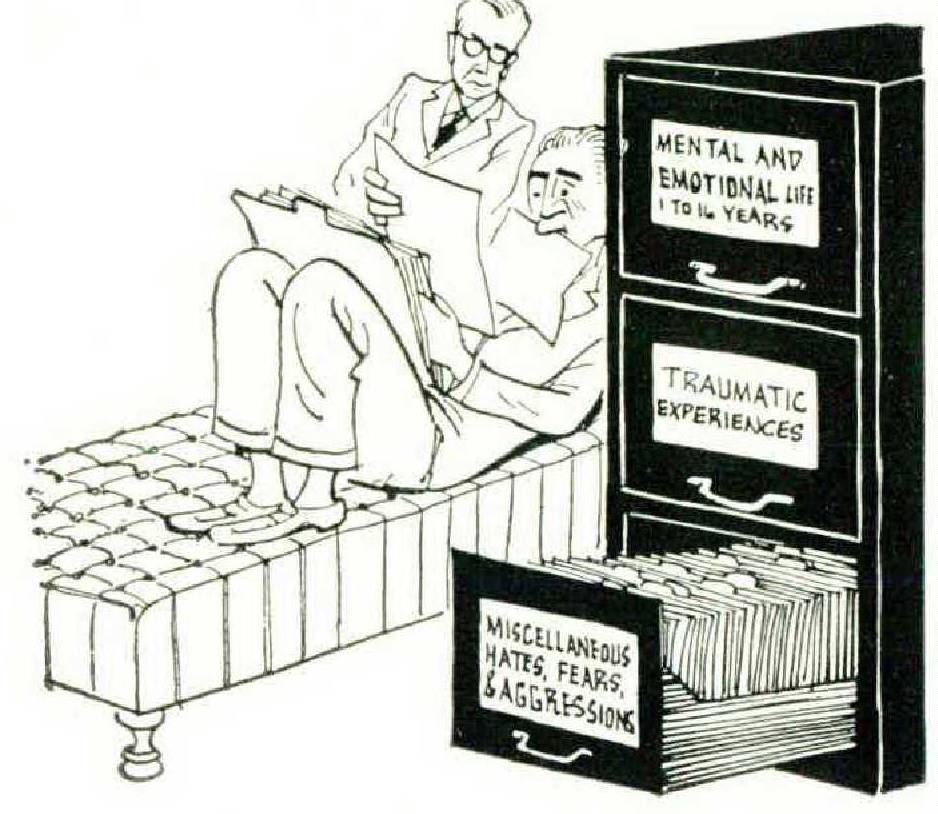
Obviously, what we need is a few practical, preventive measures. “See your psychiatrist once a week for ten years” is sensible enough advice for adults, but what about the children? The old idea that childhood is a happy time is badly outmoded, and the sooner we make the kids understand how miserable they are, the better off they will be in the long run. We take great pains to oversee the educational and physical progress of the young, and faithfully file away for future reference such items as the advent of six-year molars, the dates of tetanus shots, and the yearly marks in arithmetic and spelling. Why not do the same with emotional milestones? In my opinion, we are guilty of grave negligence when we fail to keep a similar account of the continuing mental trials of our offspring.
I’m aware that an emotionaldocumentation system would be somewhat time-consuming, but I don’t think we should take a defeatist approach. Anything worth while presents a few difficulties. With preschool children, even the busiest parents could set aside fifteen minutes, say, at bedtime, for hearing and writing down the setbacks in little Junior’s or Sister’s day — such as who got the kiddy car first or who crunched all those nice plastic toys underfoot. Later, beginning perhaps in the first or second grade, the boys and girls could take over the filing chore themselves, progressing to incidents like who ducked Sister in the swimming pool and how Junior had to make do with an eighty-dollar English bicycle. These daily data could be typed up biannually and kept in a folder for latter-day perusal, with headings like “Junior, Hates and Frustrations, Age Four” at the immediate disposal of future psychiatrists. I feel sure that a few well-tabulated facts would be infinitely preferable to a bunch of old hit-or-miss memories.
An accounting of the adolescent years would be more of a problem, of course, because of the numerous and fluctuating tribulations of children passing through that particular period of development. Teen-agers hate everything (and I do mean everything). Therefore, I should like to suggest that kids from twelve to sixteen list their hates no oftener than once a month. Their mam hates, that is. Otherwise, everyone is going to run out of paper.
Since the modern world continues to stress greater efficiency in all areas, I believe the preceding plan has a great deal to recommend it. There is only one thing that bothers me. I have privately noted a certain faddism (more kindly referred to as progress) in medical circles, and I am inclined to think the physicians will always be one jump ahead of us laymen. For instance, as soon as they decide that sulfa is a cure-all, they announce that penicillin is better, except it happens to be dangerous, whereupon they change to Terramycin, which turns out to be tricky in a number of cases, so they switch to cortisone, which makes everyone moonfaced. And just when they get through saying that most ailments are unquestionably caused by various vitamin deficiencies, they come up with viruses, which eventually, and predictably, become old hat when the professional men get going on some new and fascinating discovery like the current cholesterol kick. Consequently, I have a nagging feeling that when today’s mixed-up moppets finally reach maturity and enter the psychiatric waiting rooms carefully clutching their well-compiled records of nervous and neurotic experiences, the psychiatrists will start expounding about the probable perils inherent in messing around inside people’s minds. Either that, or they will soberly insist that all mental and emotional disturbances can be directly traced to physical causes.